Key Takeaways
- Webhook Architecture defines how enterprise systems publish, receive, validate, route, retry, and audit event-driven API messages.
- Event-driven integration helps systems respond to business changes without waiting for scheduled polling or batch synchronization.
- Webhook delivery design should include signature checks, event IDs, retry rules, deduplication, timeout handling, and delivery status tracking.
- Webhook event handling protects downstream systems by validating payloads, classifying events, routing them to the correct workflow, and isolating failed events.
- Webhook endpoint management requires ownership, security controls, version awareness, observability, audit trails, and lifecycle review.
Enterprise integrations increasingly depend on events rather than scheduled requests. capturing a payment. A booking has changed. A product attribute is approved. A supplier risk status update. A marketplace listing fails validation. A customer profile changes in CRM. Downstream systems need to know about these events quickly, but they should not need to poll every source continuously.
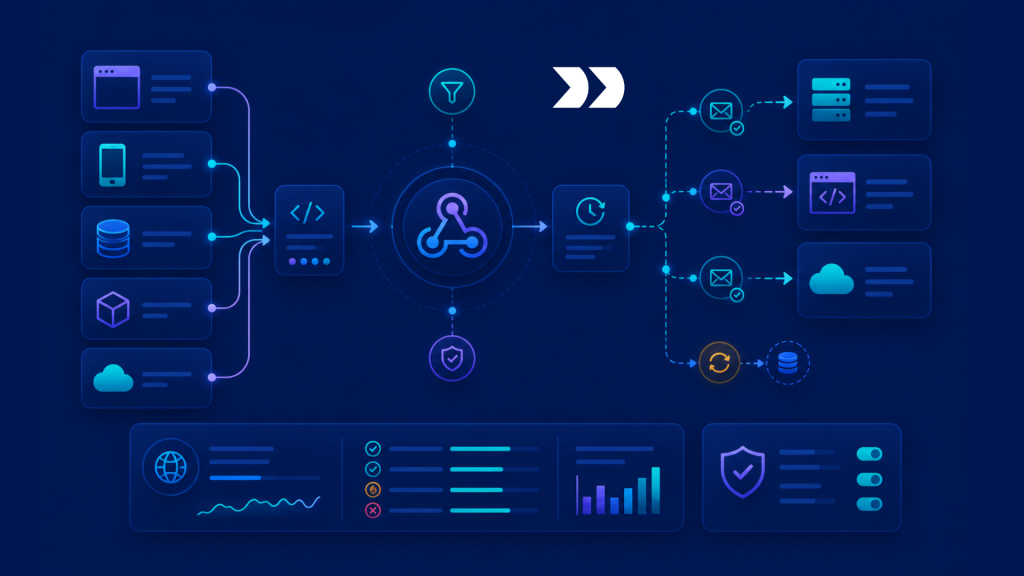
Webhook Architecture provides the structure for event-driven API integrations. Structure is defined by how events are published, delivered, authenticated, validated, retried, routed, and monitored across enterprise systems.
In cross-system integration programs, webhooks are not just notification callbacks. They are operational data movement mechanisms. If webhook delivery is unreliable, downstream workflows can miss events, process duplicates, or act on incomplete states.
Why Webhook Architecture Matters in API Integration
Webhook Architecture matters because enterprise systems often need to respond to state changes as they happen. Batch integrations may be sufficient for reporting, but operational workflows frequently require faster notification. Payment confirmation, booking availability, product publishing, customer updates, fraud alerts, fulfillment changes, and supplier events may all require near real-time propagation.
Deloitte’s API governance guidance for agentic AI emphasizes that API strategy standardizes how APIs are designed, published, secured, and reused as enterprise systems and AI workflows scale. Webhook Architecture extends that same governance discipline into event-driven integration. Adopting api governance best practices for enterprises ensures that organizations maintain control over their APIs, reducing security risks while enhancing interoperability. Furthermore, these best practices help in establishing clear guidelines for API lifecycle management, facilitating smoother collaboration between development teams. Emphasizing standards helps organizations maximize the value derived from their API investments, ultimately leading to better business outcomes.
Why Event-Driven Integration Changes API Operations
Traditional API integrations often use request-response patterns. A system asks for data, receives a response, and processes the result. Event-driven integration works differently. A source system publishes an event when something changes, and subscribed systems react to that event.
This improves responsiveness, but it changes the operational model. The receiving system must validate event authenticity, handle duplicate events, process events out of order, recover missed deliveries, and protect downstream systems from malformed payloads.
At scale, event-driven APIs require stronger controls than simple callbacks. Each webhook event becomes part of the operational data flow, so it needs identity, structure, traceability, retry behavior, and ownership.
How Weak Webhook Design Creates Downstream Risk
Weak webhook design creates risk because failures do not always appear immediately. A missed payment event may create reconciliation issues later. A duplicated order event may trigger duplicate fulfillment. A delayed product approval event may prevent marketplace publication. A malformed supplier update may break downstream risk scoring.
These failures are often harder to detect than synchronous API errors. The source system may believe it delivered the event. The receiving system may have rejected it. A retry may arrive later. You may be processing A duplicate twice. A downstream workflow may continue with a stale state.
Gartner’s 2025 Magic Quadrant for API Management notes that AI is increasing security and governance demands for resilient API ecosystems. Also, webhook reliability is part of that resilience because event-driven integrations extend API dependency into live operational workflows.
Webhook Delivery Design for Enterprise Systems
Webhook delivery design defines how events are transmitted from producer to consumer. It should include event identity, endpoint registration, delivery attempts, timeout behavior, retry policy, authentication, payload structure, and delivery-state tracking.
A webhook design should assume failure. Network issues, endpoint downtime, validation rejection, duplicate delivery, and delayed processing are normal operating conditions in enterprise environments.
Defining Event Identity, Source System, and Delivery Metadata
Every webhook event should carry a stable identity and delivery metadata. This usually includes event ID, event type, source system, timestamp, schema version, target endpoint, delivery attempt, and trace ID. These fields allow receiving systems to detect duplicates, trace incidents, and reconcile delivery status.
Event identity is especially important. If the same event is delivered twice, the receiver should recognize it as a duplicate and avoid processing the business action again. Without a stable identity, retries can create operational side effects.
A product update event may look simple, but it should still carry enough metadata to support validation and downstream routing.
def route_webhook_event(event):
    if event["event_type"] == "product.attribute_updated":
        print(f"Routing {event['sku']} to product publishing workflow")
        return

    if event["event_type"] == "inventory.stock_changed":
        print(f"Routing {event['sku']} to inventory sync workflow")
        return

    print(f"Unsupported event type: {event['event_type']}")


event = {
    "event_id": "evt-900184",
    "event_type": "product.attribute_updated",
    "source_system": "pim",
    "sku": "SKU-48192",
    "updated_fields": ["product_title", "material", "care_instructions"],
    "schema_version": "v2",
    "timestamp": "2026-06-17T11:15:00Z",
}

route_webhook_event(event)
This snippet follows the same operating pattern as the earlier integration examples: inspect the event, classify it, and route it to the correct workflow. In production, the routing action would connect to queues, workflow engines, or integration services.
Designing Delivery Attempts, Timeouts, and Retry Rules
Webhook delivery should not rely on a single attempt. Endpoints may be temporarily unavailable. Networks may fail. Receiving systems may be overloaded. Retry logic should define how many attempts are allowed, how backoff works, and when an event moves to a dead-letter or manual review path.
Retries should be safe. If the receiver has already processed the event, a retry should not create duplicate effects. This requires event IDs, idempotency, and delivery-state tracking.
Businesses should manage timeouts carefully. A producer should not wait indefinitely for a receiver. The receiver should acknowledge quickly and process longer tasks asynchronously where possible. This prevents webhook delivery from becoming tightly coupled to slow downstream workflows.
Tracking Delivery Status Across Producers and Consumers
Delivery status should be visible to both technical and operational teams. Producers need to know whether events were accepted, rejected, retried, or failed permanently. Consumers need to know which events were processed, quarantined, duplicated, or delayed.
Delivery metadata should include attempt count, response code, failure reason, last attempt time, next retry time, and final status. This evidence supports incident response and auditability.
Without delivery tracking, teams cannot distinguish between missing events, delayed events, rejected events, and downstream processing failures.
Webhook Event Handling and Validation
Webhook event handling defines what the receiving system does after an event arrives. It should authenticate the event, validate payload structure, classify the event type, check business readiness, and route the payload safely.
The receiver should not assume that every delivered event is safe to process. Validation protects downstream systems from malformed, unauthorized, unsupported, or incomplete event payloads.
Validating Event Type, Required Fields, and Business State
Webhook validation should check required fields, allowed event types, schema version, source system, timestamp, and business state. For example, a product publishing event may require an approved status before it can flow to ecommerce, marketplace, or sales systems.
A compact validation pattern can look like this:
WEBHOOK_EVENT_RULES = {
    "required_fields": ["event_id", "event_type", "source_system", "timestamp"],
    "supported_events": ["payment.captured", "booking.updated", "product.attribute_updated"],
    "blocked_statuses": ["pending_review", "rejected"],
}


def validate_webhook_event(event):
    missing = [field for field in WEBHOOK_EVENT_RULES["required_fields"] if not event.get(field)]

    if missing:
        return {"valid": False, "reason": "missing_required_fields", "fields": missing}

    if event.get("event_type") not in WEBHOOK_EVENT_RULES["supported_events"]:
        return {"valid": False, "reason": "unsupported_event_type"}

    if event.get("approval_status") in WEBHOOK_EVENT_RULES["blocked_statuses"]:
        return {"valid": False, "reason": "business_state_not_ready"}

    return {"valid": True}
This is intentionally simple. It shows the control logic: validate structure and business state before routing the event into operational systems.
Managing Duplicate, Late, and Out-of-Order Events
Webhook systems must expect duplicate, late, and out-of-order events. A retry may deliver the same event twice. A delayed event may arrive after a newer event. A sequence of updates may reach the receiver in the wrong order.
The receiving system should maintain processed event IDs and relevant entity state. If an event has already been processed, it should be ignored or marked as a duplicate. If an event is older than the current entity state, it may need review or controlled rejection.
This is especially important for order status, payment updates, booking availability, inventory movement, product publication, and customer lifecycle events. Processing old events after new events can reverse a valid business state.
Routing Failed Events to Review or Recovery Paths
Failed webhook events should not disappear into logs. They should be routed to defined recovery paths. Missing required fields may be quarantined. Unsupported event types may trigger producer review. Unauthorized events may trigger a security review. Repeated delivery failures may move to a dead-letter queue.
Webhook event handling should preserve enough metadata for recovery: event ID, source system, event type, timestamp, failure reason, attempt count, and owner. Without this, failed events become difficult to investigate and replay.
In practice, failure routing is what prevents event-driven integration from becoming uncontrolled asynchronous noise.
Webhook Endpoint Management
Webhook endpoint management defines how receiving endpoints are registered, secured, monitored, versioned, and retired. A webhook endpoint is not just a URL. It is an operational integration surface with business impact.
NIST’s 2025 publication Guidelines for API Protection for Cloud-Native Systems states that APIs integrate and communicate with modern enterprise IT application systems that support business processes, making API protection important across the API lifecycle. Webhook endpoints should be treated as part of that lifecycle, because they expose event-driven entry points into enterprise systems.
Securing Webhook Endpoints with Signature and Scope Controls
Webhook endpoints should verify that events came from an approved producer. Common controls include signatures, shared secrets, token validation, source allowlists, timestamp tolerance, replay protection, and endpoint-specific permissions.
The receiving system should reject events that fail authentication or signature validation. It should also avoid exposing detailed error information that helps attackers. Failed authentication attempts should be logged and monitored.
Security controls should not be added after deployment. They should be part of the webhook endpoint design from the beginning.
Managing Endpoint Registration, Ownership, and Consumers
Each webhook endpoint should have an owner, purpose, producer list, supported event types, schema version, security requirements, and downstream workflow. Without this metadata, endpoints become difficult to govern.
Endpoint registration should identify which systems send events and which systems consume the output. It should also document expected volume, retry behavior, supported versions, and escalation contact.
Ownership is critical. If webhook failures occur, teams should know who owns the producer, receiving endpoint, processing workflow, and downstream business process.
Retiring Webhook Endpoints Without Breaking Event Flows
Webhook endpoints should have lifecycle controls. Old endpoints may remain active because some producers still send events to them. If they are not monitored and retired properly, they become an unmanaged integration risk.
Endpoint retirement should include consumer review, producer notification, migration path, support window, traffic monitoring, and final blocking. If events still arrive after retirement, teams should know whether they come from a misconfigured producer, old integration, or an unauthorized source.
Webhook endpoint management is therefore part of API lifecycle management, not only infrastructure maintenance.
Event-Driven Integration Controls
Event-driven integration requires controls that make asynchronous workflows predictable. Unlike synchronous API calls, webhooks may not provide immediate end-to-end confirmation that the downstream business process has completed.
This requires observability, reconciliation, retry logic, and operational status tracking. Supply chain event visibility solutions play a crucial role in enhancing operational efficiency. They enable businesses to monitor and manage supply chain activities in real time. This increased transparency helps organizations respond swiftly to disruptions and maintain customer satisfaction.
Using Queues, Workflow Engines, and Processing States
Webhook receivers should often acknowledge events quickly and process them asynchronously. This can involve queues, workflow engines, orchestration systems, or integration layers. The objective is to decouple event receipt from business processing.
Processing states should be explicit. An event may be received, validated, queued, processed, completed, failed, quarantined, duplicated, or replayed. These states help teams understand where an event sits in the workflow.
Event driven integration becomes more reliable when event state is visible rather than hidden inside application logs.
Preventing Event Sprawl Across Enterprise Systems
As webhook usage expands, event sprawl becomes a risk. Many systems may publish events with inconsistent naming, schemas, retry behavior, and ownership. Consumers may subscribe to events without clear approval. Old event types may remain active after workflows change.
Event governance should define naming standards, supported event types, schema ownership, producer rules, consumer registration, retention windows, and lifecycle review. This keeps event-driven integration manageable at scale.
Deloitte’s agentic AI orchestration and governance guidance argues that growing autonomous enterprise workflows require robust orchestration, proactive management, and planning. Webhook governance supports that same operating need by controlling how event-driven systems trigger downstream actions.
Operational Controls for Webhook Reliability
Webhook reliability depends on monitoring delivery, processing, latency, failures, duplicates, and downstream impact. A webhook may be delivered successfully but still fail during processing. Monitoring should cover both layers.
Operational controls should make webhook health visible to engineering, operations, and business teams where critical workflows are affected.
Monitoring Delivery, Processing, Latency, and Failures
Webhook monitoring should track delivery attempts, response codes, retry count, endpoint latency, duplicate rate, failed validation rate, quarantine volume, dead-letter volume, and processing completion.
Latency should be measured across stages. Delivery latency shows how long it takes the event to reach the receiver. Processing latency shows how long it takes the event to complete downstream action. Both matter.
For example, a booking update may be delivered quickly but processed late. A payment event may be accepted but delayed in reconciliation. Monitoring should show the real operational state, not only whether the webhook endpoint returned a successful response.
Replaying Missed or Failed Events Safely
Webhook replay is necessary when events fail, endpoints are unavailable, or downstream processing breaks. Replay should be controlled with event IDs, timestamps, sequence handling, and idempotency rules.
A replay should not duplicate business actions. If a payment captured event is replayed, the target system should recognize that the payment has already been applied. If an inventory event is replayed, the system should avoid double-adjusting stock.
Safe replay is one of the difference-makers between a fragile webhook implementation and a resilient event-driven integration architecture.
Technology and Integration Considerations
Webhook Architecture must connect to API gateways, queues, event processors, observability systems, warehouses, lineage tools, and operational applications. The technology stack should support both delivery reliability and governance visibility.
The goal is not only to receive webhooks. The goal is to manage event-driven API integrations as enterprise infrastructure. API integration services for businesses are essential for ensuring seamless communication between different systems. These services enhance operational efficiency by streamlining workflows and reducing the potential for errors. By leveraging such integration solutions, companies can focus on their core competencies while letting technology handle the connectivity challenges.
Using API Gateways, Message Queues, Airflow, and Observability Tools
API gateways can authenticate webhook requests, enforce policies, route traffic, and monitor endpoint behavior. Message queues can buffer events and protect downstream systems from spikes. Airflow can orchestrate recovery jobs, backfills, and downstream dependencies. Observability tools can track delivery health, endpoint latency, processing failures, and replay activity.
These systems should be connected through shared metadata. Event ID, source system, event type, trace ID, endpoint, processing status, and error reason should travel through the workflow.
This makes webhook incidents easier to investigate and makes event-driven workflows easier to govern.
Connecting Webhook Metadata to Warehouses, BI, AI, and Lineage Systems
Webhook metadata should remain visible downstream. Snowflake, BigQuery, Databricks, BI systems, AI workflows, and lineage tools should preserve event source, event time, processing time, schema version, and event ID where relevant.
This is important for reconciliation. If a dashboard changes unexpectedly, teams should know whether a webhook event caused the update. If an AI feature changes, teams should know which event stream contributed to the input. Also, if an operational workflow fails, teams should trace the event path.
Webhook metadata turns event-driven integration from a black box into an auditable data flow.
Governance and Auditability in Webhook Architecture
Governance defines who owns webhook endpoints, who approves event types, how schemas change, how endpoints are secured, and how failures are reviewed. Auditability preserves the evidence behind event delivery and processing.
The OECD’s data governance work describes governance as the technical, policy, and regulatory structures needed to manage data across its value cycle. Webhook Architecture fits this model because events must be governed from production through delivery, processing, recovery, and downstream consumption.
Creating Ownership, Review Cycles, and Escalation Paths
Each webhook endpoint and event type should have defined ownership. Producers own event publication. Receivers own endpoint validation and processing. Integration teams own routing and recovery. Business owners own the process impact.
Review cycles should occur when new event types are added, schemas change, endpoints are retired, authentication rules change, or incident patterns appear. Critical event flows should receive more frequent review than low-risk notifications.
Escalation paths should define who responds to delivery failure, signature rejection, replay requests, duplicate processing, and downstream impact. This prevents webhook failures from becoming cross-team confusion.
Maintaining Audit Trails for Webhook Events and Recovery Actions
Audit trails should capture event receipt, validation status, delivery attempts, processing state, retry attempts, replay actions, duplicate handling, quarantine decisions, and manual overrides.
Auditability matters when webhook events support payments, bookings, customer updates, product publishing, supplier workflows, compliance monitoring, or AI systems. Teams should be able to show which event arrived, whether it was valid, how it was processed, and what recovery action occurred.
A strong audit trail also supports incident review. Repeated failures can reveal unstable endpoints, weak producer schemas, insufficient retry logic, poor ownership, or missing consumer controls.
Conclusion: Turning Webhooks into Controlled Event-Driven Infrastructure
Webhook Architecture helps enterprises move from scheduled data exchange to responsive event-driven API integration. It defines how events are delivered, authenticated, validated, routed, retried, replayed, monitored, and governed across connected systems.
Strong webhook delivery design prevents missed, duplicated, delayed, or unauthorized events from damaging downstream workflows. Webhook event handling validates payloads before processing. Webhook endpoint management controls lifecycle, ownership, security, and retirement. Operational controls make event delivery and processing visible.
The capability matters because webhooks often trigger real business action. Payment, booking, product, customer, supplier, marketplace, order, and AI workflows can all depend on event-driven updates. When webhook systems are unmanaged, event-driven integration becomes fragile. When they are governed, observable, and auditable, webhooks become a reliable enterprise integration layer.
A structured review can help evaluate whether current API workflows have reliable Webhook Architecture, event-driven integration controls, webhook delivery design, webhook event handling, and webhook endpoint management. You can run an external data infrastructure audit with our team to review your current setup and understand what is required to build reliable, enterprise-scale API integration infrastructure.