Key Takeaways
- Data Source Coverage is about representing the decision environment, not collecting as many sources as possible.
- Source coverage analysis helps teams understand whether critical markets, segments, and signals are represented.
- Source gap analysis reduces false confidence by identifying what systems cannot see.
- Scalable data programs require coverage standards, metadata, lineage, observability, and ongoing gap review.

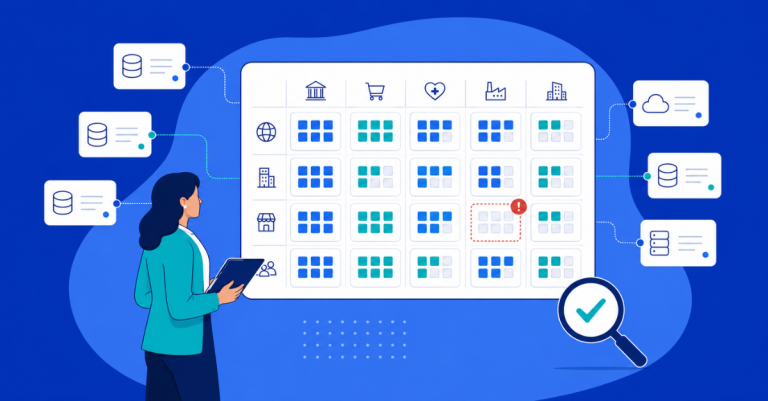
Data source coverage is often misunderstood as a volume problem. Many organizations assume stronger coverage means adding more sources, feeds, vendors, platforms, or repositories. However, source volume alone does not create better intelligence. At enterprise scale, coverage means the organization’s source portfolio accurately represents the decision environment it is trying to understand.
Data Source Coverage determines whether AI systems, analytics platforms, dashboards, and market intelligence workflows reflect the markets, customers, competitors, channels, regions, and edge cases that matter. A source portfolio can look broad while still missing critical signals. That is why coverage must be managed as a strategic infrastructure issue, not as a simple sourcing checklist.
Data Source Coverage Is About Representing the Decision Environment, Not Collecting More Sources
Enterprise teams often measure source coverage by counting sources. This creates a misleading sense of maturity. A company may collect from hundreds of sources and still lack visibility into important regions, competitors, customer segments, product categories, or regulatory environments. The real question is not how many sources exist. It is whether those sources represent the business questions the organization needs to answer.
McKinsey’s State of AI 2025 notes that many organizations still struggle to move from AI adoption to scaled enterprise impact, even as AI use becomes more widespread. That gap reinforces a broader data principle: enterprise systems need more than access to data. They need data foundations that represent real workflows, decisions, and operating conditions.
Source Coverage Analysis Shows Whether Critical Markets, Segments, and Signals Are Represented
Source coverage analysis evaluates whether the organization has the right evidence for the decisions it is trying to support. A pricing intelligence program may need competitor prices, promotions, seller data, stock availability, marketplace rank, and regional price variation. A risk monitoring system may require public filings, regulatory updates, enforcement actions, procurement notices, and jurisdiction-specific sources. An AI training workflow may need coverage across languages, behaviors, edge cases, user segments, and changing external conditions.
Coverage analysis should therefore begin with the decision environment. Which markets must be represented? Which entities matter? Also, which sources show demand, supply, pricing, risk, sentiment, or availability? What signals appear early, and what signals are lagging?
A strong source portfolio is not defined by breadth alone. It is defined by its ability to represent the external reality that downstream systems must interpret.
Broad Source Lists Can Still Leave Strategic Blind Spots When Coverage Is Misaligned
A large source list can still create blind spots. This happens when sources cluster around what is easy to collect rather than what is strategically necessary. Teams may gather data from accessible platforms while missing niche competitors, regional marketplaces, emerging customer communities, non-English sources, alternative distribution channels, or regulatory repositories.
Misaligned coverage creates false confidence because outputs appear structured. Dashboards refresh, models run, and reports look complete. However, the system may be blind to the parts of the market that matter most.
At scale, the danger is not only missing data. It is believing the organization has sufficient visibility when the source universe is incomplete. This is why source coverage analysis must measure relevance, representation, and decision fit, not just source count.
Why Coverage Gaps Become More Expensive as Data Programs Scale
Coverage gaps become more expensive as more systems depend on the same source portfolio. A missing source may begin as a small limitation in one workflow. Over time, that limitation can affect dashboards, AI models, executive reports, market intelligence feeds, pricing systems, and operational decisions. Once incomplete coverage becomes embedded, correction becomes harder.
IBM’s 2025 CDO Study emphasizes the role of high-quality data and strong governance frameworks in creating value from proprietary and ecosystem data. That finding matters for coverage because ecosystem data only becomes useful when organizations can understand whether it represents the environment they are trying to analyze.
Source Gap Analysis Reveals Missing Context Before Models or Dashboards Depend on Incomplete Inputs
Source gap analysis identifies where source coverage fails to represent the decision environment. It may reveal missing geographies, absent customer segments, weak competitor coverage, incomplete product categories, limited time-series history, unsupported languages, or lack of coverage for rare but important events.
This analysis is most valuable before data becomes embedded in production systems. If gaps are found early, teams can adjust source selection, add fallback sources, improve coverage depth, or clarify limitations. If gaps are discovered after deployment, the organization may need to rebuild datasets, retrain models, revise reports, or explain why past decisions relied on incomplete evidence.
In practice, source gap analysis protects downstream systems from inheriting blind spots that become harder to correct later.
Partial Coverage Creates False Confidence When Outputs Appear Structured but Remain Incomplete
Partial coverage is dangerous because it can look mature. A dashboard may show clean metrics. A model may produce stable predictions. A market intelligence report may include structured findings. Yet each output may be based on a source universe that excludes important evidence.
For example, a competitive dashboard that tracks known competitors may miss new entrants. A demand model trained on internal sales data may miss external demand signals. A market report based on English-language sources may miss regional movement. A regulatory monitoring workflow may track central agencies while missing local updates.
The issue is not that the output is technically broken. The issue is that it is contextually incomplete. Leaders may act confidently because the system appears organized, even as the source coverage behind it remains insufficient.
Market Source Coverage Defines the Quality of External Intelligence
External intelligence depends on whether source coverage reflects how the market actually moves. Markets do not move through one channel. They move through customers, competitors, suppliers, platforms, public institutions, marketplaces, review environments, search behavior, product availability, pricing changes, job postings, and regulatory updates. Market source coverage must reflect that complexity.
Gartner’s 2025 Data and Analytics Predictions state that by 2027, half of business decisions will be augmented or automated by AI agents for decision intelligence. As more decisions become AI-supported, incomplete source coverage becomes more consequential because blind spots can influence decisions at scale.
Competitive, Customer, Channel, and Regional Sources Must Reflect How the Market Actually Moves
Market source coverage should map to the way business conditions form. Competitors may reveal strategy through pricing, product pages, hiring, public filings, marketplace visibility, product launches, and promotional behavior. Customers may signal change through reviews, search behavior, support conversations, community discussions, and channel activity. Regional markets may move through local platforms, language-specific sources, distributors, public notices, and different regulatory environments.
A strong coverage model connects these signals rather than treating each source as isolated. This allows teams to understand whether a market movement is local, regional, category-wide, competitor-driven, or customer-led.
External intelligence weakens when source coverage reflects internal convenience rather than external reality. The right source portfolio should mirror the market’s structure, not the organization’s reporting structure.
External Data Programs Need Coverage Depth, Not Only Source Volume
Coverage depth means having enough source representation within a market, category, channel, or segment to support reliable interpretation. A company may track one marketplace, but that may not represent the full category. It may monitor one competitor, but miss substitute products or adjacent players. A single regulatory source may not capture local enforcement or sector-specific guidance.
Depth allows teams to compare signals across sources and detect whether patterns are isolated or meaningful. A competitor price change on one platform may be tactical. The same pattern across marketplaces, regions, and product variants may indicate strategic repositioning.
Therefore, external data programs should evaluate both breadth and depth. Breadth asks whether major environments are included. Depth asks whether each environment is sufficiently represented for decision-making.
How Source Coverage Affects AI, Analytics, and Decision Systems
Source coverage affects AI and analytics before any model is trained or a dashboard is built. The source universe defines what data systems can see. If that universe is incomplete, downstream systems inherit the gaps. Transformations, validation, and modeling can improve existing data, but they cannot fully compensate for missing evidence.
NIST’s AI Risk Management Framework provides a lifecycle approach to AI risk, including governance, measurement, mapping, and management. Source coverage belongs in that lifecycle because the origin and representativeness of data shape model behavior, evaluation quality, and risk exposure. The impact of unreliable sources on research is significant, as it can lead to incorrect conclusions and misguided decision-making. Researchers must be vigilant in evaluating their data sources to ensure accuracy and validity. By prioritizing reliable data, they can enhance the overall quality and trustworthiness of their findings.
Models Learn from the Source Universe They Are Given, Including Its Missing Areas
Models learn from the data available to them, including the limitations of that data. If source coverage underrepresents certain users, markets, languages, edge cases, or behaviors, models may perform unevenly in production. The problem may not appear in aggregate metrics if the evaluation data reflects the same coverage gaps.
This is especially important for AI systems that depend on external conditions. A forecasting model that excludes marketplace signals may miss demand changes. A risk model that lacks public-source coverage may react late. A classification model trained on limited examples may fail on emerging categories.
Model performance is therefore shaped by source coverage before training begins. Better coverage does not guarantee better models, but weak coverage almost always narrows what models can reliably learn.
Executive Reporting Becomes Less Reliable When Source Coverage Does Not Match Business Questions
Executive reporting depends on source coverage that matches the business question. If leaders ask whether the company is gaining market position, the source portfolio must represent competitors, channels, regions, pricing, visibility, and customer response. If leaders ask whether risk exposure is increasing, sources must represent the relevant jurisdictions, entities, signals, and time horizons.
Reports become less reliable when source coverage is misaligned. A market position report based on partial competitor tracking may overstate strength. A customer sentiment report based on one channel may misread demand. A compliance dashboard based on limited public sources may miss regional developments.
In practice, source coverage determines whether reporting answers the actual question or only the portion that the data can see.
The Infrastructure Layer Behind Scalable Source Coverage
Scalable source coverage requires infrastructure that can measure, monitor, and maintain coverage over time. Source portfolios change. Markets evolve. Platforms update structures. Competitors appear or disappear. Public sources change formats. Internal priorities shift. Without infrastructure, coverage decays quietly.
The World Economic Forum’s 2025 analysis on scaling AI with strategy, data, and workforce readiness argues that strong data foundations are necessary to scale AI across the enterprise. Source coverage is part of that foundation because AI and analytics systems need data that reflects the environments they are intended to support. Data sourcing strategies for enterprises play a crucial role in maintaining the integrity and reliability of the data used for decision-making. By implementing robust sourcing methods, organizations can ensure their data remains relevant and high-quality, even as market dynamics change. Ultimately, investing in effective sourcing strategies will empower enterprises to leverage insights that drive innovation and competitive advantage.
Metadata, Taxonomy Alignment, and Versioning Make Coverage Easier to Measure Over Time
Coverage cannot be managed if it is not described. Metadata records source ownership, geography, market segment, entity type, update cadence, source quality, access constraints, and business relevance. Taxonomy alignment ensures that products, competitors, categories, locations, and signals are classified consistently across sources. Versioning preserves how coverage changes over time.
These controls make coverage measurable. Teams can see which regions are represented, which categories have weak coverage, which source types are missing, and how coverage changed after a source was added, removed, or degraded.
Technical systems support this discipline. Airflow can orchestrate source checks and ingestion workflows. Kafka can support continuous data movement. Spark can process large source portfolios. dbt can structure source transformations. Snowflake, BigQuery, and Databricks can support scalable storage and analysis. When external sources are dynamic, Playwright and browser automation frameworks may be required to capture signals that do not exist in stable APIs.
Lineage and Observability Help Teams Detect Coverage Decay Across Critical Sources
Coverage decay occurs when source representation weakens over time. A source may stop updating, lose fields, reduce coverage, change structure, or become less relevant as the market evolves. If teams do not monitor coverage, downstream systems may continue operating while their view of the market becomes weaker.
Observability systems such as Prometheus can monitor pipeline health, freshness, latency, volume, and failures. Data lineage tools and metadata systems help teams understand which dashboards, models, reports, and workflows depend on each source. Great Expectations can support schema validation, completeness checks, and anomaly detection.
These systems help teams detect whether coverage decay is affecting critical workflows. If a source supporting pricing intelligence loses key fields, lineage reveals the downstream impact. If a region becomes underrepresented in an AI dataset, metadata can show the coverage gap. Also, if a source stops updating, observability can trigger escalation before business users lose trust.
Why Data Source Coverage Is Becoming an Enterprise Governance Priority
Data source coverage is becoming a governance priority because coverage determines the boundaries of what enterprise systems can know. As AI, analytics, and intelligence workflows become more important to business decisions, leaders need visibility into where source coverage supports or weakens critical systems. Coverage is no longer only a data acquisition concern. It is part of enterprise risk and decision quality.
The World Bank’s Digital Progress and Trends Report 2025 emphasizes the role of foundational systems in responsible and scalable AI adoption. Inside enterprises, source coverage functions as one of those foundations because weak representation limits the reliability of AI and analytics systems built on top of data.
Leaders Need Visibility into Where Source Coverage Supports or Weakens Critical Decisions
Executives do not need to review every source manually, but they do need visibility into coverage risk for critical decisions. A board-level growth report should not rely on an unexamined source portfolio. A pricing model should not depend on competitor data with unknown market coverage. An AI system should not be scaled without understanding which users, regions, and edge cases are underrepresented.
Coverage visibility helps leaders evaluate confidence. It clarifies where evidence is strong, where it is weak, and where decisions should be made with caution. This is especially important when systems influence pricing, risk, compliance, customer experience, market expansion, or capital allocation.
Leadership teams make better decisions when they understand not only what the data shows, but also what the source portfolio may be missing.
Scalable Data Programs Require Coverage Standards, Ownership, and Ongoing Gap Review
Scalable data programs require formal coverage standards. These standards should define which sources are required for each business-critical use case, what level of coverage is acceptable, how gaps are measured, who owns coverage review, and when missing sources must be escalated.
Ownership matters because source coverage crosses functions. Data teams may manage ingestion. Business teams define which markets matter. Compliance teams review sourcing constraints. AI teams evaluate model impact. Strategy teams interpret market signals. Without shared ownership, coverage gaps remain unresolved.
Ultimately, Data Source Coverage means representing the decision environment with enough depth, relevance, and reliability to support enterprise systems. Source coverage analysis shows where evidence is strong. Source gap analysis reveals what systems cannot see. Market source coverage determines whether external intelligence reflects how markets actually move.
Organizations that treat coverage as a governance and infrastructure issue will build more reliable AI, analytics, and intelligence programs. Those that treat coverage as a source-counting exercise may collect more data, but they will continue to make decisions from incomplete representations of reality.