Key Takeaways
- Data Source Strategy determines what AI and analytics systems can reliably learn, compare, and explain.
- Source selection strategy affects data coverage, quality, compliance posture, and downstream model trust.
- External source planning reduces blind spots by ensuring source portfolios reflect real markets, users, and operating conditions.
- A scalable data sourcing strategy requires monitoring, metadata, lineage, ownership, and governance across the source lifecycle.
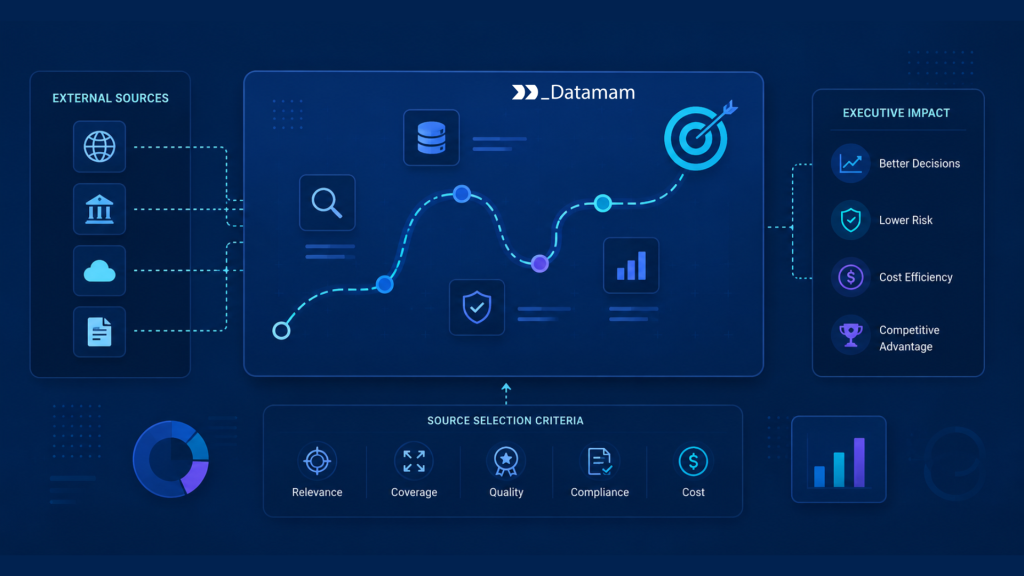
Data sources now shape enterprise AI performance, analytics reliability, compliance exposure, and executive decision quality. The sources an organization chooses determine what its models can learn, what its teams can observe, and what its decision systems may miss. In that sense, source selection is no longer a technical procurement detail. It is a strategic decision that affects risk, trust, scalability, and competitive visibility.
Data Source Strategy defines how organizations identify, evaluate, approve, monitor, and govern the sources that feed AI, analytics, and market intelligence systems. Weak source strategy creates problems before data reaches a warehouse, dashboard, model, or workflow. Poor sources introduce noise, gaps, bias, duplication, legal ambiguity, and operational fragility. Strong source strategy creates a more reliable foundation for enterprise intelligence.
Data Source Strategy Now Shapes AI Reliability, Risk, and Enterprise Decision Quality
Enterprise AI and analytics systems depend on the quality of the sources behind them. A model may be technically advanced, but if its sources are incomplete, outdated, unrepresentative, or poorly governed, its outputs become unreliable. A dashboard may be well-designed, but if the source portfolio misses important market signals, its conclusions remain partial.
McKinsey’s State of AI 2025 shows that AI adoption is widespread, yet many organizations still struggle to embed AI deeply enough into workflows and processes to create material enterprise impact. Source strategy is part of that challenge. AI systems cannot scale reliably when the data they depend on comes from loosely selected, weakly documented, or unstable sources.
Source Selection Strategy Determines What AI Systems Can Learn and What They Miss
Source selection strategy determines the boundaries of what AI systems can learn. If sources overrepresent certain users, regions, languages, products, or behaviors, the model will learn a partial view of reality. When key sources are excluded, the system may miss important patterns. Poor source selection can also introduce duplicated, low-quality, or outdated information that weakens model behavior.
For example, a demand forecasting model that relies only on internal sales history may miss external demand signals. A risk model that excludes recent public indicators may react too late. A customer intelligence system that draws from only one interaction channel may misunderstand customer intent.
The issue is not only whether a source is available. Leadership teams need to know whether the source is relevant, representative, current, permissible, and stable enough to support the intended use case.
Poor Source Planning Creates Blind Spots Before Data Reaches Models or Analytics Systems
Blind spots often begin at the source layer. Once a weak source portfolio is embedded into pipelines, downstream teams may not realize what is missing. Dashboards may appear complete. Models may generate outputs. Reports may be delivered on time. However, the system may still exclude important external signals, segments, market activity, or operational context.
External source planning helps prevent this by mapping source coverage against business questions. Which markets must be represented? Which competitors matter? Which customer behaviors are visible? Which channels produce meaningful signals? Which sources carry compliance constraints? Which sources are likely to change structure or availability?
Without this planning, organizations often discover gaps only after AI performance weakens, market intelligence misses a shift, or leadership questions whether the data can be trusted.
Why Data Sources Are No Longer a Technical Procurement Decision
Data sources used to be treated as operational inputs purchased, collected, or integrated by technical teams. That view is no longer sufficient. Source choices now influence enterprise AI governance, model risk, compliance review, analytics reliability, and strategic decision-making. Executives, therefore, need visibility into source strategy because source quality affects outcomes at the business level.
Gartner’s Predicts 2025: The Data and Analytics Governance Reset Continues With AI notes that generative AI and the growing need to govern unstructured data are straining traditional governance operating models. This pressure begins at the source layer, where organizations must decide which structured, semi-structured, and unstructured sources can be used responsibly.
Enterprise Leaders Need to Understand the Business Risk Embedded in Source Choices
Every source carry business risk. Some sources may be incomplete. Others may change without warning. A few may contain sensitive information, unclear usage rights, or jurisdictional constraints. Certain external sources may require careful review of platform policies, sourcing methods, retention rules, or cross-border data movement. Internal sources can also carry risk when definitions are inconsistent or ownership is unclear.
These risks affect business outcomes. A weak source can distort model training. An unstable source can interrupt production workflows. An unapproved source can create compliance friction. A narrow source set can produce biased decisions.
In practice, source choices influence the reliability of systems that executives increasingly depend on. That makes source strategy a leadership issue, not only a data engineering issue.
Data Sourcing Strategy Affects Compliance, Model Trust, and Long-Term Scalability
Data sourcing strategy affects how confidently organizations can scale AI and analytics programs. A well-designed source portfolio includes approved sources, documented collection methods, quality scoring, usage constraints, refresh logic, and monitoring rules. This creates clarity for data teams, model owners, legal reviewers, and business stakeholders.
Compliance teams need to know whether sources are permitted and whether restrictions apply. AI teams need confidence that sources are representative and stable. Data engineering teams need to understand source formats, update frequency, failure risk, and change patterns. Executives need assurance that critical systems are not dependent on fragile or undocumented inputs.
Long-term scalability depends on this discipline. If every AI or analytics project selects sources independently, the organization accumulates duplication, inconsistency, and governance risk.
The Strategic Cost of Weak External Source Planning
External sources are increasingly important for enterprise intelligence because many critical signals originate outside internal systems. Competitor pricing, product availability, customer sentiment, public filings, regulatory activity, reviews, marketplace rankings, job postings, economic indicators, and digital shelf movement can all influence AI and analytics outcomes. However, external source planning must be deliberate because external environments are dynamic and uneven.
IBM’s 2025 CDO Study emphasizes the need for high-quality data and strong governance frameworks to unlock value from proprietary and ecosystem data. For enterprise teams, the implication is clear: external data only becomes valuable when source quality, governance, and operational reliability are managed intentionally.
Unverified Sources Increase Noise, Bias, Duplication, and Operational Fragility
Unverified sources can introduce noise before any downstream validation occurs. A source may contain duplicated records, inconsistent fields, outdated values, misleading labels, changing structures, or irrelevant content. If teams collect from such sources without qualification, they push quality problems downstream into pipelines, dashboards, and models.
Bias is also a source-level problem. If an external source overrepresents certain regions, customer segments, price tiers, seller types, or user behaviors, the resulting data may distort AI outputs or strategic conclusions. Duplication can inflate signals, while unstable source structures can break pipelines or create silent data loss.
Source qualification reduces these risks. Teams should evaluate reliability, coverage, update frequency, structural stability, representativeness, and governance constraints before a source becomes part of critical workflows.
Incomplete Source Coverage Weakens Market, Customer, and Model Context
Incomplete source coverage narrows the organization’s view of reality. A market intelligence system may track known competitors but miss new entrants. A pricing model may include internal sales data but exclude marketplace activity. A customer analytics workflow may rely on CRM data while ignoring reviews, support conversations, or behavioral signals. An AI training dataset may include common cases while excluding rare but important scenarios.
The problem becomes more serious when leaders assume the system is comprehensive. Missing sources create false confidence because outputs appear structured while the underlying source universe remains incomplete.
External source planning addresses this by defining source coverage requirements. The goal is not to collect from every possible source. It is to select the sources that best represent the decisions, markets, users, and risks the organization needs to understand.
How Source Selection Strategy Influences AI and Analytics Outcomes
Source selection strategy influences AI and analytics outcomes before modeling, transformation, or visualization begins. Strong sources improve coverage, relevance, freshness, and reliability. Weak sources create constraints that downstream systems cannot fully correct. Validation and modeling can improve data use, but they cannot fully compensate for a source portfolio that excludes critical evidence.
NIST’s AI Risk Management Framework provides a lifecycle approach to AI risk, including governance, mapping, measurement, and management. Source strategy aligns directly with this lifecycle because data origin, quality, and intended use shape AI system behavior and risk exposure. The impact of source prioritization strategies plays a crucial role in determining the effectiveness of AI models. Effective prioritization can lead to improved insights and actionable outcomes, ultimately driving better decisions. Conversely, neglecting the importance of source quality may result in significant oversight, hindering the advancement of analytical capabilities.
Strong Source Design Improves Coverage Across Segments, Markets, and Edge Cases
Strong source design begins by asking what the system needs to represent. For AI, this may include user segments, languages, geographies, product categories, rare cases, behavioral patterns, or external conditions. For analytics, it may include markets, competitors, channels, time periods, and operational variables.
Once those needs are defined, sources can be selected intentionally. Internal systems may provide transactional depth. External sources may provide market context. Partner data may provide ecosystem visibility. Public sources may provide regulatory, economic, or competitive signals. Synthetic data may support certain testing needs when governed carefully.
Better source design improves representativeness. It also helps teams identify where coverage is weak before the system enters production or executive reporting.
Source Quality Determines Whether Downstream Validation Can Produce Reliable Intelligence
Downstream validation is essential, but it has limits. It can detect missing fields, schema inconsistencies, duplicates, anomalies, and quality failures. It cannot create missing market coverage, repair unclear permissions, or fully remove source-level bias. If the wrong sources were selected, validation may only confirm that incomplete data is internally consistent.
This distinction matters. A clean dataset can still be strategically weak if its sources are too narrow. A validated model input can still be misleading if it excludes relevant external conditions. A governed dashboard can still give partial insight if the source selection ignored important market segments.
Therefore, source quality must be evaluated upstream. Reliable intelligence begins with choosing sources that are fit for purpose, not merely processing whatever data is easiest to obtain.
The Infrastructure Layer Behind Reliable Data Source Strategy
A reliable source strategy requires infrastructure because sources change. Websites update structures. APIs change schemas. Internal systems modify definitions. External platforms alter access patterns. Public sources shift formats. New sources become relevant as markets evolve. Without monitoring and metadata, source portfolios degrade quietly.
The World Economic Forum’s 2025 analysis on scaling AI with strategy, data, and workforce readiness argues that strong data foundations are necessary for enterprise AI scale. Source infrastructure is part of that foundation because it determines whether data entering the organization remains reliable, governed, and operationally useful. Data sourcing services for businesses are essential for maintaining the integrity of information across varying platforms. By utilizing these services, organizations can ensure that their data remains current and relevant. This capability is crucial for making informed strategic decisions in an ever-changing market landscape.
Source Monitoring, Validation, and Metadata Make Data Inputs Easier to Govern
Source monitoring helps teams understand whether sources remain available, fresh, stable, and structurally consistent. Validation checks whether incoming data meets expected standards. Metadata records source ownership, origin, collection timing, refresh frequency, usage restrictions, quality scores, and transformation logic.
Tools such as Great Expectations can support schema validation, completeness checks, and anomaly detection. Airflow can orchestrate source workflows. Kafka can support continuous data movement. Spark can process high-volume external and internal datasets. dbt can structure transformations into governed analytical models. Snowflake, BigQuery, and Databricks can support scalable storage and analysis.
External source collection may require Playwright when signals exist in dynamic web environments. Source resilience may also involve change detection, extraction monitoring, proxy orchestration, rate management, and legal sourcing controls. These capabilities make source strategy operational rather than theoretical.
Lineage, Observability, and Version Control Help Teams Track Source Impact Over Time
Lineage shows how data moved from source to downstream workflows. Observability reveals whether source pipelines are healthy, fresh, and complete. Version control preserves changes in source definitions, schemas, and datasets over time.
Prometheus and other observability systems can monitor pipeline failures, latency, freshness, and coverage. Data lineage tools and metadata systems help teams understand which models, dashboards, or workflows depend on each source. Dataset version control helps teams compare how source changes affected model behavior or analytics results.
This matters because source impact is often discovered late. A source schema change, and model performance declines. A public data source stops updating, and a dashboard becomes stale. A competitor website changes its structure, and market intelligence coverage weakens. Observability and lineage make these dependencies visible before failures become business problems.
Why Data Source Strategy Is Becoming an Executive Governance Priority
Executives need visibility into data source strategy because critical AI and decision systems increasingly depend on source portfolios that span internal, external, partner, public, and vendor-provided data. Without clear governance, organizations may not know which sources support which decisions, which risks apply, or which systems are exposed if a source fails.
The World Bank’s Digital Progress and Trends Report 2025 emphasizes the importance of foundational digital systems for responsible and scalable AI adoption. Inside enterprises, source governance is one of those foundations. AI and analytics cannot scale responsibly when source accountability is unclear. Organizations must also address data supply chain vulnerabilities in finance to enhance their operational resilience. A comprehensive understanding of these vulnerabilities can help mitigate risks associated with data breaches and disruptions. Additionally, fostering collaboration between departments will ensure that financial data is robust and secure, enabling smarter decision-making.
Leaders Need Visibility into Which Sources Support Critical AI and Decision Systems
Leadership teams should know which sources support critical systems. A pricing model may depend on competitor pricing feeds. A risk model may depend on public filings and internal transaction data. A forecasting system may depend on historical sales, marketplace signals, and macroeconomic indicators. A customer intelligence workflow may depend on CRM data, support tickets, review data, and behavioral signals.
If leaders do not understand these dependencies, they cannot evaluate operational risk. A source failure may interrupt a decision system. A source quality issue may distort outputs. A compliance concern may require removing a source and retraining a model.
Executive visibility does not require leaders to manage every source. It requires clear source accountability for systems that influence important decisions.
Scalable Data Sourcing Strategy Requires Clear Ownership, Controls, and Risk Accountability
A scalable data sourcing strategy depends on ownership. Each source should have defined responsibility for approval, access, quality, monitoring, documentation, and retirement. Controls should clarify which sources are allowed, how source quality is measured, when issues escalate, and how compliance is reviewed.
Risk accountability is equally important. Not all sources carry the same exposure. Some support low-risk analytics. Others feed production AI, pricing engines, compliance systems, or executive reporting. Source governance should reflect that difference.
Ultimately, Data Source Strategy has become an executive issue because source choices shape enterprise intelligence before any model, dashboard, or decision workflow is built. The source selection strategy determines what systems can learn and what they miss. External source planning reduces blind spots. Data sourcing strategy strengthens compliance, trust, and scalability.
Organizations that manage sources as strategic infrastructure will be better positioned to build reliable AI, analytics, and intelligence systems. Those that treat source selection as a tactical procurement task may continue collecting data, but they will struggle to prove that their decision systems are complete, trustworthy, and resilient.