
Key Takeaways
- Property data matching connects source-specific records to the same real-world property.
- Source IDs are useful within a provider but rarely work as universal property identifiers.
- Address matching is usually the starting point, not the complete solution.
- Property identity, listing identity, parcel identity, and unit identity should remain separate.
- Multifamily and condominium properties require more granular matching than most single-family homes.
- Deterministic rules work for obvious matches, while uncertain records may require scoring or probabilistic methods.
- False matches are usually more damaging than leaving an ambiguous property unmatched.
- Datamam’s documented real estate work includes address matching, cross-source reconciliation, deduplication, changing URL resolution, and recurring property identity maintenance.
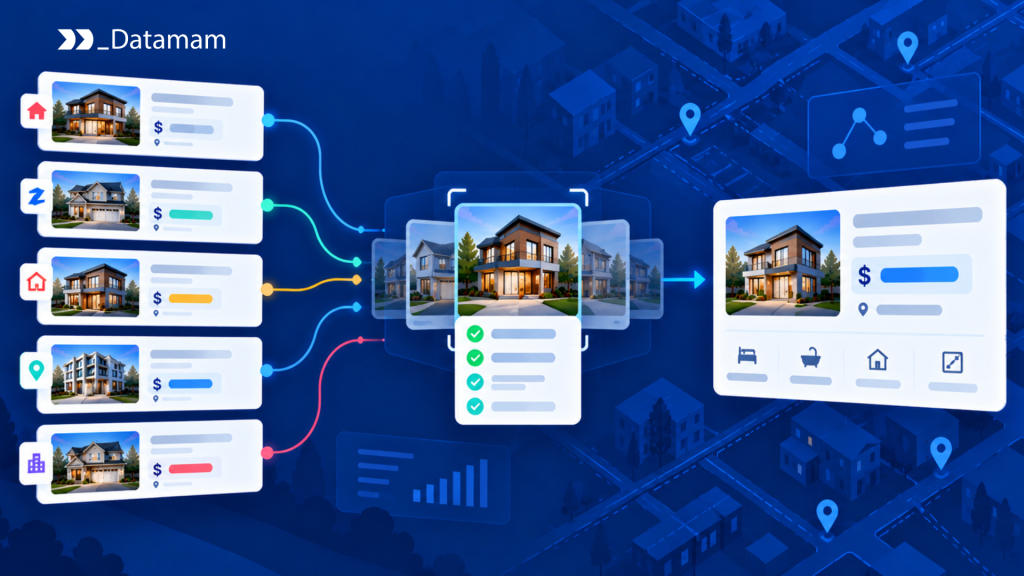
Property data matching determines whether records from different real estate sources refer to the same physical property. The problem appears whenever listings, public records, property portals, rental marketplaces, parcel databases, brokerage websites, or commercial datasets are combined. The same house might appear as 125 N Main St, 125 North Main Street, and 125 N Main Street, Unit A, while each source assigns a completely different record ID. A multifamily building can make the problem harder because hundreds of units may share the same street address while representing different rentable properties.
Reliable property matching therefore requires more than comparing addresses. A matching system may use normalized addresses, unit numbers, parcel identifiers, coordinates, property characteristics, listing history, source IDs, building names, and other signals to decide whether two records represent the same real-world entity. The result is a canonical property identity that allows records from several sources to be compared without losing their original provenance.
What Is Property Data Matching?
Property data matching is the process of determining whether two or more records refer to the same real-world property. In data engineering this is a form of entity resolution. Instead of assuming that the identifier supplied by Zillow, an MLS, an assessor, a rental marketplace, or another provider identifies the property universally, the matching layer creates relationships between those source-specific records.
What is real estate entity resolution?
Real estate entity resolution converts multiple representations of a property into a shared identity. Suppose three sources contain:
200 West 38th Street Apt 5A
200 W 38 ST #5A
200 W. 38th St., Unit 5-A
A person can quickly recognize that these probably refer to the same unit. A data system has to reach that conclusion using rules or statistical evidence. It must normalize the address, understand the unit designation, consider geography, and determine whether enough evidence exists to create a match.
The output might assign all three records to:
canonical_property_id = PROP_0004821
The original source IDs should still remain attached so the system knows where every observation originated.
Is property record matching the same as deduplication?
They overlap but are not identical. Deduplication usually identifies repeated records within a dataset. Property record matching can also connect records between completely different sources. A database might contain three duplicates from one provider and two different representations from another. Deduplication cleans the first problem, while cross-source entity resolution solves the second.
Why Is Matching Real Estate Records Difficult?
Real estate looks highly structured because properties have addresses, but addresses are imperfect identifiers. Formatting varies, unit information may disappear, buildings can have multiple valid addresses, new developments may be renamed, and listings can be created and removed repeatedly over the property’s lifetime.
Why doesn’t exact address matching work?
Two addresses can describe the same place without being identical strings. Common differences include abbreviations, punctuation, directional prefixes, street suffixes, unit formatting, ZIP+4 codes, spelling variations, and missing components. Apartment 12, Apt 12, Unit 12, and #12 may all refer to the same residence.
Address standardization therefore happens before comparison. The U.S. Postal Service’s Publication 28 provides standardized conventions for street suffixes, directional information, secondary unit designators, and other address components. These standards are useful for turning source-specific representations into fields that can be compared consistently.
Normalization does not prove two properties are the same. It only makes comparison more reliable.
Why can the same address represent different properties?
Multifamily buildings are the obvious example. Hundreds of apartments can share one street address. Commercial buildings can contain multiple suites. Condominium units can have separate ownership records while using the same building address. One parcel can also contain multiple buildings.
Matching only at the street-address level can therefore collapse distinct entities together. The system needs to understand the required level of identity:
parcel → property/building → unit → listing
The correct level depends on the business question.
Why can one property have several listing IDs?
Listing IDs normally describe market events rather than permanent physical assets. A house may be listed, withdrawn, and relisted months later under another ID. The underlying property did not change, but the listing did.
A good data model therefore keeps property_id and listing_id separate. This allows several historical listings to remain connected to one property without incorrectly merging the listing events themselves.
Which Fields Are Most Useful for Property Matching?
No single field works perfectly across every property type. Matching quality improves when several independent signals support the same conclusion.
| Matching Signal | Typical Value | Main Limitation |
| Normalized address | Very high | Unit and formatting problems |
| Unit number | Very high for multifamily | Frequently missing |
| Parcel identifier | High | Not universal across sources or units |
| Coordinates | High | Multiple units can share coordinates |
| Source property ID | High within one source | Usually not portable |
| Building/property name | Medium-high | Names can change |
| Bedrooms/bathrooms | Supporting | Many properties share values |
| Square footage | Supporting | Measurements can differ |
| Property type | Supporting | Too broad alone |
| Listing history | Supporting | Requires historical data |
A strong match normally combines the strongest identifiers first and uses descriptive attributes as supporting evidence.
Are parcel IDs the best property identifier?
Parcel identifiers can be extremely useful because they relate the record to a land parcel rather than to a website representation. They are not universal property identifiers, however. Parcel numbering systems vary by jurisdiction; identifiers can be formatted differently, and one parcel can contain several structures or rentable units.
Parcel identity should therefore be treated as one important layer rather than as a universal replacement for property matching.
Can latitude and longitude identify the same property?
Coordinates are useful for confirming proximity and detecting address variations. They become less precise inside dense buildings because several apartments, suites, or condominium units may share essentially the same location. Different geocoders can also return slightly different coordinate points for the same address.
The U.S. Census Bureau’s Geocoder is one example of an address-based system that can connect normalized U.S. addresses with geographic coordinates and Census geographies. For entity resolution, geocoding can provide useful supporting evidence, but unit identity still needs to come from another field when several properties occupy the same location.
How Does a Property Matching Pipeline Work?
A production property matching workflow usually has four stages: normalization, candidate generation, comparison, and canonical assignment. Separating these steps is important because comparing every record against every other record becomes computationally expensive as datasets grow.
Step 1: Normalize the matching fields
Addresses, unit numbers, coordinates, property types, and identifiers should first be represented consistently. For example:
17 SOUTH MAIN STREET APARTMENT 03
might become:
house_number = 17
street_name = MAIN
street_suffix = ST
unit_number = 3
Normalization also removes cosmetic differences that should not influence identity.
This is intentionally only the minimum normalization needed for matching. Deeper real estate data normalization belongs to a separate problem because matching and normalization solve different objectives.
Step 2: Generate likely matching candidates
A large database should not compare one property against millions of unrelated properties. Candidate generation, sometimes called blocking, reduces the possible comparisons.
Records might first be restricted to properties sharing:
- postal code;
- normalized street number;
- geographic radius;
- parcel identifier;
- normalized street name;
- building identifier.
A record in Chicago does not need to be compared with every property in Miami.
Step 3: Score the remaining candidates
Obvious records can use deterministic rules. More ambiguous candidates can receive scores according to how much evidence agrees.
def match_score(a, b):

    score = 0


    if a.get("normalized_address") == b.get("normalized_address"):

        score += 50


    if (

        a.get("unit_number")

        and a.get("unit_number") == b.get("unit_number")

    ):

        score += 25


    if (

        a.get("parcel_id")

        and a.get("parcel_id") == b.get("parcel_id")

    ):

        score += 20


    if a.get("property_type") == b.get("property_type"):

        score += 5


    return score
A real system would use more sophisticated similarity measures, geography, missing-value handling, conflicting signals, and property-type-specific thresholds. The example demonstrates the underlying principle: property identity should be supported by several signals rather than guessed from one field.
Step 4: Assign or create a canonical property ID
When the match exceeds the required confidence threshold, the incoming record is connected to the existing canonical property. If it does not, the system can create another property or send the candidate into an ambiguous-review state.
It is often safer to leave an uncertain record unmatched than to create an incorrect relationship that later contaminates price comparisons, history, availability, or analytics.
Deterministic vs Probabilistic Property Matching
Deterministic matching uses explicit rules. Probabilistic matching evaluates how strongly several fields together support the hypothesis that records represent the same entity.
When should deterministic matching be used?
Deterministic matching is ideal when strong identifiers agree. Examples include:
- same standardized address + same unit;
- same trusted parcel ID + compatible address;
- same persistent internal property ID;
- same building ID + same unit identifier.
These matches are easier to explain and audit.
When should fuzzy or probabilistic matching be used?
Fuzzy matching becomes useful when information is incomplete or slightly inconsistent. For example:
875 W Jefferson Ave
and
875 West Jefferson Avenue
are straightforward after normalization. More difficult cases might have a misspelled street name, slightly different coordinate, missing unit information, or different square footage.
A scoring model can combine similarity across address components, coordinates, parcel information, property attributes, and history. The goal is not to make every record match. It is to quantify whether the available evidence is strong enough.
Should AI decide whether two properties match?
Machine-learning models can help rank ambiguous candidates, particularly at large scale, but high-quality reference fields and deterministic rules remain valuable. Matching systems also need explainability because downstream users may need to understand why records were merged.
For many real estate pipelines, a hybrid design works well: deterministic rules resolve high-confidence records, similarity scoring handles ambiguous cases, and uncertain records remain separate or undergo targeted review.
How Is Listing Matching Different From Property Matching?
Property matching determines whether records describe the same asset. Listing matching determines whether they describe the same market event. Property listings from Zillow provide a broad view of available assets in various markets. By analyzing these listings, stakeholders can identify trends and make informed decisions. This insight is crucial for optimizing investment strategies and enhancing market presence.
Can the same property have multiple valid listings?
Yes. A property can generate many sale or rental listings during its lifetime. It can also appear on several websites at the same time. Those source records may represent one shared listing event or separate events associated with the same property.
The RESO Data Dictionary helps illustrate why this separation matters. Real estate systems distinguish fields related to properties, listing status, media, members, offices, and other resources rather than treating every piece of information as one permanent property record.
How do you identify a relisted property?
A relisting can receive a new source listing ID while the property itself remains unchanged. Matching should first establish the canonical property identity. The system can then examine previous listing records, timing, price, status, broker information, and other evidence to determine whether the new observation represents a continuation, a relisting, or a genuinely different listing event.
This separation preserves both property history and listing history.
How Do You Match Apartments and Multifamily Properties?
Multifamily data requires more careful entity resolution because property-level and unit-level information coexist.
How should apartment units be matched?
A unit-level match usually needs the property identity first. Within that property, useful signals include unit number, floor-plan name, bedrooms, bathrooms, square footage, floor, and source-specific unit identifiers.
Two units in different buildings should not be matched simply because both are called Unit 301. The hierarchy matters:
property → floor plan → unit Apartment layout design strategies play a crucial role in maximizing the functionality and appeal of living spaces. Effective use of space can influence not only the aesthetics but also the practicality of the unit. By considering factors such as flow, accessibility, and natural light, designers can create environments that truly enhance the living experience.
What if the source does not expose a unit number?
The system may only be able to match at the floor-plan or property level. A record describing a two-bedroom floor plan at 950 square feet should not automatically be assigned to one individual unit unless sufficient evidence exists.
Maintaining different confidence levels is better than manufacturing unit identity that the source does not support.
How Should Conflicting Property Matches Be Handled?
Conflicting signals are normal. The address may agree while square footage differs. Coordinates may match while unit numbers conflict. A parcel ID may agree while one source describes a duplex and another describes a single-family property.
What should happen when strong identifiers disagree?
Do not automatically merge. Strong disagreement should reduce confidence or trigger review. In particular, conflicting unit numbers or trusted parcel identifiers can indicate that records represent separate properties even when the street address is identical.
The source records should remain available so the decision can be audited later.
What is worse, a false match or a missed match?
For many real estate applications, a false match is more damaging. If two different homes are merged, their prices, listing histories, transactions, and attributes can contaminate one another. An unmatched record can often be reconciled later without corrupting existing history.
The acceptable balance depends on the application, but systems should generally avoid aggressively merging uncertain properties simply to maximize match rate.
How Do You Measure Property Matching Quality?
Entity resolution needs measurable quality controls. A high match rate does not prove the matching is accurate because an overly aggressive algorithm can achieve high coverage by incorrectly joining records.
What are precision and recall in property matching?
Precision measures how many created matches were actually correct.
Recall measures how many true matches the system successfully found.
For example, a conservative system might achieve very high precision but leave more properties unmatched. Another model might increase recall while introducing false relationships. The correct balance depends on the business consequence of each error.
What should be manually reviewed?
Sample review is particularly useful for records around the decision threshold, multifamily properties, conflicting parcel data, missing units, similar neighboring addresses, and high-value records where an incorrect match could materially affect analysis.
Monitoring should also look for unusual outcomes such as one canonical property suddenly accumulating many unrelated source records.
What Datamam’s Real Estate Matching Work Shows
Datamam has documented real estate work that provides real estate insights, where matching was not an abstract downstream task but part of making the collected data usable. In one recurring PropTech project, the source set included Apartments.com, Zillow, and RealAtlas. Records included addresses, prices, listing statuses, bedrooms, bathrooms, square footage, amenities, availability, listing URLs, and floor plans. The workflow required property and address normalization, deduplication, and address-based entity resolution supported by price, status, and historical information. Quality controls included duplicate-address checks, field completeness checks, and validation of listing-status transitions. Datamam_Technical_Marketing_Cas…
The retained project material provides a more concrete picture of what this meant operationally. Datamam received property and address inputs, found the relevant properties across external sources, matched addresses, resolved changing URLs, collected pricing and listing attributes, retrieved floor-plan assets, removed duplicate property records, and maintained recurring records over time. Pasted markdown (2)(2)
This highlights an important characteristic of real estate entity resolution: matching has to survive change. A property URL can change without the property changing. A listing can receive a new ID. A price can change while the address remains stable. One source may temporarily omit a field that existed previously. A robust canonical identity should not disappear every time one source changes its presentation.
It also shows why matching works better when historical information is available. Suppose two records share a normalized address but one source currently reports a slightly different square footage. If previous observations consistently connected the records and their listing-price and status history move together, that history provides additional evidence. Conversely, if two records have the same building address but repeatedly show independent prices, units, and availability changes, they are more likely to represent separate units.
The Practical Lesson
The practical lesson is that property matching should be treated as an ongoing part of the data pipeline rather than a one-time cleanup operation. New source records need to be evaluated against the canonical property universe on every refresh. Previously matched entities may require reconciliation when sources change identifiers or representations. Quality rules need to detect both duplicates and suspicious over-merging.
For Datamam projects that depend on several external property sources, the matching layer is what makes cross-source pricing, listing monitoring, historical analysis, and property intelligence possible. Collecting records establishes source coverage. Entity resolution establishes whether those records can actually be compared.
When Does Custom Property Matching Become Necessary?
A single commercial database may already provide persistent property identifiers, in which case additional entity resolution can be limited. Custom property matching becomes more important when a business combines several independent sources, monitors named property websites, creates its own historical dataset, or integrates external data with an internal property universe.
When should a business build its own canonical property ID?
It is useful when the business does not want its identity model to depend entirely on one data provider. An internal canonical ID makes it easier to add or replace sources while keeping downstream property relationships stable.
The canonical ID should not attempt to replace external IDs. It should act as the parent identity connecting them.
When is Datamam relevant?
Datamam is particularly relevant when matching forms part of a broader managed data requirement, such as collecting several property sources, identifying the same properties across them, normalizing the results, preserving recurring history, and delivering one consistent dataset.
If a single provider already supplies a reliable unified property universe that satisfies the requirement, using its identifiers can be simpler. Custom entity resolution earns its value when the required sources do not naturally share a common identity system.
How to Build Reliable Property Data Matching
Reliable property data matching begins by deciding exactly what is being identified. Property, parcel, building, unit, and listing are related entities, but they are not interchangeable. Once the correct identity level is defined, normalize the strongest available fields, generate realistic match candidates, compare those candidates using several independent signals, and assign canonical identities only when confidence is sufficient.
The system should preserve source IDs and provenance instead of replacing them, retain ambiguous records when evidence is weak, and continuously validate the resulting relationships. Historical observations can strengthen matching because they reveal whether records move together over time, while unit and parcel information can prevent similar addresses from being merged incorrectly.
The objective is not to maximize the number of matched records. It is to create a property identity layer reliable enough that prices, listings, transactions, availability, and history from several sources can safely be compared. Once that layer exists, multi-source real estate data becomes significantly more useful because the business is no longer comparing records. It is comparing the same real-world properties across sources.