
Key Takeaways
- Real estate normalization standardizes how equivalent information is represented, not whether two records are the same property.
- Raw source values should usually be preserved alongside normalized values.
- Addresses should be decomposed into components before they are used for matching.
- Unit identifiers need their own fields rather than being permanently embedded in street-address strings.
- Prices should preserve currency, price type, period, and whether the value is exact or a range.
- Listing statuses should map source-specific values into a controlled taxonomy.
- Dates and timestamps should use consistent formats and time-zone rules.
- Validation should happen after normalization because technically valid transformations can still produce incorrect business data.
- Datamam’s documented real estate work includes schema normalization across multiple listing sources, address normalization, deduplication, status mapping, and recurring data delivery.
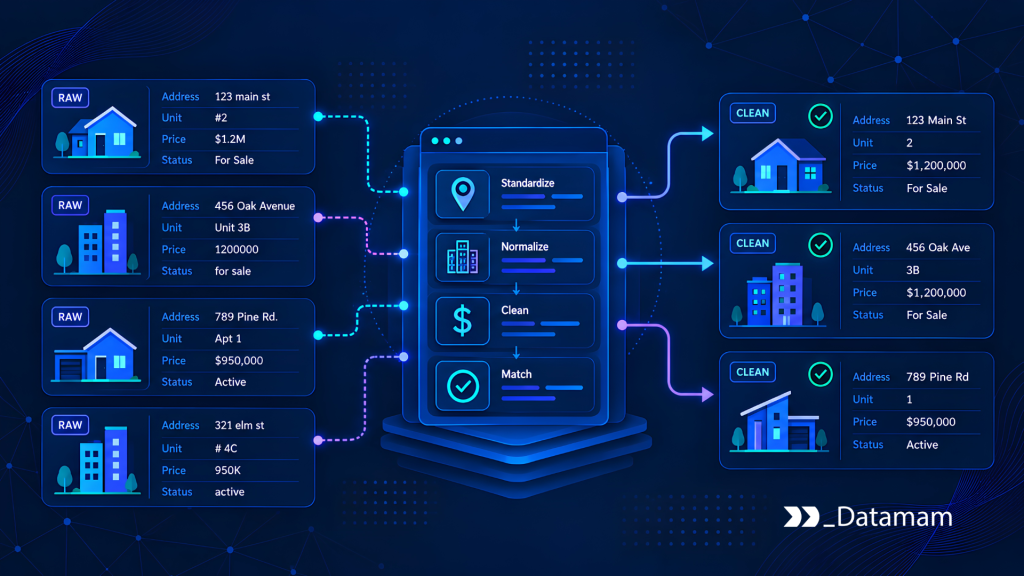
Real estate data integration converts source-specific property information into a consistent structure that can be compared, matched, stored, and analyzed reliably. The problem appears whenever data comes from more than one property portal, MLS, public record system, rental marketplace, brokerage website, commercial database, or internal source. The same address can use different abbreviations, the same listing status can appear under several labels, rent can be represented as a single value or a range, and apartment units can be embedded inside an address or stored separately.
Normalization does not mean deleting those differences. A good real estate data pipeline preserves the original source values while creating canonical fields that downstream systems can use consistently. A source might report For Sale, another Active, and another an internal code such as A. The normalized record can map all three into a controlled listing status while retaining the original values for provenance. The same principle applies to addresses, prices, units, property types, timestamps, amenities, and almost every other field used in multi-source real estate resources.
What Is Real Estate Data Normalization?
Real estate data normalization is the process of transforming source-specific values into a controlled schema while preserving their meaning. It allows information from several systems to be processed as one dataset even when those systems use different field names, formats, units, or taxonomies.
A source may return:
beds = “3 bd”
another:
bedrooms = 3
and another:
bed_count = “3.0”
A normalized schema might represent all three as:
bedrooms = 3
That transformation seems simple, but real estate data quickly becomes more complicated once fields such as addresses, apartment units, listing statuses, prices, square footage, availability, property types, and dates are involved.
What is the difference between normalization and property matching?
Normalization standardizes the representation of data. Property matching decides whether two standardized records refer to the same real-world property.
For example, converting 125 North Main Street and 125 N Main St. into comparable address components is normalization. Deciding that those records represent the same house is matching.
Keeping these stages separate is important. A normalized address is evidence that can support entity resolution, but normalization itself should not silently merge records.
Why should the original source values be preserved?
Normalization inevitably loses some source-specific representation. Suppose a marketplace reports a listing as Active – Under Contract. A canonical schema might map that value to Active Under Contract, but retaining the original field allows engineers to verify the transformation and change the mapping later if needed.
A useful model therefore often contains both:
source_status = “Active – Under Contract”
and:
normalized_status = “Active Under Contract”
The same approach can be used for addresses, prices, property types, units, and other important fields.
How Should Real Estate Addresses Be Normalized?
Address normalization transforms different representations of the same location into comparable components. It is one of the most important normalization steps because addresses are frequently used for property matching, deduplication, enrichment, and geographic analysis.
What does address normalization change?
Consider these representations:
1. 417 West 31st Street Apartment 08
2. 417 W 31 ST #8
3. 417 W. 31st St., Apt. 8
A normalized representation might separate them into:
house_number = 417
predirectional = W
street_name = 31ST
street_suffix = ST
unit_type = APT
unit_number = 8
city
state
postal_code
Separating components is generally safer than relying on one normalized full-address string because downstream systems may need to compare different parts independently.
The U.S. Postal Service’s Publication 28 Postal Addressing Standards provides standardized address formats, street suffix abbreviations, directional conventions, and secondary-unit designators. USPS specifically notes that standardization facilitates computer-based address matching and merge/purge operations.
Should punctuation and capitalization matter?
Usually not for identity. Periods, commas, capitalization, and extra whitespace are typically presentation differences rather than meaningful property characteristics.
120 N. Main St.
and
120 N MAIN ST
should normally normalize into equivalent components.
The original address should still be preserved because businesses may need the source presentation for audit, display, or debugging purposes.
Should ZIP+4 always be reduced to a five-digit ZIP code?
Not necessarily. It is often useful to maintain both the full source postal code and a normalized base postal code. Removing detail during normalization can make future matching weaker.
A better approach is:
postal_code = 10001
postal_code_extension = 1234
rather than permanently replacing 10001-1234 with only 10001.
How Should Apartment and Unit Data Be Normalized?
Units require separate treatment because the same building address can represent hundreds of independent properties or rental opportunities. Embedding unit information permanently inside the address makes matching and analysis unnecessarily difficult.
How should apartment numbers be stored?
Different sources may represent the same unit as:
Apartment 7B
Apt 7-B
Unit #7B
#7B
A normalized record might preserve:
source_unit = “Apt 7-B”
unit_type = “APT”
unit_number = “7B”
This makes it possible to compare the unit independently from the building address.
Should unit numbers always be converted to numbers?
No. Unit identifiers are strings, not mathematical values.
Examples such as:
PH1
4B
12-A
G
101C
cannot safely be represented as integers.
Even 003 should not automatically become 3 unless the source rules establish that leading zeros are insignificant. In some systems they can carry meaning.
What is the difference between a property, floor plan, and unit?
A property or building is the broader physical entity. A floor plan describes a repeatable layout. An individual unit represents a specific rentable or saleable space.
This becomes important for multifamily normalization. Several apartments might share:
floor_plan = A2
bedrooms = 2
bathrooms = 2
square_feet = 1050
while individual units such as 301, 401, and 501 have different rents and availability dates.
Normalization should preserve that hierarchy rather than flattening everything into independent property rows.
How Should Real Estate Prices Be Normalized?
A price cannot be normalized reliably by stripping the currency symbol and converting the remaining value to a number. The system also needs to understand what kind of price it represents.
What information should be stored with a property price?
At minimum, useful fields include the numeric value, currency, price type, source value, and observation time. Depending on the use case, the schema may also need minimum and maximum values, billing period, lease term, effective price, concession information, and whether the price refers to a property, floor plan, or unit.
For example:
$2,500/mo
could become:
price = 2500.00
currency = USD
price_type = asking_rent
period = month
while:
$625,000
might become:
price = 625000.00
currency = USD
price_type = listing_price
The ISO 4217 currency standard provides internationally recognized three-letter currency codes such as USD and EUR, which are preferable to relying on currency symbols that can be ambiguous across countries.
How should price ranges be stored?
Do not convert:
$2,200 – $2,850
into a single value unless the downstream use explicitly requires one.
A better representation is:
price_min = 2200
price_max = 2850
This distinction is particularly important for apartment floor plans where several available units can produce an advertised rent range.
Should rental concessions be included in normalized rent?
Usually not by overwriting the advertised rent. A property offering one month free on a twelve-month lease may have an effective monthly cost below the displayed asking rent, but the two values describe different concepts.
Store them separately:
asking_rent
concession
effective_rent
when effective pricing is actually calculated.
Otherwise, analysts may later be unable to determine whether a price difference resulted from a rent change or a promotional offer.
How Should Listing Status Be Normalized?
Listing status normalization maps source-specific terminology into a controlled set of lifecycle states. This sounds straightforward until several property sources are combined.
One website might use:
For Sale
another:
Active
another:
Available
and an MLS-derived feed may provide a more specific lifecycle status.
What listing statuses should a normalized schema use?
The exact taxonomy depends on the application, but the real estate industry already provides a useful reference. RESO’s StandardStatus field defines standardized values including Active, Active Under Contract, Canceled, Closed, Coming Soon, Expired, Hold, Pending, and Withdrawn.
A source mapping layer could therefore translate:
For Sale → Active
Under Offer → a source-appropriate contract state
Sold → Closed
Withdrawn by Owner → Withdrawn
The actual mappings must be based on what each source’s terminology means, not merely on similar wording.
Why shouldn’t every inactive listing become “Off Market”?
Because the reason matters. Pending, closed, expired, canceled, and withdrawn listings represent different events. Collapsing all of them into inactive may make the database easier to query but destroys valuable market information.
A useful design can contain both a detailed normalized status and a higher-level availability flag:
normalized_status = Pending
is_active = False
This gives downstream applications simplicity without throwing away the lifecycle state.
What if a source has statuses that do not map cleanly?
Keep the source value and use an Unknown, Other, or source-specific exception until the mapping is understood. Guessing creates more damage than leaving a value temporarily unresolved.
Mapping dictionaries should also be versioned because source terminology can change.
How Should Dates and Timestamps Be Standardized?
Time is essential in real estate data because prices, availability, listing status, and inventory can change rapidly. A record saying that a property costs $450,000 is much less useful if the system cannot determine when that value was observed. Historical property price trends analysis is crucial for making informed decisions in the real estate market. Understanding these trends allows buyers and sellers to gauge when to enter or exit the market effectively. Additionally, historical data can help identify patterns that may impact future pricing strategies.
Which timestamps should be stored?
It is useful to distinguish at least the source event time from the collection time when both are available. A listing might state that its price changed at one time while the external-data pipeline observes the change several hours later.
Fields might include:
source_updated_at
observed_at
first_seen_at
last_seen_at
status_changed_at
Using an unambiguous representation such as ISO 8601 date and time format helps prevent different regional date conventions and time zones from creating ambiguous timestamps.
Should all timestamps be converted to UTC?
For machine processing, storing a UTC-normalized timestamp is often useful. The original timezone or offset can also be retained when it is meaningful. This becomes especially important when a pipeline monitors sources across several regions.
The important rule is consistency. Mixing local timestamps without timezone information can make the sequence of events impossible to reconstruct accurately.
What Other Real Estate Fields Need Normalization?
Addresses, units, prices, and statuses are among the most important fields, but a production schema normally needs additional standardization.
Property types are a common example. Sources may use Single Family, Single-Family Home, Detached, or their own categories. Bedroom and bathroom values need consistent numeric treatment. Square footage needs to distinguish living area from lot area or commercial rentable area. Amenities often need taxonomy mapping because Pool, Swimming Pool, and Outdoor Pool may represent overlapping but not identical concepts.
The goal should not be to standardize every possible field immediately. Normalize the fields required for matching, comparison, filtering, monitoring, and downstream analysis first.
What Does a Real Estate Normalization Pipeline Look Like?
A useful architecture keeps source extraction separate from normalization. Each source adapter interprets the source-specific representation and maps it into the canonical schema.
A simplified example:
STATUS_MAP = {

    "for sale": "Active",

    "active": "Active",

    "pending sale": "Pending",

    "sold": "Closed",

    "withdrawn": "Withdrawn",

}


def normalize_record(record):

    raw_status = str(record.get("status") or "").strip()


    return {

        "source_id": str(record.get("id") or ""),

        "address": normalize_address(record.get("address")),

        "unit_number": normalize_unit(record.get("unit")),

        "price": parse_price(record.get("price")),

        "currency": "USD",

        "source_status": raw_status,

        "normalized_status": STATUS_MAP.get(

            raw_status.lower(),

            "Unknown"

        ),

        "observed_at": record.get("observed_at"),

    }
A production implementation would normally use source-specific mappings, structured address parsing, multiple currencies, field-level validation, schema versions, provenance, unit hierarchies, property-type taxonomies, and error handling. The important architectural principle is that normalization occurs in a controlled transformation layer rather than being scattered throughout collectors and downstream applications.
How Do You Validate Normalized Property Data?
Normalization can succeed technically and still be wrong semantically. A string may convert successfully to a number while representing the wrong price type. A listing status may map cleanly while using the wrong business meaning.
What checks should happen after normalization?
Validation should test expected data types, permitted categories, plausible ranges, required fields, address completeness, unit consistency, price relationships, status transitions, timestamp order, and unexpected increases in unmapped values.
For example, a sharp increase in normalized_status = Unknown may indicate that a source introduced new status terminology. A sudden rise in unitless apartment records may signal that a parser stopped capturing unit numbers.
Monitoring distributions can therefore catch problems that simple schema validation misses.
Should normalization errors delete the record?
Usually not automatically. A better pattern is to preserve the source record, mark the normalization problem, and prevent unreliable values from silently entering downstream analytics.
This makes correction possible without recollecting the source.
What Datamam’s Real Estate Normalization Work Shows
Datamam’s documented real estate projects show why normalization becomes important as soon as several external property sources or recurring observations are involved. In one PropTech engagement, the source set included Apartments.com, Zillow, and RealAtlas, with records covering addresses, listing status, price, days on market, bedrooms, bathrooms, square footage, year built, broker or agent information, amenities, availability, listing URLs, and floor plans. The retained technical evidence describes address and property normalization, deduplication, canonical schema mapping, field-level QA, and validation of listing-status transitions as part of the workflow. Datamam_Technical_Marketing_Cas…
A related documented real estate project involving Apartments.com and Zillow also required source-specific extraction and schema normalization across property, pricing, availability, amenity, floor-plan, and listing fields. The records were not useful simply because they had been collected. They needed to be converted from the representation chosen by each source into a consistent model that downstream systems could work with. Datamam_Technical_Marketing_Cas…
Another recurring real estate engagement operated on daily and monthly schedules while producing property inventory, pricing, and listing-status intelligence from multiple external sources. The retained project evidence describes geo-constrained collection, address and property normalization, deduplication, status-transition checks, and schema-aligned delivery. Datamam_Technical_Marketing_Cas…
Taken together, these projects show several recurring normalization problems.
What Are Several Recurring Normalization Problems?
The first is field meaning. Two sources can both expose something called a price but mean different things. A listing price, monthly rent, floor-plan minimum rent, and property-level price range cannot safely enter one undifferentiated column.
The second is entity level. Apartment marketplaces frequently expose property, floor-plan, and unit information simultaneously. A value associated with a floor plan should not be assigned to the entire property, and a unit-level availability date should not automatically become building-level availability.
The third is status consistency. Recurring monitoring only works if equivalent source states remain comparable across collection runs. If For Sale, Active, and another equivalent source value are not standardized consistently, downstream listing-change detection can produce false events.
The fourth is schema stability. External sources can change field names, representations, or available values. The customer’s downstream schema should not need to change every time one source changes. The normalization layer absorbs those source-specific changes and continues delivering a stable structure.
This is an important distinction in Datamam’s role. Collection gets the source information into the pipeline. Normalization makes that information dependable enough to use across sources and over time.
When Does Custom Real Estate Data Normalization Become Necessary?
A single structured property API may already provide standardized records, in which case significant additional normalization may not be necessary. The challenge becomes more important when several sources are combined, source-specific data is required, or a company needs its own long-term real estate schema.
When should a company define its own canonical real estate schema?
It becomes useful when downstream applications should remain stable even if upstream providers change. The canonical schema acts as a contract between data acquisition and the applications consuming the data.
For example, an internal system may always expect:
listing_price
normalized_status
property_type
unit_number
observed_at
while the upstream mapping logic determines how Zillow, Realtor.com, Apartments.com, public records, and other sources populate those fields.
When is Datamam useful for normalization?
Datamam is most relevant when normalization is part of a wider managed external-data pipeline. That can include collecting several real estate sources, translating source-specific schemas into one model, maintaining recurring refreshes, validating changes, and delivering a consistent dataset into the customer’s existing infrastructure.
If an existing provider already supplies the exact normalized schema and coverage required, using that product may be simpler. Custom normalization is valuable when the business needs a data model that the existing providers were not designed to deliver.
How to Build Reliable Real Estate Data Normalization
Reliable real estate data normalization starts with meaning, not formatting. Define what each canonical field represents before mapping source values into it. Keep the property, unit, floor plan, listing, transaction, and market entities distinct. Preserve raw values alongside normalized fields, and avoid forcing unknown source values into categories that only approximately fit.
Addresses should be decomposed into comparable components. Units should remain strings and be separated from the building address. Prices should carry their currency, type, period, and source context. Listing statuses should use a controlled taxonomy without collapsing meaningful lifecycle states. Dates and timestamps should use unambiguous representations and consistent timezone handling.
The final objective is not to make every source look identical. The goal is to create a stable layer where equivalent information means the same thing regardless of its origin. Once that layer exists, matching, aggregation, price comparison, listing monitoring, historical analysis, and downstream AI or analytics systems become substantially more reliable.