
Key Takeaways
- Floor plan data describes apartment layouts, including bedrooms, bathrooms, square footage, floor-plan names, images, and associated rental information.
- A property, floor plan, and individual apartment unit are different entities. One floor plan can represent several rentable units with different prices and availability.
- Floor plan scraping requires collecting both structured listing attributes and associated visual assets without losing their relationships.
- Cross-source matching should distinguish genuinely identical layouts from units that share bedroom counts or similar square footage.
- Reliable datasets need persistent identifiers, source provenance, asset validation, and recurring updates to reflect changes in layouts, rents, and availability.
- Custom floor plan collection becomes useful when businesses need specific properties, multiple sources, recurring refreshes, or delivery formats unavailable through standard datasets.
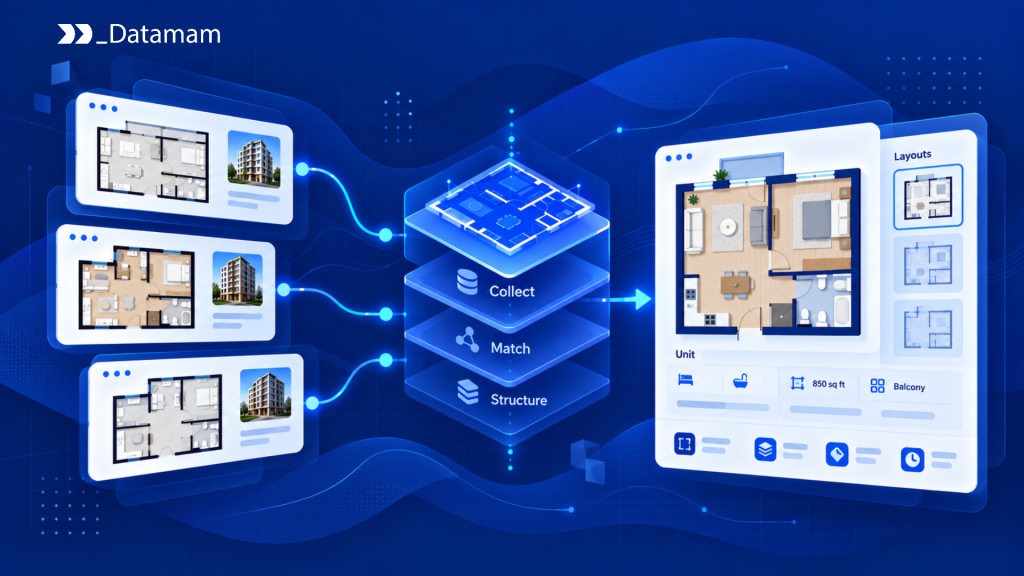
An apartment community may advertise 15 different floor plans, each associated with several individual units. The same two-bedroom layout might be listed at $2,100 on one website and $2,250 on another, while a leasing portal displays three available units with different move-in dates. If these records are collected without preserving their relationships, the resulting dataset can contain duplicate layouts, incorrect prices, and misleading availability.
Floor plan data connects apartment layouts with the properties, units, and rental offers they represent. It can include structured attributes such as bedrooms, bathrooms, square footage, layout names, and rent ranges, alongside images, diagrams, and availability information.
Collecting these details is only the first step. A production dataset needs to distinguish a reusable layout from an individual apartment, identify matching floor plans across sources, preserve image associations, and handle changes to advertised rents or available units.
For PropTech platforms, rental marketplaces, property managers, and real estate intelligence providers, the objective is to transform fragmented apartment floor plans into structured records that can support comparison, search, analysis, and recurring data delivery.
What Is Apartment Floor Plan Data?
Apartment floor plan data is structured information describing the layout and configuration of residential units within a property. It typically combines physical characteristics, visual representations, and rental-related attributes associated with a particular unit type.
What information does a floor plan record contain?
A floor plan record may include a marketing name, bedroom count, bathroom count, advertised area, rental range, and an image illustrating the unit’s layout. The exact information depends on the property and source.
| Data field | Example | Purpose |
| Floor plan name | The Aspen | Identifies the advertised layout |
| Bedrooms | 2 | Supports layout classification |
| Bathrooms | 2 | Describes configuration |
| Square footage | 1,120 sq ft | Supports size comparisons |
| Base rent | $2,250/month | Associates pricing with the layout |
| Available units | 3 | Indicates reported availability |
| Floor plan image | Image URL | Connects visual layout data |
| Property identifier | PROP-104 | Associates the plan with a property |
| Source URL | Listing URL | Preserves provenance |
| Observation date | October 15, 2026 | Establishes when values were collected |
These are illustrative fields, not a mandatory industry-wide schema. Some properties publish detailed unit-level prices, while others display only starting rents or request that prospective tenants contact the leasing office.
How is a floor plan different from an apartment unit?
A floor plan describes a reusable layout, while an apartment unit represents a specific rentable space. Multiple units can share one floor plan without having identical prices, availability dates, floor levels, or other attributes.
A building might offer ten apartments under the same two-bedroom layout. Although their general configurations match, individual units may differ in orientation, floor level, balcony access, or monthly rent.
The distinction is reflected in the RESO Data Dictionary’s PropertyUnitTypes resource, which includes fields for unit-type descriptions, bedroom and bathroom counts, rents, and unit totals.
A useful dataset preserves the relationship between the shared layout and the individual units rather than treating every available apartment as a separate floor plan.
Where Can Floor Plan Data Be Collected?
Floor plan information is distributed across rental marketplaces, property management websites, leasing portals, multifamily listing platforms, and commercial property systems. Coverage and detail vary significantly between sources.
Which websites provide apartment floor plan data?
Apartment marketplaces such as Apartments.com, property management websites, and individual apartment community pages commonly publish information about layouts, available units, rental prices, and amenities.
Property websites can provide particularly detailed information because they may connect floor plans directly with the building’s leasing system. A marketplace may provide broader geographic coverage but display only selected attributes or available layouts.
Some listings present floor plans through dedicated sections, while others embed the information in interactive availability interfaces or image galleries. As a result, source evaluation should examine where the information appears and whether the relevant attributes can be associated reliably.
What makes floor plan scraping more complicated than listing collection?
Floor plan scraping often involves several related records rather than one property description. A collection process may need to retrieve layout names, attributes, images, available unit identifiers, and rental information from different sections of the same website.
For example, a property page might display the layout image and bedroom count, while a separate availability section contains unit-specific prices and move-in dates. Combining these records requires preserving the appropriate identifiers or relationships.
Dynamic rendering, pagination, image-loading behavior, and changes to website structures can also affect collection reliability. Source access, applicable terms, permitted use, licensing, and relevant compliance requirements should be evaluated during project design.
The engineering challenge is to produce a complete, correctly associated dataset rather than merely extract the visible text.
How Should Floor Plan Data Be Structured?
A reliable floor plan dataset needs an entity model that separates apartment communities, buildings, layouts, and individual units. This structure prevents information from different levels from being combined incorrectly.
What is the correct property-to-unit data hierarchy?
A practical multifamily model commonly follows this relationship:
Property
Apartment community
Building
Physical structure, where applicable
Floor Plan
Reusable layout or configuration
Unit A
Price, availability
Unit B
Price, availability
Illustrative model. A floor plan can also be shared across multiple buildings, so the actual relationships may be many-to-many.
The property record contains community-level information. A building record identifies an individual structure when necessary. Floor-plan records describe reusable layouts, and unit records contain information about specific rentable apartments.
This separation allows a property to advertise one floor plan across multiple buildings while retaining separate availability and pricing observations for individual units.
Which identifiers should be preserved?
A structured dataset should retain both internal identifiers and source identifiers. These serve different purposes.
An internal floor_plan_id identifies the canonical layout within the data platform. A source_floor_plan_id preserves the identifier assigned by the original website, if available. Other useful fields include property_id, building_id, unit_id, and source_id.
Source identifiers should not be assumed to remain stable indefinitely. Websites can change naming conventions, regenerate URLs, or restructure their leasing systems. A historical relationship between old and new source identifiers helps preserve continuity during recurring collection.
How Do You Match Floor Plans Across Different Sources?
Floor plan matching determines whether two records describe the same apartment layout. This is more specific than matching the underlying property because one apartment community may contain numerous similar layouts.
Can bedroom count and square footage identify the same layout?
No. Bedroom count and square footage are useful matching signals, but they rarely establish layout identity on their own.
Two floor plans within the same community may both contain two bedrooms, two bathrooms, and approximately 1,100 square feet while having different room arrangements or configurations.
A stronger matching process considers several attributes together, including:
- Property identity and building association
- Floor plan name or source identifier
- Bedroom and bathroom configuration
- Advertised square footage and measurement tolerance
- Layout image characteristics
- Unit associations and source relationships
The strongest evidence depends on what the source provides. An exact source identifier may be decisive within one system, while records from different websites may require several independent signals.
How should matching handle different floor plan names?
The same layout may appear under different marketing names, abbreviations, or formatting conventions. For example, one website may use “Aspen B2,” while another displays “The Aspen – 2 Bed.”
Name similarity can help identify candidates, but it should not automatically establish a match.
A useful process first restricts candidates to the correct property, then compares layout attributes and available identifiers. Image similarity can provide supporting evidence when diagram assets are accessible and sufficiently comparable.
Ambiguous candidates should remain unresolved rather than be merged simply to increase the number of matches. Incorrectly combining two floor plans can contaminate rent comparisons, unit counts, and availability analysis.
How Should Floor Plan Images and Layout Assets Be Managed?
Floor plan images are valuable because they describe spatial relationships that cannot always be represented through bedroom counts and square footage. However, image assets need their own metadata and associations.
What information should be stored with a floor plan image?
A useful asset record includes the originating URL, associated floor plan, media type, collection timestamp, and any available source identifier. Where relevant, the system may also preserve image dimensions, a file checksum, and the stored asset location.
The RESO Data Dictionary includes a Media resource for associating photos, documents, and other media with real estate records, illustrating the importance of separating asset metadata from property attributes.
An image URL alone may be insufficient for long-term use because source URLs can expire or change. When authorized, retaining a managed copy can improve asset continuity. The storage and delivery approach should account for applicable usage rights.
Can floor plan images be converted into structured layout data?
Some additional information can be extracted from floor plan images, but results depend heavily on image quality and diagram conventions.
Optical character recognition may identify printed room dimensions, labels, or unit names. Computer vision can help identify visual similarities or support classification of layout images. More advanced spatial interpretation may attempt to identify rooms, walls, and connections.
These techniques should not be assumed to produce an accurate architectural model automatically. Marketing floor plans may be illustrative, not to scale, or missing dimensions.
Image-derived fields are best stored with their extraction method and confidence or review status. Values directly reported by the source should remain distinguishable from values inferred from diagrams.
How Do You Connect Floor Plans With Rental Pricing and Availability?
Floor plans frequently serve as the grouping level for rental offers, but advertised pricing and availability can apply to individual units rather than the entire layout.
Should rental prices be stored at the floor plan or unit level?
Prices should be stored at the level they actually describe.
If a community advertises “Starting at $2,100” for a two-bedroom floor plan, that amount represents a floor-plan-level advertised starting price. It should not automatically be assigned as the rent for every individual unit.
When individual apartments have distinct prices, the dataset should preserve those values separately.
For example:
| Record | Floor plan | Advertised monthly rent | Availability |
| Layout B2 | Aspen | From $2,100 | 3 units listed |
| Unit 204 | Aspen | $2,100 | Available now |
| Unit 307 | Aspen | $2,180 | November 1 |
| Unit 412 | Aspen | $2,250 | December 1 |
Illustrative example.
The structure supports both layout-level comparisons and unit-specific rental analysis without confusing an advertised starting price with a universal rent.
How should availability changes be represented?
Availability should be recorded as a dated observation associated with the appropriate unit or floor plan.
A floor plan may remain advertised even when none of its individual units are currently available. Similarly, an apartment may appear as available on one collection date and unavailable on the next.
A missing unit should not automatically be classified as leased. The listing may have been removed, temporarily suppressed, or affected by a collection issue.
Preserving observation dates and source-reported statuses makes these changes interpretable without claiming knowledge of an actual leasing transaction.
What Does Datamam’s Floor Plan Collection Experience Show?
Documented Datamam real estate resources include floor-plan assets, recurring property collection, and multi-source record matching. These requirements demonstrate the relationships that need to be preserved when floor plan information becomes part of a structured data pipeline. Property data integration techniques can enhance the accuracy of real estate analytics. By employing these methods, organizations can ensure that inconsistencies in property data are minimized. This leads to better insights and improved decision-making in the real estate market.
What was involved in the documented multi-source PropTech work?
In a recurring PropTech engagement, Datamam worked with property information from leading real estate platforms such as Apartments.com, Zillow, and RealAtlas. The documented project requirements included locating properties across sources, matching addresses, handling changing URLs, collecting pricing and listing attributes, retrieving floor-plan assets, and maintaining recurring records.
Monthly monitoring was part of the engagement.
This created a data problem beyond obtaining individual listing pages. Property information, floor-plan assets, and recurring observations needed to remain associated with the correct source records.
The available evidence supports those collection and matching requirements. It does not establish that every floor-plan image was converted into spatial geometry or that specific automated image-recognition techniques were deployed.
What technical lessons does recurring floor plan collection provide?
The documented requirements illustrate why floor-plan collection must be designed around entity relationships and recurring source behavior.
A changed listing URL should not automatically create a new property. A repeated floor-plan image should not automatically create a second layout. Different advertised rents should not be merged unless their unit or floor-plan relationships are understood.
These are practical engineering implications of the documented workflow, rather than claims about particular undocumented implementation details.
Datamam’s managed data acquisition model is relevant when businesses need custom source coverage, asset collection, recurring refreshes, matching, validation, and structured delivery rather than a predefined property dataset.
How Can Floor Plan Data Quality Be Evaluated?
Floor plan data quality depends on whether layouts, units, prices, and media assets are represented accurately and consistently. A dataset can contain individually valid fields yet remain unreliable if their relationships are incorrect.
Which validation checks are most important?
Validation should examine both individual attributes and the connections between records.
| Validation check | Problem it identifies |
| Property association | Floor plan linked to the wrong community |
| Layout identity | Duplicate or incorrectly merged floor plans |
| Unit relationship | Unit assigned to the wrong layout |
| Bedroom and bathroom consistency | Conflicting configurations |
| Area validation | Missing or implausible square footage |
| Price association | Unit rent assigned to an entire floor plan |
| Asset validation | Broken, duplicated, or unrelated images |
| Observation completeness | Missing records caused by collection issues |
The checks should be source-aware. A small studio and a large three-bedroom apartment require different plausibility expectations, while legitimate source variations should not automatically be treated as errors.
How should conflicting floor plan measurements be handled?
Conflicting measurements should be investigated rather than resolved through arbitrary averaging.
A property website may advertise a layout as 1,105 square feet while a marketplace reports 1,120 square feet. The discrepancy could result from a revised measurement, rounding, different area definitions, or a source that has not updated its record.
Both original measurements should remain traceable. A canonical value can be selected according to a documented source-priority or verification rule, but the conflicting evidence should not disappear.
The RESO Data Dictionary specification establishes common real estate resources, fields, and lookup structures that can support consistent data exchange. It does not eliminate the need to evaluate source-specific interpretations and measurement differences.
How Often Should Floor Plan Data Be Refreshed?
Floor plan attributes and rental availability do not necessarily change at the same frequency. Collection schedules should reflect the behavior of each field and the decisions supported by the dataset.
Do floor plans and rental availability need the same refresh schedule?
Not necessarily. A layout’s bedroom count and general configuration may remain stable for extended periods, while rental prices, available units, and move-in dates can change much more frequently.
A system may therefore use different refresh priorities:
- Layout definitions and structural attributes: periodic verification or updates when changes are detected.
- Rental prices and concessions: more frequent collection when pricing analysis requires it.
- Unit availability: refreshes aligned with operational or marketplace freshness requirements.
- Images and media: validation when asset URLs or layout records change.
These are planning principles, not universal collection schedules. The appropriate cadence depends on source update frequency, business requirements, operational cost, and access conditions.
How should changed or discontinued floor plans be handled?
A floor plan may be renamed, replaced, removed from active marketing, or modified following renovations. Historical datasets should preserve earlier records when those changes matter.
A renamed floor plan does not necessarily represent a new layout. Conversely, a redesigned layout may need a new version even if the marketing name stays the same.
Maintaining effective dates, observation history, and source relationships allows downstream systems to distinguish revised layouts from genuinely new configurations.
When Should a Business Use a Custom Floor Plan Data Pipeline?
The choice between an existing dataset and custom collection should depend on coverage, field requirements, source access, refresh frequency, and integration needs.
When is an existing real estate dataset sufficient?
An existing provider may be the simpler choice when it already includes the necessary communities, unit-layout attributes, media references, geographic coverage, and update frequency.
This is particularly true for projects requiring standardized property attributes without detailed source-specific layouts or recurring unit-level availability.
Before selecting a provider, businesses should verify whether floor-plan images, unit identifiers, and rental prices are actually included. Broad apartment coverage does not guarantee complete floor-plan coverage.
When is custom floor plan scraping more appropriate?
Custom collection becomes more relevant when a project requires particular apartment communities, information from several platforms, structured image assets, or relationships between layouts and individual units.
It may also be necessary when a business wants recurring records with its own field definitions, matching logic, and delivery requirements.
A managed pipeline can collect approved source information, associate records, validate attributes, and deliver structured outputs through files, APIs, or downstream data systems.
The underlying requirement should determine the architecture. A search application may prioritize standardized layouts and image availability, while a rental analytics product may need unit-level pricing, historical observations, and stronger identity continuity.
What Makes Floor Plan Data Useful at Scale?
Useful floor plan data preserves the relationship between a property’s physical configuration and its market-facing rental information. Collecting bedrooms, bathrooms, square footage, and images is necessary, but these attributes lose value when they cannot be associated with the correct layout or individual unit.
A dependable dataset distinguishes the apartment community from its buildings, layouts, units, and rental offers. It also retains source identifiers, media relationships, observation dates, and enough validation evidence to explain discrepancies between platforms.
The objective is not to maximize the number of collected floor-plan records. It is to create a consistent representation of apartment layouts that remains reliable as properties, listings, images, prices, and availability change.