Key Takeaways
- A Places API is useful for real-time lookup, search, nearby places, enrichment, and application workflows.
- Bulk POI data is better for large-scale analytics, market mapping, site selection, trade area analysis, and territory planning.
- A place data API should be evaluated by latency, coverage, rate limits, fields, confidence scores, licensing, and response consistency.
- Bulk POI datasets should be evaluated by schema stability, update cadence, persistent IDs, category normalization, and refresh logic.
- Many enterprise workloads need both: an API for live place lookup and bulk data for analytical infrastructure.
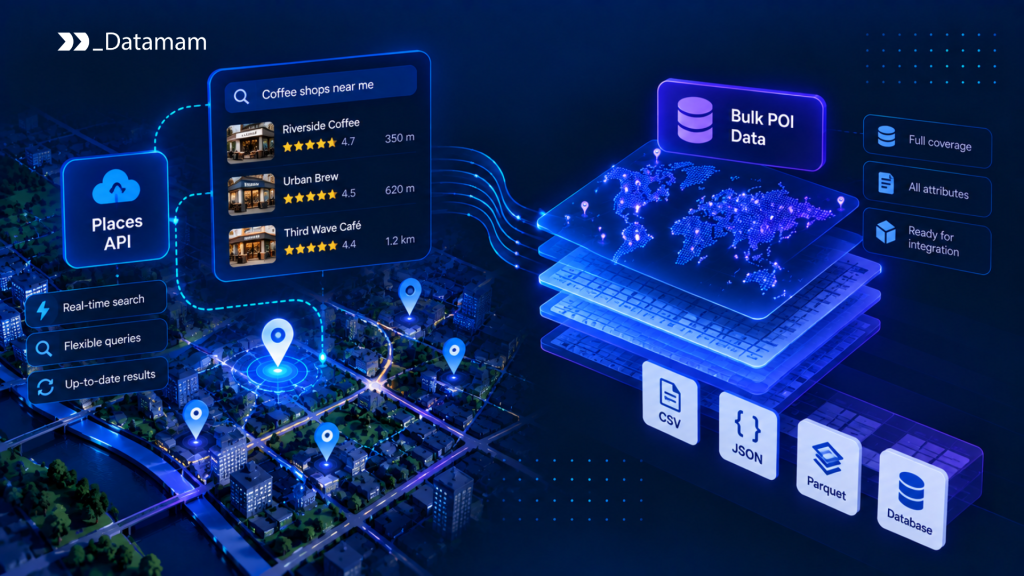
Enterprises often ask whether they need a Places API or bulk POI data. The answer depends on the workload. A mobile app that needs nearby business search has different requirements from a data science team modeling retail whitespace across 50 markets.
A Places API delivers records on demand. Bulk POI data delivers large datasets for storage, analysis, enrichment, and repeatable modeling.
Both models can be useful. The wrong model creates friction: API workflows can become expensive or slow for large-scale analytics, while bulk datasets may be too heavy for real-time application lookup.
Why Delivery Model Matters
The delivery model determines how POI data enters enterprise systems, how often it updates, how it is queried, and how downstream teams use it.
Deloitte’s geospatial analytics research describes geospatial use cases across site selection, logistics, risk, and operations. Those workflows require location data to be delivered in a form that fits the decision process, not just collected once.
APIs Support Live Lookup
A Places API is designed for on-demand access. A user searches for a business, enters an address, requests nearby locations, or enriches one record at a time.
This works well for apps, CRMs, store locators, delivery workflows, lead enrichment, and search interfaces. The system asks for a specific place or area, and the API returns a response.
The advantage is responsiveness. The limitation is scale. Large historical analysis, full-market coverage, and repeated scans across millions of records can become inefficient through API calls alone. Geocoding API functionality explained enables developers to integrate location-based services seamlessly into their applications. It allows for quick and accurate translation of addresses into geographic coordinates. By leveraging this technology, businesses can enhance user experiences and optimize operational efficiency through precise location data.
Bulk Data Supports Analytical Workloads
Bulk POI data is designed for ingestion into enterprise systems. Data teams can load it into Snowflake, BigQuery, Databricks, GIS tools, BI platforms, or internal data lakes.
This works well for market mapping, competitor density analysis, trade area modeling, site selection, territory design, and location intelligence.
The advantage is control. Teams can join POI data with internal sales, customer, mobility, demographic, and operational data. The limitation is that bulk data needs refresh pipelines, storage, deduplication, and governance. Evaluating poi data providers effectively enhances the quality of insights that organizations can derive from their data. By assessing the reliability and accuracy of these providers, companies can ensure they are making informed decisions based on current and relevant information. Ultimately, this can lead to better strategic planning and improved operational efficiency across various departments.
When a Places API Fits
A Places API fits when the enterprise needs targeted, live, or user-triggered place retrieval.
The API model is strongest when the question is narrow and immediate.
Search, Lookup, and Enrichment
A place data API is useful when users need to search for a business, validate a place, enrich a single record, or retrieve nearby locations. Examples include entering a store name, validating a restaurant address, finding businesses near a customer, or enriching CRM leads with location metadata.
A poi search api should return structured fields such as name, address, coordinates, category, phone, website, business status, source confidence, and place ID where available.
For these workflows, API access reduces the need to store every possible place record internally. Point of interest data applications can significantly enhance the user experience by providing relevant information in real time. These applications leverage geolocation technologies to deliver tailored content, ensuring users receive personalized recommendations based on their current location. As a result, businesses can better engage with customers and optimize their marketing strategies.
Application and Operational Workflows
APIs are useful inside live applications. A store locator, delivery app, insurance workflow, field sales tool, or mapping interface may need quick responses rather than full-dataset access.
The key evaluation criteria are latency, uptime, rate limits, field coverage, documentation, authentication, response stability, and licensing.
If an application depends on the API during user interaction, reliability and predictable response behavior matter as much as data coverage.
When Bulk POI Data Fits
Bulk POI data fits when the enterprise needs to analyze large geographic areas, compare markets, join datasets, or build repeatable models.
The bulk model is strongest when the question is broad and analytical.
Market Mapping and Site Selection
Bulk data is usually better for site selection and market analysis. Teams can evaluate competitor density, nearby anchors, business clusters, category mix, drive-time areas, store overlap, and market saturation.
Deloitte’s site selection guidance notes that location decisions require rigor, objectivity, and multidisciplinary analytics, even though online location data may make the process appear simple. Bulk POI data supports that rigor by allowing repeatable analysis across markets.
Territory Planning and Enterprise Analytics
Bulk POI data also supports B2B territory planning, franchise whitespace analysis, commercial real estate screening, sales coverage planning, and competitor network analysis.
These workflows need full-market visibility. An API can retrieve records, but bulk data lets teams build stable analytical tables, compare historical changes, and join POIs with internal enterprise data.
For data science and BI teams, bulk delivery usually creates more control over modeling and refresh logic.
Comparing API and Bulk Delivery
The right choice depends on query pattern, volume, latency, governance, and downstream usage.
A simple rule: use APIs for live retrieval and bulk data for analytical infrastructure.
Scale and Cost Behavior
APIs usually work well when queries are targeted. However, repeated large-area searches, full-market scans, or high-volume enrichment can create rate-limit, latency, or cost issues.
Bulk datasets require storage and pipelines, but they allow teams to run unlimited internal analysis after ingestion. This is useful when analysts need repeated queries over the same market or category.
Enterprises should model expected usage before choosing a delivery model.
Freshness and Update Control
APIs may provide fresher responses when the provider updates its backend frequently. Bulk data provides more control over refresh cycles, versioning, and reproducibility.
For example, an app may need the latest business status. A site selection model may need a monthly snapshot so results remain consistent across planning reviews.
The question is not only “Which is fresher?” It is “Which freshness model fits the workflow?”
Data Governance and Licensing
Delivery model affects governance. API access and bulk data may have different usage rights, storage rules, redistribution limits, and audit requirements.
The OECD’s data governance work emphasizes trust, data quality, ownership, stewardship, and responsible data use. POI delivery models should follow the same logic because place data becomes part of enterprise decision infrastructure.
API Governance
For API workflows, governance should cover authentication, rate limits, logging, response storage rules, caching permissions, user access, and usage monitoring.
Teams should understand whether API responses can be stored, reused, enriched, displayed, or joined with internal data.
A places data api may be technically easy to call, but licensing can restrict how results are retained or repurposed.
Bulk Data Governance
Bulk data governance should cover ingestion logs, versioning, lineage, access control, allowed use cases, retention rules, refresh cadence, and downstream sharing.
Bulk POI data often enters warehouses, BI systems, machine learning workflows, and operational tools. That makes auditability important.
Gartner’s 2025 data and analytics trends highlights governance and AI-ready data as priorities. Bulk POI data needs similar controls when it supports analytics, automation, or AI-driven location decisions.
Quality Controls for Both Models
Both APIs and bulk datasets require quality controls. Delivery format does not guarantee data reliability.
The same POI quality issues can appear in either model.
Required Quality Signals
Useful POI records should include name, address, coordinates, category, business status, source timestamp, confidence score, and stable identifier where possible.
For APIs, the response should expose enough quality metadata for the application to decide whether to accept, reject, or review the result. For bulk data, those fields should be available for filtering, scoring, and QA.
A response without confidence context can create silent errors.
Duplicate and Conflict Handling
APIs may return several similar places for one query. Bulk datasets may contain duplicate or conflicting records across sources. Both models need entity resolution.
Enterprises should evaluate how the provider handles same-name businesses, nearby branches, franchise locations, store-within-store cases, and conflicting categories.
Without duplicate controls, location analysis can overcount businesses or misrepresent market density.
Hybrid Delivery Models
Many enterprise teams need both API and bulk delivery. This is especially common when analytics and applications use the same place-data foundation.
A hybrid model can reduce tradeoffs.
Bulk for Baseline, API for Updates
Bulk data can create the baseline location layer for analytics. A Places API can then support live lookup, record enrichment, or targeted updates.
For example, a retailer may load a full competitor store database monthly, then use an API to verify specific locations during planning review.
This gives analysts broad coverage while allowing operational users to retrieve current details when needed.
Shared Identifiers Across Both Models
A hybrid model works best when API and bulk records share persistent identifiers. If IDs do not align, teams must reconcile the same place across delivery channels.
Shared IDs allow teams to connect historical analysis, live enrichment, and operational workflows.
This prevents duplicate place logic from forming in different systems.
Conclusion
A Places API and bulk POI data solve different enterprise problems. A Places API is best for live lookup, search, enrichment, nearby places, and application workflows. Bulk POI data is better for market mapping, site selection, trade area analysis, territory planning, BI, and large-scale geospatial analytics.
The right model depends on usage pattern, volume, freshness needs, governance requirements, integration environment, and licensing. Many enterprises need both: bulk data for analytical infrastructure and APIs for targeted operational access.
The capability matters because POI data only creates value when it reaches the right systems in the right format. With the right delivery model, enterprises can build more reliable location intelligence, market analysis, and geospatial decision workflows.
A structured review can help evaluate whether current workflows need a Places API, place data API, places data API, poi search api, bulk POI data, or a hybrid delivery model. You can run a location data infrastructure audit with our team to review your current place-data delivery workflows and understand what is required to build reliable enterprise POI infrastructure.