Key Takeaways
- Location Intelligence is only as strong as the place data behind it.
- A location intelligence platform needs accurate business locations, coordinates, categories, and status signals.
- Business location intelligence breaks down when place records are stale, duplicated, misclassified, or poorly geocoded.
- Location-based analytics depends on knowing which businesses exist, where they operate, and how they change.
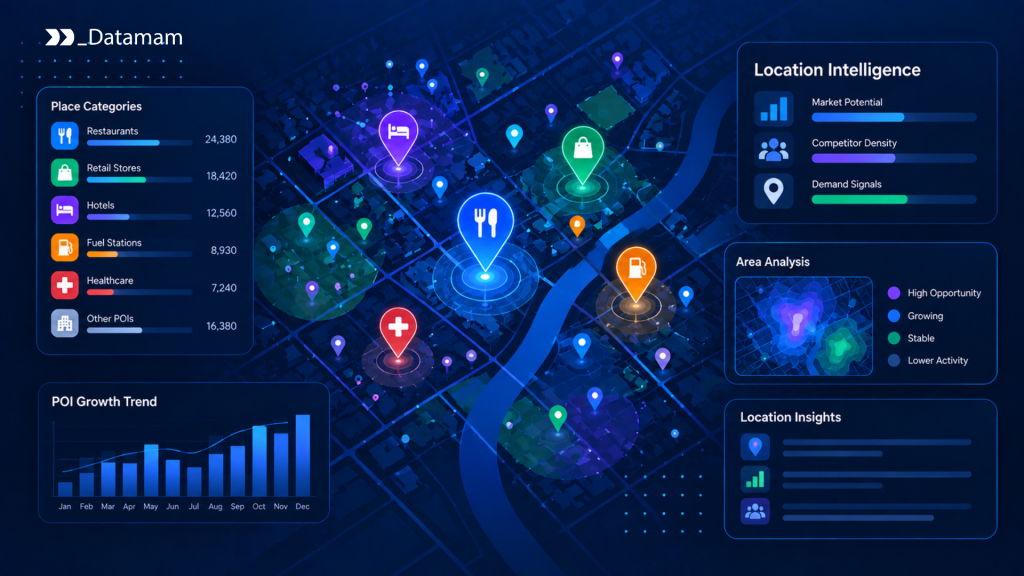
Location Intelligence depends on a basic but often underestimated condition: the places inside the system must be accurate. A location intelligence platform can visualize trade areas, map competitors, compare territories, analyze site potential, and model customer access. However, those outputs become unreliable when the underlying place data is stale, duplicated, misclassified, poorly geocoded, or missing key business context.
Location Intelligence refers to the use of geographic, commercial, demographic, operational, and behavioral data to understand markets through place-based relationships. It includes location intelligence platforms, business location intelligence, location-based analytics, POI data, address validation, geocoding, category taxonomy, store network mapping, competitor density, trade area analysis, and market expansion planning.
Location Intelligence Is Only as Strong as the Place Data Behind It
Location decisions are rarely abstract. They involve real stores, restaurants, clinics, branches, warehouses, service points, competitors, franchise units, and local market boundaries. When the data representing those places is wrong, the analysis built on top of it becomes unstable.
A retailer evaluating expansion may overestimate opportunity if competitor locations are missing. A restaurant group may underestimate saturation if franchise units are duplicated under different names. A logistics team may miscalculate coverage if addresses are poorly geocoded. A real estate team may misunderstand demand if business openings and closures are not refreshed.
McKinsey’s work on geospatial analytics in retail frames retail networks as complex systems shaped by store-level, site-level, environmental, and customer-movement data. That logic depends on reliable place data because every model starts with an assumption about what exists in a market and where it is located.
A Location Intelligence Platform Needs Accurate Business Locations, Coordinates, Categories, and Status Signals
A location intelligence platform needs more than addresses. It needs business names, coordinates, categories, operating status, opening and closure signals, chain affiliation, parent-child relationships, phone numbers, websites, hours, source history, and update timestamps.
Coordinates determine where a business appears on the map. Categories determine how it is interpreted. Status signals determine whether it is active, closed, moved, or newly opened. Chain relationships determine whether a location belongs to a regional brand, national franchise, or independent operator.
In practice, the same address can represent different business meanings. A shopping center may contain multiple tenants. A franchise may operate under a local entity name. A restaurant may move across the street. A store may close but remain visible in old directories. Reliable place data must resolve these details before analytics teams use the record.
Business Location Intelligence Breaks Down When Place Records Are Stale, Duplicated, Misclassified, or Poorly Geocoded
Business location intelligence breaks down when place records do not reflect market reality. A stale record may show a closed store as active. A duplicate record may count one location twice. A misclassified record may treat a pharmacy as a grocery store. A poor geocode may place a business in the wrong shopping district, trade area, or side of a highway.
These errors distort analysis. Competitor density becomes inflated or understated. Market coverage becomes misleading. Territory boundaries become inefficient. Site selection models become biased. Store network analysis becomes less trustworthy.
Therefore, place data quality is not a data-cleaning detail. It is the foundation of location-based decision-making.
Why Place Data Quality Shapes Market Visibility
Place data quality shapes market visibility because enterprises use location records to interpret commercial structure. They need to know where competitors operate, where customers have access, where demand is underserved, where markets are saturated, and where expansion may create cannibalization.
Deloitte’s 2025 Retail Industry Outlook highlights the continued importance of physical stores, in-store experience, margin pressure, and technology investment in retail. In that environment, place-based market visibility remains important because store networks, local availability, proximity, and service coverage still shape commercial performance.
Location-Based Analytics Depends on Knowing Which Businesses Exist, Where They Operate, and How They Change
Location-based analytics depends on three questions: which businesses exist, where they operate, and how they change over time. If any of these answers are weak, the analysis becomes incomplete.
Existence matters because market models need accurate business counts. Location matters because distance, access, catchment zones, and competitive overlap are spatial calculations. Change matters because commercial markets are dynamic. Stores open, close, relocate, rebrand, expand, consolidate, and shift formats.
A location intelligence system should therefore maintain continuous refresh logic. It should detect new locations, closed locations, address changes, category changes, and chain-affiliation changes. Otherwise, the enterprise is making current decisions from old market structure.
Incomplete Place Data Distorts Competitor Density, Trade Areas, Catchment Zones, and White-Space Analysis
Incomplete place data distorts every major location decision. Competitor density analysis may miss nearby rivals. Trade area analysis may draw boundaries around incomplete market conditions. Catchment zones may ignore real alternatives customers can access. White-space analysis may identify opportunities that are already occupied.
For example, a franchise expansion team may see a neighborhood as open because the POI dataset misses several independent competitors. A retailer may see a trade area as attractive because duplicate competitor records are filtered poorly. A healthcare provider may evaluate patient access incorrectly because clinic locations are geocoded to postal centroids rather than actual entrances.
Ultimately, unreliable place data makes markets look cleaner than they are.
The Strategic Risk of Weak Place Data
Weak place data creates strategic risk because location decisions are expensive and difficult to reverse. A poor store location, overbuilt territory, weak franchise market, or misread competitor cluster can affect capital allocation for years.
Gartner’s 2025 data and analytics trends emphasize data readiness and governance as essential to analytical and AI success. The same principle applies to location intelligence: geospatial models cannot compensate for unreliable place identity, weak data governance, or stale source records.
Enterprises Misread Market Opportunity When Locations Are Treated as Static Dots Instead of Changing Commercial Entities
Enterprises misread markets when they treat locations as static dots. A business location is not only a coordinate. It is a changing commercial entity with category, brand, ownership, operating status, format, traffic environment, accessibility, and competitive context.
A coffee shop, bank branch, pharmacy, gym, grocery store, clinic, or franchise unit may change name, format, ownership, hours, service model, or category relevance. If the location intelligence system does not track those changes, the market model becomes outdated.
By contrast, reliable place data treats each location as a living record. It monitors status, identity, category, address, source evidence, and relationship to other entities.
Expansion Planning, Territory Design, and Competitive Mapping Become Less Reliable Without Verified Place Identity
Expansion planning requires verified place identity because teams must understand where competitors, partners, customers, and complementary businesses operate. Territory design requires it because boundaries depend on coverage, density, travel time, overlap, and local market structure. Competitive mapping requires it because competitor presence must be counted accurately.
Verified place identity means the enterprise can answer: is this the same business as another record? Is it active? Is it part of a chain? Is it located at this coordinate? Is it classified correctly? Has it moved? Has it closed?
Without that identity layer, location intelligence becomes visually convincing but analytically weak.
How Reliable Place Data Improves Location Decisions
Reliable place data improves location decisions by turning raw location records into decision-ready intelligence. This requires validation, matching, enrichment, and refresh logic.
A raw address may not be enough. It must be parsed, standardized, validated, geocoded, linked to a business identity, classified into a category taxonomy, checked against duplicates, enriched with source evidence, and monitored for change.
Address Validation, Geocoding, Category Taxonomy, and Entity Resolution Turn Raw Locations Into Decision-Ready Data
Address validation confirms that a location can be interpreted consistently. Geocoding turns address text into coordinates. Category taxonomy defines what type of business the location represents. Entity resolution determines whether multiple records refer to the same place.
A simple quality gate can show how raw place records become usable:
def evaluate_place_record(record):

    if record["address_validated"] is False:

        return {"status": "review", "reason": "address_not_validated"}


    if record["geocode_confidence"] < 0.90:

        return {"status": "review", "reason": "low_geocode_confidence"}


    if record["category_status"] != "approved":

        return {"status": "review", "reason": "category_not_approved"}


    if record["duplicate_risk"] == "high":

        return {"status": "merge_review", "reason": "possible_duplicate_location"}


    if record["operating_status"] not in ["open", "temporarily_closed"]:

        return {"status": "exclude", "reason": "inactive_location"}


    return {"status": "analytics_ready", "place_id": record["place_id"]}


record = {

    "place_id": "poi_48192",

    "address_validated": True,

    "geocode_confidence": 0.96,

    "category_status": "approved",

    "duplicate_risk": "low",

    "operating_status": "open",

}


evaluate_place_record(record)
This logic protects location-based analytics from using records that are not accurate enough for market decisions. Geographic data importance in trade analysis cannot be overstated. Accurate geographic information helps businesses understand market trends and identify potential opportunities. By leveraging this data, companies can make informed decisions that enhance their competitive edge. Geospatial analytics for market strategies plays a crucial role in identifying consumer behavior patterns and optimizing resource allocation. By utilizing advanced mapping technologies, businesses can target their marketing efforts more effectively. This ensures that they not only reach their intended audience but also enhance their return on investment.
Opening, Closure, Relocation, and Chain-Affiliation Signals Help Teams Track Market Movement Over Time
Opening, closure, relocation, and chain-affiliation signals help teams understand market movement. A new store may indicate competitive investment. A closure may reveal weak local demand or format pressure. A relocation may change accessibility. A franchise expansion may show market confidence. A chain acquisition may change the competitive landscape.
These signals matter because markets change before internal performance data fully reflects the shift. A retailer may not see sales impact immediately after a competitor opens nearby. A restaurant may not notice demand pressure until after several similar concepts enter the area. A bank may not see branch traffic change until competitors adjust local coverage.
Therefore, location intelligence should track change as a continuous process, not a one-time dataset refresh.
The Infrastructure Layer Behind Reliable Location Intelligence
Reliable location intelligence requires infrastructure that collects, validates, matches, enriches, refreshes, and delivers place data at scale. POI collection, deduplication, category normalization, address validation, geocoding, QA, metadata, and observability must operate together.
Browser automation frameworks such as Playwright can collect public business location information from directories, store locators, marketplaces, maps, and business websites. Airflow can orchestrate recurring refresh workflows. Spark can process large place datasets. dbt can standardize transformations. Snowflake, BigQuery, and Databricks can store and analyze location records. Great Expectations can validate completeness, coordinate ranges, duplicate rates, and schema expectations. Prometheus and observability systems can monitor freshness, failures, and pipeline reliability.
POI Collection, Deduplication, Matching, Enrichment, QA, and Refresh Pipelines Make Place Data Usable at Scale
POI collection captures business names, addresses, coordinates, categories, contact details, hours, websites, source URLs, and status indicators. Deduplication removes repeated records. Matching connects records across sources. Enrichment adds categories, chain relationships, metadata, and geographic context. QA identifies missing coordinates, invalid addresses, duplicate risks, and category conflicts. Refresh pipelines keep the dataset current.
A scalable system should also preserve source traceability. Teams should know which sources supported a place record, when it was last updated, and which fields changed.
In practice, reliable location intelligence is built through continuous place data operations.
Airflow, Spark, dbt, Snowflake, BigQuery, Databricks, Great Expectations, Prometheus, GIS Systems, and Geocoding APIs Support Scalable Location Intelligence
Each infrastructure component has a role. Airflow manages workflow dependencies. Spark processes high-volume data. dbt creates standardized models. Snowflake, BigQuery, and Databricks provide analytical storage and compute. Great Expectations validates data quality. Prometheus monitors operations. GIS systems support spatial analysis, isochrones, trade areas, and map-based workflows. Geocoding APIs convert addresses into usable coordinates.
However, tools do not create location intelligence by themselves. They must be connected to quality rules, governance standards, refresh cadence, and business definitions. A map with inaccurate locations is still an inaccurate decision system.
Why Location Intelligence Is Becoming an Executive Strategy Issue
Location Intelligence is becoming an executive strategy issue because place-based decisions affect capital allocation, market coverage, competitive position, and growth planning. Retailers, restaurants, logistics operators, healthcare networks, franchises, financial institutions, and real estate teams all make decisions that depend on where businesses operate and how markets are structured.
Executives do not need to inspect every POI record. However, they need confidence that expansion, territory planning, competitor mapping, and market analysis are based on reliable place data. Location intelligence for market analysis can reveal hidden opportunities within regions that may align better with corporate goals. By leveraging advanced analytics, businesses can optimize their strategies and enhance their understanding of market dynamics. This approach not only improves decision-making but also fosters a competitive advantage in an increasingly data-driven environment.
Leaders Need Visibility Into Market Coverage, Competitive Density, Expansion Risk, Store Networks, and Location-Based Demand
Leadership visibility should focus on market structure. Which markets are underserved? Which territories are overbuilt? Where is competitor density rising? Which locations create cannibalization risk? Which store networks need consolidation? Which areas have strong demand but weak coverage? Which competitors are opening or closing locations?
These questions cannot be answered reliably with incomplete place data. They require verified business locations, accurate coordinates, current status, strong category taxonomy, and continuous refresh.
Location intelligence becomes strategic when it helps leaders allocate capital with better spatial evidence.
Scalable Location Intelligence Requires Place Data Governance, Source Traceability, Refresh Cadence, Quality Controls, and Continuous Market Review
Scalable location intelligence requires governance. Place records need owners, quality thresholds, source traceability, refresh rules, category standards, duplicate resolution, and audit logs. Review external place data for sourcing, permitted use, coverage, and update frequency. Cross-border location datasets may also require data residency, access, and compliance review.
Ultimately, Location Intelligence depends on reliable place data because market opportunity is spatial. A location intelligence platform can only support strong decisions when the underlying business locations are accurate, current, deduplicated, classified, geocoded, and traceable.
Enterprises that treat places as living commercial entities will understand markets more clearly. Enterprises that treat them as static dots on a map will keep making location decisions based on incomplete representations of reality.