Key Takeaways
- POI Data Quality determines whether business locations can be trusted in mapping, search, site selection, territory planning, and location analytics.
- POI accuracy depends on correct names, addresses, coordinates, categories, open/closed status, duplicates, and source traceability.
- Location data quality issues can misplace businesses, inflate competitor density, weaken local search results, and distort trade area analysis.
- Place data accuracy requires validation controls for geocoding precision, category consistency, entity resolution, freshness, and record lineage.
- Enterprise location decisions become more reliable when POI records include confidence scores, timestamps, quality flags, and review workflows.
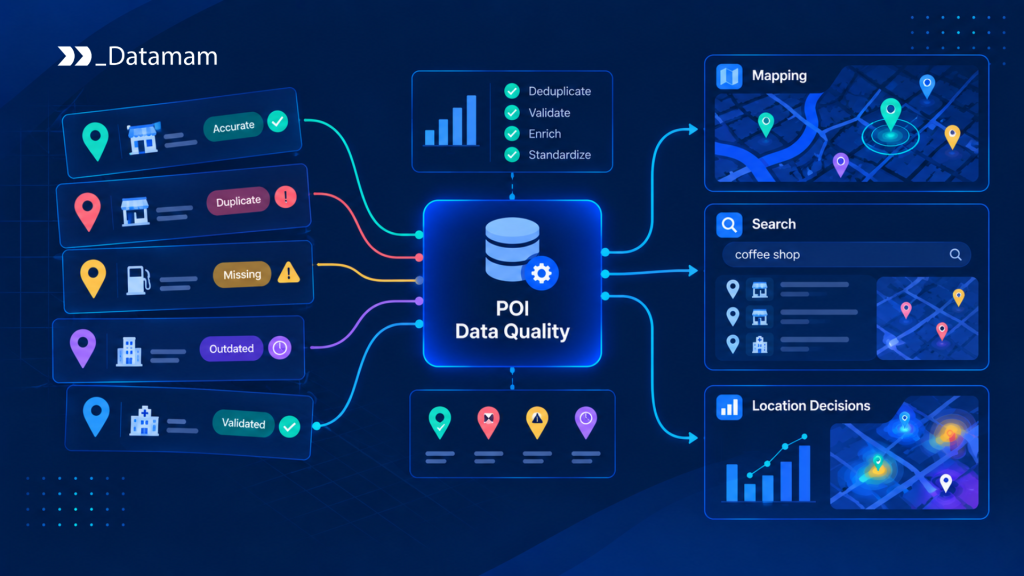
POI Data Quality affects every system that depends on business location records. A map may show a location in the wrong place. A search product may return the wrong category. A site selection model may overcount nearby competitors. A territory plan may assign accounts to the wrong region. A trade area analysis may treat closed businesses as active demand generators.
The problem is rarely one field. POI quality depends on the full record: business name, address, coordinates, category, status, source, timestamp, duplicate logic, and confidence score.
In enterprise workflows, POI data is not just map content. It is infrastructure for search, analytics, expansion planning, sales coverage, delivery design, and market intelligence.
Why POI Data Quality Matters
POI Data Quality matters because location systems convert place records into decisions. If the underlying business locations are wrong, the output looks analytical but becomes unreliable.
Deloitte’s geospatial analytics research describes geospatial use cases across site selection, logistics, operations, public services, and risk analysis. These workflows depend on reliable spatial data because errors in location records weaken the analysis layer before the decision is made.
Poor POI Accuracy Creates False Confidence
A POI record can look complete while still being wrong. It may have a business name, address, category, and coordinates, but the coordinates may be approximate, the category may be too broad, or the business may have closed.
This creates false confidence. A dashboard may show precise dots on a map, but the precision is visual, not operational.
For enterprise users, POI accuracy should be evaluated through validation, not appearance. A point on a map is only useful if the underlying record is verified enough for the workflow.
Quality Problems Spread Downstream
POI errors rarely stay isolated. A wrong category can affect search relevance. A duplicate record can inflate market density. A stale location can distort competitor analysis. A bad coordinate can move a business into the wrong trade area, sales territory, or delivery zone.
Once POI data enters BI, GIS, CRM, site selection, or AI workflows, errors become harder to detect.
Therefore, quality controls should happen before POI data becomes part of enterprise decision infrastructure.
POI Accuracy in Mapping Systems
Mapping systems depend on accurate names, addresses, coordinates, and categories. When these fields are weak, the map may still render correctly, but the business meaning is wrong.
Location accuracy is not only about coordinates. It is about whether the record represents the right real-world place.
Coordinate Precision
Coordinate precision determines whether a business is placed at a rooftop, parcel, street address, interpolated segment, postal-code centroid, or city centroid. These precision levels are not interchangeable.
A rooftop coordinate may support store mapping or site selection. A city centroid may only support broad market analysis. A street-level point may be acceptable for visualization but not delivery routing or trade area modeling.
A reliable POI system should preserve coordinate precision and geocode confidence so downstream systems can decide whether to accept, reject, or review the record.
Address and Boundary Alignment
A coordinate should align with the address and relevant boundaries. A business placed on the wrong side of a road, census boundary, ZIP code, shopping center, or trade area can create misleading analysis.
Boundary alignment matters for retail expansion, franchise territory planning, delivery coverage, public-sector analysis, and sales assignment.
This is why POI quality workflows should validate both address structure and coordinate placement.
POI Quality in Local Search
Search depends on more than the presence of a location record. It depends on whether the record can be found, classified, ranked, and displayed correctly.
Weak place data accuracy creates bad search experiences.
Name and Category Relevance
Local search relies on business names, aliases, categories, keywords, and attributes. If a restaurant is classified only as “food,” search may miss cuisine-specific queries. If a pharmacy is misclassified as general retail, healthcare-related searches may fail.
Categories should be specific enough for search but standardized enough for analytics.
A useful POI database should preserve both raw source categories and normalized enterprise categories. This allows teams to support search relevance while maintaining analytical consistency.
Open and Closed Status
Search results become less useful when they include closed businesses or omit newly opened ones. Open/closed status is one of the most important freshness indicators in POI data.
A stale record can frustrate users in consumer search. In enterprise analysis, it can make markets look more active or more competitive than they really are.
Therefore, track freshness through last seen date, last verified date, source timestamp, and status confidence.
Location Data Quality for Enterprise Decisions
Location data quality affects decisions in site selection, trade area analysis, market mapping, territory design, store planning, and competitor analysis.
Poor quality doesn’t just create bad maps. It changes business interpretation.
Site Selection and Trade Area Analysis
Site selection models often use nearby competitors, complementary businesses, anchors, accessibility, demographics, foot traffic, and customer proximity. If POI records are outdated or misplaced, the model can misread market attractiveness.
Deloitte’s site selection guidance notes that online location data can make site selection appear simpler than it is, while serious location decisions still require rigor, objectivity, and multidisciplinary analytics. POI data quality is part of that rigor because location inputs shape the decision environment.
Territory Planning and Market Mapping
Territory planning depends on accurate business density, account locations, competitor coverage, and regional market structure. Duplicate or stale POI records can make one territory look overcovered and another look underserved.
For B2B sales teams, poor location data can distort account assignment and coverage planning. For franchise brands, weak POI data can misrepresent whitespace opportunities or market saturation.
Location data quality should therefore be treated as a planning control, not a back-office cleanup task.
Common POI Data Quality Failure Modes
POI Data Quality issues usually follow repeatable patterns. Enterprise teams should monitor these patterns directly.
The goal is to detect data risk before it affects maps, search, or analytics.
Duplicates, Conflicts, and Stale Records
Duplicate records occur when the same business appears under slightly different names, addresses, phone numbers, websites, or coordinates. Conflicting records occur when different sources disagree about category, status, or location. Stale records occur when the real-world business changes but the database does not.
A basic validation pattern can look like this:
POI_DATA_QUALITY_RULES = {

    "required_fields": ["name", "address", "latitude", "longitude", "category", "status"],

    "blocked_statuses": ["closed", "duplicate", "unverified"],

    "minimum_coordinate_confidence": 0.85,

}


def validate_poi_quality(record):

    missing = [field for field in POI_DATA_QUALITY_RULES["required_fields"] if not record.get(field)]


    if missing:

        return {"valid": False, "reason": "missing_required_fields", "fields": missing}


    if record.get("status") in POI_DATA_QUALITY_RULES["blocked_statuses"]:

        return {"valid": False, "reason": "blocked_poi_status"}


    if record.get("coordinate_confidence", 0) < POI_DATA_QUALITY_RULES["minimum_coordinate_confidence"]:

        return {"valid": False, "reason": "low_coordinate_confidence"}


    return {"valid": True}
This shows the control logic. A POI record should not enter production workflows just because it exists.
Category Drift and Weak Taxonomy
Category drift happens when businesses are classified inconsistently over time or across sources. A café may appear as a restaurant in one source, a coffee shop in another, and a retail food location in another.
Weak taxonomy affects search, analytics, and competitive mapping.
A strong POI system should include category confidence, raw category, normalized category, parent category, and review status for ambiguous classifications.
Quality Controls for Place Data Accuracy
Place data accuracy requires operational controls. Validation should not be a one-time cleanup exercise.
POI records change as businesses open, close, relocate, rebrand, and update their digital presence.
Confidence Scores and Review Queues
Confidence scores should apply to address, coordinates, category, duplicate status, and business status. Low-confidence records should move into review workflows.
A routing model can look like this:
POI_QUALITY_EXCEPTION_ROUTING = {

    "low_coordinate_confidence": {"owner": "geospatial_team", "action": "verify_location"},

    "category_conflict": {"owner": "taxonomy_owner", "action": "review_classification"},

    "duplicate_candidate": {"owner": "data_quality_team", "action": "resolve_entity_match"},

    "status_conflict": {"owner": "data_operations", "action": "verify_open_closed_status"},

}


def route_poi_quality_exception(exception):

    route = POI_QUALITY_EXCEPTION_ROUTING.get(exception.get("exception_type"))


    if not route:

        return {"owner": "data_operations", "action": "manual_triage"}


    return {

        "poi_id": exception.get("poi_id"),

        "exception_type": exception.get("exception_type"),

        "severity": exception.get("severity"),

        "owner": route["owner"],

        "action": route["action"],

    }
This keeps quality issues accountable. Coordinate problems, category conflicts, duplicate candidates, and status conflicts require different owners.
Source Traceability and Lineage
Each POI record should preserve source, capture date, last verified date, update method, confidence score, and change history. This helps teams understand why a record is trusted.
The OECD’s data governance work emphasizes trust, data quality, responsibility, ownership, and stewardship. POI workflows need the same governance discipline because place records become shared decision infrastructure across teams.
Governance for Mapping, Search, and Analytics
POI Data Quality must be governed because the same records may be used by different teams for different decisions.
A map, search product, site selection model, and sales territory workflow may all depend on the same location record.
Quality Thresholds by Use Case
Quality thresholds should vary by workload. A consumer search app may require active business status and strong category accuracy. A site selection model may require coordinate precision and duplicate control. A territory model may prioritize business type and address consistency.
One universal threshold is rarely enough.
Enterprises should define which records are acceptable for which use cases. A record may be acceptable for broad market mapping but not for store-level routing.
Auditability for Decision Review
Auditability matters when location decisions are questioned. Teams should be able to explain which POI records were used, when they were captured, how they were classified, and what confidence levels were applied.
Gartner’s 2025 data and analytics trends highlight governance and AI-ready data as priorities. POI Data Quality supports those priorities by making location records traceable, validated, and fit for downstream analytics or AI workflows.
What Strong POI Data Quality Enables
Strong POI Data Quality improves the reliability of location-based systems and decisions.
It turns place records into trusted enterprise infrastructure.
Better Mapping and Search
Mapping improves when businesses are placed correctly, categorized consistently, and updated regularly. Search improves when names, aliases, categories, status, and location context are accurate.
This reduces user friction and improves confidence in place-based products.
Stronger Location Decisions
Site selection, market mapping, territory planning, competitor analysis, trade area modeling, and franchise expansion improve when place data is accurate and current.
The same quality controls also reduce manual cleanup for data, analytics, GIS, and operations teams.
Conclusion
POI Data Quality affects mapping, search, and location decisions because every downstream workflow depends on the accuracy of business locations. POI accuracy is not one field. It includes name, address, coordinates, category, open/closed status, duplicate resolution, source traceability, timestamps, and confidence scores.
Location data quality determines whether maps show the right places, search returns relevant results, and enterprise teams make decisions from trustworthy market context. Place data accuracy prevents closed locations, duplicate records, weak categories, and misplaced coordinates from distorting analysis.
The capability matters because poor POI data creates false location confidence. With governed POI quality controls, enterprises can build more reliable mapping, search, site selection, territory planning, and location intelligence workflows.
A structured review can help evaluate whether current workflows have reliable POI Data Quality, POI accuracy, location data quality, and place data accuracy controls. You can run a location data infrastructure audit with our team to review your current place-data workflows and understand what is required to build reliable enterprise POI infrastructure.