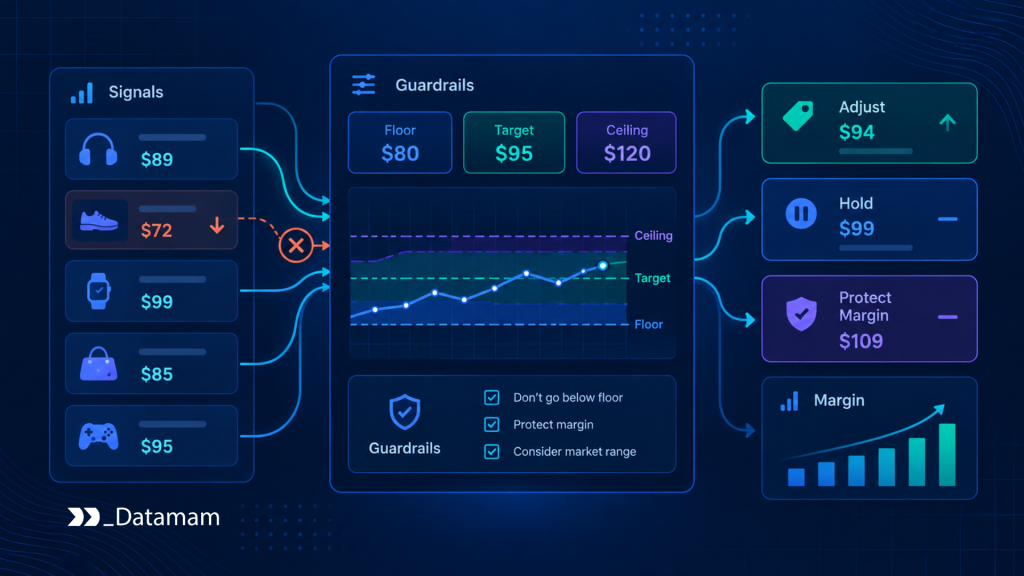
Competitor prices matter, but they are not pricing instructions.
A retailer may observe a rival selling the same product for less. The lowest offer might be temporary, out of stock, loyalty-only, available in another market, sold by a third-party marketplace seller, or attached to a different pack, condition, or fulfillment method.
Even when the observation is fully comparable, another question remains:
Should the retailer actually change its own price?
That is where Price Optimization begins.
Filtering competitor data determines which external observations are usable. Price Optimization goes further by evaluating candidate prices against a defined commercial objective, internal economics, product role, customer response, and policy constraints.
A stronger workflow is:
observe competitor offer → establish comparability → construct eligible reference signals → define pricing objective → apply internal economics and constraints → generate recommendation → review or execute → evaluate outcome
The goal is not to win every individual price comparison.
It is to use external market evidence without allowing competitors to control the retailer’s pricing strategy.
Key Takeaways
- Competitor prices are market observations, not automatic pricing instructions.
- Price Optimization should define what is being optimized, such as contribution margin, revenue, sell-through, inventory reduction, or a defined price-position objective.
- Price Optimization and Dynamic Pricing are related but different. Optimization determines what price or range best serves an objective; dynamic pricing determines how and when prices adjust as relevant inputs change.
- An observed competitor offer should pass product, market, condition, promotion, availability, fulfillment, freshness, and price-basis checks before becoming a pricing reference signal.
- A valid observation may be unsuitable for one pricing metric while remaining useful for price history or market monitoring.
- Competitor benchmarks should be constructed from explicitly defined competitors and aggregation rules rather than automatically using the lowest observed offer.
- Historical price response can inform elasticity analysis, but correlation should not be treated as a causal elasticity estimate without appropriate methodology.
- Pricing recommendations should remain separate from policy approval and execution.
- International price comparison should preserve currency, FX provenance, tax basis, shipping, condition, and market context.
- Post-execution monitoring provides feedback, but causal impact requires stronger evaluation than simple before-and-after comparison.
Price Optimization Is Not the Same as Dynamic Pricing
The terms often appear together, but they answer different questions.
| Concept | Main Question |
| Price Optimization | What price or price range best serves a defined commercial objective under specified constraints? |
| Dynamic Pricing | When and how should price change as relevant inputs change? |
| Competitor Monitoring | What prices, promotions, availability states, and offers are being observed externally? |
| Repricing | How is an approved price change applied operationally? |
A retailer may optimize prices without changing them frequently.
It may also operate dynamic pricing while enforcing strict optimization constraints.
For example, a retailer might determine that the preferred price range for a product is $95 to $100 given its economics and positioning. Dynamic pricing rules may then determine whether the price should move within that range as competitor, stock, or demand conditions change.
The two capabilities can work together, but they should not be treated as synonyms.
Price Optimization Needs an Explicit Objective
A model cannot optimize price without knowing what the retailer is trying to achieve.
Possible objectives may include:
- contribution margin;
- revenue;
- unit volume;
- inventory sell-through;
- clearance progression;
- price-position target;
- category profitability;
- another retailer-defined commercial objective.
The objective can also differ by product or lifecycle stage.
A mature core product may be managed primarily around contribution margin and price position.
A seasonal item approaching the end of its selling window may prioritize sell-through.
A strategically important value item may operate within a narrower competitive price range.
An overstocked product may use a different objective from an item with constrained inventory.
Competitor data provides external context to these decisions.
It does not define the objective.
The Deloitte 2026 Global Retail Industry Outlook discusses dynamic pricing, data-led promotions, targeted assortment shifts, margin discipline, customer value, and trust as retailers navigate profitability pressures. Those considerations reinforce why external price signals need to sit inside a broader commercial strategy rather than trigger automatic matching.
An Observed Competitor Price Is Not Yet a Benchmark
Suppose a retailer observes:
Competitor A: $89
That tells the pricing system what was displayed under a particular set of conditions.
It does not yet establish that $89 belongs in the optimization model.
A useful pipeline separates:
observed offer
from:
eligible reference offer
from:
derived competitor benchmark
The distinction matters because the observed offer may involve:
- another market;
- another currency;
- different taxes;
- shipping charges;
- loyalty eligibility;
- a different condition;
- marketplace seller terms;
- an unavailable product;
- a different pack size;
- an unresolved product match.
Only after those dimensions are understood should the observation influence a reference metric.
Start With Product Relationship
Price comparison begins with product identity.
Useful relationship types can include:
- exact product;
- same product, different pack or variant;
- close comparable;
- broader substitute;
- bundle;
- non-comparable;
- unresolved.
An exact product can support direct offer comparison when the commercial conditions are also aligned.
A close comparable can provide category or positioning context.
A substitute may help explain the surrounding price architecture.
Those relationships should not be collapsed into one generic competitor price.
A useful rule is:
product relationship determines what kind of pricing comparison is valid
rather than:
high match score means use the price.
Match Confidence Should Support, Not Replace, Relationship Semantics
A confidence value can help prioritize review, but no universal numerical threshold determines whether a product comparison is safe.
Confidence depends on:
- matching method;
- category;
- available attributes;
- calibration quality;
- cost of a false match.
The pricing workflow should preserve:
- relationship type;
- match evidence;
- calibrated confidence where appropriate;
- rule or model version;
- review status.
A policy can then decide which relationships are eligible for a particular metric.
For example:
exact identity
may be required for direct SKU price comparison.
close comparable
may be allowed for broader category-price analysis.
Offer Normalization Comes Before Price Comparison
Even exact products can have commercially different offers.
Useful fields may include:
- displayed item price;
- standard or promotional price;
- loyalty requirement;
- coupon;
- quantity condition;
- bundle contents;
- product condition;
- shipping;
- currency;
- tax basis;
- fulfillment;
- location;
- availability;
- seller.
For example:
$90 + $15 mandatory shipping
should not automatically appear cheaper than:
$100 with free delivery.
Similarly:
$85 refurbished
is not equivalent to:
$95 new.
The first offer remains valid data.
It simply belongs in a different comparison set.
Separate Availability From Fulfillment
Availability answers:
Can this product currently be purchased?
Possible states may include:
- in stock;
- limited;
- out of stock;
- backordered;
- preorder where relevant;
- unknown.
Fulfillment answers:
How can the customer receive it?
Possible modes include:
- shipping;
- delivery;
- pickup;
- multiple;
- unknown.
These dimensions should not be merged.
A product can be:
availability = in_stock
and:
fulfillment = pickup_only
at the same time.
That matters because a pickup-only local offer may not be comparable with a nationally delivered ecommerce offer.
A Valid Observation Can Be Ineligible for a Specific Pricing Metric
An out-of-stock price is not necessarily bad data.
It may remain useful for:
- price history;
- promotion history;
- competitive-position history;
- catalog monitoring.
But it may be unsuitable for a metric intended to answer:
What available competitor offers can customers purchase now?
A useful model therefore uses metric-specific eligibility:
eligible_for_price_history = true
eligible_for_current_available_price_index = false
The same applies to:
- unknown seller;
- refurbished product;
- unclear bundle;
- stale observation;
- incomplete fulfillment data.
observation validity ≠ eligibility for every optimization use case
International Price Comparison Needs a Defined Price Basis
Currency conversion alone does not make two prices comparable.
A cross-market pricing record may need to preserve:
- source amount;
- source currency;
- normalized amount;
- normalized currency;
- FX rate;
- FX source;
- FX effective timestamp;
- tax-inclusive or tax-exclusive basis;
- mandatory shipping where applicable;
- market or country;
- unit or pack basis.
The original value should remain available alongside the normalized value.
For example:
source_price = 89.00
source_currency = EUR
normalized_price = 104.20
normalized_currency = USD
fx_rate = …
fx_effective_at = …
This makes the transformation reproducible.
It also prevents a converted number from appearing more comparable than the underlying commercial conditions justify.
Define the Relevant Competitor Set
The lowest price found anywhere on the market is rarely the most useful reference.
Retailers may define competitor sets by:
- market;
- category;
- channel;
- customer proposition;
- product type;
- first-party versus marketplace;
- strategic relevance.
Those classifications are internal pricing inputs.
Competitor monitoring can observe retailers and sellers.
It does not determine which of them should influence pricing strategy.
A benchmark should therefore document:
- included competitors;
- excluded competitors;
- product relationships;
- condition rules;
- availability rules;
- promotion handling;
- market scope;
- aggregation method.
“Competitor Price” Needs a Formula
Suppose the eligible offers are:
- Competitor A: $98
- Competitor B: $102
- Competitor C: $94
- Competitor D: $99
What is the competitor price?
Possible metrics include:
- named competitor price;
- minimum eligible offer;
- median eligible offer;
- average eligible offer;
- weighted competitor index;
- price range;
- percentile position.
Each answers a different question.
A retailer should not display one generic:
competitor price
without specifying the calculation.
The optimization model should receive the metric that matches the pricing objective.
For example, a pricing team may care more about:
median price across three direct competitors
than:
absolute lowest eligible market offer.
Promotion Context Should Be Preserved
A temporary promotion is not necessarily equivalent to a standard shelf-price change.
Useful promotion fields can include:
- base price;
- promotional price;
- mechanic;
- eligibility;
- quantity requirement;
- observed start/end where available;
- observed duration;
- affected products.
This allows the pricing system to distinguish:
- standard price;
- coupon;
- loyalty price;
- clearance;
- multi-buy;
- bundle;
- temporary markdown.
A competitor promotion can contribute to a defined competitive-promotion metric.
It does not reveal why the competitor chose the promotion.
Competitor Price and Stock Moving Together Does Not Establish Cause
Suppose a competitor:
- goes from in stock to limited stock;
- raises price during the same period.
The observations establish that both states changed.
They do not establish that inventory caused the price increase.
Likewise, a low competitor price may reflect commercial considerations that are invisible externally.
The retailer should therefore avoid reasoning such as:
the competitor is cutting margin to win traffic
unless separate evidence supports that conclusion.
Price Optimization should react to observed market conditions, not imagined competitor intent.
Internal Economics Determine What Responses Are Feasible
Competitor evidence becomes useful only after it is combined with internal context.
Relevant inputs may include:
- unit cost;
- contribution margin;
- inventory;
- lifecycle stage;
- own promotion calendar;
- product role;
- price architecture;
- demand estimates;
- elasticity estimates;
- traffic;
- conversion;
- operational constraints.
The same competitor price can lead to different recommendations for two products.
One might justify holding price.
Another might justify reviewing a promotion.
Another might justify a price reduction within policy.
Another may trigger no action.
The external signal is identical.
The internal economics differ.
Product Role Should Come From Internal Pricing Strategy
A retailer may internally classify products as:
- key value items;
- premium items;
- long-tail products;
- private label;
- exclusive;
- seasonal;
- clearance;
- traffic-driving products;
- margin-priority products.
Competitor monitoring should not invent those roles.
The stronger model is:
competitor reference signal + internal product role → pricing relevance
For example, an internally defined key value item may use tighter competitive positioning than a differentiated long-tail product.
A private-label product may have no exact external equivalent and therefore require comparable-product or price-band context instead of one-to-one matching.
Price Architecture Is Also an Internal Constraint
Terms such as:
- opening price;
- good;
- better;
- best;
- premium;
should be governed by the retailer’s own merchandising and pricing framework.
Competitor data may show that selected competitors have expanded coverage in lower or higher price bands.
That can trigger a review of the retailer’s architecture.
It does not automatically redefine the retailer’s tiers.
A useful relationship is:
external price-band evidence + internal price architecture → architecture review
Elasticity Requires More Than Historical Correlation
Price Optimization often uses elasticity or other demand-response models.
But a historical relationship such as:
price decreased and sales increased
does not by itself establish causal price elasticity.
Sales may also have changed because of:
- promotion;
- seasonality;
- availability;
- marketing;
- distribution;
- assortment;
- competitor activity;
- other demand changes.
If elasticity materially affects pricing recommendations, teams should understand:
- how it was estimated;
- which variables were controlled;
- which products or categories it applies to;
- how stable the estimate is;
- how uncertainty is represented.
Historical observational models can still be useful.
They should not be presented as more causal or precise than their methodology supports.
Recommendations Should Be Separate From Approval and Execution
Price Optimization becomes easier to govern when workflow states are explicit.
A useful lifecycle is:
- observed
- eligible reference input
- recommendation generated
- policy checked
- approved, rejected, or escalated
- executed
- measured
These stages should not collapse into one field such as:
optimized_price = 94.99
A model-generated recommendation has not necessarily passed:
- margin rules;
- product-role rules;
- legal/compliance rules;
- promotional rules;
- human approval where required.
Likewise, an approved recommendation may never be executed.
Keeping the stages separate improves traceability.
Constraints Should Be Explicit and Policy-Driven
Possible pricing constraints may include:
- unit economics;
- minimum contribution requirements;
- inventory policy;
- promotion limits;
- approved price architecture;
- manufacturer pricing policies where applicable;
- contractual restrictions;
- applicable legal or compliance requirements;
- channel rules;
- maximum permitted change;
- category-specific approval requirements.
These are examples, not universal rules.
A retailer may intentionally accept lower margin on a product if that is part of an approved strategy.
The important point is that the exception should come from the retailer’s policy, not from mechanically following a competitor.
Price Change Frequency Is a Policy Decision
Competitor prices can change frequently.
That does not mean the retailer should.
Price-change cadence can depend on:
- category;
- channel;
- demand;
- market volatility;
- operational capability;
- promotion calendar;
- customer proposition.
Frequent changes may also conflict with the retailer’s intended customer experience or pricing strategy.
The system should therefore define:
- which products can change frequently;
- which require review;
- whether minimum movement rules apply;
- how temporary competitor events are treated.
This is where Dynamic Pricing and Price Optimization interact.
Optimization defines an acceptable recommendation.
Dynamic pricing policy determines whether and when to act on changing conditions.
Exception Types Need Different Owners
Pricing exceptions are not one category of problem.
A match problem requires different expertise from a margin-policy problem.
A seller-context problem differs from an unusual market move.
A simple routing layer might look like this:
PRICE_EXCEPTION_ROUTING = {
“product_match_issue”: {
“owner”: “product_data_team”,
“action”: “review_product_relationship”,
},
“margin_policy_conflict”: {
“owner”: “pricing_manager”,
“action”: “review_recommendation”,
},
“seller_context_unresolved”: {
“owner”: “marketplace_team”,
“action”: “review_seller_context”,
},
“price_anomaly”: {
“owner”: “pricing_analyst”,
“action”: “review_market_observation”,
},
}
def route_price_exception(exception):
route = PRICE_EXCEPTION_ROUTING.get(exception[“type”])
if not route:
return {
“owner”: “pricing_operations”,
“action”: “manual_triage”,
}
return {
“product_id”: exception[“product_id”],
“type”: exception[“type”],
“owner”: route[“owner”],
“action”: route[“action”],
}
The example deliberately does not define universal match thresholds, freshness windows, or price-gap cutoffs.
Those belong in retailer-specific policies.
What a Competitor Pricing Feed Should Preserve
A pricing feed should retain enough context to reconstruct the comparison.
Useful fields may include:
Product and Entity
- internal product ID;
- competitor product ID;
- relationship type;
- match evidence/status;
- competitor;
- seller where applicable.
Offer
- displayed item price;
- standard/list price where observable;
- promotional price;
- promotion mechanic;
- condition;
- quantity or bundle context;
- shipping;
- comparable total offer price.
Market Context
- currency;
- tax basis where relevant;
- market;
- region/location;
- channel;
- availability;
- fulfillment.
Evidence
- observed timestamp;
- source URL;
- raw values;
- normalized values;
- source quality status;
- transformation/rule version.
The feed should preserve history when the use case requires persistence or volatility analysis.
A single current observation can be appropriate for current-state pricing.
Historical observations are useful for determining whether the price position is persistent, temporary, recurring, or unusually volatile.
Source Evidence Should Follow the Recommendation
Pricing teams should be able to explain why a competitor observation entered or did not enter a recommendation.
A recommendation record may preserve:
- competitor reference metric;
- included reference offers;
- excluded offers and reasons;
- internal objective;
- relevant constraints;
- model/rule version;
- recommendation;
- approval status;
- execution status.
This makes the decision chain traceable:
source observation → eligible reference → recommendation → decision → execution
Traceability does not make the recommendation correct by itself.
It makes the reasoning reconstructable and reviewable.
Post-Execution Monitoring and Causal Evaluation Are Different
After a price executes, teams may monitor:
- revenue;
- margin;
- units;
- inventory;
- conversion;
- exception frequency;
- recommendation acceptance;
- execution rate;
- relative market position.
These measures provide useful operational feedback.
But:
sales increased after the price changed
does not necessarily mean:
the pricing recommendation caused the increase.
Causal evaluation may require stronger methods, such as:
- controlled experiments where feasible;
- matched comparisons;
- appropriately designed quasi-experimental analysis;
- other validated evaluation methods.
The distinction matters because a pricing strategy should not learn the wrong lesson from coincidental changes in:
- seasonality;
- traffic;
- inventory;
- promotions;
- competitor activity.
Post-execution evidence should support review and recalibration rather than automatically prove the model was right.
How to Measure Price Optimization Input and Decision Quality
The number of competitor prices collected is not a useful optimization metric by itself.
| Area | Example Measure |
| Competitor coverage | Share of required competitors, markets, and channels observed |
| Product relationship quality | Precision of reviewed exact/comparable relationships |
| Offer normalization | Share with usable condition, pack, promotion, and price basis |
| Availability context | Share with usable availability state |
| Fulfillment context | Share with usable delivery/pickup/shipping context |
| Freshness | Share meeting the use-case-specific observation policy |
| Price-basis completeness | Share with usable currency, tax, shipping, and unit basis |
| Reference transparency | Share of benchmarks with documented inclusion and aggregation rules |
| Recommendation traceability | Share linked to reference signals, objectives, and constraints |
| Policy compliance | Share passing defined pricing controls |
| Exception rate | Share requiring review or escalation |
| Approval rate | Share of recommendations approved |
| Execution rate | Share of approved recommendations actually executed |
These evaluate whether the pricing workflow is functioning as intended.
They do not by themselves prove that the strategy caused better commercial outcomes.
How to Evaluate Price Optimization Readiness
A retailer using competitor data for Price Optimization should be able to answer:
- What commercial objective is being optimized for each product or pricing policy?
- Is Price Optimization clearly distinguished from Dynamic Pricing and repricing execution?
- Are observed competitor offers separated from eligible reference signals?
- Is the competitor set defined explicitly?
- Are exact products, variants, comparables, substitutes, bundles, and unresolved matches distinguished?
- Does match confidence supplement rather than replace product-relationship semantics?
- Are new, used, refurbished, and other product conditions compared under explicit rules?
- Are availability and fulfillment stored separately?
- Can an out-of-stock observation remain valid for history while being excluded from a current available-offer metric?
- Are promotions classified separately from standard prices?
- Are source amount, currency, FX conversion, tax basis, shipping, and market scope preserved where relevant?
- Is the aggregation method behind every competitor benchmark documented?
- Are product roles and price architecture supplied by internal strategy rather than inferred from competitor data?
- Are elasticity and demand-response estimates accompanied by methodology and uncertainty?
- Are model recommendations separated from policy approval and execution?
- Are pricing constraints explicitly configured rather than treated as universal rules?
- Are product-match, pricing-policy, seller-context, and market-anomaly exceptions routed separately?
- Can each recommendation be traced back to the source observations and rules that produced it?
- Are post-execution business metrics separated from causal impact evaluation?
- Is there a defined process for reviewing and recalibrating policies when outcomes or exception patterns change?
These questions reveal whether competitor pricing data is actually supporting Price Optimization or simply creating a more sophisticated form of price matching.
Conclusion
Price Optimization should not begin with:
What is the lowest competitor price?
It should begin with:
What objective are we trying to serve, which competitor observations are genuinely comparable, and what constraints govern the decision?
Competitor data provides evidence about external market conditions.
Product matching establishes whether the comparison is valid.
Offer normalization establishes whether the commercial terms are comparable.
Reference rules determine which competitor observations enter the benchmark.
Internal economics, product role, price architecture, elasticity evidence, inventory, and strategy determine which responses are feasible.
The optimization layer then generates a recommendation.
Policy determines whether it can be approved.
Execution determines whether it actually reaches the market.
Measurement determines what happened afterward.
The useful model is:
observe → qualify → benchmark → optimize → recommend → review → execute → evaluate
That is how retailers can use competitor data without turning Price Optimization into a race to the bottom.