Key Takeaways
- Restaurant Site Selection improves when POI data shows nearby competitors, anchors, complementary businesses, traffic generators, and trade area context
- Restaurant location analysis should evaluate cuisine clusters, daypart demand, delivery density, competitor saturation, and cannibalization risk
- Restaurant market analysis fails when teams rely only on demographics, broker notes, or manual map searches
- Restaurant expansion strategy depends on POI freshness, address accuracy, category taxonomy, geocoding precision, and duplicate resolution
- Reliable location intelligence requires validation, lineage, governance, sourcing controls, and integration into GIS, BI, or real estate workflows
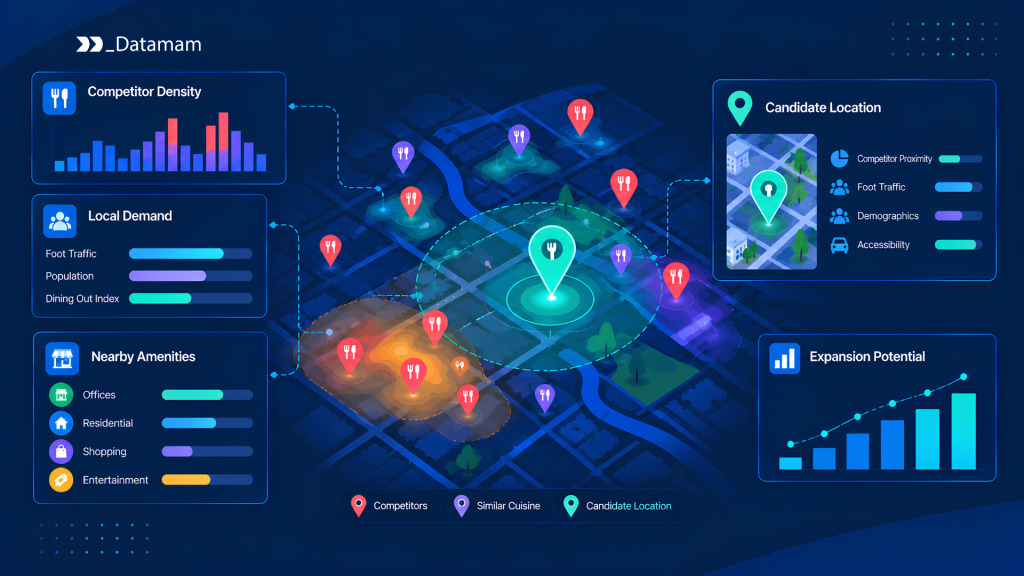
Restaurant expansion decisions depend on more than population density, rent, or available storefronts. A strong restaurant location may sit near offices, apartments, gyms, schools, hotels, transit, nightlife, grocery stores, or complementary food operators. A weak location may look attractive on demographics but already be saturated with similar concepts or lack the right daypart demand. Restaurant Site Selection uses competitor and POI data to evaluate where demand exists, where competition is concentrated, and where a concept can realistically win. The commercial goal is not only choosing a site with foot traffic. It is understanding whether the surrounding market supports the restaurant’s format, price point, cuisine, operating hours, delivery radius, and expansion strategy.
The Operational Problem in Restaurant Location Decisions
Restaurants are highly sensitive to local context. A coffee shop, fast-casual salad chain, pizza restaurant, family dining brand, sushi concept, drive-thru operator, and premium casual restaurant all need different site conditions. Some depend on office lunch demand. Others depend on residential dinner demand, school traffic, tourist corridors, nightlife, delivery density, or car access.
This makes restaurant location analysis difficult. A site may have strong population counts but weak commercial adjacency. Another may sit in a lower-density area but benefit from commuter traffic, hotels, entertainment venues, or limited direct competition. POI data helps restaurant teams understand these patterns before committing capital.
Why Demographics Alone Miss Restaurant Demand
Demographics help teams understand who lives in a market, but restaurants also depend on who works, travels, shops, studies, and passes through the area. A lunch-focused concept may need offices and daytime worker density. A delivery-heavy concept may need residential density and nearby order volume. A drive-thru concept may need road access, visibility, and commuter flow.
Competitor and POI data adds this commercial layer. It shows nearby restaurants, cafes, grocery stores, hotels, schools, gyms, bars, shopping centers, offices, transit stations, and entertainment venues. These POIs help teams evaluate actual meal occasions, not just population statistics.
Where Manual Restaurant Market Analysis Breaks
Manual restaurant market analysis may work for a few candidate sites. It breaks when expansion teams need to compare many markets, formats, and trade areas. Analysts may review Google Maps, broker packages, competitor websites, local directories, delivery apps, and spreadsheet notes, but the process becomes inconsistent.
One site may receive a detailed competitor review. Another may miss ghost kitchens, new openings, delivery-only operators, or nearby substitutes. A third may overcount competitors because duplicate or closed locations remain in the analysis. Restaurant Site Selection needs structured and validated POI data to make site comparisons consistent.
POI Data as a Restaurant Market Intelligence Layer
POI data becomes valuable when it acts as a restaurant market intelligence layer between local market geography and expansion decisions. The goal is not simply to map restaurants. The goal is to classify the local market by competition, adjacency, demand drivers, trade area fit, and expansion risk.
This layer should answer practical questions. Which restaurants operate nearby? Which cuisine types are overrepresented? Are there complementary traffic generators? Does the area support breakfast, lunch, dinner, late-night, delivery, pickup, or drive-thru demand? Is the location close to existing stores that may cannibalize revenue?
Mapping Direct and Indirect Competitors
Restaurant competitor mapping should separate direct competitors from broader foodservice density. A burger chain competes directly with other burger, fast-casual, and QSR operators, but it may also be affected by nearby pizza, chicken, taco, sandwich, and convenience food operators. A premium casual concept may care more about sit-down restaurants, bars, hotels, and entertainment zones.
Competitor POI data should include business name, cuisine category, chain affiliation, address, coordinates, opening status, hours, delivery availability, rating signals where available, and source freshness. This helps restaurant teams understand competitive pressure at the concept level instead of only counting restaurants.
Identifying Demand Drivers and Complementary POIs
Restaurants often benefit from nearby anchors. Offices can support weekday lunch. Apartment clusters can support dinner and delivery. Hotels can support breakfast and evening demand. Schools can affect family traffic. Gyms can support healthy fast-casual concepts. Bars, theaters, stadiums, and entertainment districts can support late-night and weekend traffic.
Restaurant location analysis should classify these POIs by relevance to the concept. The same anchor may matter differently for different brands. A coffee brand may value office towers and transit stops. A family dining concept may value residential density and schools. A fast-casual bowl concept may value gyms, offices, and universities.
def route_restaurant_site(site):

    if site["quality_status"] == "validated":

        return {"action": "publish_to_expansion_dashboard", "site_id": site["site_id"]}

    if site["quality_status"] == "failed":

        return {"action": "send_to_market_review", "site_id": site["site_id"]}

    return {"action": "hold_for_review", "site_id": site["site_id"]}


REQUIRED_RESTAURANT_SITE_FIELDS = [

    "site_id",

    "address",

    "latitude",

    "longitude",

    "concept_type",

    "trade_area_radius",

    "quality_status",

]


def validate_restaurant_site(site):

    missing = [field for field in REQUIRED_RESTAURANT_SITE_FIELDS if not site.get(field)]

    if missing:

        return {"valid": False, "reason": "missing_fields", "fields": missing}

    if site.get("direct_competitor_count") is None:

        return {"valid": False, "reason": "direct_competitor_count_required"}

    if site.get("poi_freshness_days", 999) > 90:

        return {"valid": False, "reason": "poi_data_stale"}

    return {"valid": True}


site = {

    "site_id": "REST-48192",

    "address": "Candidate restaurant site",

    "latitude": 34.0522,

    "longitude": -118.2437,

    "concept_type": "fast_casual",

    "trade_area_radius": 2,

    "direct_competitor_count": 8,

    "poi_freshness_days": 18,

    "quality_status": "validated",

}


print(route_restaurant_site(site))

print(validate_restaurant_site(site))
This simple logic reflects the operating principle. A candidate restaurant site should not enter expansion dashboards unless the location, concept type, trade area, competitor count, and POI freshness are validated.
Data Requirements for Restaurant Expansion Strategy
Restaurant expansion strategy depends on clean, current, and categorized POI data. A restaurant POI record should include name, address, latitude, longitude, cuisine type, brand affiliation, opening status, hours, phone, website, delivery presence, marketplace references where available, source, and last updated date.
Poor POI quality can distort site decisions. A closed restaurant may still appear active. A duplicate listing may inflate foodservice density. A chain location may be classified as independent. A ghost kitchen may be missed. A restaurant may be geocoded to a ZIP centroid instead of its actual parcel or storefront. These errors can change how a market is scored.
Address Validation and Geocoding Precision
Address validation and geocoding precision are essential because restaurants compete at small distances. A site on one side of a highway, mall, campus, or transit corridor may perform very differently from a nearby coordinate on the other side. Rooftop or parcel-level precision is often more useful than broad centroid-level geocoding.
For restaurant site selection, distance alone is not always enough. Drive-time, walk-time, parking access, visibility, delivery radius, and local barriers may all affect whether nearby POIs actually influence demand. However, accurate coordinates are the starting point.
Cuisine Taxonomy and Chain Affiliation
Restaurant categories need more detail than “food” or “restaurant.” A useful taxonomy should separate QSR, fast casual, casual dining, fine dining, coffee, bakery, dessert, bar, pizza, burger, chicken, sushi, Mexican, Mediterranean, vegan, healthy, family dining, and other relevant categories.
Chain affiliation also matters. A national QSR chain, regional franchise, independent concept, and ghost kitchen may have different competitive meaning. Clean restaurant market analysis should preserve both local venue identity and brand-level grouping.
Infrastructure Application Model for Restaurant Location Analysis
At scale, restaurant location analysis requires repeatable data infrastructure. Restaurant openings, closures, hours, delivery availability, ratings, and marketplace presence change frequently. Expansion teams need an updated POI layer, not static research.
ETL and ELT pipelines can move raw POI records into structured staging tables. Airflow can orchestrate refresh schedules, validation checks, deduplication, geocoding updates, and trade area scoring. Spark can process large POI datasets, geospatial joins, and market scoring models. dbt can transform raw location records into normalized competitor, cuisine, anchor, and site evaluation tables. Snowflake, BigQuery, or Databricks can support analytics, history, and delivery into GIS, BI, or real estate systems.
Validation, Observability, and Lineage
Validation controls should check missing addresses, invalid coordinates, duplicate restaurants, stale locations, closed venues, weak cuisine categories, inconsistent chain names, and impossible geographic values. Great Expectations or similar frameworks can test completeness, uniqueness, accepted values, and freshness. Data observability systems can monitor source failures, abnormal POI count changes, stale categories, and geocoding error rates.
Lineage helps real estate and strategy teams understand how a site score was produced. If a site is marked as saturated, leaders should know which competitors were counted, when they were last updated, and how they were categorized.
Governance and Cross-Market Controls
Restaurant POI workflows need governance. Teams should document approved sources, refresh cadence, category taxonomy, deduplication rules, coordinate precision, trade area assumptions, retention, and access controls. Cross-market expansion adds complexity because restaurant categories, address formats, cuisine names, delivery platforms, and chain structures vary by region.
Governance prevents expansion teams from treating inconsistent local evidence as comparable. It also supports auditability when executives ask why a market was approved, delayed, or rejected.
Commercial Impact of POI-Driven Restaurant Site Selection
The commercial value of competitor and POI data appears when restaurant teams can compare candidate sites consistently and reduce avoidable location mistakes. Better POI intelligence can improve market prioritization, competitor visibility, concept-market fit, cannibalization analysis, and trade area understanding.
For restaurant real estate and strategy teams, research cycles can move from manual map review to recurring location intelligence updates. Analyst time spent compiling competitor lists, cuisine maps, and local anchor context can fall materially when POI data is validated and integrated into dashboards. More importantly, teams can reduce the risk of approving sites based on incomplete market context.
Better Concept-Market Fit
Concept-market fit improves when teams evaluate a site against the restaurant’s actual demand model. A coffee concept may score higher near offices, transit, and morning routines. A delivery-heavy brand may score higher in dense residential trade areas. A drive-thru brand may score higher near commuter roads and car-oriented retail.
POI data makes these assumptions visible. It helps teams compare sites based on the commercial pattern around them, not just the lease opportunity.
Reduced Cannibalization and Saturation Risk
Restaurant expansion must account for nearby existing stores and competitive density. A new location may look attractive but could pull sales from another store. A market may appear strong but already contain too many direct competitors.
Competitor and POI data help teams identify cannibalization, over-saturation, and white-space opportunity before committing to leases, buildouts, hiring, and launch marketing.
Risk Avoidance and Strategic Advantage
Without reliable POI data, restaurant brands risk opening in markets that look good on paper but fail operationally. A location may lack the right daypart demand. Competitors may be stronger than expected. Nearby anchors may have closed. A trade area may not support delivery economics. Existing stores may already cover the market.
Restaurant site selection mistakes are costly because restaurant leases, construction, equipment, staffing, and opening campaigns require significant upfront investment. Location intelligence does not remove judgment, but it reduces avoidable blind spots.
Governance Gaps in Restaurant Expansion Decisions
Governance gaps appear when teams cannot explain which competitors were counted, how cuisine categories were assigned, how trade areas were defined, or when POI data was refreshed. This weakens confidence in expansion recommendations.
Audit logs, metadata, and lineage support commercial accountability. Real estate, finance, and executive teams need to know whether a site score is based on fresh, validated, and relevant market data.
AI and Automation Risk
As restaurant brands use AI for site scoring, delivery zone modeling, market prioritization, and expansion forecasting, POI quality becomes more important. Models trained on stale, duplicated, or poorly categorized restaurant data can recommend weak sites or miss better ones.
POI data must therefore be structured enough for human review and reliable enough for automated analytics. Otherwise, automation may scale poor market assumptions across the expansion pipeline.
Evaluating Restaurant Site Selection Readiness
A restaurant site selection readiness review should assess whether current location workflows produce trusted, comparable, and timely market intelligence. The review should not only ask whether restaurant POI data exists. It should ask whether the data is accurate enough to support expansion decisions.
Useful evaluation areas include restaurant source coverage, address validation, geocoding precision, duplicate resolution, cuisine taxonomy, chain affiliation, competitor mapping, anchor classification, trade area logic, freshness, lineage, and integration into GIS or BI tools.
What a Restaurant POI Audit Should Reveal
A structured POI data audit should show where restaurant expansion risk accumulates. It may reveal stale competitor records, weak cuisine classification, duplicate restaurant locations, missing delivery-only concepts, imprecise coordinates, closed businesses, or inconsistent chain affiliation.
The output should clarify which markets have reliable coverage, which cuisine categories need better classification, which sources require refresh, and which expansion workflows can safely use automated POI-based scoring.
When Infrastructure Review Becomes Necessary
A location intelligence infrastructure consultation becomes useful when restaurant brands are expanding across markets, comparing many candidate sites, adding delivery-based analysis, or building internal site scoring models. At that point, the key question is not only “do we have restaurant data?” The stronger question is “can we trust this location intelligence enough to approve expansion decisions?”
An architecture review should evaluate source strategy, POI data model design, geocoding workflows, validation coverage, observability, governance, and integration pathways.
Conclusion: Restaurant Site Selection as Location Intelligence Infrastructure
Restaurant site selection depends on more than demographics, broker notes, and available storefronts. It requires accurate visibility into competitors, cuisine clusters, anchors, daypart demand drivers, delivery density, existing stores, and trade area conditions. POI data makes this analysis more consistent when it is validated, normalized, deduplicated, and connected to expansion workflows.
Restaurant Site Selection becomes commercially valuable when competitor and POI data turn fragmented local market information into structured location intelligence. It helps teams prioritize markets, compare sites, reduce cannibalization risk, and avoid expansion decisions based on incomplete local context. Ultimately, restaurant brands that treat POI data as site selection infrastructure will be better positioned to expand with discipline and confidence.