Key Takeaways
- Data Migration Governance determines whether cutover can be approved with evidence.
- A migration governance framework defines ownership, rules, controls, and decision rights before execution.
- A migration control model reduces risk across mapping, validation, reconciliation, and exception handling.
- Cutover governance planning fails when data quality, access, and business rules are reviewed too late.
Data migration governance starts before cutover because the most consequential migration decisions are made long before the production switch. By the time teams reach go-live, mappings have already been accepted, exceptions have been handled or ignored, access rules have been applied, reconciliation thresholds have been set, and business owners have either approved or deferred critical decisions. If governance only appears at cutover, it arrives too late to control the migration.
Data Migration Governance refers to the rules, ownership, controls, evidence, and decision rights used to manage data movement during modernization. It includes a migration governance framework, migration control model, cutover governance planning, source-to-target approval, validation rules, reconciliation thresholds, exception ownership, access controls, lineage, audit logs, rollback planning, and executive signoff.
Data Migration Governance Determines Whether Cutover Can Be Approved with Evidence
Enterprise migration programs often treat governance as a final approval layer. Teams complete mapping, testing, validation, and loading, then ask governance, compliance, or leadership to approve cutover. However, governance is not a final checkpoint. It is the control structure that should shape the migration from the beginning.
A CRM migration may affect customer identity, billing, marketing consent, revenue reporting, and support workflows. An ERP migration may affect finance, procurement, tax logic, supplier records, and inventory. A cloud warehouse migration may affect executive dashboards, AI pipelines, compliance reports, and historical analytics. Each of these areas requires governance before production transition.
McKinsey’s State of AI 2025 shows that many organizations use AI, but fewer have embedded it deeply into workflows and enterprise processes. That reinforces a broader modernization lesson: enterprise value depends on governed data foundations, not only platform deployment.
A Migration Governance Framework Defines Ownership, Rules, Controls, and Decision Rights Before Execution
A migration governance framework defines who can approve mappings, who resolves data-quality issues, who accepts exceptions, who signs off reconciliation, who owns access rules, and who decides whether cutover can proceed. Without this framework, migration teams may make business decisions informally under delivery pressure.
Governance should cover data domains, source systems, target systems, business rules, sensitive fields, retention requirements, audit evidence, downstream dependencies, and rollback criteria. It should also clarify which decisions belong to data engineering, business owners, compliance teams, security teams, and executive sponsors.
In practice, the framework turns migration from a technical transfer into a controlled business transition.
Migration Control Model Reduces Risk Across Mapping, Validation, Reconciliation, and Exception Handling
A migration control model defines the checks that must pass before data can move into production. These controls should apply across mapping, transformation, validation, reconciliation, exception routing, access control, and cutover readiness.
For example, a customer record should not move simply because it exists in the source system. It should satisfy required fields, approved mapping rules, target-system constraints, duplicate checks, and access policies. A financial balance should not be accepted simply because it loaded into the target platform. It should reconcile against the source and pass approved variance thresholds.
Therefore, governance must be operational. It should appear in validation jobs, batch controls, approval gates, audit logs, and exception queues, not only in project documentation.
Why Governance Cannot Wait Until Cutover
Governance cannot wait until cutover because migration risk accumulates during planning and execution. If unclear rules, unresolved exceptions, or weak controls persist for weeks, the final approval meeting cannot fix them without delaying go-live or accepting risk.
Gartner’s 2025 Data and Analytics Predictions point to the growing role of AI agents and decision intelligence in business decisions. As more workflows become automated or AI-supported, migrated data errors can influence downstream decisions faster and with less human review.
Cutover Governance Planning Fails When Data Quality, Access, and Business Rules Are Reviewed Too Late
Cutover governance planning fails when teams discover late that source data is incomplete, mappings are disputed, access rules are unresolved, or business definitions differ across departments. At that point, the organization faces compressed choices: delay the cutover, move imperfect data, or apply rushed remediation.
Late governance review is especially risky for regulated, financial, customer, healthcare, and AI-related data. A field may contain sensitive information that should not move to the target environment. A legacy value may require business interpretation before transformation. A record may need retention review before migration.
Accordingly, governance review should begin during discovery. Sensitive fields, critical records, mapping rules, ownership, and evidence requirements must be defined before migration execution creates downstream dependencies.
Late Governance Decisions Create Delays, Rework, and Unclear Accountability Across Migration Teams
Late governance decisions create rework because they force teams to revisit completed migration steps. A mapping may need to change after test loads. A batch may need to rerun after access rules are updated. A report may need to be retested after business definitions are clarified. A reconciliation result may need new thresholds after finance review.
The accountability problem is equally important. If governance decisions are made late, teams may not know who owns exceptions. Data engineering may identify a duplicate record, but the business must decide whether to merge, exclude, or preserve it. Compliance may identify a restricted field, but governance must define whether it can move.
In practice, late governance turns migration execution into a decision backlog.
The Strategic Cost of Weak Migration Governance
Weak migration governance creates cost by weakening trust in the modernized environment. A new platform may go live, but if business users question migrated records, reports, balances, permissions, or mappings, the migration still carries operational risk.
IBM’s 2025 CDO Study emphasizes the importance of decision-ready data for creating business value from data and AI. Migration governance supports that objective because migrated data cannot become decision-ready if its rules, ownership, lineage, and controls are unclear. Data migration strategies for executives must prioritize clarity and transparency to reinforce user confidence in the integrity of data. By establishing robust governance frameworks, organizations can effectively minimize risks associated with data accuracy and compliance. Ultimately, thoughtful execution of data migration strategies will empower businesses to leverage their data assets for strategic decision-making.
Modernization Programs Lose Trust When Teams Cannot Prove Data Accuracy and Control
Modernization programs lose trust when teams cannot prove that data moved correctly. Leaders may ask whether account records match the source, whether financial totals reconcile, whether product attributes remain accurate, whether access permissions are appropriate, and whether exceptions were approved.
If the answer depends on informal explanation, confidence declines. Migration evidence should include mapping approvals, validation results, reconciliation reports, exception logs, access decisions, lineage records, and cutover signoff.
At scale, trust depends on proof. Governance provides the proof layer that allows leaders and business teams to rely on the migrated environment.
Executive Confidence Declines When Cutover Decisions Depend on Assumptions Instead of Evidence
Executives need evidence before approving cutover. They need to know which domains are ready, which exceptions remain open, which reconciliation gaps are within tolerance, which mappings are approved, which access controls are active, and whether rollback plans are credible.
Without this evidence, cutover becomes a calendar decision. The project may be scheduled to go live, but the organization may not know whether it should.
In this context, Data Migration Governance becomes an executive control point. It turns go-live approval from a project milestone into a risk-managed decision.
How Governance Shapes ERP, CRM, Cloud, and Analytics Migration
Governance shapes migration differently depending on the system, but the same principle applies: business meaning and control must survive transition. ERP migration requires governance over balances, suppliers, cost centers, tax rules, and legal entities. CRM migration requires governance over customer identity, consent, account hierarchy, lifecycle stage, and ownership. Cloud analytics migration requires governance over metrics, data lineage, access, dashboards, and AI feature tables.
The NIST AI Risk Management Framework emphasizes governance, mapping, measurement, and management as core risk functions. Those same functions apply to migration because migrated data often feeds analytics, AI systems, automated workflows, and executive reporting after modernization.
Source-to-Target Mapping Requires Business Approval, Not Only Technical Execution
Source-to-target mapping should not be approved only by technical teams. A field may map cleanly by name and type, but still fail business meaning. A legacy account_status may contain values that do not exist in the new CRM. A product category may reflect an old channel structure. A finance code may be valid historically but invalid in the future chart of accounts.
Governance should require business approval for critical mappings before records are loaded into production.
MAPPING_APPROVALS = {

    "customer_status": "approved",

    "billing_country": "approved",

    "tax_region": "pending",

}


REQUIRED_APPROVALS = ["customer_status", "billing_country", "tax_region"]


def check_mapping_governance(record):

    pending = [

        field for field in REQUIRED_APPROVALS

        if MAPPING_APPROVALS.get(field) != "approved"

    ]


    if pending:

        return {

            "ready": False,

            "reason": "mapping_approval_pending",

            "fields": pending,

            "record_id": record["record_id"],

        }


    return {"ready": True, "record_id": record["record_id"]}


record = {

    "record_id": "CUST-88412",

    "source_system": "legacy_crm",

    "target_system": "new_crm",

}


check_mapping_governance(record)
This pattern shows how governance becomes a migration control. Records tied to unresolved approval areas should not move as if they are fully ready.
Validation, Reconciliation, and Parallel Runs Need Governance Rules Before Go-Live
Validation, reconciliation, and parallel runs are only useful when governance defines what “acceptable” means. Teams need approved rules for required fields, duplicate tolerance, reconciliation variance, sample size, exception severity, and signoff ownership.
For ERP migration, governance may define acceptable variance for balances and transaction totals. For CRM migration, it may define duplicate thresholds and account hierarchy rules. Also, for cloud warehouse migration, it may define metric reconciliation thresholds for dashboards and AI feature tables.
Parallel runs need the same discipline. If legacy and target outputs differ, governance should define who decides whether the difference is expected, acceptable, or blocking.
The Infrastructure Layer Behind Migration Control
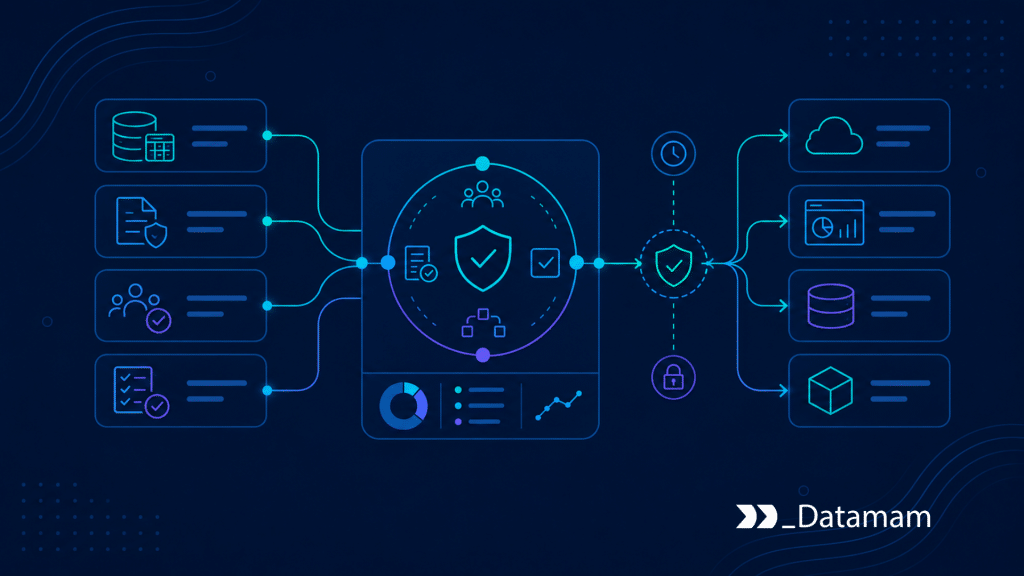
Migration control requires infrastructure that can make governance enforceable. Policies cannot remain in documents while migration jobs move data separately. Controls must appear in profiling, mapping approval, batch tracking, validation, reconciliation, exception routing, audit logs, and cutover gates.
Airflow can orchestrate migration batches and validation checkpoints. Spark can process large source datasets. dbt can define transformation logic and target-model tests. Snowflake, BigQuery, and Databricks can support staging, reconciliation, and migration analytics. Great Expectations can validate schema, completeness, uniqueness, allowed values, and thresholds. Metadata systems and lineage tools can show how migrated fields affect reports, models, workflows, and integrations.
Profiling, Approval Gates, Batch Controls, and Exception Routing Make Governance Operational
Profiling identifies the condition of source data before migration. Approval gates prevent unresolved rules from moving into production. Batch controls show which records were extracted, transformed, loaded, rejected, retried, or approved. Exception routing sends issues to the correct owner.
def route_governance_exception(record, issue):

    if issue["type"] == "restricted_field":

        return {"status": "blocked", "owner": "governance_team", "record_id": record["id"]}


    if issue["type"] == "mapping_conflict":

        return {"status": "business_rule_review", "owner": "process_owner", "record_id": record["id"]}


    if issue["type"] == "reconciliation_variance":

        return {"status": "finance_review", "owner": "finance_controller", "record_id": record["id"]}


    if issue["type"] == "duplicate_record":

        return {"status": "manual_review", "owner": "data_steward", "record_id": record["id"]}


    return {"status": "migration_operations_review", "record_id": record["id"]}
This structure prevents migration issues from becoming generic technical failures. It also creates accountability for decisions that affect cutover readiness. Challenges in legacy system migration can often lead to unexpected complications if not managed effectively. Organizations must prioritize strategic planning to mitigate these risks. Additionally, ongoing communication between teams is crucial to ensure a smooth transition and to address any emerging issues promptly.
Metadata, Lineage, Audit Logs, and Access Controls Make Migration Decisions Defensible
Metadata records source fields, target fields, definitions, owners, classifications, retention rules, and approved mappings. Lineage shows where data came from, how it changed, and which downstream systems depend on it. Audit logs record extraction, transformation, validation, rejection, approval, loading, reconciliation, and cutover decisions.
Access controls ensure that sensitive data is moved only into approved target environments and made available only to authorized users or systems. This matters for customer data, employee data, healthcare records, financial data, third-party data, and cross-border migration scenarios.
Ultimately, defensible migration requires traceability. The organization should be able to explain not only what moved, but why it moved, how it changed, who approved it, and whether it met control requirements.
Why Data Migration Governance Is Becoming an Executive Priority
Data Migration Governance is becoming an executive priority because modernization programs now affect finance, compliance, analytics, AI readiness, customer experience, operational continuity, and regulatory exposure. A migration issue can become a reporting issue, a customer issue, a compliance issue, or an AI reliability issue.
Executives do not need to manage validation rules directly. However, they need visibility into governance evidence: which domains are approved, which exceptions remain open, which controls passed, which risks are accepted, and whether cutover can proceed responsibly. Enterprise system migration strategies are essential for ensuring that all systems align with regulatory demands and performance standards. These strategies must consider the complexities of legacy systems and the diverse needs of stakeholders involved in the migration process. By adopting a well-structured approach, organizations can mitigate risks and enhance their operational efficiency during the transition.
Leaders Need Visibility into Which Data Domains, Controls, and Exceptions Affect Cutover Risk
Leadership visibility should focus on cutover risk. Which data domains are business-critical? Which mappings remain unapproved? Also, which exceptions are blocking? Which reconciliation results exceed thresholds? Which access controls are pending? As well as which downstream systems depend on migrated data on day one?
This visibility helps executives distinguish project completion from migration readiness. A migration can be technically advanced while still lacking governance maturity.
In practice, leadership should require a cutover evidence pack, not only a status update.
Scalable Migration Programs Require Governance Standards, Ownership, Testing, and Continuous Review
Scalable migration programs require governance standards. These standards should define mapping approval, validation rules, reconciliation thresholds, exception severity, access controls, retention review, audit logging, lineage capture, rollback criteria, and cutover signoff.
Ownership must be explicit. Data engineering operates migration pipelines. Business owners approve rules and mappings. Governance teams define access and usage controls. Compliance teams define evidence requirements. Finance, product, customer, and operations leaders approve domain-specific outcomes. Executives approve transition risk.
Ultimately, Data Migration Governance starts before cutover because cutover only confirms the decisions already made. A migration governance framework defines ownership and decision rights. A migration control model makes risk visible during execution. Cutover governance planning gives leaders evidence before the production transition.
Organizations that build governance into migration from the start will modernize with stronger control and trust. Those that wait until cutover may still move data, but they will struggle to prove that the business is ready to rely on it.