Key Takeaways
• System Migration Risk determines whether modernization creates stability or disruption.
• Migration risk assessment shows which data domains, systems, and workflows carry transition exposure.
• System migration planning must account for data quality, mapping, dependencies, and business continuity.
• Modernization risk management requires evidence before go-live, not explanations after disruption.
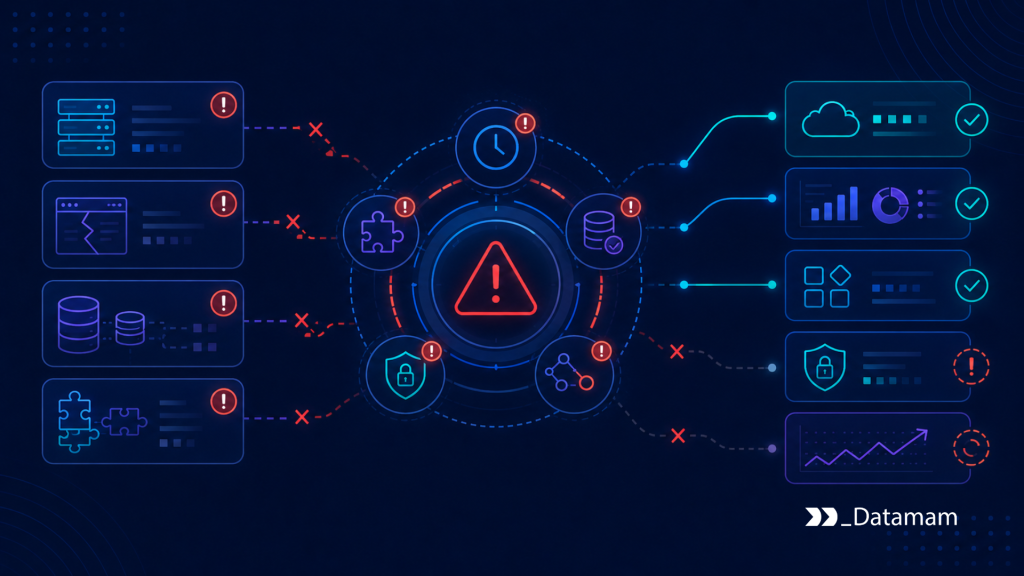
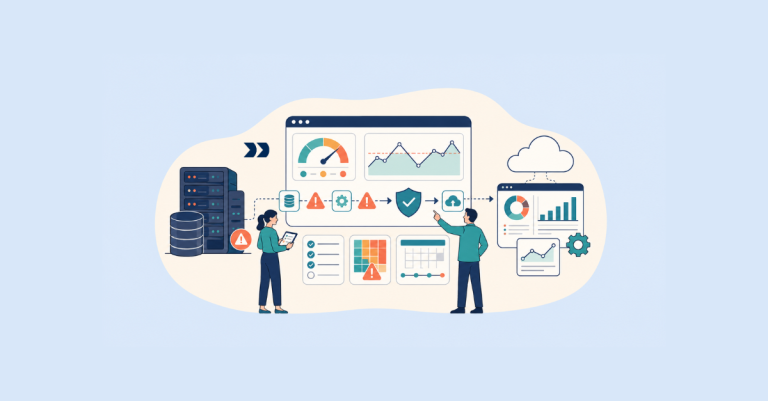
System migration risk affects modernization outcomes because enterprise transition is rarely limited to moving records from one platform to another. A migration may involve ERP, CRM, finance, cloud warehouse, ecommerce, healthcare, customer support, or analytics systems. Each platform carries dependencies across reports, workflows, user access, integrations, compliance evidence, AI features, and business continuity. When those risks are not visible before cutover, modernization becomes unstable even if the technical migration completes.
System Migration Risk refers to the exposure created when data, mappings, dependencies, validation, reconciliation, ownership, access controls, and cutover plans are not prepared for transition. It includes migration risk assessment, system migration planning, modernization risk management, source-to-target mapping, exception routing, parallel runs, rollback readiness, lineage, audit logs, and executive signoff.
System Migration Risk Determines Whether Modernization Creates Stability or Disruption
Modernization programs are usually approved to improve scalability, visibility, workflow efficiency, analytics readiness, compliance, and operating control. However, those outcomes depend on whether the new system receives data that is accurate, mapped correctly, governed, reconciled, and usable by downstream teams.
A new CRM cannot improve customer visibility if duplicate accounts, inconsistent lifecycle stages, and unclear ownership are migrated into it. A new ERP cannot strengthen finance operations if balances, cost centers, suppliers, and tax rules do not reconcile. Also, a new cloud warehouse cannot improve analytics if dashboard definitions, historical tables, and feature datasets are not aligned.
McKinsey’s State of AI 2025 shows that most organizations are still in early stages of scaling AI and capturing enterprise-level value, while stronger performers are more likely to redesign workflows and invest in data infrastructure. Migration risk matters in this context because modernization platforms cannot create value if the data foundation moving into them is unstable.
Migration Risk Assessment Shows Which Data Domains, Systems, and Workflows Carry Transition Exposure
A migration risk assessment identifies where transition exposure exists before execution pressure increases. It should evaluate source data quality, duplicate records, required-field completeness, obsolete values, source-to-target mappings, target-system constraints, downstream dependencies, access controls, reconciliation requirements, and business-rule ownership.
Risk assessment should also distinguish critical domains from lower-risk data. Customer identity, financial balances, product catalogs, supplier records, healthcare records, permissions, and reporting metrics may carry different risk than historical archives or inactive records. Each domain needs a readiness threshold tied to business impact.
In practice, migration risk assessment gives leaders a domain-level view of modernization exposure. It shows where teams can proceed, where remediation is required, and where cutover should not occur until evidence improves.
System Migration Planning Must Account for Data Quality, Mapping, Dependencies, and Business Continuity
System migration planning must connect data quality with business continuity. A migration plan that tracks extraction, transformation, loading, and testing is incomplete if it does not show how operations continue after go-live. Teams need to know which reports must reconcile, which integrations must remain active, which users need access, which workflows depend on migrated data, and which rollback path exists if production issues appear.
Data quality and mapping are only part of the risk. Dependency risk is often larger. A customer migration may affect billing, support, revenue operations, marketing automation, dashboards, and AI scoring. A product migration may affect ecommerce, marketplaces, pricing, inventory, search, and analytics.
Therefore, system migration planning should treat migration as an operating transition, not a data transfer event.
Why Migration Risk Often Appears Late in Modernization Programs
Migration risk often appears late because teams underestimate legacy complexity during planning. Source systems may contain undocumented business logic, manual workarounds, inconsistent values, old fields, duplicate entities, and reports that depend on hidden filters. These issues may remain invisible until test loads, reconciliation, or user acceptance testing.
Gartner’s 2025 Data and Analytics Predictions highlight the growing role of AI agents and decision intelligence in business decisions. As more workflows become AI-supported or automated, migration defects can affect downstream decisions faster, which raises the importance of identifying risk before production transition. Strategies for effective migration planning should include thorough documentation and a clear understanding of legacy systems. Engaging stakeholders early in the process can also help identify potential issues that may not be immediately apparent. Additionally, continuous testing and validation throughout the migration journey can mitigate risks before they escalate.
Source-System Issues Become Cutover Problems When They Are Not Profiled Early
Source-system issues become cutover problems when teams do not profile data early. Missing billing countries, duplicate account records, invalid product categories, obsolete supplier codes, inconsistent finance classifications, and unapproved status values may all block migration or weaken the target system.
Late discovery creates pressure. Teams may delay cutover, move imperfect data, or apply rushed fixes. Each option carries risk. Delays affect modernization timelines. Moving imperfect data damages the new environment. Rushed fixes may not be traceable or approved.
Accordingly, source profiling should happen early enough to support remediation, retesting, and business approval. Migration risk is easier to control when issues are visible before the timeline becomes constrained.
Modernization Risk Management Fails When Data, Process, and Platform Risk Are Treated Separately
Modernization risk management fails when data risk, process risk, and platform risk are managed as separate workstreams. A target system may be configured correctly while data rules remain unclear. Data may be transformed correctly while reports fail to reconcile. Reports may reconcile while integrations or user access fail after cutover.
These risks interact. A mapping change can affect dashboards. An access decision can affect compliance. A duplicate-record policy can affect customer workflows. A target-system constraint can affect business rules.
In this context, modernization risk management requires an integrated view. Teams need one risk model that connects data domains, system dependencies, workflow impact, governance controls, and cutover readiness.
The Strategic Cost of Weak Migration Risk Control
Weak migration risk control reduces modernization value. The organization may complete the migration but still lose trust in the new platform. Users may question record accuracy. Executives may request legacy comparisons. Reports may require manual reconciliation. Operations teams may create workarounds. AI and analytics teams may delay adoption because migrated data is not reliable enough.
IBM’s 2025 CDO Study emphasizes the importance of decision-ready data for creating value from AI and analytics. System migration risk directly affects that readiness because migrated data becomes the foundation for future reporting, automation, and decision systems. Data migration for enterprise modernization is crucial for ensuring that organizations can leverage their data effectively. A successful data migration process can enhance trust in new platforms, leading to improved user satisfaction and operational efficiency. Furthermore, investing in robust migration risk control can pave the way for more reliable decision-making and innovative AI solutions.
Modernization Outcomes Decline When Migrated Data Cannot Be Trusted in the Target System
Modernization outcomes decline when migrated data cannot be trusted. A CRM may go live, but account owners may still validate records manually. An ERP may launch, but finance teams may keep parallel spreadsheets. A cloud warehouse may replace legacy reporting, but executives may ask why metrics changed. An ecommerce platform may receive product data, but marketplace feeds may reject incomplete attributes.
These outcomes weaken the business case for modernization. Instead of improving performance, the new system inherits old data problems and adds new transition uncertainty.
At scale, trust is the real migration outcome. If teams do not trust the migrated environment, modernization remains incomplete.
Executive Confidence Weakens When Teams Cannot Prove Readiness Before Go-Live
Executive confidence depends on evidence. Leaders need to see validation results, reconciliation outcomes, exception volumes, mapping approval, access control status, downstream dependency readiness, and rollback plans. Without this evidence, go-live becomes a calendar decision rather than a risk-managed transition.
This is where system migration risk becomes strategic. Executives do not need to inspect migration scripts, but they need confidence that critical domains are controlled.
A migration program should provide a clear readiness view: what is ready, what is blocked, what risk is accepted, and what would trigger rollback or delay.
How System Migration Risk Affects ERP, CRM, Cloud, and Analytics Programs
System migration risk appears differently across modernization programs. ERP migration carries financial, procurement, inventory, tax, supplier, and compliance risk. CRM migration carries customer identity, account hierarchy, consent, ownership, revenue, and support risk. Cloud warehouse migration carries analytics, dashboard, AI feature, lineage, and metric-definition risk.
The NIST AI Risk Management Framework is built around govern, map, measure, and manage functions. Those concepts apply to migration risk because migrated data increasingly feeds AI, analytics, automated workflows, and executive reporting after modernization.
Source-to-Target Mapping Errors Can Distort Business Meaning Across Platforms
Source-to-target mapping errors can distort business meaning. A field may move correctly by name but fail by meaning. A legacy account_status value may not match the target lifecycle model. A product category may represent channel logic that no longer exists. A finance code may be valid historically but invalid under the new reporting structure.
A mapping check should identify missing fields and unapproved values before records move:
FIELD_MAPPING = {

    "legacy_account_id": "customer_id",

    "company_name": "legal_name",

    "account_status": "status",

    "billing_country": "primary_country",

}


APPROVED_STATUS = {

    "active": "active",

    "inactive": "inactive",

    "archived": "inactive",

    "suspended": "suspended",

}


def validate_migration_record(source_record):

    missing = [field for field in FIELD_MAPPING if not source_record.get(field)]

    if missing:

        return {"valid": False, "reason": "missing_source_fields", "fields": missing}


    status = source_record["account_status"].lower()

    if status not in APPROVED_STATUS:

        return {"valid": False, "reason": "unmapped_status", "value": status}


    return {"valid": True, "target_status": APPROVED_STATUS[status]}
This pattern shows why system migration planning needs business-rule validation, not only schema alignment.
Validation, Reconciliation, and Parallel Runs Make Migration Risk Visible Before Production Transition
Validation confirms that records meet target-system rules. Reconciliation compares source and target counts, balances, totals, identifiers, categories, and exception volumes. Parallel runs compare legacy and target outputs before the business depends fully on the new environment.
For ERP migration, reconciliation may include balances, suppliers, purchase orders, cost centers, and transaction totals. For CRM migration, it may include customer counts, account hierarchy, lifecycle stage, ownership, duplicate rates, and opportunity totals. Also, for cloud warehouse migration, it may include dashboard metrics, row counts, historical reports, and AI feature tables.
Parallel runs are especially important because they expose whether the new system produces acceptable business outputs before legacy systems are retired.
The Infrastructure Layer Behind Migration Risk Management
Migration risk management requires infrastructure that can profile, validate, reconcile, route exceptions, preserve lineage, monitor batches, and create audit evidence. Manual tracking may support early planning, but enterprise migration needs repeatable controls.
Airflow can orchestrate migration batches and validation workflows. Spark can process large source datasets. dbt can define transformation logic and target-model tests. Snowflake, BigQuery, and Databricks can support staging, reconciliation, and migration analytics. Great Expectations can validate schema, completeness, uniqueness, allowed values, and thresholds. Metadata systems and lineage tools can show how migrated fields affect downstream reports, models, workflows, and integrations.
Profiling, Batch Controls, Exception Routing, and Cutover Gates Reduce Transition Exposure
Profiling exposes source-system quality issues. Batch controls show which records were extracted, transformed, loaded, rejected, retried, or approved. Exception routing sends issues to the correct owner. Cutover gates prevent production transition until key readiness conditions are met.
def evaluate_cutover_risk(summary):

    if summary["critical_exceptions"] > 0:

        return {"ready": False, "reason": "critical_exceptions_open"}


    if summary["reconciliation_variance"] > summary["allowed_variance"]:

        return {"ready": False, "reason": "reconciliation_variance_too_high"}


    if summary["mapping_status"] != "approved":

        return {"ready": False, "reason": "mapping_not_approved"}


    if summary["rollback_status"] != "approved":

        return {"ready": False, "reason": "rollback_plan_not_approved"}


    return {"ready": True, "decision": "approved_for_cutover"}


summary = {

    "critical_exceptions": 0,

    "reconciliation_variance": 0.06,

    "allowed_variance": 0.10,

    "mapping_status": "approved",

    "rollback_status": "approved",

}


evaluate_cutover_risk(summary)
This structure makes risk visible before go-live. It also prevents cutover from becoming a date-driven decision.
Metadata, Lineage, Audit Logs, and Access Controls Make Migration Decisions Defensible
Metadata records source fields, target fields, definitions, owners, classifications, retention rules, and approved mappings. Lineage shows where data came from, how it changed, and which downstream systems depend on it. Audit logs record extraction, transformation, validation, exception handling, loading, reconciliation, approval, and cutover decisions.
Access controls ensure sensitive data moves only into approved target environments and is available only to authorized users or systems. This matters for customer data, financial data, employee data, healthcare records, third-party data, and cross-border migration scenarios.
Ultimately, defensible migration depends on traceability. The organization should be able to explain what moved, how it changed, who approved it, and whether it met defined controls.
Why System Migration Risk Is Becoming an Executive Governance Issue
System Migration Risk is becoming an executive governance issue because modernization now affects financial reporting, customer experience, operational continuity, analytics, AI readiness, compliance, and regulatory exposure. A migration problem can become a business problem quickly when target systems feed critical workflows.
Executives do not need to manage migration mechanics directly. However, they need visibility into which migration risks affect modernization outcomes, which domains are ready, which exceptions remain open, and which risks are accepted. Challenges in legacy system migration can hinder the adoption of new technologies if not addressed properly. Additionally, understanding the nuances of these challenges can help leaders prioritize resources accordingly. Effective communication about migration strategies can ensure that all stakeholders are aligned and prepared for the transition.
Leaders Need Visibility into Which Migration Risks Affect Modernization Outcomes
Leadership visibility should focus on risk concentration. Which data domains are most critical? Which have the highest defect rates? Also, which mappings remain unresolved? Which downstream systems depend on migrated data on day one? Which reconciliation results are outside tolerance? As well as which access controls or rollback plans remain pending?
This visibility allows executives to distinguish technical progress from business readiness. A migration can appear on track while still carrying transition risk.
In practice, leaders should require evidence-based readiness reporting before approving cutover.
Scalable Migration Programs Require Risk Standards, Ownership, Testing, and Continuous Review
Scalable migration programs require risk standards. These standards should define profiling requirements, mapping approval, validation rules, reconciliation thresholds, exception severity, ownership, access controls, lineage capture, audit logging, parallel run criteria, rollback planning, and cutover signoff.
Ownership must be explicit. Data engineering operates migration pipelines. Business owners approve mappings and rules. Governance teams define access, retention, and usage controls. Compliance teams define evidence requirements. Operations teams define continuity thresholds. Executives approve transition risk.
Ultimately, System Migration Risk affects modernization outcomes because new platforms inherit the quality, meaning, and control of the data moved into them. Migration risk assessment makes exposure visible. System migration planning connects data movement to business continuity. Modernization risk management gives leaders the evidence needed to approve transition responsibly.
Organizations that manage migration risk as governance infrastructure will modernize with greater trust and continuity. Those that treat migration as a technical transfer may launch new systems, but they will struggle to prove that the business is ready to rely on them.