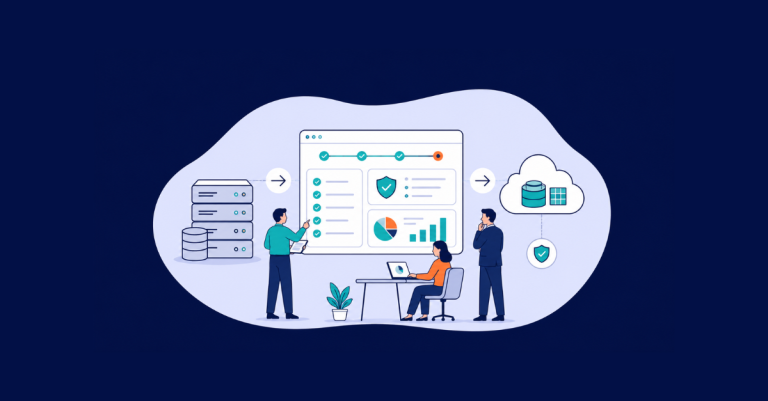
Key Takeaways
- Data Migration Readiness determines whether modernization can proceed without avoidable business disruption.
- Migration readiness assessment shows whether source data, target systems, mappings, and business rules are prepared.
- Enterprise migration planning fails when legacy data issues are discovered too late.
- System migration readiness depends on validation, reconciliation, ownership, and cutover confidence.
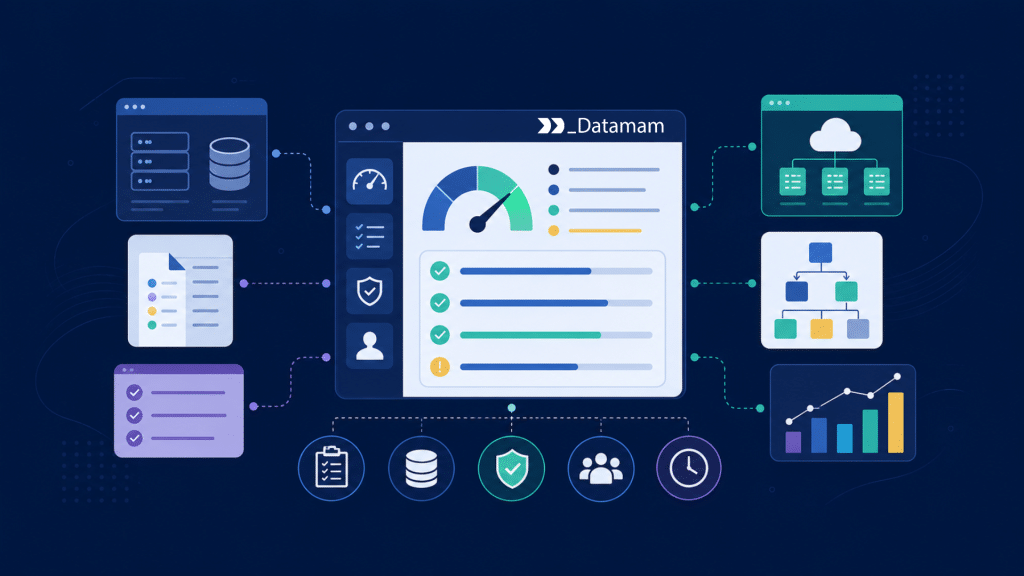
Data migration readiness has become an executive priority because modernization failure rarely begins at cutover. It begins earlier, when legacy data quality, ownership gaps, source-to-target mapping issues, governance weaknesses, and business-rule ambiguity remain unresolved until the transition is already under pressure. By then, migration teams are no longer preparing for change. They are defending the business from disruption.
Data Migration Readiness refers to the ability of an organization to prove that its data, systems, controls, mappings, validation logic, ownership model, and cutover plan are prepared for migration. It includes migration readiness assessment, enterprise migration planning, system migration readiness, reconciliation, exception handling, lineage, audit logs, rollback readiness, and stakeholder sign-off.
Data Migration Readiness Determines Whether Modernization Can Proceed Without Business Disruption
Enterprise modernization programs often focus on the target platform: a new ERP, CRM, cloud warehouse, finance system, healthcare records system, ecommerce platform, or customer support environment. However, the target system cannot compensate for unprepared data. If source records are duplicated, incomplete, inconsistent, poorly mapped, or misaligned with business rules, the migration will carry legacy problems into the new environment.
McKinsey’s State of AI 2025 shows that many organizations are using AI, but fewer have embedded it deeply into workflows and enterprise processes. That pattern matters for migration because modernization depends on operational data foundations, not only new platforms. If the migrated data is not reliable, downstream AI, analytics, reporting, and operational workflows remain constrained.
Migration Readiness Assessment Shows Whether Source Data, Target Systems, and Business Rules Are Prepared
A migration readiness assessment evaluates whether the organization is ready to move data without disrupting business operations. It should examine source data quality, field completeness, duplicate records, schema conflicts, master data consistency, source-to-target mappings, target-system constraints, ownership, validation rules, access controls, and audit requirements.
This assessment is not only technical. Business rules often carry more risk than schemas. A field may map cleanly from a source system to a target system, but its business meaning may have changed over time. A customer status field, product category, payment term, clinical record type, or finance classification may have been used inconsistently across teams.
In practice, readiness assessment turns hidden migration risk into visible decision evidence. Executives can see which domains are ready, which require remediation, and which should not move until rules are clarified.
System Migration Readiness Depends on Mapping, Validation, Ownership, and Cutover Confidence
System migration readiness depends on whether teams can prove that data will arrive in the target environment correctly. Source-to-target mapping defines where each field moves. Validation confirms whether required fields, formats, types, and business rules are satisfied. Reconciliation compares source and target counts, values, totals, and exceptions. Ownership defines who resolves issues before cutover.
Cutover confidence depends on these controls working together. A migration cannot be considered ready simply because data can be extracted. It is ready when teams can show that target records reflect the intended business meaning and that exceptions are understood before go-live.
Therefore, readiness is a governance condition. It is the point where business, data, engineering, compliance, and operations leaders agree that transition risk is controlled enough to proceed.
Why Migration Readiness Is More Than a Technical Checklist
Migration readiness is often reduced to technical preparation: extract files, prepare scripts, map schemas, run test loads, and schedule cutover. These steps matter, but they do not address the full risk. Migration changes how the business operates. It affects customer records, product catalogs, financial reporting, user permissions, audit evidence, workflows, integrations, and downstream decision systems.
Gartner’s 2025 Data and Analytics Predictions highlight the growing role of AI-supported decision intelligence across business decisions. As more workflows depend on automated or augmented decisions, migration errors become more consequential because bad records can influence downstream systems quickly.
Enterprise Migration Planning Fails When Legacy Data Quality Problems Are Discovered Too Late
Enterprise migration planning fails when legacy data problems are treated as implementation details. Duplicate customer records, inconsistent product identifiers, missing billing fields, obsolete supplier codes, fragmented patient records, and invalid account hierarchies can all delay migration if discovered late.
Late discovery creates pressure to choose between postponing cutover, moving defective data, or applying rushed manual fixes. Each option carries cost. Delayed cutover affects modernization timelines. Moving defective data compromises the target system. Manual fixes create inconsistency and may lack auditability.
A readiness-driven migration identifies these issues before transition pressure increases. Legacy problems should be quantified, prioritized, assigned to owners, and resolved or formally accepted before go-live.
Business Continuity Is Exposed When Migration Dependencies Are Not Identified Before Cutover
Migration dependencies extend beyond source and target systems. A CRM migration may affect billing, support, marketing automation, revenue dashboards, and customer success workflows. An ERP migration may affect procurement, finance reporting, tax logic, supplier management, and inventory systems. A cloud warehouse migration may affect dashboards, AI pipelines, compliance reports, and executive metrics.
If these dependencies are not identified before cutover, business continuity is exposed. A technically successful migration may still disrupt downstream reports, integrations, permissions, or operational processes.
Accordingly, enterprise migration planning should include dependency mapping. Teams need to know which applications, dashboards, APIs, files, models, users, and business processes rely on the migrated data.
The Strategic Cost of Weak Migration Readiness
Weak migration readiness creates cost through delays, rework, degraded trust, operational disruption, and executive uncertainty. Modernization programs are usually justified by efficiency, visibility, scalability, compliance, and better decision-making. Poor readiness threatens each of those outcomes.
IBM’s 2025 CDO Study emphasizes the importance of decision-ready data for generating business value from data and AI. Migration readiness supports that objective because a modernized platform cannot deliver decision-ready outputs if the migrated data is structurally weak.
Modernization Programs Lose Momentum When Data Issues Delay System Transition
Migration programs lose momentum when data issues appear late in the delivery cycle. Teams may need additional profiling, remapping, cleansing, reconciliation, stakeholder review, or business-rule clarification. These activities are necessary, but when they occur near cutover, they create schedule risk and stakeholder fatigue.
The operational impact is also significant. Business teams continue working in legacy systems longer than expected. Parallel environments remain open. Reporting teams maintain temporary processes. Engineering teams support both old and new integrations. Finance and compliance teams may need additional evidence to approve the transition.
As a result, weak readiness turns migration into an extended period of uncertainty rather than a controlled modernization step.
Executive Confidence Declines When Teams Cannot Prove Migration Accuracy Before Go-Live
Executive confidence depends on evidence. Leaders need to know whether customer records migrated correctly, whether financial balances reconcile, whether product attributes remain accurate, whether access controls are preserved, and whether downstream reports will continue working after cutover.
A migration team should be able to show validation results, reconciliation outcomes, exception volumes, open-risk domains, approval status, and rollback readiness. Without that evidence, go-live becomes a judgment call rather than a controlled decision.
In this context, migration readiness is a board-level concern. It determines whether leadership can approve transition with confidence rather than hope.
How Readiness Affects ERP, CRM, Cloud, and Analytics Migration
Migration readiness looks different across systems, but the core issue is consistent: business meaning must survive transition. ERP, CRM, cloud warehouse, healthcare, finance, ecommerce, and support-system migrations all require mapping, validation, reconciliation, access control, and downstream continuity.
NIST’s AI Risk Management Framework emphasizes governance, mapping, measurement, and management as core functions for AI risk control. Those same functions apply to migration readiness because migrated data often feeds AI, analytics, and automated workflows after modernization. Data governance strategies for migration are essential to ensure that information integrity is maintained throughout the process. Effective governance also supports compliance with regulatory standards, enabling organizations to mitigate risks associated with data handling. By implementing robust data governance strategies, companies can enhance the overall quality and usability of their migrated data, ultimately leading to better decision-making and operational efficiency.
Source-to-Target Mapping Determines Whether Business Meaning Survives Migration
Source-to-target mapping is more than field movement. It defines whether business meaning is preserved in the target system. A legacy field named account_status may contain active, inactive, suspended, archived, and informal values created over years. The target system may accept only approved statuses. Without mapping logic, invalid values may be dropped, misclassified, or manually patched.
A simple mapping validation pattern shows the operating principle:
FIELD_MAPPING = {

    "legacy_customer_id": "customer_id",

    "company_name": "legal_name",

    "account_status": "status",

    "billing_country": "primary_country",

}


ALLOWED_STATUS = {

    "active": "active",

    "inactive": "inactive",

    "archived": "inactive",

    "suspended": "suspended",

}


def transform_customer(source_record):

    target = {}


    for source_field, target_field in FIELD_MAPPING.items():

        if not source_record.get(source_field):

            return {

                "valid": False,

                "reason": "missing_required_field",

                "field": source_field,

            }


        target[target_field] = source_record[source_field]


    status = source_record["account_status"].lower()

    if status not in ALLOWED_STATUS:

        return {"valid": False, "reason": "invalid_status", "value": status}


    target["status"] = ALLOWED_STATUS[status]

    return {"valid": True, "target_record": target}
This example shows why readiness cannot rely on schema matching alone. Migration logic must preserve business interpretation.
Validation, Reconciliation, and Parallel Runs Reduce Risk Before Production Transition
Validation confirms that records meet target requirements. Reconciliation confirms that source and target values align. Parallel runs compare outputs from legacy and target systems before production transition. Together, these controls reduce risk before cutover.
For finance systems, reconciliation may compare balances, transaction totals, account counts, and tax classifications. For CRM systems, it may compare account hierarchies, ownership, lifecycle stages, and duplicate rates. Also, for ecommerce systems, it may compare product counts, attributes, prices, categories, and channel readiness.
Parallel runs are especially useful because they show whether the new environment produces expected operational outputs before the old system is retired.
The Infrastructure Layer Behind Migration Readiness
Migration readiness requires infrastructure that can profile, map, validate, reconcile, route exceptions, track lineage, and preserve audit evidence. Manual spreadsheets may help during early analysis, but they cannot support enterprise-scale readiness alone.
Airflow can orchestrate migration batches and validation jobs. Spark can process large migration datasets. dbt can define transformation logic and test target models. Snowflake, BigQuery, and Databricks can support staging, reconciliation, and migration analytics. Great Expectations can validate schema, completeness, allowed values, uniqueness, and threshold checks. Metadata systems and lineage tools can show how migrated fields affect downstream reports, models, and workflows.
Profiling, Schema Mapping, Batch Controls, and Exception Routing Improve Migration Control
Profiling identifies data quality conditions before migration. Schema mapping defines how source fields become target fields. Batch controls track which records were extracted, transformed, loaded, rejected, retried, or approved. Exception routing ensures issues go to the right owner.
def route_migration_exception(record, issue):

    if issue["type"] == "duplicate_record":

        return {"status": "manual_review", "owner": "data_steward", "record_id": record["id"]}


    if issue["type"] == "missing_required_field":

        return {"status": "blocked", "owner": "source_system_owner", "record_id": record["id"]}


    if issue["type"] == "mapping_conflict":

        return {"status": "business_rule_review", "owner": "process_owner", "record_id": record["id"]}


    if issue["type"] == "access_policy_violation":

        return {"status": "blocked", "owner": "governance_team", "record_id": record["id"]}


    return {"status": "migration_operations_review", "record_id": record["id"]}
This pattern prevents migration issues from becoming generic error queues. Different failures require different owners and remediation paths.
Lineage, Audit Logs, Metadata, and Governance Make Migration Outcomes Defensible
Lineage shows where migrated data came from, how it changed, and which downstream systems depend on it. Audit logs show when records were extracted, transformed, loaded, validated, rejected, approved, or corrected. Metadata records field definitions, owners, classifications, retention rules, and target-system requirements.
These controls matter during audits, regulatory reviews, incident investigations, and executive signoff. If a migrated field affects financial reporting, customer decisions, clinical operations, or AI outputs, the organization should be able to prove how that field moved and why the target value is correct.
Therefore, governance should be embedded before migration execution. It should not be reconstructed after issues appear.
Why Data Migration Readiness Is Becoming an Executive Governance Issue
Data Migration Readiness is becoming an executive governance issue because migration risk now extends across operations, analytics, compliance, AI, finance, customer experience, and business continuity. A failed migration is not only an IT problem. It can affect reporting accuracy, regulatory evidence, revenue workflows, customer records, product availability, and system trust.
Executives do not need to manage migration scripts. However, they do need visibility into readiness evidence: which data domains are prepared, which mappings are approved, which reconciliation gaps remain, which downstream dependencies are exposed, and whether rollback plans are credible. Effective data migration strategies for enterprises can mitigate these risks and ensure a smoother transition. By implementing well-defined processes and continuous monitoring, organizations can greatly enhance their migration success. It is crucial for leaders to prioritize these strategies to safeguard their operations and maintain trust with customers.
Leaders Need Visibility Into Which Data Domains Create Transition Risk
Leadership visibility should focus on risk concentration. Which data domains are most critical to cutover? Which have the highest defect rates? Also, which mappings remain unresolved? Which systems depend on migrated data on day one? Which business processes cannot tolerate disruption? As well as which exceptions remain open?
This visibility helps leaders make informed go-live decisions. A low-risk archive migration may tolerate a different readiness threshold than a finance, ERP, CRM, healthcare, or customer-facing migration.
In this context, readiness becomes an executive control point. It determines whether modernization can proceed responsibly. Parallel run strategies for data migration are essential for managing the transition effectively. By implementing these strategies, organizations can mitigate risks associated with data integrity and system compatibility. Additionally, thorough testing during the parallel run phase allows teams to identify and resolve potential issues before the final cutover.
Scalable Migration Programs Require Readiness Standards, Ownership, Testing, and Continuous Review
Scalable migration programs require readiness standards. These standards should define profiling requirements, mapping approval, validation rules, reconciliation thresholds, exception ownership, parallel run criteria, access controls, audit logging, rollback planning, and cutover signoff.
Ownership must be explicit. Data engineering may operate migration pipelines. Business owners define rules and approve mappings. Governance teams define access and usage controls. Compliance teams define evidence requirements. Operations teams define continuity expectations. Executives approve risk acceptance.
Ultimately, Data Migration Readiness has become an executive priority because modernization depends on controlled transition. Migration readiness assessment makes data, mapping, and system gaps visible. Enterprise migration planning reduces late-stage disruption. System migration readiness gives leaders the evidence needed to approve cutover with confidence.
Organizations that treat readiness as governance infrastructure will modernize with greater stability. Those that treat migration as a technical transfer may move records into a new system, but they will struggle to prove that the business is ready to operate from it.