Key Takeaways
- Legacy System Migration often fails before production cutover because source-system complexity is underestimated.
- Legacy system modernization breaks down when planning ignores data quality, hidden logic, and downstream dependencies.
- Legacy data migration requires business-rule clarity before technical execution begins.
- System modernization planning must expose what should move, what should change, and what should be retired.
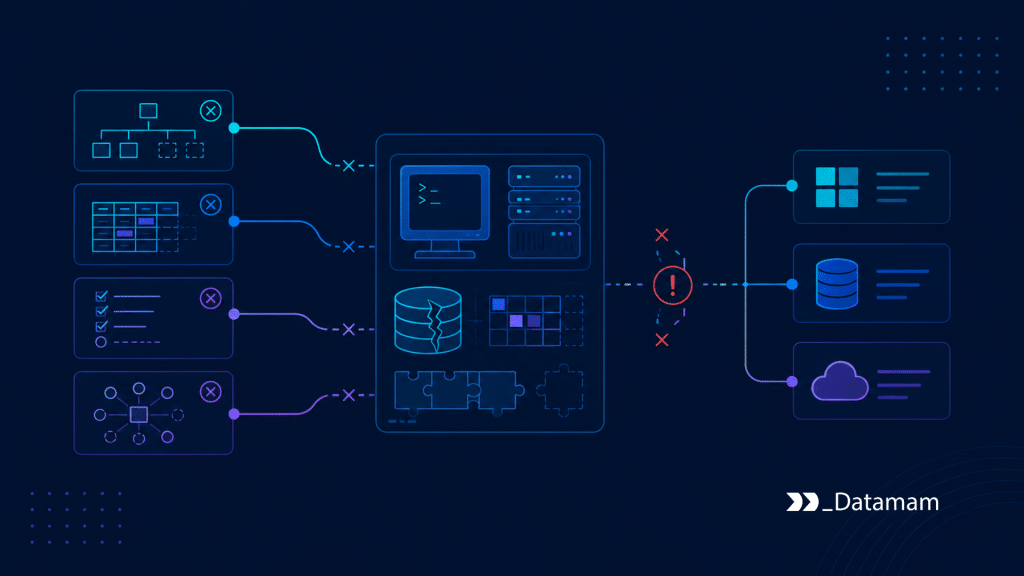
Legacy system migration often fails before technical execution begins because the real migration risk is already embedded in the old environment. Legacy platforms usually contain years of undocumented business logic, inconsistent records, manual workarounds, inactive fields, duplicate entities, and reporting dependencies that are not visible in a basic system inventory. By the time execution starts, these weaknesses have already shaped the outcome.
Legacy System Migration refers to the movement of data, workflows, rules, and operational dependencies from older systems into modern platforms. It includes legacy system modernization, legacy data migration, system modernization planning, source-to-target mapping, validation, reconciliation, parallel runs, cutover readiness, rollback planning, lineage, audit logs, and governance. When the pre-migration phase is weak, execution becomes a recovery effort rather than a controlled transition.
Legacy System Migration Often Fails Before the First Production Cutover
Enterprises usually frame legacy migration as a technical transition from an old platform to a new one. However, legacy systems are not only databases or applications. They are operating histories. They contain old decisions, temporary fixes, business exceptions, user behaviors, abandoned fields, local naming conventions, and informal rules that teams have learned to work around.
This matters because modernization value depends on whether the new system receives clean, meaningful, governed data. McKinsey’s State of AI 2025 shows that many organizations use AI, but fewer have embedded it deeply into workflows and enterprise processes. Also, legacy migration affects that gap because poor migrated data constrains downstream AI, analytics, reporting, and automation even after a modern platform goes live.
Legacy System Modernization Breaks Down When Data Reality Is Ignored During Planning
Legacy system modernization breaks down when teams plan around the target platform without understanding the actual condition of the legacy data. A CRM may contain duplicate accounts, outdated ownership, inconsistent lifecycle stages, and custom fields no one owns. An ERP may contain inactive suppliers, invalid cost centers, inconsistent tax rules, and financial classifications that differ by region. A product system may contain outdated categories, incomplete attributes, and channel-specific exceptions.
These issues do not disappear during migration. They either block migration, move into the new system, or require rushed correction under timeline pressure.
Therefore, modernization planning must begin with data reality. Teams need to understand field usage, record quality, business-rule consistency, ownership, and downstream dependencies before migration scripts are written.
Legacy Data Migration Requires Business Rule Clarity Before Technical Execution Starts
Legacy data migration is not just the movement of tables, fields, and files. It is the transfer of business meaning from one environment to another. A field named “status” may mean active customer in one process, billable account in another, and eligible user in another. A product category may have changed meaning over time. A supplier code may remain active in reports even though it is inactive in operations.
If business rules are unclear, technical teams cannot make reliable migration decisions. They can map fields, but they cannot decide what values should mean in the target system without business ownership.
In practice, business-rule clarity should be resolved before execution. Waiting until test loads expose conflicts makes migration slower, more expensive, and harder to govern.
Why Failure Begins in the Pre-Migration Phase
Legacy migration failure begins in the pre-migration phase because assumptions are formed early. Teams estimate timelines, define scope, allocate resources, and set cutover expectations before they fully understand source-system complexity. Once those assumptions become commitments, every hidden data issue becomes a schedule problem.
Gartner’s 2025 Data and Analytics Predictions point to a growing role for augmented and automated decision-making. As more workflows depend on data-driven systems, legacy migration defects become more dangerous because poor records can affect downstream decisions quickly after modernization.
System Modernization Planning Fails When Source Data Quality, Ownership, and Dependencies Are Unclear
System modernization planning fails when source data quality is not measured early. Teams need to profile completeness, duplicates, invalid values, obsolete records, format drift, reference mismatches, and unused fields. They also need ownership: who decides whether a field moves, whether values are remediated, whether records are merged, and whether exceptions are accepted.
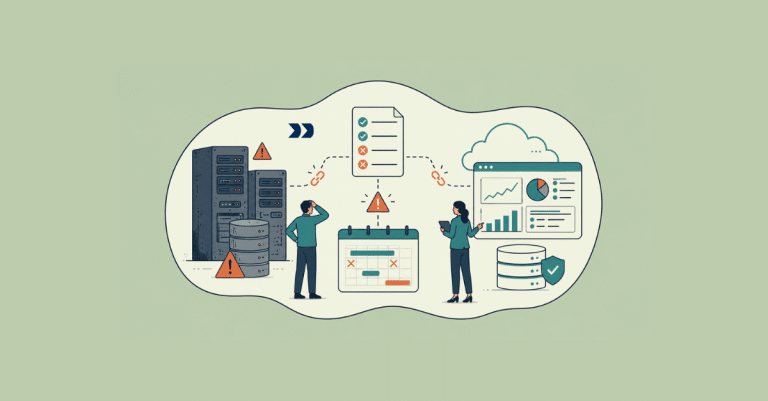
Dependencies matter as much as quality. A legacy customer table may feed billing, support, marketing, revenue dashboards, and AI scoring. A product table may feed ecommerce, marketplace publishing, inventory, search, and analytics. A finance table may feed compliance reporting, tax workflows, procurement, and executive metrics.
Without dependency visibility, migration teams may move data successfully while disrupting downstream operations.
Hidden Legacy Logic Creates Risk When Teams Cannot Explain How Old Systems Actually Work
Legacy systems often contain hidden logic that is not fully documented. A report may depend on a filter built years ago. A workflow may rely on a field that was never formally defined. A finance process may use a manual adjustment outside the system. A customer success team may interpret values differently from sales or billing.
Hidden logic creates risk because migration teams may replicate data without replicating the behavior the business expects. The new system may be technically correct but operationally wrong.
Accordingly, pre-migration discovery should include user interviews, report dependency review, integration mapping, data profiling, and business-rule validation. Legacy systems must be understood as operating environments, not only data sources.
The Strategic Cost of Weak Legacy Migration Preparation
Weak legacy migration preparation creates cost through delays, rework, failed test cycles, data remediation pressure, stakeholder distrust, and reduced modernization value. A migration may still go live, but if users do not trust the migrated data, the new platform begins with credibility problems.
IBM’s 2025 CDO Study emphasizes the importance of decision-ready data for enterprise value creation. Legacy system migration supports that objective only when migrated data is accurate, reconciled, traceable, and fit for operational use. Data migration solutions for enterprises play a crucial role in enhancing trust among users. These solutions ensure that organizations can confidently rely on the integrity of their data during and after the migration process. By prioritizing accuracy and reconciliation in data migration, enterprises can significantly improve their operational effectiveness and overall business outcomes.
Modernization Timelines Slip When Legacy Complexity Is Discovered Too Late
Modernization timelines slip when complexity appears after planning is already locked. Duplicate accounts require stewardship. Unapproved values require business review. Missing fields require remediation. Mapping conflicts require redesign. Reconciliation gaps require investigation. Downstream report differences require retesting.
Each issue pulls the project backward. Teams return to profiling, mapping, validation, and stakeholder review instead of progressing toward cutover.
This is why legacy migration timelines should include discovery, remediation, exception handling, parallel runs, and signoff. A timeline that assumes clean source data is not a migration plan. It is a best-case scenario.
Executive Confidence Declines When Teams Cannot Prove What Will Move, Change, or Be Retired
Executive confidence depends on evidence. Leaders need to know which data domains will move, which records will be excluded, which fields will be transformed, which reports will change, and which legacy functions will be retired. They also need to know whether the new system can support day-one operations.
If teams cannot prove these points, go-live becomes difficult to approve. Executives may face conflicting signals: the technical team reports progress, while business teams raise concerns about missing records, unresolved mappings, or untested workflows.
In this context, legacy migration becomes an executive governance issue. Leadership needs visibility into transition risk before the organization commits to cutover.
How Legacy Migration Risk Affects ERP, CRM, Cloud, and Analytics Programs
Legacy migration risk appears differently across systems. ERP migration carries finance, procurement, inventory, tax, and supplier risk. CRM migration carries customer identity, account hierarchy, pipeline, support, and marketing risk. Cloud warehouse migration carries reporting, analytics, AI, and compliance risk. Ecommerce migration carries product catalog, pricing, inventory, order, and channel risk.
NIST’s AI Risk Management Framework emphasizes governance, mapping, measurement, and management across AI systems. These same principles apply to legacy migration because migrated data often becomes the foundation for analytics, automation, and AI-enabled decisions.
Source-to-Target Mapping Must Preserve Business Meaning, Not Just Field Movement
Source-to-target mapping must preserve meaning. A legacy field may technically fit into a target field, but the value may not be approved, current, or semantically correct. Migration teams need mapping logic that checks required fields, allowed values, and transformation rules before records are loaded.
FIELD_MAPPING = {

    "legacy_customer_id": "customer_id",

    "company_name": "legal_name",

    "account_status": "status",

    "billing_country": "primary_country",

}


STATUS_MAPPING = {

    "active": "active",

    "inactive": "inactive",

    "archived": "inactive",

    "suspended": "suspended",

}


def map_legacy_customer(source_record):

    missing = [field for field in FIELD_MAPPING if not source_record.get(field)]

    if missing:

        return {"valid": False, "reason": "missing_required_fields", "fields": missing}


    legacy_status = source_record["account_status"].lower()

    if legacy_status not in STATUS_MAPPING:

        return {"valid": False, "reason": "unmapped_status", "value": legacy_status}


    target_record = {}

    for source_field, target_field in FIELD_MAPPING.items():

        target_record[target_field] = source_record[source_field]


    target_record["status"] = STATUS_MAPPING[legacy_status]

    return {"valid": True, "target_record": target_record}
This pattern shows why legacy data migration needs business logic, not only extraction and loading.
Validation, Reconciliation, and Parallel Runs Reduce Risk Before Legacy Systems Are Decommissioned
Validation checks whether migrated records meet target-system rules. Reconciliation compares source and target counts, balances, totals, identifiers, categories, and exception volumes. Parallel runs compare outputs from legacy and target systems before the old system is retired.
For ERP migration, reconciliation may include account balances, supplier records, purchase orders, inventory values, and transaction totals. For CRM migration, it may include customer counts, duplicate rates, lifecycle stages, ownership, and opportunity totals. Also, for analytics migration, it may include dashboard outputs, metric definitions, feature tables, and row counts.
Parallel runs are especially important because they show whether the modernized environment produces expected outputs before the business depends on it fully.
The Infrastructure Layer Behind Legacy Data Migration Readiness
Legacy data migration readiness requires infrastructure that can profile source data, apply mapping rules, validate target records, reconcile outputs, track batches, route exceptions, preserve lineage, and maintain audit logs. Manual review is useful, but enterprise-scale migration needs repeatable controls.
Airflow can orchestrate migration batches, validations, and reruns. Spark can process large legacy datasets. dbt can define transformation logic and target-model tests. Snowflake, BigQuery, and Databricks can support staging, reconciliation, and migration analytics. Great Expectations can validate schema, completeness, uniqueness, allowed values, and thresholds. Metadata systems and lineage tools can show how migrated fields affect reports, models, workflows, and integrations.
Profiling, Mapping Controls, Batch Tracking, and Exception Routing Expose Legacy Risk Early
Profiling exposes source-system conditions before migration execution. Mapping controls define how legacy values become target values. Batch tracking shows which records were extracted, transformed, loaded, rejected, retried, or approved. Exception routing ensures that issues reach the right owner.
def route_legacy_exception(record, issue):

    if issue["type"] == "duplicate_customer":

        return {"status": "manual_review", "owner": "customer_data_steward", "record_id": record["id"]}


    if issue["type"] == "missing_required_field":

        return {"status": "blocked", "owner": "source_system_owner", "record_id": record["id"]}


    if issue["type"] == "mapping_conflict":

        return {"status": "business_rule_review", "owner": "process_owner", "record_id": record["id"]}


    if issue["type"] == "retention_policy_conflict":

        return {"status": "blocked", "owner": "governance_team", "record_id": record["id"]}


    return {"status": "migration_operations_review", "record_id": record["id"]}
This structure prevents legacy migration issues from becoming generic technical errors. Some issues require stewardship. Others require governance, source-system ownership, or business-rule approval. Data quality assessment techniques play a crucial role in identifying inconsistencies within the data. By applying these techniques, organizations can ensure their data is accurate and reliable for decision-making. Implementing a robust framework enhances both stewardship and governance practices across various departments.
Metadata, Lineage, Audit Logs, and Governance Make Legacy Migration Decisions Defensible
Metadata records source fields, target fields, owners, classifications, definitions, approved mappings, and retention rules. Lineage shows where migrated data came from, how it changed, and which downstream systems depend on it. Audit logs record extraction, transformation, validation, rejection, correction, approval, loading, and reconciliation events.
These controls matter when migrated data affects finance, customer operations, healthcare records, compliance reporting, AI workflows, or executive dashboards. If a value changes during migration, the organization should be able to explain why. If a record is excluded, teams should know whether it was duplicate, obsolete, restricted, or invalid.
Therefore, governance should be embedded into legacy migration before execution begins. It cannot be added reliably after trust has already been damaged.
Why Legacy System Migration Is Becoming an Executive Governance Issue
Legacy System Migration is becoming an executive governance issue because old systems increasingly constrain modernization, AI readiness, analytics reliability, compliance, and operational continuity. A failed migration can disrupt customer records, financial reporting, supplier workflows, product availability, healthcare records, and executive metrics.
Executives do not need to manage migration scripts. However, they need visibility into which legacy data domains create risk, which business rules remain unresolved, which dependencies are critical, and which systems can be safely retired. Migration challenges in system modernization can significantly impact an organization’s ability to adapt to new technologies. Addressing these challenges requires a strategic approach that prioritizes data integrity and stakeholder engagement. By fostering collaboration among IT teams and business leaders, companies can enhance their migration process and minimize disruptions.
Leaders Need Visibility into Which Legacy Data Domains Create Modernization Risk
Leadership visibility should focus on risk concentration. Which legacy domains have the highest defect rates? Which fields are used but poorly defined? Also, which reports depend on old logic? Which integrations rely on legacy identifiers? Which records should be archived rather than migrated? As well as which domains need business-rule approval before cutover?
This visibility helps leaders distinguish modernization progress from modernization readiness. A target platform can be configured while the migration still carries major risk.
In this context, executive oversight should focus on readiness evidence, not only project milestones.
Scalable Modernization Programs Require Migration Standards, Ownership, Testing, and Continuous Review
Scalable modernization programs require migration standards. These standards should define profiling requirements, mapping approval, validation rules, reconciliation thresholds, exception ownership, parallel run criteria, data retention review, audit logging, rollback planning, dependency review, and cutover signoff.
Ownership must be explicit. Data engineering operates migration pipelines. Business owners approve rules and mappings. Governance teams define access, retention, and compliance controls. Operations teams define continuity requirements. Compliance teams define evidence standards. Executives approve transition risk.
Ultimately, Legacy System Migration fails before execution begins when planning ignores the real condition of legacy systems. Legacy system modernization requires data reality, business-rule clarity, dependency visibility, and governance before technical movement begins. Legacy data migration must preserve business meaning, not just field structure. System modernization planning must prove what will move, what will change, and what should be retired.
Organizations that treat legacy migration as governance infrastructure will modernize with stronger continuity and trust. Those that treat it as a technical transfer may launch new platforms, but they will carry old system risk into the future environment.