Key Takeaways
- Data Transition Strategy determines whether modernization moves from plan to stable operation.
- A transition planning framework connects data, systems, business rules, validation, and cutover readiness.
- System transition strategy reduces risk across migration, reconciliation, go-live, and post-transition operations.
- Cross-platform transition fails when source systems, target systems, and downstream dependencies are not aligned.
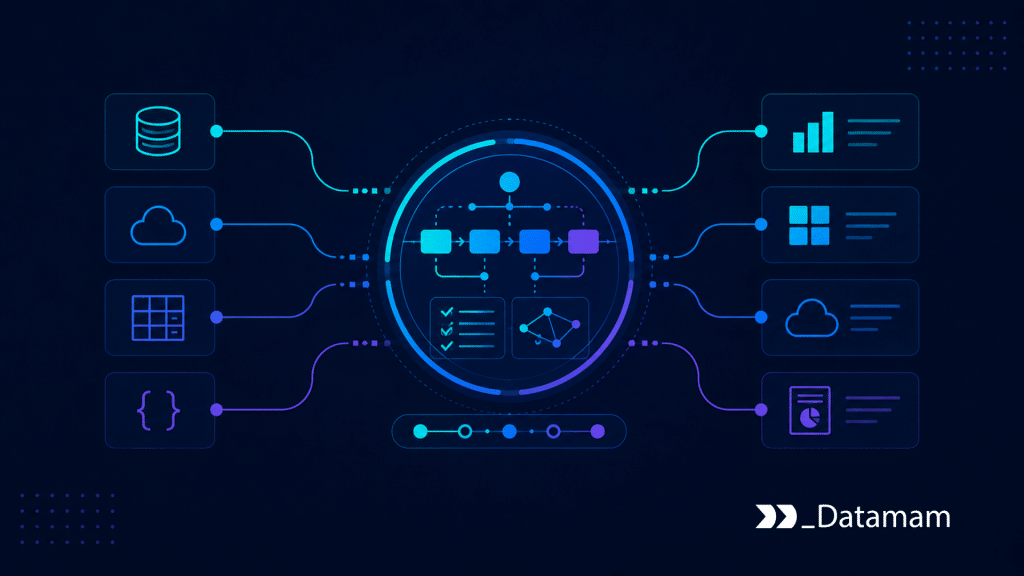
Data transition strategy matters because modernization is not complete when data moves from one system to another. The real test is whether the business can operate from the new environment without losing meaning, continuity, reporting trust, access control, or downstream workflow stability. Many migration programs underestimate this point. They plan the transfer, but not the transition.
Data Transition Strategy refers to the structured approach for moving data, business rules, dependencies, controls, and operating workflows from legacy or current-state systems to the future-state environment. It includes transition planning framework design, system transition strategy, cross-platform transition, source-to-target mapping, validation, reconciliation, parallel runs, cutover gates, rollback planning, lineage, audit logs, and governance.
Data Transition Strategy Determines Whether Modernization Moves from Plan to Stable Operation
Migration teams often focus on moving data successfully into a new system. However, a successful load does not guarantee a successful transition. A CRM may receive migrated customer records, but billing, support, marketing automation, and revenue dashboards may still depend on unresolved identity logic. An ERP may accept supplier and finance records, but procurement, reporting, and tax workflows may not behave as expected. A cloud warehouse may receive transformed tables, but dashboards and AI features may not reconcile with legacy outputs.
McKinsey’s 2025 AI research shows that although AI use is widespread, many organizations remain early in scaling AI and capturing enterprise-level value. McKinsey also links stronger AI outcomes with workflow redesign and data infrastructure maturity, which reinforces the importance of treating transition as an operating change rather than a data movement task.
A Transition Planning Framework Connects Data, Systems, Business Rules, and Cutover Readiness
A transition planning framework should connect five elements: source data condition, target system requirements, business-rule approval, downstream dependency mapping, and cutover readiness. If any of these are missing, the transition may appear technically prepared while operational risk remains high.
For example, a target CRM may require standardized lifecycle stages, but the legacy system may contain years of informal values. A finance platform may require strict legal-entity structures, while the source system may contain regional exceptions. A product platform may require controlled category hierarchies, while the legacy environment may contain channel-specific workarounds.
In practice, the framework should show what will move, what will be transformed, what will be retired, what requires business approval, and what must be validated before go-live.
System Transition Strategy Reduces Risk Across Migration, Validation, Reconciliation, and Go-Live
System transition strategy turns migration into a controlled operating sequence. It defines how data is extracted, staged, transformed, validated, reconciled, approved, loaded, tested, and monitored after cutover. It also defines what happens when records fail validation or when target outputs do not reconcile with legacy results.
This matters because transition risk often comes from gaps between stages. Data may be transformed correctly but not reconciled. Reports may reconcile, but downstream integrations may fail. Business users may approve samples but not full batches. Cutover may proceed before rollback criteria are clear.
Accordingly, transition strategy should create evidence at every stage. Teams should not rely on a single final readiness meeting to decide whether the business can move.
Why Weak Transition Planning Creates Modernization Risk
Weak transition planning creates modernization risk because it separates data migration from business continuity. It assumes the new system will become operational once data is loaded. However, business operations depend on rules, timing, access, integrations, reports, user workflows, and control evidence.
Gartner’s 2025 data and analytics predictions highlight the growing role of AI agents and decision intelligence in business decisions. As more decisions become automated or AI-supported, transition defects become more consequential because bad records, broken mappings, or inconsistent outputs can move into downstream workflows faster. Effective enterprise data management strategies are essential to mitigate these risks. They ensure that data is accurately mapped and transformed throughout the migration process. By prioritizing these strategies, organizations can maintain operational integrity and enhance the reliability of their business decisions.
Cross Platform Transition Fails When Source, Target, and Downstream Dependencies Are Not Aligned
Cross-platform transition fails when teams plan source-to-target movement without mapping downstream dependencies. A customer table may feed billing, support, marketing, revenue dashboards, and AI scoring. A product dataset may feed ecommerce, marketplaces, inventory, search, and analytics. A finance dataset may feed compliance reporting, tax workflows, procurement, and executive metrics.
If these dependencies are not aligned before cutover, transition problems appear as business disruptions. Reports no longer match. Applications reject records. Users cannot find migrated data. AI features become stale or inconsistent. Workflows require manual workarounds.
Therefore, cross-platform transition should identify every critical downstream consumer before the production move. The target system is only one destination. The broader operating environment is the real transition scope.
Business Teams Lose Confidence When Transition Logic Is Unclear Before Cutover
Business teams lose confidence when they cannot explain how old values become new values. If a legacy customer status, product category, supplier type, or finance code changes during transition, users need to understand the rule behind that change. Otherwise, the new system appears unreliable even when the migration technically succeeded.
A simple transition mapping check can expose whether source values are approved before records move: Hidden costs of migration issues can often arise when there’s a lack of transparency in the transition process. Teams may not realize the potential pitfalls until they encounter unexpected complications further down the line. By prioritizing clear communication about these hidden costs, organizations can mitigate risks and enhance overall confidence in their migration efforts.
STATUS_MAPPING = {

    "active": "active",

    "inactive": "inactive",

    "archived": "inactive",

    "suspended": "suspended",

}


REQUIRED_FIELDS = ["legacy_customer_id", "company_name", "account_status"]


def validate_transition_record(record):

    missing = [field for field in REQUIRED_FIELDS if not record.get(field)]

    if missing:

        return {"ready": False, "reason": "missing_required_fields", "fields": missing}


    status = record["account_status"].lower()

    if status not in STATUS_MAPPING:

        return {"ready": False, "reason": "unmapped_status", "value": status}


    return {

        "ready": True,

        "target_status": STATUS_MAPPING[status],

        "source_id": record["legacy_customer_id"],

    }
This pattern shows that transition logic must be explicit before cutover. Unmapped values should not become production surprises.
The Strategic Cost of Poor Data Transition Strategy
Poor transition strategy affects modernization outcomes by weakening trust in the new environment. A system may go live, but if business teams continue reconciling outputs manually, asking for legacy comparisons, or questioning migrated values, the transition has not fully succeeded.
IBM’s 2025 CDO Study emphasizes the importance of decision-ready data for creating business value from data and AI. Data transition strategy supports that goal because migrated systems cannot produce decision-ready outputs unless the transition preserves accuracy, meaning, access, and continuity. Developing effective data migration strategies for enterprises is crucial to ensure that all necessary data attributes are maintained throughout the process. By addressing potential pitfalls and establishing clear objectives, organizations can enhance the reliability and efficiency of their data transitions. Ultimately, a well-executed migration strategy paves the way for leveraging advanced analytics and driving innovation in the business environment.
Modernization Programs Slow Down When Data Movement and Business Continuity Are Planned Separately
Modernization programs slow down when data movement and business continuity are handled as separate workstreams. Data teams may complete migration batches while business teams are still clarifying rules. System integrators may configure target workflows while reporting teams are still reconciling legacy metrics. Operations teams may prepare go-live while governance teams are still reviewing access controls.
These gaps create late-stage rework. Teams revisit mappings, rerun test loads, adjust transformations, revalidate reports, and delay cutover decisions. The cost is not only timeline delay. It is the loss of momentum and stakeholder confidence.
In practice, transition strategy should integrate data movement with business continuity from the start. The migration plan should reflect how the business will operate on day one.
Executive Confidence Declines When Teams Cannot Prove What Will Change During Transition
Executives need evidence of what will change during transition. Which records will move? Which will be excluded? Also, which fields will be transformed? Which reports will differ from legacy outputs? Which integrations will be affected? As well as which users will receive new permissions? Which rollback path exists if production outcomes fail?
Without this evidence, go-live approval becomes subjective. Leaders may see project milestones, but not transition readiness. They may know the target platform is configured, but not whether the business can operate from it safely.
In this context, transition strategy becomes an executive control point. It turns modernization from a project milestone into a governed operating decision.
How Transition Strategy Affects ERP, CRM, Cloud, and Analytics Programs
Transition strategy has different risk patterns across systems. ERP transition affects finance, procurement, inventory, suppliers, tax, and compliance. CRM transition affects customer identity, account hierarchy, lifecycle status, revenue operations, support, and marketing. Cloud warehouse transition affects dashboards, AI features, metric definitions, compliance reports, and executive analytics.
NIST’s AI Risk Management Framework is organized around govern, map, measure, and manage functions for AI risk. These concepts are relevant to data transition because migrated data increasingly feeds AI, analytics, and automated business workflows after modernization.
Source-to-Target Mapping Must Preserve Business Meaning Across Platforms
Source-to-target mapping is the core mechanism that preserves business meaning during transition. It should define field movement, value transformation, data type expectations, required fields, ownership, accepted exceptions, and target-system constraints.
A technical field match is not enough. A legacy customer_type value may represent billing category in one region and market segment in another. A product status field may reflect approval in one system and publication readiness in another. A finance code may have different meaning before and after chart-of-accounts redesign.
Therefore, mappings should be approved by business owners, not only implemented by technical teams.
Validation, Reconciliation, and Parallel Runs Make Transition Risk Visible Before Go-Live
Validation checks whether target records satisfy required rules. Reconciliation compares source and target outputs. Parallel runs compare legacy and future-state results before the old environment is retired.
For ERP programs, reconciliation may compare balances, transaction totals, supplier counts, cost centers, and tax classifications. For CRM programs, it may compare customer counts, ownership, account hierarchy, lifecycle stage, and opportunity totals. Also, for cloud warehouse programs, it may compare row counts, dashboard metrics, feature tables, and historical reporting outputs.
Parallel runs are especially important because they show whether the future environment produces business-acceptable results before the organization depends on it fully.
The Infrastructure Layer Behind Strong System Transition Strategy
Strong system transition strategy requires infrastructure that can profile, map, validate, reconcile, route exceptions, track batches, preserve lineage, and maintain audit evidence. Manual spreadsheet tracking may support early discovery, but enterprise transition requires repeatable controls.
Airflow can orchestrate transition batches and validation jobs. Spark can process large legacy datasets. dbt can define transformation logic and target-model tests. Snowflake, BigQuery, and Databricks can support staging, reconciliation, and analytics comparison. Great Expectations can validate schema, completeness, uniqueness, allowed values, and threshold rules. Metadata systems and lineage tools show how transitioned fields affect downstream reports, models, workflows, and integrations.
Profiling, Batch Controls, Exception Routing, and Cutover Gates Improve Transition Discipline
Profiling exposes data quality and rule conflicts before execution. Batch controls show which records were extracted, transformed, loaded, rejected, retried, or approved. Exception routing assigns issues to the right owner. Cutover gates prevent the transition from proceeding until defined evidence is available.
def evaluate_transition_gate(summary):

    if summary["open_critical_exceptions"] > 0:

        return {"ready": False, "reason": "critical_exceptions_open"}


    if summary["reconciliation_variance"] > summary["allowed_variance"]:

        return {"ready": False, "reason": "reconciliation_variance_too_high"}


    if summary["business_rule_approval"] != "approved":

        return {"ready": False, "reason": "business_rules_not_approved"}


    if summary["rollback_plan"] != "approved":

        return {"ready": False, "reason": "rollback_plan_not_approved"}


    return {"ready": True, "decision": "approved_for_cutover"}


summary = {

    "open_critical_exceptions": 0,

    "reconciliation_variance": 0.07,

    "allowed_variance": 0.10,

    "business_rule_approval": "approved",

    "rollback_plan": "approved",

}


evaluate_transition_gate(summary)
This type of gate gives leaders a clear view of transition readiness. It also prevents teams from treating cutover as a calendar decision.
Metadata, Lineage, Audit Logs, and Governance Make Cross-Platform Transition Defensible
Metadata records source fields, target fields, business definitions, owners, classifications, mappings, and retention rules. Lineage shows where data came from, how it changed, and which downstream systems depend on it. Audit logs record extraction, transformation, validation, exception handling, approval, loading, reconciliation, and cutover decisions.
Governance makes transition defensible. If a customer value changes, teams should know why. If a record is excluded, teams should know whether it was duplicate, obsolete, restricted, or invalid. Also, if a dashboard differs after cutover, teams should be able to trace whether the difference came from mapping, timing, metric logic, or data quality.
Ultimately, governance prevents transition decisions from becoming undocumented project compromises.
Why Data Transition Strategy Is Becoming an Executive Governance Issue
Data Transition Strategy is becoming an executive governance issue because modernization now affects operational continuity, AI readiness, analytics trust, compliance evidence, financial reporting, customer experience, and cross-platform workflows. A transition failure can disrupt more than a system launch. It can weaken the business environment that depends on the system.
Executives do not need to manage mapping scripts or validation jobs. However, they need visibility into which data domains, workflows, and platforms carry transition risk. They need to know which rules remain unresolved, which dependencies are critical, which exceptions are open, and whether cutover evidence is strong enough.
Leaders Need Visibility into Which Data Domains, Workflows, and Platforms Carry Transition Risk
Leadership visibility should focus on transition risk concentration. Which domains have the highest defect rates? Which mappings remain unresolved? Also, which downstream systems depend on transitioned data on day one? Which workflows cannot tolerate disruption? Which reports must reconcile before go-live? As well as which access controls need approval before users move to the new platform?
This visibility helps executives distinguish project progress from transition readiness. A target platform can be configured while the transition remains risky. Conversely, a project may appear slower because teams are properly resolving data and workflow risk before cutover.
In this context, executive oversight should prioritize evidence over speed.
Scalable Modernization Programs Require Transition Standards, Ownership, Testing, and Continuous Review
Scalable modernization programs require transition standards. These standards should define profiling requirements, mapping approval, validation rules, reconciliation thresholds, exception ownership, parallel run criteria, access controls, audit logging, rollback planning, dependency review, and cutover signoff.
Ownership must be explicit. Data engineering operates transition pipelines. Business owners approve rules and mappings. Governance teams define access, retention, and usage controls. Compliance teams define evidence requirements. Operations teams define continuity expectations. Executives approve transition risk.
Ultimately, Data Transition Strategy matters because modernization is not a transfer event. It is the controlled movement of data, rules, workflows, dependencies, and trust from one operating environment to another. A transition planning framework makes that movement visible. A system transition strategy reduces uncertainty before go-live. Cross-platform transition succeeds when the business can operate in the new environment with confidence.
Organizations that treat transition strategy as governance infrastructure will modernize with stronger continuity and control. Those that treat it as a technical migration schedule may move data successfully, but they will struggle to prove that the enterprise is ready to operate from the future-state system.