Key Takeaways
- Data integration reliability determines whether downstream systems can trust the data they receive.
- Reliable data integration requires stable pipelines, validation, lineage, metadata, monitoring, and clear ownership.
- Integration performance stability affects AI systems, dashboards, operational workflows, and executive reporting.
- Downstream system reliability depends on integration quality before data reaches models, reports, or applications.
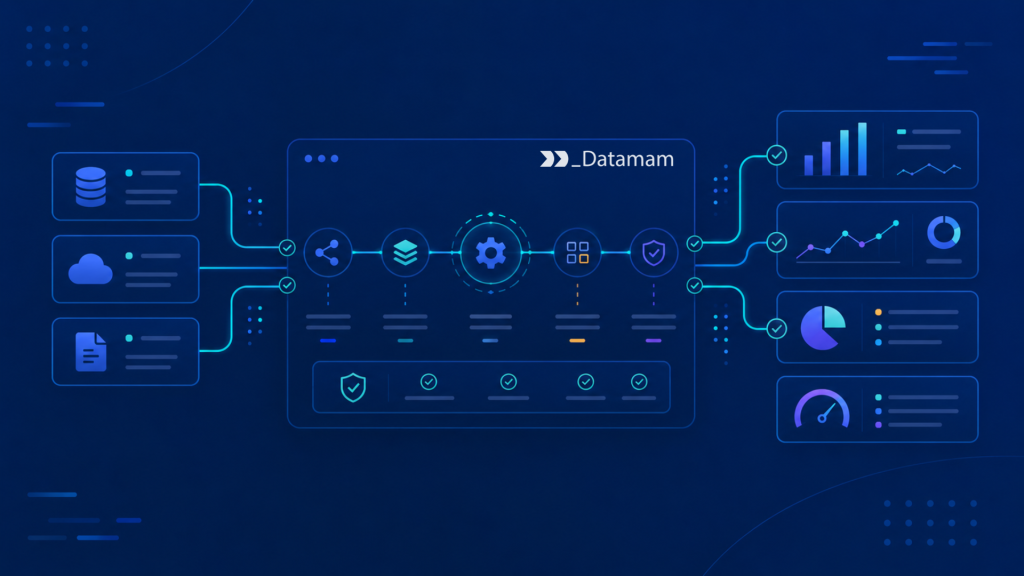
Data integration reliability determines whether enterprise systems can depend on the data they receive. A pipeline may connect two platforms, a warehouse may refresh on schedule, and dashboards may appear current. However, if the underlying integration is unstable, delayed, incomplete, or inconsistent, downstream decisions inherit that weakness.
Data Integration Reliability is the ability of data flows to move across systems with consistent structure, timing, quality, lineage, and operational stability. It matters because modern enterprises increasingly depend on connected data environments across AI, analytics, reporting, risk monitoring, customer operations, finance, and market intelligence. When integration performance weakens, decisions may still be made quickly, but they are made from unstable evidence.
Integration Reliability Now Defines Whether Enterprise Data Can Be Trusted
Enterprise data environments are increasingly connected across warehouses, lakehouses, applications, APIs, AI pipelines, external sources, and operational systems. This connectivity creates value only when the integrations are reliable enough to support business decisions. If data flows break silently, arrive late, lose fields, duplicate records, or change meaning between systems, the organization cannot rely on the outputs built on top of them.
McKinsey’s State of AI 2025 shows that while AI use is widespread, many organizations still struggle to embed AI deeply into workflows and generate scaled impact. That gap reinforces a broader enterprise data principle: advanced systems do not scale because data exists. They scale when data moves reliably through the systems where work happens.
Reliable Data Integration Preserves Meaning Across Systems
Reliable data integration is not only about successful data transfer. It is about preserving meaning as data moves from source systems into downstream environments. Customer records, product identifiers, transaction fields, timestamps, regional classifications, pricing attributes, and external signals must retain consistent interpretation across systems.
A CRM may define customer status differently from finance. An ERP may structure product categories differently from a digital commerce platform. An external market feed may use a taxonomy that does not align with internal reporting. If integration logic does not reconcile these differences, downstream systems inherit conflicting definitions.
In practice, integration reliability means that data arrives with the right structure, context, and business meaning. Without that, technical connectivity creates the appearance of alignment without the decision reliability that leaders actually need.
Downstream System Reliability Begins Before Data Is Consumed
Downstream system reliability depends on what happens before data reaches the dashboard, model, or business application. A model may perform poorly because upstream features are stale. A dashboard may show inconsistent performance because integration jobs load partial records. A risk system may miss a signal because source data arrived after the decision window closed.
These issues often appear downstream, but their cause begins in the integration layer. Data may pass through ingestion, transformation, enrichment, validation, storage, and delivery before it reaches business users. Each handoff can introduce delay, distortion, or loss of context.
Consequently, downstream reliability should be evaluated through the full data flow, not only the final output. A dashboard that refreshes is not reliable if the pipeline feeding it is unstable.
Why Weak Integration Performance Creates Decision Risk
Weak integration performance creates decision risk because business systems continue operating even when data flows degrade. A pipeline can run while loading incomplete data. A transformation can succeed while applying outdated logic. A dashboard can refresh while displaying stale figures. A model can generate predictions while receiving weakened features.
Gartner’s 2025 Data and Analytics Predictions state that by 2027, half of business decisions will be augmented or automated by AI agents for decision intelligence. As more decisions become automated or AI-supported, integration instability becomes more consequential because defects can influence action before humans detect them. Executive concerns in data integration often arise when organizations face challenges in synchronizing their data across various platforms. These challenges can hinder effective decision-making and disrupt operational efficiency. Addressing these concerns is essential for leveraging data as a strategic asset in a rapidly evolving business landscape.
Integration Performance Stability Reduces Reporting Volatility
Integration performance stability means that data flows operate with predictable timing, completeness, schema behavior, and quality. Stable integrations reduce reporting volatility because teams can trust that metric changes reflect business conditions rather than pipeline behavior.
Without stability, teams spend time asking whether a change is real. Did revenue decline, or did a source load fail? Did customer activity fall, or did event data arrive late? Also, did market pricing shift, or did competitor data lose coverage? These questions slow interpretation and weaken confidence.
At scale, unstable integrations create repeated reconciliation work. Analysts compare systems, engineers inspect logs, business users challenge reports, and executives wait for confirmation. The hidden cost is not only technical repair. It is delayed decision-making across the organization.
Poor Integration Reliability Turns Data Defects into Business Signals
One of the most damaging effects of weak integration reliability is that defects can appear as business signals. A missed batch may look like reduced demand. A duplicate load may look like growth. A schema change may distort product performance. A delayed external feed may make a market appear stable when competitors have already moved.
These false signals are difficult to identify when monitoring is weak. Teams may interpret the output rather than question the flow that produced it. By the time the issue is discovered, reports may have been circulated, models may have been updated, and decisions may have already been made.
Accordingly, integration reliability protects the organization from mistaking system behavior for market or operational reality.
How Integration Failures Affect AI, Analytics, and Operations
AI, analytics, and operational systems depend on the reliability of the integrations feeding them. If integration quality is poor, each downstream environment becomes less dependable. AI systems receive unstable features. Analytics teams work from inconsistent datasets. Operations teams act on delayed or incomplete information.
IBM’s 2025 CDO Study focuses on the importance of decision-ready data for AI and enterprise value creation. Decision-ready data requires more than storage and access. It requires reliable movement across the systems that produce, transform, govern, and consume data. Integration sync architecture explained can enhance the efficiency of these systems by ensuring consistent data flow. By implementing robust integration strategies, organizations can improve their operational readiness and responsiveness. This architecture lays the groundwork for seamless data sharing and collaboration among AI frameworks, analytics tools, and operational processes.
AI Systems Depend on Stable Integrated Inputs
AI systems are sensitive to integration reliability because they depend on consistent data inputs across training, inference, monitoring, and retraining. If feature pipelines are delayed, incomplete, or structurally inconsistent, model behavior can shift without clear explanation.
A demand forecasting model may underperform because external signals arrive late. A personalization model may degrade because customer activity data is duplicated. A risk model may miss emerging threats because public-source data fails to load. A pricing model may react incorrectly because competitor and inventory data are not synchronized.
The issue is not always model design. In many cases, model weakness reflects integration weakness. Reliable data integration gives AI systems a more stable operating foundation.
Analytics and Reporting Workflows Lose Confidence When Flows Are Unstable
Analytics teams depend on predictable data flows to produce reports that business users trust. When integrations are unreliable, analysts must spend more time validating source freshness, reconciling metrics, and explaining anomalies. Reporting becomes slower because every output requires additional scrutiny.
This is especially damaging in executive environments. Leadership reports often combine finance, sales, customer, product, operations, and external market data. If one integration is unstable, the full reporting package may become questionable. Leaders then shift from interpreting performance to interrogating data quality.
In practice, weak integration reliability reduces decision velocity. The organization may have more reporting infrastructure, but less confidence in the decisions those reports support.
The Infrastructure Layer Behind Reliable Data Integration
Reliable data integration requires infrastructure that can orchestrate workflows, process data at scale, validate inputs, monitor performance, preserve lineage, and provide visibility into downstream impact. Point-to-point connectors and isolated scripts may work early, but they become fragile when systems, sources, teams, and decision workflows scale.
NIST’s AI Risk Management Framework emphasizes governance, mapping, measurement, and management across AI systems. Those same principles apply to integration reliability because AI and analytics inherit risk from the way data is moved, transformed, and delivered.
Orchestration, Streaming, and Transformation Systems Must Operate Together
Integration reliability depends on coordinated systems. Airflow can orchestrate scheduled ingestion, transformation, validation, and delivery workflows. Kafka can support continuous data movement where streaming or near-real-time flows are required. Spark can process large datasets across distributed environments. dbt can structure transformation logic into governed models with clearer dependencies.
Storage and analytics platforms such as Snowflake, BigQuery, and Databricks provide scalable environments for integrated data. However, these platforms only support reliable decision-making when upstream flows are stable, validated, and documented.
External sources add complexity. Playwright and other browser automation frameworks may be required when strategic external signals are not available through stable APIs. Those flows must still be monitored, validated, mapped, and governed before they become part of downstream decision systems.
Validation and Observability Reduce Silent Integration Failure
Silent integration failure occurs when a pipeline appears successful but delivers weakened data. The job is complete, but rows are missing. The schema loads, but a key field is null. The feed arrives, but the source coverage has changed. The dashboard refreshes, but the data is stale.
Validation systems such as Great Expectations can test schema consistency, completeness, uniqueness, field ranges, and anomaly patterns. Observability systems such as Prometheus can monitor freshness, latency, volume, error rates, and pipeline health. Data observability platforms can provide broader visibility into quality, lineage, and operational dependencies.
These controls help teams detect integration problems before they distort downstream decisions. They also reduce incident response time by showing where the failure began and which systems are affected.
Governance, Lineage, and Auditability Depend on Stable Integration
Governance depends on knowing how data moves. If an organization cannot trace data from source to downstream use, it cannot fully govern quality, access, usage, retention, or compliance obligations. Integration reliability, therefore, supports governance because stable flows are easier to document, monitor, audit, and control.
The World Economic Forum’s 2025 analysis on scaling AI with strategy, data, and workforce readiness argues that strong data foundations are necessary for enterprise AI scale. Integration reliability is part of that foundation because governed AI and analytics require reliable data movement across systems. Enterprises that invest in effective enterprise data management solutions will likely see improvements in their data governance frameworks. These solutions enable organizations to maintain accurate records and ensure compliance with various regulations. As a result, businesses can make informed decisions based on reliable data, driving better outcomes and boosting operational efficiency.
Lineage Makes Downstream Impact Visible
Lineage shows where data came from, how it changed, where it moved, and which systems consumed it. This visibility is essential when integration issues appear. If a source schema changes, lineage helps teams identify affected models, dashboards, reports, APIs, and business workflows. If a transformation introduces an error, lineage shows downstream exposure.
Without lineage, teams investigate symptoms manually. A model changes behavior, a dashboard metric shifts, or a report becomes inconsistent, but teams may not know which upstream flow caused the issue.
Lineage turns integration reliability from a technical concern into an accountable operating model. It allows teams to understand the impact quickly and prioritize remediation based on business criticality.
Audit Logs and Compliance Controls Make Integrated Data Defensible
Integrated data becomes defensible when teams can show who accessed it, where it came from, how it changed, which controls were applied, and where it was used. Audit logs, metadata systems, data catalogs, access controls, and policy enforcement help create this evidence.
This is especially important for cross-border data movement, regulated workflows, customer data, external data sourcing, and AI systems. Legal and compliance teams may need to understand whether a dataset can be used for analytics, AI training, automated decisions, or external reporting. A technically successful integration may still create risk if usage constraints are not carried downstream.
Accordingly, integration reliability includes compliance architecture. Data must not only arrive. It must arrive with traceability, permissions, and governance context intact.
Why Integration Reliability Is Becoming an Executive Priority
Data integration reliability is becoming an executive priority because downstream decisions increasingly depend on connected systems. Revenue reporting, forecasting, customer intelligence, pricing, supply chain planning, risk monitoring, compliance workflows, and AI systems all depend on data moving reliably across environments. When integration reliability is weak, the business becomes slower, less confident, and more exposed to decision errors.
The World Bank’s Digital Progress and Trends Report 2025 emphasizes foundational digital systems as part of responsible and scalable AI adoption. Within enterprises, reliable integration is one of those foundations because data cannot support AI or analytics at scale if it cannot move predictably through governed systems.
Leaders Need Visibility into Critical Integration Dependencies
Executives do not need to manage every pipeline. However, they need visibility into the integrations that support critical decisions. Which flows feed production AI models? Which pipelines support financial reporting? Also, which integrations connect CRM, ERP, product, and customer data? Which external data flows support pricing, market intelligence, or risk monitoring?
This visibility helps leaders understand where the business is exposed. A fragile integration supporting exploratory analysis may be acceptable. A fragile integration supporting revenue reporting, compliance monitoring, or production AI requires stronger controls.
In this context, integration reliability becomes a governance and capital allocation issue. Leaders must know where integration weaknesses create the highest downstream decision risk.
Scalable Data Programs Require Reliability Standards and Continuous Review
Scalable data programs require formal reliability standards. These standards should define acceptable freshness, completeness, latency, schema stability, validation coverage, lineage requirements, ownership, escalation thresholds, and incident response expectations.
Ownership is equally important. Data engineering may operate the pipeline, but business teams define meaning, analytics teams define reporting requirements, AI teams define model input needs, and governance teams define control standards. Reliable integration requires shared accountability across these functions.
Ultimately, Data Integration Reliability shapes downstream decisions because every model, dashboard, report, and operational workflow depends on the stability of upstream movement. Reliable data integration preserves meaning across systems. Integration performance stability reduces reporting volatility. Downstream system reliability depends on integration quality before the data is consumed.
Organizations that treat integration reliability as enterprise infrastructure will build stronger AI, analytics, and operational decision environments. Those that treat integration as basic connectivity may continue moving data, but they will struggle to prove that the data arriving downstream is complete, current, governed, and fit for decision-making.