Key Takeaways
- Data Fragmentation Risk turns enterprise data into disconnected evidence across systems, teams, and workflows.
- Fragmented data systems prevent organizations from seeing the full operating picture.
- Data silos risk increases reconciliation work, reporting delays, duplicated effort, and decision friction.
- Scalable data programs require integration standards, metadata, lineage, observability, and governance controls to reduce fragmentation.
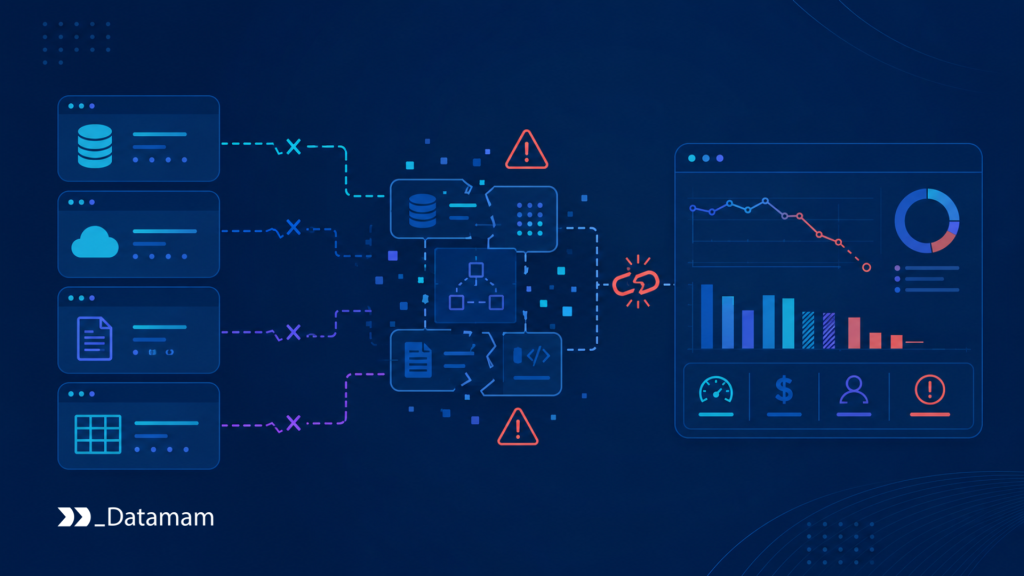
Enterprise performance depends on whether information can move across functions with shared meaning. Many organizations have invested in cloud platforms, warehouses, analytics tools, AI systems, customer platforms, ERP systems, and external data feeds. However, those investments do not automatically create a connected decision environment. When data remains fragmented across systems, teams operate from partial evidence, conflicting metrics, and inconsistent assumptions.
Data Fragmentation Risk is the exposure created when enterprise data is dispersed across fragmented data systems, disconnected data environments, and poorly aligned workflows. The issue is not only technical inefficiency. Fragmentation affects revenue visibility, risk monitoring, AI reliability, forecasting confidence, and executive decision speed. At scale, the enterprise may have more data than ever while understanding less about how the business is actually performing.
Fragmentation Turns Enterprise Data into Disconnected Evidence
Enterprise data often becomes fragmented because different systems evolve around different business functions. Sales manages CRM data. Finance manages ERP and billing data. Marketing manages campaign and customer engagement data. Operations manages supply, inventory, and fulfillment data. Product teams manage usage and behavioral data. Risk and compliance teams manage control evidence. External data programs add market, competitor, regulatory, and public-source signals.
Each system may be useful on its own. However, enterprise performance depends on how well those systems connect. McKinsey’s State of AI 2025 shows that organizations continue to adopt AI broadly, but many still struggle to embed AI deeply into workflows and generate scaled enterprise impact. That gap reflects a broader infrastructure problem: advanced systems depend on connected data foundations, not isolated data assets.
Fragmented Data Systems Prevent Teams from Seeing the Full Operating Picture
Fragmented data systems limit visibility because each function sees only part of the business. A CRM may show pipeline movement. An ERP may show invoiced revenue. A support platform may show customer friction. A product analytics system may show usage behavior. External market data may show competitive pressure. If these systems are not connected through shared identifiers, definitions, and lineage, the organization cannot easily interpret cause and effect across functions.
For example, a decline in renewal rates may be explained by pricing pressure, product usage decline, support failures, competitive discounting, or regional demand change. If those signals sit in disconnected systems, teams may debate the symptom rather than identify the pattern.
In practice, fragmentation reduces the enterprise’s ability to understand performance as a system. It produces isolated evidence where leadership needs connected intelligence.
Disconnected Data Environments Create Conflicting Views Across Business Functions
Disconnected data environments create conflicting versions of operational truth. Sales may define an active customer differently from finance. Product teams may classify usage differently from customer success. Regional teams may use local category structures that do not match global reporting. External data may enter market intelligence workflows without being connected to internal revenue or product performance.
These differences create tension in executive reporting. One dashboard shows growth. Another shows margin pressure. A third shows customer churn risk. A fourth shows stronger market demand. Each view may be technically accurate inside its own environment, but the organization lacks a reconciled operating picture.
Consequently, leaders spend more time resolving metric conflicts and less time acting on business signals.
Why Siloed Data Becomes More Expensive as Systems Scale
Data silos become more expensive as organizations add more platforms, teams, markets, products, vendors, and analytical workflows. A small inconsistency may be manageable when one team uses one dataset. The same inconsistency becomes costly when it spreads across models, reports, forecasts, operational applications, and board-level performance reviews.
Gartner’s 2025 Data and Analytics Predictions state that by 2027, half of business decisions will be augmented or automated by AI agents for decision intelligence. As more decisions become AI-supported or automated, disconnected data environments become more consequential because inconsistency can influence decisions before people notice the underlying issue.
Siloed Data Flows Increase Reconciliation Work and Reporting Delays
Siloed data flows force teams into constant reconciliation. Analysts compare numbers across systems. Data engineers trace differences across pipelines. Finance reviews metric definitions. Business teams export spreadsheets to validate reports manually. AI teams investigate whether model errors come from features, labels, training data, or fragmented upstream inputs.
This work is often invisible to executives because systems continue running. Dashboards refresh. Pipelines complete. Models produce outputs. However, the organization loses time through repeated explanation, correction, and manual validation.
At scale, reconciliation becomes a hidden operating cost. The enterprise pays not only for data platforms, but also for the labor required to compensate for fragmentation.
Fragmentation Weakens AI and Analytics Before Models or Dashboards Are Built
AI and analytics systems inherit fragmentation before modeling or visualization begins. If customer identity is inconsistent across systems, customer-level models become weaker. If product taxonomy differs across regions, category analysis becomes unreliable. Also, if revenue data and usage data cannot be joined cleanly, retention insights become incomplete. If external market signals are not connected to internal performance data, market intelligence remains isolated from business execution.
Downstream systems can clean and transform data, but they cannot fully correct missing context or disconnected meaning. A model trained on fragmented inputs may produce outputs that look precise while still reflecting incomplete enterprise reality.
Therefore, fragmentation is not only a data management problem. It is a performance risk embedded in the analytical foundation.
The Strategic Cost of Disconnected Operating Environments
Disconnected data environments reduce enterprise performance because they slow decisions, weaken confidence, and create misalignment between teams. Leaders need to understand how revenue, cost, customer behavior, market pressure, operational capacity, and risk interact. Fragmentation makes that harder by separating signals that should be interpreted together.
IBM’s 2025 CDO Study emphasizes that many organizations are still working to make data ready for AI and enterprise value creation. Data readiness depends not only on quality inside individual datasets, but also on whether data can be connected, governed, and operationalized across the business. Enterprise data delivery solutions overview is crucial for addressing the challenges of fragmented data environments. By streamlining how data flows across platforms, organizations can harness insights more effectively. Implementing these solutions not only enhances operational efficiency but also empowers teams to make informed decisions swiftly.
Leaders Lose Decision Confidence When Metrics Differ Across Systems
Executive confidence declines when metrics differ across systems. If one system shows one revenue number and another system shows a different one, leaders must ask which number is correct. If customer churn differs between finance, sales, and customer success, the organization must reconcile definitions before acting. Also, if market share estimates do not align with internal sales movement, leaders may hesitate to allocate capital.
This hesitation is rational. Leaders cannot confidently act on data when they do not trust whether the evidence is complete or aligned.
As a result, fragmentation slows decision velocity. It turns strategic discussion into data arbitration.
Enterprise Performance Declines When Teams Optimize from Partial Views
Fragmentation encourages local optimization. Sales may optimize for pipeline volume without margin context. Marketing may optimize campaigns without retention visibility. Operations may optimize fulfillment without demand signals. Product teams may prioritize features without customer profitability data. Risk teams may monitor compliance indicators without commercial exposure context.
Each team may improve its own metrics while weakening enterprise outcomes. This is one of the most damaging effects of fragmentation: it allows functions to operate efficiently in isolation while the organization performs poorly as a system.
Ultimately, enterprise performance depends on aligned decisions across functions. Fragmented data systems make that alignment harder to achieve.
How Fragmentation Accumulates Over Time
Data fragmentation usually accumulates gradually. It is rarely the result of one decision. New systems are adopted to solve specific problems. Vendors are added to fill capability gaps. Business units create local reporting structures. Mergers introduce legacy platforms. External data programs add new signal sources. AI teams create feature pipelines. Over time, the enterprise becomes a collection of partially connected data environments.
The World Economic Forum’s 2025 analysis on scaling AI with strategy, data, and workforce readiness argues that strong data foundations are necessary for scaling AI. Fragmentation directly weakens those foundations because AI systems depend on connected, trustworthy, and governed data flows.
New Platforms, Vendors, Business Units, and External Sources Expand Without Shared Alignment
Enterprises often add platforms faster than they define shared data standards. A new marketing platform introduces one customer identifier. A new ERP module introduces another product hierarchy. A vendor feed uses different naming conventions. An external source adds market data that does not align with internal categories. A regional business unit creates local reporting fields that do not map to global definitions.
Each addition may be reasonable in isolation. However, without shared alignment, every new system increases the cost of connection. The result is fragmented data that requires repeated mapping, transformation, and reconciliation before it can be used across the enterprise.
In practice, fragmentation is often the byproduct of growth without data architecture discipline.
Legacy Architecture Creates Hidden Dependencies Across Critical Workflows
Legacy architecture adds another layer of fragmentation. Older systems may contain critical records but lack modern APIs. Business logic may be embedded in undocumented scripts. Manual exports may feed recurring reports. Batch processes may run on schedules that do not match current decision needs. Some systems may use outdated schemas that require constant transformation.
These dependencies often remain hidden until a workflow breaks. A dashboard stops updating. A model receives stale features. A compliance report cannot be traced. A revenue metric changes unexpectedly. Teams then discover that critical decisions depended on fragile, undocumented data movement.
Accordingly, fragmentation reduction requires visibility into both modern platforms and legacy dependencies.
The Infrastructure Layer Behind Fragmentation Reduction
Reducing fragmentation requires more than moving data into a central platform. Centralization without shared definitions, lineage, quality controls, and governance can simply relocate confusion. The infrastructure challenge is to make data flows connected, traceable, interpretable, and reliable across systems.
NIST’s AI Risk Management Framework emphasizes governance, mapping, measurement, and management for AI risk. Those functions apply directly to enterprise data fragmentation because AI and analytics systems inherit risk from disconnected sources, inconsistent transformations, and unclear data lineage. Connected data infrastructure benefits organizations by enhancing the quality of insights derived from their data. It enables businesses to make informed decisions based on a holistic view of their information assets. Ultimately, a well-structured data ecosystem fosters collaboration and innovation, driving strategic growth.
Data Flow Mapping, Lineage, and Metadata Expose Fragmentation Points
Data flow mapping shows how information moves from source systems into pipelines, warehouses, lakehouses, dashboards, models, APIs, and operational applications. It identifies where data is created, transformed, joined, delayed, enriched, or consumed.
Lineage reveals downstream dependency. If a customer table feeds a churn model, renewal dashboard, executive report, and customer success workflow, lineage helps teams understand the impact of a change. Metadata records source ownership, schema definitions, update cadence, business rules, usage constraints, quality expectations, and classification.
These controls expose fragmentation points. Teams can see where identifiers diverge, where transformations conflict, where ownership is unclear, and where disconnected environments create reporting or operational risk.
Integration, Observability, and Governance Controls Make Disconnected Environments More Manageable
Integration infrastructure connects data across systems. Airflow can orchestrate scheduled workflows. Kafka can support event-driven movement when systems require streaming or near-real-time alignment. Spark can process large-scale datasets. dbt can manage transformation logic and dependencies. Snowflake, BigQuery, and Databricks can support centralized analytics, lakehouse patterns, and scalable data modeling.
However, integration alone does not solve fragmentation. Observability systems such as Prometheus monitor freshness, latency, failures, and volume changes. Great Expectations can validate schema, completeness, uniqueness, and anomaly patterns. Data observability platforms can track quality, lineage, and pipeline health across environments.
External data adds further complexity. Playwright and other browser automation frameworks may be required when strategic signals are not available through stable APIs. Those external flows must still be mapped into internal taxonomies, governed with sourcing controls, and monitored for structural change.
Governance and Compliance Become Harder in Fragmented Environments
Fragmentation weakens governance because control depends on visibility. If data is dispersed across systems with inconsistent ownership, documentation, access rules, and lineage, the organization cannot easily prove where data came from, how it changed, who used it, or whether it remained compliant with internal and external requirements.
The World Bank’s Digital Progress and Trends Report 2025 emphasizes the importance of foundational digital systems for responsible AI adoption. Within enterprises, reducing fragmentation is part of that foundation because responsible AI and analytics require traceable, governed, and interoperable data environments. Implementing effective data quality management strategies is crucial for maintaining the integrity of information across all systems. Organizations should prioritize these strategies to ensure data remains accurate, reliable, and compliant throughout its lifecycle. Furthermore, investing in training and resources can empower teams to uphold the standards set forth by these management strategies.
Auditability Requires Connected Evidence Across the Data Lifecycle
Auditability depends on the ability to trace data through the lifecycle. Teams need to know the source of a record, the transformations applied, the systems that consumed it, the access controls used, the quality checks performed, and the decisions it influenced.
In fragmented environments, this evidence is scattered. One system may hold the source record. Another may hold the transformation logic. A third may hold the report. A fourth may hold the model output. If those systems are not connected through lineage and metadata, the audit response becomes manual and slow.
This creates risk in regulated environments, AI governance programs, financial reporting, risk monitoring, and customer data workflows. Auditability cannot depend on institutional memory.
Cross-Border and External Data Flows Increase Fragmentation Exposure
Cross-border and external data flows increase fragmentation exposure because they introduce different legal, technical, and operational conditions. Data may move across jurisdictions, vendors, cloud regions, third-party platforms, and public sources. Each environment may have different rules for access, usage, retention, sourcing, and transfer.
Disconnected data environments make those obligations harder to enforce. A dataset collected for analytics may later be used for AI training without proper review. A source approved for one jurisdiction may be combined with data from another. A vendor feed may enter a warehouse without clear usage metadata.
Therefore, fragmentation is also a compliance architecture issue. Governance controls must travel with the data, not remain isolated in policy documents.
Why Fragmentation Is Becoming an Executive Governance Issue
Data Fragmentation Risk is becoming an executive governance issue because fragmented data affects enterprise performance directly. It slows decision-making, weakens AI readiness, increases reporting friction, creates operational inconsistency, and reduces confidence in strategic planning. Leaders cannot delegate the issue entirely to technical teams because the business impact appears across functions.
Executives need visibility into where fragmentation affects critical decisions. Which systems define customers differently? Which data flows support revenue reporting? Also, which dashboards depend on manual reconciliation? Which AI models rely on fragmented feature pipelines? Which external data sources remain disconnected from internal performance data?
Leaders Need Visibility into Where Fragmentation Affects Critical Decisions
Leadership visibility should focus on critical decision paths. A board-level revenue report may depend on CRM, ERP, billing, product usage, and regional reporting data. A pricing decision may depend on competitor data, margin data, inventory data, and demand signals. A risk workflow may depend on public records, internal controls, vendor information, and regulatory updates.
If these flows are fragmented, leaders need to know where the exposure exists. This does not require executives to manage pipelines manually. It requires clear reporting on dependency, quality, ownership, and unresolved fragmentation risk.
In this context, fragmentation visibility supports better capital allocation. Leaders can prioritize infrastructure investment where disconnected data creates the greatest performance risk.
Scalable Data Programs Require Shared Standards, Ownership, and Continuous Alignment Review
Scalable data programs require shared standards for identifiers, schemas, taxonomies, definitions, refresh cadence, access control, data contracts, metadata, lineage, and quality thresholds. Without these standards, every new platform or source increases fragmentation.
Ownership is equally important. Data engineering may operate pipelines, but business teams define meaning. Governance teams define controls. AI teams define model input requirements. Analytics teams define reporting logic. Legal and compliance teams define usage constraints. Fragmentation persists when ownership is unclear across these boundaries.
Ultimately, Data Fragmentation Risk undermines enterprise performance because it turns data abundance into disconnected evidence. Fragmented data systems limit visibility. Data silos risk increases operational drag. Disconnected data environments weaken AI, analytics, governance, and executive confidence.
Organizations that treat fragmentation as an infrastructure and governance issue will build stronger decision environments. Those that treat it as a platform problem alone may continue adding systems, but they will struggle to make enterprise data coherent enough to support performance at scale.