Key Takeaways
- Integration Sync Architecture defines how enterprise systems keep operational data aligned across ERP, CRM, warehouse, BI, product, supplier, and order management environments.
- Data synchronization design should clarify sync direction, system ownership, update rules, latency requirements, and conflict handling before production delivery.
- Sync frequency planning helps teams balance freshness, cost, system load, business timing, and operational reliability.
- Real-time synchronization should be reserved for workflows where delayed data creates operational risk, not applied universally.
- Operational data sync requires monitoring, idempotency, replay logic, audit trails, ownership, and recovery procedures.

Enterprise systems do not remain consistent simply because they are connected. ERP, CRM, warehouse, order management, product information, supplier, and analytics systems may exchange data successfully while still drifting out of alignment. Updates may arrive late. Events may be missed. Records may be duplicated. Conflicting changes may occur in two systems at once. A field may update in one platform but not reach another before an operational decision is made.
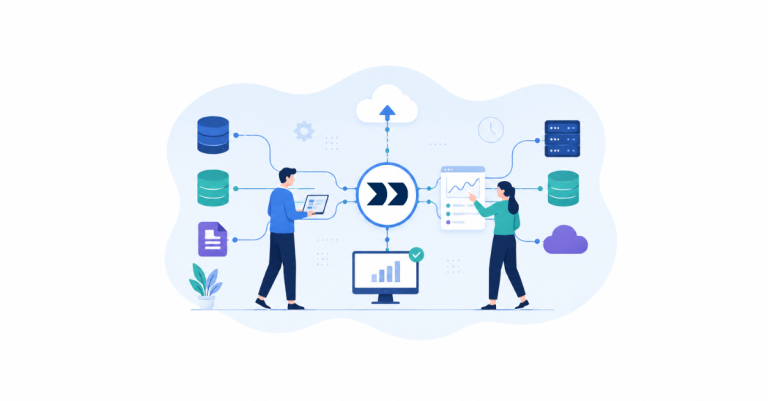
Integration Sync Architecture defines how data synchronization works across enterprise systems. It establishes which systems publish updates, which systems consume them, how often synchronization occurs, how conflicts are resolved, and how failures are detected.
In cross-system integration programs, synchronization is not a background job. It is an operational control that determines whether teams can trust shared records, workflows, dashboards, and downstream systems.
Why Integration Sync Architecture Matters in Enterprise Data Programs
Integration Sync Architecture matters because connected systems still operate with different clocks, ownership rules, and process assumptions. A CRM update may need to reach ERP before billing. An inventory change may need to reach order management before a customer order is accepted. A product update may need to reach digital channels before launch. A supplier status change may need to reach procurement workflows before risk decisions are made.
Gartner’s 2025 data and analytics predictions emphasize that AI-augmented and automated decisions are becoming more common across enterprise operations, which increases the need for reliable data foundations before downstream actions are automated. Data reliability impacts business strategies significantly, as businesses increasingly depend on data-driven insights for decision-making. Ensuring that data is accurate and timely can enhance operational efficiency and foster better customer relationships. Organizations that invest in data integrity are better positioned to adapt to market changes and drive innovation.
Why Connected Systems Still Drift Without Sync Controls
System drift occurs when two or more systems represent the same business entity differently. A customer address may be updated in CRM but remain stale in ERP. A product status may change in the product information system, but not reach the e-commerce platforms. A supplier risk flag may update in a governance tool but not propagate to procurement systems.
This drift can happen even when integration jobs are running. A sync job may operate on the wrong cadence. An event may fail silently. A target system may reject a record. A retry may create duplicates. A batch process may overwrite a newer value with an older one.
Integration Sync Architecture prevents uncontrolled drift by defining sync direction, source of truth, update timing, conflict rules, monitoring expectations, and recovery logic. The objective is not only to move data. It is to keep the operational state consistent across systems.
How Poor Synchronization Creates Operational Data Risk
Poor synchronization creates risk because operational teams act on system state. Sales teams rely on account records. Finance teams rely on billing status. Supply chain teams rely on inventory availability. Customer support teams rely on order state. Executives rely on dashboards that summarize system activity.
If synchronization is weak, each team may operate from a different version of reality. Orders may be accepted against stale inventory. Customers may receive inconsistent service updates. Product launches may appear complete in one system but incomplete in another. AI workflows may consume records before sync completion.
IBM’s 2025 recognition in the Gartner Magic Quadrant for Data Integration Tools reinforces the enterprise priority of simplifying integration, reducing complexity, and delivering trusted data at scale. Sync architecture is one of the mechanisms that turns integration from data movement into operational trust.
Data Synchronization Design Across Enterprise Systems
Data synchronization design defines how updates move between systems. It should clarify ownership, direction, latency expectations, event rules, transformation responsibilities, failure handling, and downstream impact.
A synchronization design should not begin with tool selection. It should begin with operational requirements: which processes depend on current data, which systems own specific records, and what happens when systems disagree. Data mapping techniques in integration projects play a crucial role in ensuring coherence between different data systems. Effective data mapping facilitates accurate communication of information, enabling seamless interaction while minimizing discrepancies. Furthermore, these techniques can enhance data quality and streamline processes, ultimately leading to improved operational efficiency.
Defining System Roles, Sync Direction, and Data Ownership
Every synchronization architecture needs defined system roles. One system may be the system of record for customer identity. Another may own billing information. A product information system may own product attributes. A warehouse management system may own stock movement. A data warehouse may store analytical history but not its own operational updates.
Sync direction follows ownership. Some flows are one-way, such as ERP publishing invoice status to BI. Some are bidirectional, such as CRM and support systems updating customer contact details. Also, some are hub-and-spoke, where a central integration layer distributes updates to multiple targets.
Without clear ownership, systems can overwrite each other. A target system may push a stale update back to the source. A downstream enrichment process may become confused with a master record. A synchronization design should define which system wins for each data domain and which systems can only consume.
Choosing Between Batch, Near Real-Time, and Event-Driven Sync
Not every integration requires real-time synchronization. Batch sync works well for low-urgency workflows, nightly reporting, historical loads, and scheduled operational updates. Near real-time sync supports processes where delays of minutes are acceptable. Event-driven sync is appropriate when business processes require immediate propagation of changes.
The architecture should match the business process. Inventory reservations, fraud alerts, order status changes, and customer support events may require low-latency sync. Monthly finance reporting, master data exports, and historical analytics may operate effectively on scheduled batches.
The wrong model creates cost or risk. Overusing real-time synchronization increases complexity. Underusing it creates stale data in time-sensitive workflows. A mature data synchronization design assigns sync models by process criticality.
Designing Sync Logic for ERP, CRM, Warehouse, BI, and Operational Systems
ERP, CRM, warehouse, BI, and operational systems have different synchronization expectations. ERP workflows often require controlled, auditable updates. CRM systems may need fast customer and opportunity changes. Warehouse systems may require accurate stock and movement events. BI systems may tolerate delay but require consistency and historical integrity.
Sync logic should reflect the target behavior. An operational system may reject incomplete records. A warehouse may accept late-arriving events if lineage and timestamps are preserved. A BI layer may require a consistent snapshot rather than a continuous stream of partial updates.
In practice, sync design should identify which systems need the current operational state and which systems need a validated analytical state. These are different requirements.
Sync Frequency Planning for Operational Data Consistency
Sync frequency planning defines how often data should move between systems. It controls the balance between freshness, performance, cost, and reliability.
The fastest sync frequency is not always the best design. High-frequency synchronization can increase API calls, message volume, compute cost, monitoring burden, and system contention. Low-frequency synchronization can create a stale operational state. The correct cadence depends on decision timing.
Matching Sync Frequency to Business Process Timing
Sync frequency should match the timing of the business process. If a customer support system needs order updates within minutes, daily synchronization is insufficient. If a finance report closes monthly, continuous synchronization may be unnecessary. Also, if inventory availability affects checkout, latency tolerance may be measured in seconds.
Business process timing should define an acceptable delay. This delay becomes the sync service-level expectation. The architecture should specify whether each domain requires real-time, near real-time, hourly, daily, or scheduled synchronization.
This prevents teams from applying one global cadence across all systems. Customer, product, supplier, inventory, order, and finance data may each need different sync behavior.
Balancing Freshness, Cost, Load, and System Stability
Sync frequency planning must balance freshness against operational cost. More frequent synchronization can increase source system load, target system write pressure, API consumption, queue volume, storage growth, and monitoring complexity.
High-frequency sync also increases the failure surface. More events mean more opportunities for duplicate delivery, partial failure, schema mismatch, or downstream lag. Therefore, sync frequency should be justified by business value.
A strong sync frequency plan defines freshness requirements, expected volume, peak load, retry behavior, and degradation rules. If real-time sync fails, the system should know whether to retry, queue, degrade to batch, or pause downstream operations.
Managing Different Sync Frequencies Across Data Domains
Different data domains require different cadences. Customer profile updates may sync quickly across CRM and support. Product catalog updates may sync on release schedules. Inventory may require near real-time updates. Supplier risk scores may refresh daily. Finance records may sync after controlled close processes.
Managing these different frequencies requires orchestration. Some workflows depend on multiple domains. An order record may depend on customer, inventory, price, tax, and fulfillment data. If these domains sync at different intervals, downstream systems must understand freshness boundaries.
This is where sync metadata becomes important. Systems should know when each domain was last synchronized, whether sync completed successfully, and whether downstream outputs are based on current or delayed data.
Real-Time Synchronization and Event-Driven Integration
Real-time synchronization can improve operational responsiveness, but it introduces architectural complexity. It should be applied where latency creates measurable business risk.
Event-driven integration is often the preferred model for real-time synchronization because systems publish changes as events rather than waiting for scheduled extraction. However, event-driven systems require strong design discipline.
When Real-Time Synchronization Is Operationally Necessary
Real-time synchronization is necessary when delayed data can create immediate operational harm. Examples include order state changes, payment confirmation, fraud detection, inventory reservations, customer support escalations, security events, and critical supplier or compliance updates.
By contrast, many enterprise workflows do not require real-time sync. Strategic reporting, historical analytics, periodic performance review, and low-volatility reference data often work better with controlled scheduled synchronization.
The decision should be based on operational consequences, not technology preference. Real-time synchronization should be used where latency affects decisions, customer experience, compliance, or process continuity.
Using Kafka, APIs, Webhooks, CDC, and Message Queues for Event Flow
Real-time and near real-time synchronization can use several patterns. Kafka can distribute event streams across multiple consumers. APIs can provide controlled request-response updates. Webhooks can notify downstream systems when changes occur. Change data capture can detect database-level changes. Message queues can buffer events and protect systems from spikes.
Each pattern has tradeoffs. Kafka supports scalable event distribution but requires event governance. APIs provide direct control but can become tightly coupled. Webhooks are useful for notifications, but need retry and verification logic. CDC captures database changes but may expose technical changes rather than business events. Queues improve resilience but require monitoring for lag and dead-letter handling.
A reliable architecture often combines patterns. The key is to define event ownership, delivery expectations, ordering rules, idempotency, and replay behavior.
Preventing Real-Time Sync from Creating Uncontrolled Complexity
Real-time synchronization can create uncontrolled complexity if every system publishes and consumes events without governance. Event sprawl makes it difficult to understand which systems depend on which updates. Inconsistent event schemas can create downstream failures. Missing replay logic can make recovery difficult.
Event-driven architecture should include event catalogs, schema governance, ownership, versioning, consumer registration, monitoring, and retention policies. Teams should know what each event means, who owns it, which systems consume it, and what happens when delivery fails.
Gartner’s 2025 research on data and analytics governance operating models describes governance pressure from AI and more complex data use. Real-time synchronization increases that pressure because operational decisions can depend on events moving correctly across systems.
Operational Data Sync Controls and Failure Handling
Operational data sync requires controls that detect failures, prevent duplicates, support recovery, and protect downstream systems. A synchronization job that appears successful may still miss events, process records out of order, or create an inconsistent state.
Failure handling should be designed into the architecture, not added after incidents.
Detecting Sync Failures, Delays, Duplicates, and Missed Events
Sync monitoring should track job status, event lag, queue depth, error rates, duplicate counts, rejected records, retry volume, and last successful sync time. It should also detect domain-specific anomalies, such as sudden drops in order events, unexpected inventory gaps, or missing customer updates.
Delay detection is especially important. A sync may still be running, but too far behind to support the business process. Missed events are more dangerous because they may not trigger obvious errors. Reconciliation checks can compare source and target counts, timestamps, checksums, or entity states to identify drift.
Monitoring should distinguish internal integration failures from source system delays or target system rejections. The response path differs depending on the cause.
Managing Conflict Resolution, Idempotency, and Replay Logic
Conflict resolution defines what happens when two systems update the same record. The architecture may use system-of-record rules, timestamp precedence, workflow status, manual review, or domain-specific survivorship logic. These rules should be documented before conflicts occur.
Idempotency ensures that processing the same event more than once does not create duplicate effects. This is critical in retry-based systems. If a payment confirmation event is retried, it should not create multiple confirmations.
Replay logic allows teams to recover from failures by reprocessing events or records from a known point. Without replay, missed events may require manual reconstruction. Reliable operational data sync requires the ability to recover state after outage, lag, deployment error, or partial failure.
Protecting Downstream Systems During Partial Sync Failures
Partial sync failure occurs when some updates complete and others fail. This can leave systems in inconsistent states. For example, customer updates may sync successfully while related order updates fail. Product records may update without corresponding price updates. Inventory may sync without reservation events.
Downstream systems should be protected during partial failures. This may require publication gates, quarantine tables, degraded operating modes, warning flags, or controlled rollback. Critical dashboards and workflows should show sync status when data is incomplete.
In practice, operational consistency depends on making sync state visible. Users and systems should know when data is current, delayed, partial, or unreliable.
Technology and Integration Considerations
Integration Sync Architecture depends on orchestration, streaming, transformation, observability, storage, and lineage systems. The architecture should make synchronization executable, monitored, and auditable.
According to IBM’s 2025 data integration guidance, enterprise integration priorities include simplifying integration, reducing complexity, and delivering trusted data at scale. Sync metadata and operational monitoring are central to achieving that reliability in live systems. Data integration solutions for enterprises play a crucial role in ensuring seamless workflows across multiple platforms. These solutions enable organizations to connect disparate systems, allowing for improved data consistency and accessibility. As a result, businesses can make more informed decisions based on real-time insights and analytics.
Using Airflow, Kafka, Spark, dbt, and Observability Tools for Sync Operations
Airflow can orchestrate scheduled sync workflows, dependencies, retries, backfills, and failure notifications. Kafka can support event-driven synchronization and publish-subscribe patterns. Spark can process high-volume sync reconciliation, deduplication, and state comparison. dbt can manage analytical sync transformations and tests. Observability tools such as Prometheus can monitor sync lag, failures, throughput, and service health.
These tools should be connected through operating rules. Airflow should not only run jobs. It should enforce dependencies and recovery logic. Kafka should not only carry events. It should preserve event contracts and replay windows. Observability should not only detect infrastructure failures. It should monitor business-level sync health.
The technology stack should make synchronization state visible to engineering, data operations, and business stakeholders.
Connecting Sync Metadata to Snowflake, BigQuery, Databricks, BI, and Lineage Systems
Sync metadata should be stored and exposed in downstream environments. Warehouses such as Snowflake, BigQuery, and Databricks should preserve load time, source event time, sync batch ID, source system, and processing status where relevant.
BI dashboards should show freshness status for critical data products. AI workflows should know whether input data came from a complete sync or a partial sync. Lineage systems should show which downstream assets depend on specific sync flows.
This visibility matters during incidents. If a CRM-to-warehouse sync is delayed, teams should know which dashboards, reports, models, and operational workflows are affected. Sync metadata turns integration status into an enterprise control rather than an engineering detail.
Governance and Auditability in Integration Sync Architecture
Synchronization governance defines who owns sync flows, who approves cadence, how failures are escalated, and how sync changes are reviewed. Without governance, synchronization behavior can drift as systems evolve.
The OECD.AI 2025 Data Governance Working Group Report highlights the technical, legal, and institutional dimensions of data governance. Integration Sync Architecture reflects the same pattern because sync reliability depends on technical execution, business accountability, and institutional oversight.
Creating Ownership, Sync Policies, Review Cycles, and Escalation Paths
Each critical sync flow should have a defined owner. Ownership should include technical responsibility, business accountability, and escalation authority. Teams should know who owns the source system, target system, integration logic, and downstream data product.
Sync policies should define cadence, latency tolerance, retry rules, failure thresholds, conflict handling, and recovery procedures. Review cycles should occur when systems change, business processes change, data volumes increase, or incidents occur.
Escalation paths matter because sync issues often span teams. A delay may involve source system owners, integration engineers, target platform teams, business users, and governance stakeholders. A predefined path reduces response time.
Maintaining Audit Trails for Sync Events, Failures, and Recovery Actions
Audit trails should preserve sync executions, event processing, failures, retries, replays, manual corrections, conflict resolutions, and recovery actions. These records help teams investigate incidents and demonstrate control.
Auditability is especially important when synchronized data supports financial processes, customer operations, compliance workflows, AI systems, or executive reporting. Teams should be able to explain when data was moved, whether it completed, what failed, and how recovery was handled.
A strong audit trail also supports continuous improvement. Repeated failures can reveal fragile systems, poor cadence choices, weak event contracts, or insufficient ownership.
Conclusion: Turning Synchronization into Controlled Integration Infrastructure
Integration Sync Architecture determines whether connected systems remain operationally consistent after integration. Data movement alone is not enough. Enterprises need clear synchronization design, sync frequency planning, real-time synchronization controls, conflict handling, monitoring, replay logic, and auditability.
Strong data synchronization design defines system ownership, sync direction, update rules, and latency expectations. Sync frequency planning aligns freshness with business process timing while managing cost and system stability. Real-time synchronization is used where delay creates operational risk, not as a default pattern. Operational data sync controls detect failures, prevent duplicates, support recovery, and protect downstream systems during partial failure.
The capability matters because enterprise performance depends on a shared operational state. ERP, CRM, warehouse, BI, supplier, product, inventory, order, and AI systems can only support consistent decisions if synchronization is governed and reliable.
A structured review can help evaluate whether current integration workflows have a reliable Integration Sync Architecture, data synchronization design, sync frequency planning, real-time synchronization controls, and operational data sync monitoring. You can run an external data infrastructure audit with our team to review your current setup and understand what is required to build a reliable, enterprise-scale integration infrastructure.