Key Takeaways
- Data Integration Governance determines whether connected systems can be trusted after launch.
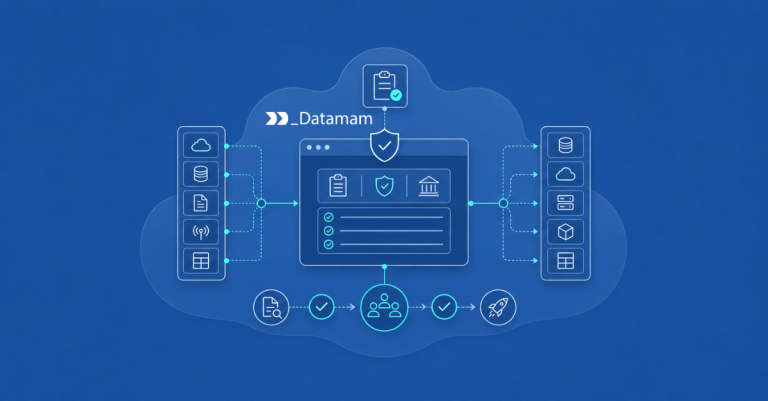
- An integration governance framework establishes rules before data moves across systems.
- Enterprise integration controls reduce rework, compliance exposure, and decision risk before pipelines become dependencies.
- Cross-system governance requires shared standards for lineage, metadata, access, quality, auditability, and ownership.
Data integration governance cannot begin after systems are already delivered. By the time a pipeline is live, data has already crossed system boundaries, transformation rules have already shaped meaning, access paths have already been created, and downstream dependencies may already exist. Adding governance at that stage often means rebuilding controls around decisions that have already been made.
Data Integration Governance is the discipline of defining how data should move, transform, validate, trace, and remain controlled across connected systems. It includes ownership, lineage, metadata, access controls, quality standards, audit logs, usage rules, cross-border constraints, and escalation procedures. As enterprises rely more heavily on AI, analytics, automation, and connected operating systems, governance must be designed into integration before delivery, not attached afterward.
Data Integration Governance Defines Whether Connected Systems Can Be Trusted After Launch
Connected systems create value only when the data moving between them remains controlled, traceable, and reliable. A pipeline may technically deliver data from one platform to another, but technical delivery does not guarantee that the data is fit for governed use. Leaders need to know where the data came from, how it changed, who can access it, what rules apply, and which decisions depend on it.
McKinsey’s State of AI 2025 notes that AI tools are now common, but most organizations have not embedded them deeply enough into workflows and processes to realize material enterprise-level benefits. That gap matters for integration governance because scaled AI and analytics depend on governed data flows, not merely connected systems.
Integration Governance Frameworks Establish Rules Before Data Moves Across Systems
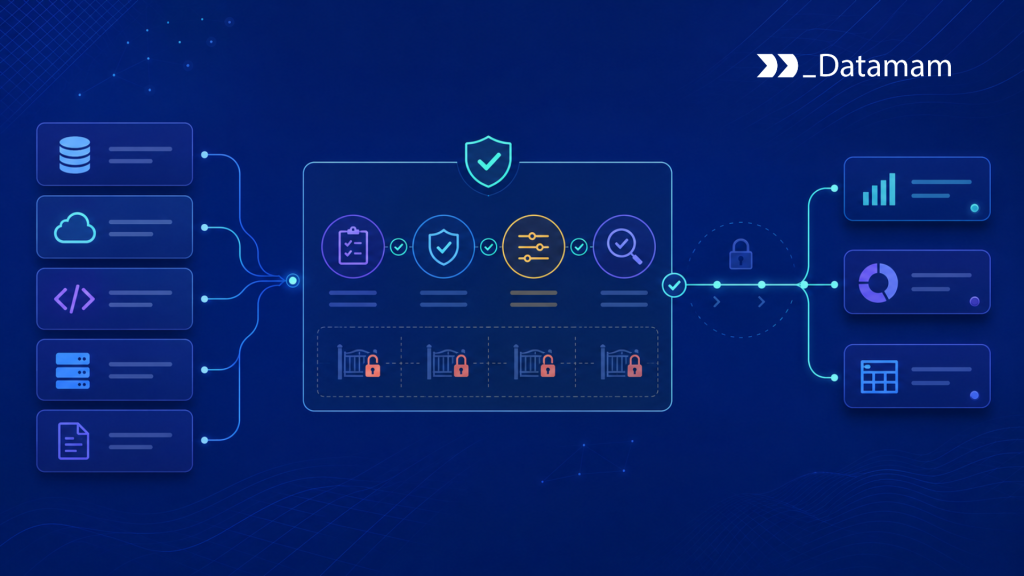
An integration governance framework defines the rules that apply before data moves between systems. It should clarify source ownership, target ownership, transformation responsibility, validation expectations, access controls, retention rules, usage constraints, data classification, lineage requirements, and escalation paths.
Without this framework, integration decisions become fragmented. Engineering may prioritize delivery speed. Business teams may prioritize availability. Legal teams may enter late. Governance teams may inherit undocumented flows. AI and analytics teams may consume data without knowing whether it is complete, current, or approved for the intended use.
In practice, governance must be part of integration design. It should shape how data is collected, transformed, delivered, monitored, and consumed before downstream systems become dependent on the flow.
Enterprise Integration Controls Reduce Risk Before Pipelines Become Business Dependencies
Enterprise integration controls reduce the risk that weak data movement becomes embedded in critical workflows. Controls should define schema expectations, validation thresholds, data contracts, access permissions, logging requirements, quality checks, and lineage capture before a pipeline enters production.
This matters because integrations become dependencies quickly. A pipeline may begin as support for one dashboard and later feed executive reporting, AI features, operational alerts, or compliance workflows. If the integration was not governed from the start, teams may discover too late that source definitions are unclear, transformations are undocumented, or access rules are too broad.
Accordingly, governance before delivery protects the enterprise from building business dependency on uncontrolled data movement.
Why Governance Cannot Be Added After Integration Is Delivered
Late governance creates rework because data flows have already been designed around assumptions. Field definitions may be inconsistent. Access paths may be too permissive. Lineage may not have been captured. Metadata may be incomplete. Quality checks may be missing. Business users may already rely on outputs that cannot be fully explained.
Gartner’s 2025 Data and Analytics Predictions state that by 2027, half of business decisions will be augmented or automated by AI agents for decision intelligence. As more decisions become AI-supported or automated, post-delivery governance becomes more dangerous because uncontrolled integrations can influence decisions before teams identify the exposure.
Late Governance Creates Rework Across Pipelines, Warehouses, Models, and Reports
When governance is added late, teams often have to rebuild parts of the integration. Pipelines may need new validation steps. Warehouses may need revised schemas. dbt models may need updated transformation logic. AI feature pipelines may require retraining or revalidation. Dashboards may need metric definitions corrected. Access policies may need to be redesigned.
This rework is expensive because downstream systems have already absorbed the original integration design. A single undocumented field may appear in multiple reports. A transformation rule may affect several models. A source without proper usage documentation may already support business decisions.
Therefore, governance should not be treated as a final approval stage. It should be embedded early enough to prevent uncontrolled decisions from becoming architecture.
Cross System Governance Becomes Harder Once Definitions, Access, and Lineage Are Already Fragmented
Cross-system governance is hardest when every system has already developed its own rules. CRM, ERP, warehouse, BI, AI, external data, and operational systems may each carry different definitions, access models, metadata standards, and audit practices. Once those inconsistencies are embedded, alignment becomes a remediation project rather than a design principle.
For example, customer status may mean one thing in CRM, another in billing, and another in customer success reporting. Product hierarchies may differ between internal catalogs, marketplaces, and analytics models. External data may enter market intelligence workflows without clear sourcing documentation or usage controls.
In this context, late governance becomes slower and less reliable. Teams must reconstruct what should have been designed, documented, and controlled from the beginning.
The Strategic Risk of Weak Integration Governance
Weak integration governance creates strategic risk because connected systems influence business decisions. Data integrations feed AI models, revenue dashboards, risk monitors, pricing workflows, customer intelligence, financial reports, and operational systems. If governance is weak, decision systems may operate from data that is incomplete, unauthorized, poorly documented, or difficult to audit.
IBM’s 2025 CDO Study emphasizes the importance of decision-ready data as organizations pursue AI and data-driven value. Decision-ready data requires governance before data is operationalized, especially when information moves across systems and becomes part of critical workflows. Executive data integration strategies are essential for maintaining high-quality data governance. By prioritizing seamless connections between various data sources, organizations can ensure that their decision-making processes are based on accurate and reliable information. Furthermore, implementing robust integration strategies helps mitigate operational risks and enhances overall business performance.
Ungoverned Integrations Create Decision Risk Across AI, Analytics, and Operations
Ungoverned integrations create decision risk because downstream users may not know whether data is reliable or appropriate for use. A dashboard may use a field that was transformed without documentation. A model may train on data that was approved for analytics but not for AI training. An operational workflow may act on stale or incomplete data because freshness rules were not defined.
AI systems are especially exposed. Models may inherit access issues, representativeness gaps, source quality problems, or transformation errors. Analytics teams may produce reports that cannot be reconciled. Operations teams may act on data that moved successfully but lacks the controls needed for critical decisions.
Ultimately, ungoverned integration creates the appearance of connectivity while weakening decision reliability.
Compliance Exposure Increases When Data Movement Is Not Traceable or Controlled
Compliance exposure increases when data movement is not traceable. Enterprises need to know what data was moved, where it came from, who accessed it, how it changed, whether usage was permitted, and which systems consumed it. This is especially important for customer data, regulated data, external data, vendor feeds, cross-border transfers, and AI workflows.
A technically successful integration may still create risk if usage rights, consent constraints, data residency requirements, platform terms, retention rules, or access controls are unclear. External data may be permissible for one use case but inappropriate for another. Customer data may be usable for reporting but restricted for automated decision-making or model training.
Therefore, integration governance must include legal and sourcing controls before data movement scales. Compliance cannot rely on after-the-fact reconstruction.
How Data Integration Governance Shapes System Reliability
System reliability depends on whether data flows are governed as they move. A pipeline that runs on time but lacks validation, lineage, access control, or metadata is not fully reliable. It may deliver data, but it does not deliver enough evidence for teams to trust the output over time.
NIST’s AI Risk Management Framework emphasizes governance, mapping, measurement, and management across AI risk. These functions apply directly to integration governance because AI and analytics systems inherit risk from the way data is sourced, transformed, moved, and consumed.
Shared Standards Preserve Meaning, Quality, and Ownership Across Connected Workflows
Shared standards define how data should behave as it moves across systems. These standards should include schema expectations, naming conventions, entity definitions, timestamp handling, transformation rules, quality thresholds, refresh cadence, access categories, and ownership responsibilities.
Without shared standards, every integration creates its own interpretation of meaning. One pipeline may define an active customer differently from another. One transformation may classify regions differently. One external source may use categories that do not match internal reporting. These inconsistencies then become decision risk downstream.
Shared standards make integration more reliable because they reduce ambiguity. Teams know what data means, how it should be validated, who owns it, and when issues should be escalated.
Audit Logs, Metadata, and Lineage Make Integrated Data Defensible Over Time
Integrated data must be defensible over time. Audit logs show access, changes, and operational activity. Metadata records source context, field definitions, ownership, classification, quality expectations, and usage constraints. Lineage shows how data moved from source through transformations into models, dashboards, APIs, reports, and operational workflows.
These controls are essential when decisions are questioned. If an executive report changes, lineage helps show whether the change came from a source update, a transformation rule, or real business movement. If a model produces unexpected results, metadata helps teams examine input quality and usage permissions. Also, if an audit occurs, logs provide evidence of control.
In practice, defensibility is not created at the end of delivery. It is created through governance controls embedded from the start.
The Infrastructure Layer Behind Enterprise Integration Controls
Enterprise integration controls must be implemented inside the infrastructure layer, not left only in policies. Policies define expectations, but infrastructure enforces behavior. The operating layer must capture lineage, validate data, monitor workflows, control access, preserve metadata, and make integration changes visible.
The World Economic Forum’s 2025 analysis on scaling AI with strategy, data, and workforce readiness argues that strong data foundations are necessary for enterprise AI scale. Integration governance is part of those foundations because AI systems require controlled and traceable data movement before they can be trusted at scale. Data fragmentation impact on performance can lead to inefficiencies and hinder decision-making processes. Organizations must prioritize the elimination of data silos to enhance data accessibility and integrity. By doing so, they can unlock the full potential of their data assets and drive better outcomes across various business functions.
Orchestration, Transformation, Validation, and Observability Must Include Governance Logic
Airflow can orchestrate ingestion, validation, transformation, and delivery workflows. Kafka can support event-driven data movement where streaming or near-real-time integration is needed. Spark can process high-volume datasets across distributed environments. dbt can structure transformations into governed, documented models. Snowflake, BigQuery, and Databricks can provide scalable environments for integrated data.
However, these systems need governance logic. Workflows should capture metadata, apply validation rules, enforce schema expectations, record lineage, and trigger escalation when quality or compliance thresholds fail. Great Expectations can support schema, completeness, uniqueness, and anomaly checks. Prometheus and other observability systems can monitor freshness, latency, failures, and volume changes.
External data adds complexity. Playwright and browser automation frameworks may be required when strategic signals are not available through stable APIs. Those flows must include source documentation, sourcing controls, legal review where appropriate, and monitoring for structural source changes.
Access Controls, Versioning, and Monitoring Help Prevent Silent Governance Drift
Governance drift occurs when systems gradually move away from approved rules. A field is reused for a new purpose. A pipeline is modified without updating documentation. A dataset approved for analytics is used in model training. A source changes structure. A transformation rule becomes outdated. An access permission remains open after business needs change.
Access controls help limit who can use data and for what purpose. Versioning preserves changes in schemas, datasets, transformations, and source behavior. Monitoring detects freshness issues, schema changes, data quality problems, and workflow failures.
Together, these controls reduce silent drift. They help teams detect when integrations no longer match governance expectations and correct issues before downstream decisions are affected.
Why Data Integration Governance Is Becoming an Executive Priority
Data Integration Governance is becoming an executive priority because integration failures now affect enterprise decisions directly. Data flows support AI, analytics, reporting, compliance, customer operations, revenue planning, risk monitoring, and market intelligence. If those flows are uncontrolled, leaders inherit hidden risk through the systems they rely on.
The World Bank’s Digital Progress and Trends Report 2025 emphasizes foundational digital systems for responsible and scalable AI adoption. Within enterprises, governed integration is part of that foundation because data must move through connected systems in ways that are traceable, controlled, and fit for use. Implementing enterprise data management solutions is essential for organizations looking to enhance data quality and accessibility. These solutions enable businesses to streamline their operations, improve decision-making processes, and gain competitive advantages in rapidly changing markets. By prioritizing robust data management practices, companies can ensure their data assets are utilized effectively and securely.
Leaders Need Visibility into Which Integrations Support Critical Decisions
Executives do not need to inspect every pipeline. However, they need visibility into the integrations that support critical decisions. Which flows feed production AI systems? Which support executive dashboards? Also, which connects CRM, ERP, billing, product, and customer systems? Which external data integrations support pricing, risk, or market intelligence? Which flows carry sensitive or regulated data?
This visibility allows leaders to prioritize governance efforts. A low-risk exploratory integration may require lighter controls. A production integration supporting financial reporting, AI decisions, or compliance monitoring requires stronger governance.
In this context, integration governance becomes part of executive risk management. Leaders need to understand where critical decisions depend on controlled or uncontrolled data movement.
Scalable Data Programs Require Governance Standards, Cross-Functional Ownership, and Continuous Review
Scalable data programs require governance standards before systems are delivered. These standards should define source approval, transformation ownership, schema rules, metadata requirements, access controls, lineage capture, audit logs, quality thresholds, retention rules, cross-border controls, and escalation procedures.
Cross-functional ownership is essential. Data engineering operates pipelines. Business teams define meaning. Analytics teams define reporting logic. AI teams define model input requirements. Governance teams define control standards. Legal and compliance teams define usage constraints. Security teams define access and monitoring expectations.
Ultimately, Data Integration Governance starts before system delivery because governance decisions shape architecture. An integration governance framework defines the rules before data moves. Cross-system governance preserves meaning and accountability. Enterprise integration controls reduce downstream risk before pipelines become dependencies.
Organizations that govern integration before delivery will build systems that are more reliable, auditable, and scalable. Those that add governance afterward may still connect systems, but they will spend more time rebuilding trust, correcting controls, and explaining decisions that were made on top of unmanaged data movement.