Key Takeaways
- Data Delivery Resilience determines whether data flows continue during failure conditions.
- Delivery recovery design helps teams restore failed, delayed, or interrupted data movement.
- Enterprise data resilience depends on queue management, retry logic, endpoint monitoring, and fallback paths.
- Data continuity planning reduces disruption across dashboards, reports, AI workflows, compliance, and operations.
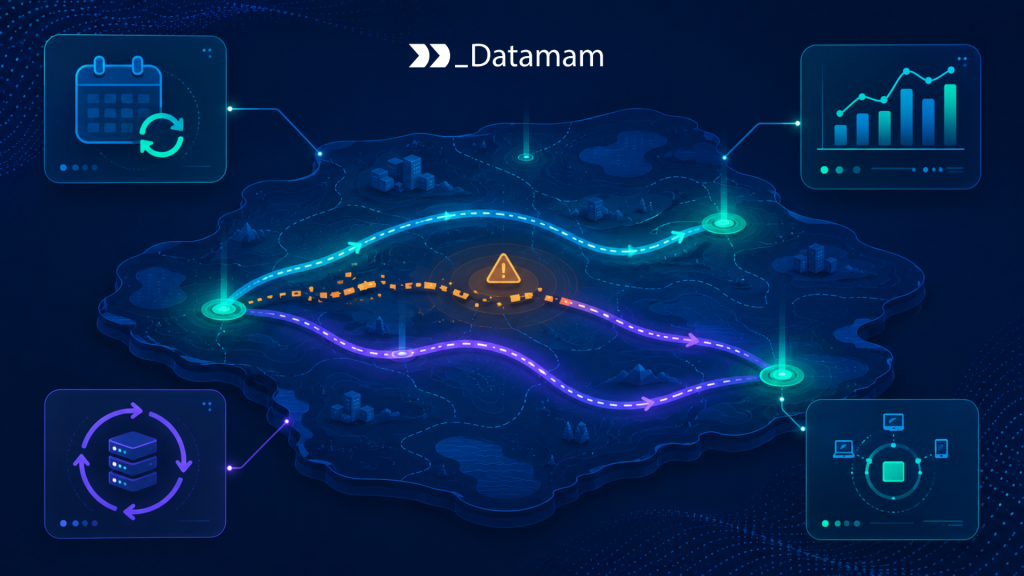
Data delivery resilience has become a business issue because enterprise workflows now depend on data movement that cannot simply stop when an endpoint fails, a queue backs up, a validation check blocks records, or a downstream system becomes unavailable. Dashboards, AI workflows, compliance reports, procurement systems, revenue operations, inventory updates, product catalogs, and market intelligence programs all depend on data reaching the right destination under changing operating conditions.
Data Delivery Resilience refers to the ability of data delivery systems to continue, recover, reroute, or degrade safely when failures occur. It includes delivery recovery design, enterprise data resilience, data continuity planning, queue management, retry logic, endpoint monitoring, validation, fallback paths, delivery status tracking, observability, lineage, metadata, audit logs, and ownership. When resilience is weak, delivery failure becomes more than a technical incident. It becomes a business continuity risk.
Data Delivery Resilience Determines Whether Data Flows Continue During Failure Conditions
Modern enterprise data environments are distributed by design. A single prepared dataset may need to move into dashboards, warehouse tables, APIs, files, queues, applications, AI pipelines, and external systems. Each destination introduces potential failure points: unavailable endpoints, expired credentials, schema mismatches, throughput limits, network interruptions, delayed acknowledgements, rejected files, or downstream processing errors.
McKinsey’s State of AI 2025 reports that AI is widely used, but many organizations still have not embedded it deeply enough into workflows to realize material enterprise-level benefits. That gap matters because embedded AI and analytics require resilient data movement into production workflows, not only data stored in controlled platforms.
Delivery Recovery Design Helps Teams Restore Failed, Delayed, or Interrupted Data Movement
Delivery recovery design defines what happens when delivery fails. It should answer whether records are retried, queued, rerouted, blocked, escalated, or delivered through an alternate path. Without recovery design, teams rely on manual intervention during incidents, which slows response and increases inconsistency.
A recovery model should distinguish between failure types. Endpoint downtime, schema incompatibility, validation failure, authentication failure, duplicate delivery, and missed delivery windows require different responses. Retrying a schema-incompatible payload will not solve the issue. Sending unvalidated data to a fallback endpoint may create governance risk. Replaying records without duplicate controls may corrupt downstream systems.
In practice, resilience depends on controlled recovery logic. The goal is not simply to move data again. The goal is to restore trusted delivery without creating new downstream defects.
Enterprise Data Resilience Depends on Queue Management, Retry Logic, Endpoint Monitoring, and Fallback Paths
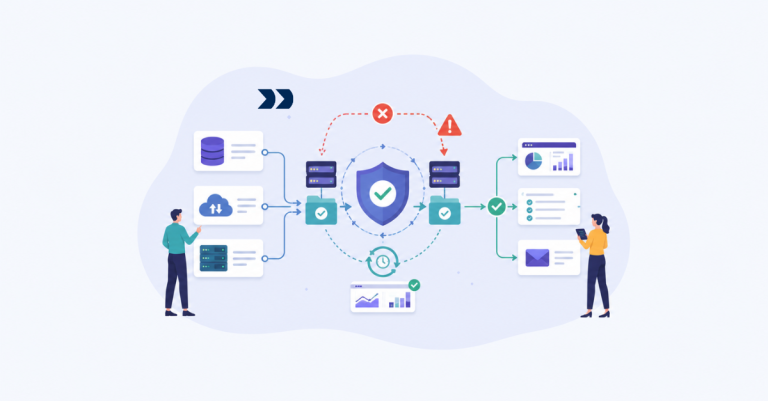
Enterprise data resilience depends on infrastructure that can absorb disruption. Queue management preserves records when endpoints are unavailable. Retry logic handles temporary failures. Endpoint monitoring detects whether receiving systems are available, overloaded, unauthorized, or rejecting data. Fallback paths allow critical delivery flows to continue when the primary path fails.
However, resilience also requires business prioritization. A critical compliance evidence feed may require faster recovery than a low-priority research export. A revenue operations delivery may need immediate escalation before a forecast review. An inventory update may need near-real-time recovery before stock decisions are made.
Accordingly, enterprise resilience is not only a technical property. It is the ability to maintain business-relevant data movement when normal delivery conditions break.
Why Delivery Failures Create Business Continuity Risk
Delivery failures create business continuity risk because downstream systems increasingly depend on timely, validated, and traceable data movement. A delivery outage may affect executive dashboards, AI features, compliance evidence, procurement reporting, product catalog updates, inventory operations, and revenue forecasting.
Gartner’s 2025 Data and Analytics Predictions state that by 2027, half of business decisions will be augmented or automated by AI agents for decision intelligence. As decisions become more automated, delivery failures can affect downstream action before teams identify the interruption. Enterprise data distribution solutions are essential for maintaining the flow of critical information across organizations. These solutions ensure that data reaches its intended destinations without delay, mitigating the risk of decision-making disruptions. By implementing robust distribution strategies, businesses can safeguard against the impact of unforeseen delivery outages.
Data Continuity Planning Reduces Disruption Across Dashboards, Reports, AI Workflows, and Operations
Data continuity planning identifies which delivery flows must continue under failure conditions. It should define recovery time expectations, acceptable freshness thresholds, fallback sources, priority queues, escalation owners, endpoint alternatives, manual override rules, and downstream notification requirements.
A dashboard may tolerate a delayed refresh if users see freshness metadata. An AI feature pipeline may need to fallback to the last validated dataset. A compliance report may require timestamped evidence of the failed delivery and recovery process. An inventory workflow may need priority recovery because stale data can affect replenishment decisions.
In this context, continuity planning protects business operations by making failure behavior predictable. Teams know what happens when delivery breaks, which systems are affected, and what recovery path applies.
Business Teams Lose Trust When Delivery Recovery Depends on Manual Intervention
Business teams lose trust when recovery depends on manual intervention. If every delivery failure requires someone to inspect logs, rerun jobs, export files, notify downstream users, or manually reconcile records, the system is not resilient. It is dependent on human attention during incidents.
Manual recovery also creates governance risk. Emergency exports may bypass lineage. Temporary permissions may exceed policy. Manually edited files may lack audit trails. Rerun jobs may duplicate records if replay controls are missing.
As a result, manual recovery may restore delivery but weaken trust. Strong delivery recovery design reduces this risk by making recovery behavior consistent, traceable, and governed.
The Strategic Cost of Weak Data Delivery Resilience
Weak delivery resilience affects enterprise performance because it turns normal system failures into business disruption. Endpoint downtime, validation blocks, queue delays, and schema errors are expected conditions in complex environments. The strategic question is whether those conditions are contained or allowed to interrupt critical workflows.
IBM’s 2025 CDO Study identifies strategy, scale, resilience, innovation, and growth as focus areas that help organizations deliver greater business value with data. The study also emphasizes that value comes from using the most valuable data to deliver specific business outcomes, not simply accessing more data. Delivery resilience supports that outcome focus by keeping critical data available under disruption.
Decision Systems Become Fragile When Data Delivery Breaks Under Endpoint or Pipeline Failure
Decision systems become fragile when delivery breaks under common failure conditions. A dashboard may remain online but show stale data. A model may continue scoring but use old features. A compliance workflow may continue preparing reports but miss the latest evidence. A procurement workflow may approve vendors without updated risk signals.
The danger is that downstream systems often keep running even when delivery has degraded. Users may not know that a delivery interruption has affected the output. That makes resilience monitoring essential. It is not enough to detect that a pipeline failed. Teams need to understand which decisions, reports, models, and operational workflows are affected.
At scale, weak resilience creates silent degradation. The business does not stop immediately, but decisions become less current and less defensible.
Operational Teams Create Workarounds When Recovery Processes Are Not Designed Upstream
Operational teams create workarounds when recovery processes are not designed upstream. They request manual extracts, copy files between systems, rerun jobs out of sequence, ask engineers for direct table access, or rebuild missing reports locally. These workarounds restore short-term access but increase long-term complexity.
The root issue is not the workaround itself. It is the absence of a designed recovery. If recovery is not part of the delivery architecture, every failure becomes an exception. Every exception consumes time, creates risk, and weakens confidence.
Therefore, delivery recovery should be embedded upstream. Recovery decisions should occur before downstream users experience unavailable, stale, duplicated, or incomplete data.
How Resilient Delivery Supports Enterprise Performance
Resilient delivery supports enterprise performance by reducing the business impact of failure. It allows teams to continue working from trusted fallback data, queued records, validated reruns, or degraded-mode outputs when primary delivery paths are interrupted. It also helps teams understand when data is current, when it is stale, and when a workflow should pause.
NIST’s AI Risk Management Framework describes govern, map, measure, and manage as core functions for trustworthy AI systems. Those same functions are relevant to delivery resilience because AI systems depend on mapped data flows, measured failure conditions, governed recovery controls, and managed operational risk. Enterprise data challenges for organizations often contribute to disruptions in decision-making processes. Addressing these challenges requires a strategic approach that prioritizes data integrity and availability. Additionally, organizations must invest in robust systems that enhance data governance to ensure that teams can navigate complexities effectively.
AI, Analytics, Compliance, and Revenue Workflows Require Recoverable Delivery Paths
AI, analytics, compliance, and revenue workflows require recoverable delivery paths because their outputs often influence important decisions. A pricing model may need a fallback dataset if the latest competitor feed fails. A compliance dashboard may need recovery evidence if the scheduled delivery misses its window. A revenue operations report may need the last validated account feed if the current delivery is delayed. An inventory workflow may need queued updates replayed in order after endpoint recovery.
These patterns require more than retry logic. They require freshness thresholds, delivery status, lineage, acknowledgement records, and business rules that define whether a workflow should continue, pause, or escalate.
In practice, resilient delivery allows enterprise systems to degrade safely instead of failing unpredictably.
Resilience Improves Confidence When Data Must Reach Multiple Downstream Systems Reliably
A single dataset may need to reach multiple systems. A product catalog feed may go to ecommerce, marketplaces, sales portals, analytics, and search. A supplier-risk feed may go to procurement dashboards, compliance reports, risk alerts, and executive reporting. A customer feed may go to CRM enrichment, billing, support, revenue operations, and AI scoring.
When one destination fails, resilience design should prevent that failure from corrupting the full distribution path. Available endpoints may continue receiving data. Failed endpoints may queue records. Critical destinations may receive priority. Downstream users may receive freshness warnings or recovery notices.
This matters because enterprise performance depends on coordinated continuity. Resilience ensures that one delivery failure does not unnecessarily disrupt every consumer.
The Infrastructure Layer Behind Delivery Recovery
Delivery recovery requires infrastructure that can detect failure, classify severity, preserve data, retry safely, route around unavailable endpoints, alert owners, and record recovery evidence. It should operate across batch, event-driven, API, file, warehouse, and application delivery models.
Airflow can orchestrate scheduled recovery jobs and reruns. Kafka can preserve event streams and support replay when endpoints recover. Spark can reprocess high-volume delivery batches. dbt can rebuild governed delivery-ready models. Snowflake, BigQuery, and Databricks can support controlled recovery from reliable storage layers. Great Expectations can validate recovered datasets before redistribution. Prometheus and data observability systems can monitor endpoint health, queue depth, latency, retries, and delivery failures.
Scheduling, Queues, Retries, Validation, and Endpoint Acknowledgement Support Resilient Delivery
Scheduling defines when delivery should happen. Queues preserve records when delivery cannot be completed. Retries handle temporary failures. Validation ensures recovered data still meets quality requirements. Endpoint acknowledgement confirms that the receiving system accepted the delivery.
A recovery event should classify failure before choosing the recovery action.
def route_recovery_event(event):
    if event["failure_type"] == "validation_failed":
        return {
            "status": "blocked",
            "action": "send_to_quality_review",
            "delivery_id": event["delivery_id"],
        }

    if event["failure_type"] == "endpoint_unavailable":
        return {
            "status": "queued",
            "action": "retry_when_endpoint_recovers",
            "delivery_id": event["delivery_id"],
        }

    if event["failure_type"] == "authentication_failed":
        return {
            "status": "blocked",
            "action": "escalate_to_access_owner",
            "delivery_id": event["delivery_id"],
        }

    if event["failure_type"] == "missed_delivery_window":
        return {
            "status": "escalated",
            "action": "notify_business_owner",
            "delivery_id": event["delivery_id"],
        }

    return {
        "status": "error",
        "action": "send_to_delivery_operations",
        "delivery_id": event["delivery_id"],
    }


event = {
    "delivery_id": "DEL-617402",
    "dataset": "revenue-forecast-feed",
    "target_endpoint": "forecasting_dashboard",
    "failure_type": "endpoint_unavailable",
    "timestamp": "2026-06-17T09:15:00Z",
}

route_recovery_event(event)
This pattern shows why delivery recovery design needs classification. Different failures require different responses, owners, and escalation paths.
Observability, Lineage, Metadata, and Audit Logs Make Recovery Measurable and Defensible
Observability makes recovery measurable. Teams should track delivery failure rate, recovery time, queue depth, retry count, duplicate replay rate, missed delivery windows, endpoint outage duration, acknowledgement delay, validation block volume, and downstream impact.
Lineage shows which dashboards, reports, models, applications, and workflows depend on a failed delivery path. Metadata records dataset owner, delivery cadence, endpoint requirements, freshness thresholds, access policy, and business priority. Audit logs record when a failure occurred, which recovery action was taken, who or what approved it, whether data was redelivered, and whether the endpoint acknowledged receipt.
Together, these controls allow teams to respond quickly and defend the recovery process later. That matters for compliance reporting, AI governance, financial workflows, customer operations, vendor delivery, and executive reporting.
Governance and Compliance Depend on Delivery Resilience
Delivery resilience is also a governance and compliance issue. A delivery failure can affect regulated reporting, customer data availability, third-party obligations, external data usage, financial reporting, or AI decision systems. Recovery must therefore be controlled, not improvised.
A resilient system should preserve access controls, data classification, retention rules, sourcing constraints, cross-border considerations, and auditability during recovery. Failure conditions should not become an excuse to bypass governance. A fallback delivery path still needs approval. A manual export still needs lineage. A replay still needs duplicate protection. The impact of unreliable data delivery can undermine stakeholder trust and lead to significant reputational damage. Organizations must prioritize data integrity to ensure compliance and maintain operational efficiency. Ultimately, addressing these challenges is crucial for fostering a culture of transparency and accountability.
Data Continuity Planning Requires Policy-Aware Recovery
Data continuity planning should define how recovery works under policy constraints. If a dataset includes restricted fields, fallback delivery should not send it to an unauthorized endpoint. If data is subject to retention limits, recovery copies should not persist indefinitely. Also, if a delivery crosses jurisdictions, recovery routing should respect cross-border data rules. If an external dataset has sourcing restrictions, redistribution during recovery should remain within approved use.
These controls are especially important when delivery involves customer data, supplier data, financial records, compliance evidence, AI training inputs, or third-party systems.
Accordingly, enterprise data resilience requires both technical continuity and compliance architecture. Also, recovery is not complete if it restores delivery while weakening control.
Recovery Evidence Matters During Audits, Incidents, and Executive Reviews
Recovery evidence matters because teams may need to explain what happened after a failure. Which delivery failed? Which records were affected? Also, which downstream systems depended on the delivery? Which recovery action was taken? Was data replayed? Were duplicates prevented? Did the endpoint acknowledge receipt? Were users notified that data was delayed or stale?
These questions matter during audits, incidents, compliance reviews, customer escalations, AI model reviews, and executive reporting disputes. Without recovery evidence, teams may fix the issue but still lack proof that recovery was controlled.
Ultimately, auditability turns resilience from an operational claim into a defensible capability.
Why Data Delivery Resilience Is Becoming an Executive Governance Issue
Data Delivery Resilience is becoming an executive governance issue because critical business workflows now depend on continuous and recoverable data movement. Leaders rely on delivery flows for dashboards, revenue operations, compliance reporting, procurement decisions, inventory updates, product catalog workflows, AI models, and market intelligence. If those flows fail without controlled recovery, business continuity is exposed.
Executives do not need to manage retry logic or queue behavior directly. However, they need visibility into which delivery flows affect business continuity, which recovery processes are automated, which depend on manual intervention, which endpoints are fragile, and which workflows lack fallback planning.
Leaders Need Visibility into Which Delivery Flows Affect Business Continuity
Leadership visibility should focus on critical delivery dependencies. Which feeds support executive reporting? Which delivery paths serve AI models? Also, which datasets support compliance evidence? Which flows drive revenue forecasting, procurement, inventory, product catalog distribution, or customer operations? Which delivery failures would affect business continuity within hours rather than days?
This visibility helps leaders prioritize resilience investment. A low-risk internal research export may tolerate delayed recovery. A production delivery flow supporting compliance, finance, AI, customer operations, or revenue decisions requires stronger recovery controls, monitoring, ownership, and escalation.
In this context, delivery resilience becomes part of enterprise risk management. The organization cannot govern business continuity if it cannot govern the delivery flows that support critical decisions.
Scalable Data Programs Require Recovery Standards, Ownership, Monitoring, and Continuous Review
Scalable data programs require recovery standards. These standards should define recovery time expectations, freshness thresholds, queue policies, retry behavior, duplicate prevention, fallback paths, endpoint acknowledgement, escalation rules, audit logging, access controls, and downstream notification.
Ownership must be explicit. Data engineering may operate pipeline recovery. Data operations may monitor queues and delivery events. Business teams define acceptable disruption windows. Governance teams define access and usage controls. Analytics and AI teams define downstream consumption requirements. Compliance teams define evidence and audit expectations.
Ultimately, Data Delivery Resilience has become a business issue because delivery failure now affects operational continuity. Delivery recovery design determines whether failed, delayed, or interrupted data movement can be restored safely. Enterprise data resilience depends on queues, retries, endpoint monitoring, validation, fallback paths, and auditability. Data continuity planning reduces disruption when failure conditions occur.
Organizations that manage delivery resilience as enterprise infrastructure will build more dependable AI, analytics, reporting, compliance, revenue, procurement, and operational workflows. Those who treat recovery as a manual incident response will continue moving data, but they will struggle to keep critical decisions stable when delivery conditions break.