Key Takeaways
- Data Delivery Scheduling defines when prepared data is delivered to downstream systems, dashboards, endpoints, reports, and operational workflows.
- A reliable data delivery schedule should account for source readiness, transformation completion, endpoint availability, business cutoffs, and downstream consumption windows.
- Scheduled data delivery requires coordination across warehouses, BI platforms, notification systems, reporting environments, operational applications, and external consumers.
- Delivery timing control prevents downstream systems from receiving incomplete, stale, duplicated, or poorly timed data.
- Strong scheduling requires orchestration logic, dependency checks, retry rules, queue awareness, ownership, monitoring, and audit trails.

Enterprise data delivery fails when timing is treated as a simple cron job. A dataset may be technically ready, but the downstream dashboard may not be open for refresh. A procurement report may require supplier updates before distribution. A revenue operations workflow may need CRM, billing, and product usage data to arrive in a controlled sequence. A compliance report may require a locked delivery window with traceable evidence.
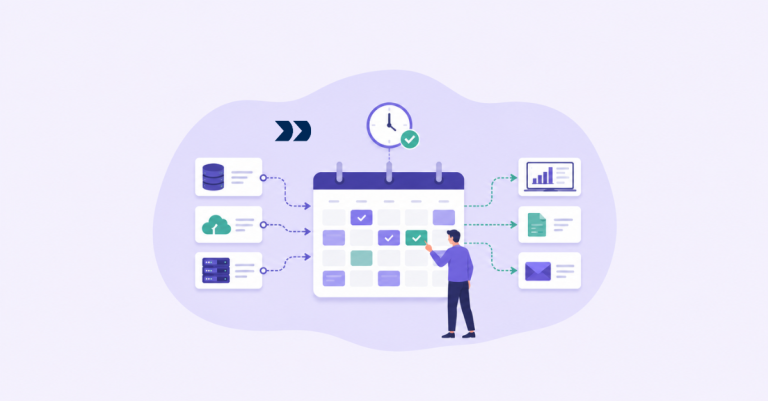
Data Delivery Scheduling creates the timing control layer for enterprise data distribution. It defines when data should move, what must be complete before delivery, which endpoints should receive it, and how failed or delayed deliveries are handled.
In multi-system operations, scheduling is not just automation. It is a reliability function that protects downstream availability, reporting accuracy, and operational decision timing.
Why Data Delivery Scheduling Matters in Enterprise Operations
Data Delivery Scheduling matters because enterprise data rarely moves to one destination. The same prepared dataset may feed executive dashboards, operational reports, customer notifications, procurement workflows, compliance archives, revenue operations, inventory systems, and product catalog endpoints.
The OECD’s data flows and governance work states that effective data use and governance depend on the ability to move, share, analyze, and protect data. In enterprise operations, scheduling is one of the mechanisms that make movement predictable rather than ad hoc. Enterprise data distribution solutions enable organizations to efficiently manage the flow of critical information across various platforms. By leveraging these solutions, businesses can enhance collaboration and ensure that stakeholders have timely access to reliable data. Ultimately, this leads to improved decision-making and operational efficiency throughout the enterprise.
Why Delivery Timing Becomes a Control Problem
Delivery timing becomes a control problem when downstream systems rely on data at specific points in the operating cycle. A dashboard refresh may need to finish before an executive meeting. A notification system may need inventory data before customer alerts are sent. A revenue report may need billing records after finance validation. A compliance package may need delivery after final approvals, not before.
At a small scale, teams may solve timing manually. They wait for a file, trigger a report, or rerun a job when something is late. At enterprise scale, this approach breaks down because too many systems depend on too many delivery windows.
Data Delivery Scheduling gives teams a formal way to coordinate timing. It defines the data delivery schedule, dependency gates, endpoint windows, retry behavior, and escalation path.
How Weak Scheduling Damages Downstream Availability
Weak scheduling creates operational problems that often appear downstream. A report may refresh before the latest data arrives. A dashboard may show yesterday’s inventory. A product catalog may be published before approval fields are complete. A compliance file may be delivered without final validation. A notification system may trigger customer messages from stale records.
The failure is not always in the data itself. Often, the data is correct but delivered at the wrong time.
Gartner’s 2025 data and analytics trends highlight that data and analytics are becoming more ubiquitous while the stakes for D&A leaders continue to rise. As data becomes embedded in more workflows, delivery timing becomes part of operational reliability, not just pipeline automation.
Data Delivery Schedule Design
A data delivery schedule defines when data is expected to move from prepared storage or processing environments into downstream destinations. It should specify cadence, readiness checks, delivery windows, dependencies, priority, endpoint owners, and recovery rules.
The schedule should not be designed only around upstream completion. It should also reflect downstream readiness and business use.
Defining Cadence, Cutoffs, and Consumption Windows
Cadence defines how often data is delivered: hourly, daily, weekly, monthly, near real time, or event-triggered. Cutoffs define the latest acceptable delivery time. Consumption windows define when downstream users or systems need the output.
For example, executive dashboards may refresh before morning review cycles. Procurement reports may be delivered after supplier files arrive. Inventory updates may be delivered more frequently during trading hours. Compliance outputs may require fixed delivery windows with audit logs.
A strong data delivery schedule connects technical timing to operational timing. It answers not only “when can we deliver?” but “when is this data useful, safe, and expected?”
Checking Readiness Before Delivery
Scheduled data delivery should include readiness checks before output moves downstream. These checks may confirm that transformations are completed, required partitions have arrived, validation has passed, target endpoints are available, and approvals are complete.
A simple scheduling rule can look like this:
D DELIVERY_SCHEDULE_RULES = {
    "required_checks": ["source_loaded", "validation_passed", "target_available"],
    "blocked_statuses": ["validation_failed", "approval_pending"],
    "delivery_windows": {
        "executive_dashboard": "07:00",
        "procurement_report": "18:00",
    },
}

def approve_scheduled_delivery(job):
    missing = [check for check in DELIVERY_SCHEDULE_RULES["required_checks"] if check not in job.get("completed_checks", [])]
    if missing:
        return {"approved": False, "reason": "missing_readiness_checks", "checks": missing}
    if job.get("status") in DELIVERY_SCHEDULE_RULES["blocked_statuses"]:
        return {"approved": False, "reason": "blocked_delivery_status"}
    window = DELIVERY_SCHEDULE_RULES["delivery_windows"].get(job.get("target_system"))
    return {"approved": True, "delivery_window": window}
This follows the same pattern as the previous cluster snippets: define rules, evaluate readiness, and block unsafe movement before downstream systems receive the output.
Aligning Schedules with Business Calendars
Data delivery schedules should account for business calendars. Month-end close, executive reporting cycles, supplier cutoffs, warehouse operations, promotional periods, and regulatory deadlines can all affect delivery timing.
A daily report may not be enough if the business needs a pre-close and post-close version. A product feed may require a different delivery frequency during peak sales periods. A compliance report may require immutable delivery after a review checkpoint.
In practice, scheduling becomes more reliable when business calendars are treated as system dependencies.
Scheduled Data Delivery Across Multiple Systems
Scheduled data delivery must coordinate multiple destinations. Data may move from Snowflake, BigQuery, Databricks, PostgreSQL, S3, or application databases into BI dashboards, customer notification systems, APIs, files, queues, reporting portals, or partner endpoints.
Each destination may have different timing, access, format, and availability requirements. Endpoint strategies for data systems are essential for ensuring seamless data flow across various platforms. Implementing these strategies can enhance the efficiency of data delivery and improve user experience. Properly managing access and format requirements will lead to more reliable and timely information for decision-making processes.
Coordinating Warehouses, BI Platforms, and Operational Endpoints
A warehouse may finish processing before BI dashboards are ready to refresh. A BI dashboard may refresh before operational metrics are certified. An API endpoint may accept updates only during defined maintenance windows. A customer notification system may require suppression rules before delivery.
Scheduling should account for these differences. It should identify destination type, delivery method, owner, expected arrival time, format, and dependency chain.
For example, a revenue operations dataset may deliver to both a dashboard and a CSV export. The dashboard may refresh hourly, while the export may run once after finance review. Treating both as the same schedule creates risk.
Sequencing Deliveries Across Dependent Systems
Some deliveries must happen in order. Customer records may need to arrive before billing updates. Product attributes may need to be published before inventory availability. Procurement master data may need to be updated before supplier performance reports. Revenue data may need CRM and invoice updates before final reporting.
A sequencing pattern may look like this:
def route_delivery_job(job):
    if job["delivery_type"] == "dashboard_refresh":
        print(f"Sending {job['dataset']} to BI refresh queue")
        return

    if job["delivery_type"] == "report_export":
        print(f"Sending {job['dataset']} to reporting archive")
        return

    if job["delivery_type"] == "operational_feed":
        print(f"Publishing {job['dataset']} to downstream endpoint")
        return

    print(f"Unsupported delivery type: {job['delivery_type']}")


job = {
    "job_id": "del-20260617-9142",
    "dataset": "daily_revenue_summary",
    "delivery_type": "dashboard_refresh",
    "source_system": "warehouse",
    "target_system": "executive_dashboard",
    "scheduled_time": "2026-06-17T07:00:00Z",
    "status": "ready",
}

route_delivery_job(job)
The example shows how scheduled delivery can route outputs based on delivery purpose. In production, routing would connect to orchestration tools, queues, API endpoints, warehouse tasks, or reporting platforms.
Managing Late, Skipped, and Replayed Deliveries
Scheduled data delivery should define how late, skipped, and replayed deliveries are handled. If a delivery misses its window, the system should know whether to retry, delay downstream refresh, send a partial notice, or escalate.
A skipped delivery may be valid if there is no new data. However, downstream systems should still know whether no delivery occurred because there was no change, a failed job, a blocked approval, or an upstream outage.
Replay also needs control. Redelivering a file, feed, or dataset may overwrite downstream state or duplicate records if idempotency is not designed properly.
Delivery Timing Control and Dependency Management
Delivery timing control ensures that data arrives when downstream systems can use it safely. It connects scheduling with dependency checks, quality checks, queue state, and operational deadlines.
Timing control is especially important when scheduled delivery supports business decisions rather than passive storage. Data delivery latency effects on operations can significantly impact the efficiency of business processes. Delays can lead to missed deadlines and poor decision-making, which undermine overall productivity. Therefore, it is crucial to implement robust systems that mitigate latency and ensure timely access to information.
Controlling Delivery Before and After Quality Validation
Data should not be delivered before validation is complete. If validation detects missing fields, unusual volume drops, duplicate records, or schema mismatches, the schedule should pause delivery or route the output for review.
Delivery after validation should also preserve evidence. Teams should know which validation checks passed before the dataset was released.
Deloitte’s data observability guidance states that data observability depends on the right combination of technology, processes, governance, and talent, not only a platform. Delivery scheduling follows the same principle because timing control requires process rules, ownership, monitoring, and escalation, not only a scheduler.
Preventing Early Delivery and Stale Delivery
Early delivery can be as damaging as late delivery. If a report is delivered before the final partition arrives, it may look complete while missing critical records. If a dashboard refreshes before approval, business users may act on unapproved figures.
Stale delivery creates a different problem. A system may deliver yesterday’s successful output because today’s job failed. Without freshness checks, downstream users may assume the data is current.
Delivery timing control should verify processing date, data freshness, schedule window, and validation status before release.
Handling Time Zones and Regional Delivery Windows
Multi-market operations require time-zone control. A report scheduled for 8:00 AM must specify which region. A supplier update may need to arrive before local business hours. A customer notification feed may need to avoid restricted sending windows.
Time-zone errors are common when data teams use UTC internally while business users operate by region. The schedule should explicitly define delivery timezone, business calendar, holiday rules, and local cutoff expectations.
At scale, regional delivery windows should be modeled, not handled through manual exceptions.
Scheduling Software, Orchestration, and Operational Tooling
Delivery scheduling software should do more than trigger jobs. It should support dependencies, retries, alerts, lineage, ownership, and auditability.
Tools such as Airflow, Dagster, Prefect, dbt jobs, warehouse tasks, Kafka, message queues, and enterprise schedulers can all participate in delivery scheduling depending on the architecture.
Using Orchestration Tools for Controlled Scheduling
Orchestration tools help sequence tasks, manage dependencies, retry failed steps, and expose job status. Airflow may coordinate warehouse loads, validation jobs, delivery exports, and dashboard refresh triggers. DBT jobs may validate transformation readiness. Kafka or queues may buffer downstream delivery. Warehouse tasks may handle scheduled materializations.
The key is not the tool itself. The key is whether the schedule reflects operational dependencies. A job that runs at 7:00 every morning is not reliable if it ignores source delay, validation failure, or endpoint downtime.
Scheduled data delivery should depend on readiness, not only on clock time.
Connecting Scheduling to Queues and Endpoint Capacity
High-volume delivery often requires queues. If downstream endpoints cannot accept all updates at once, the delivery system should throttle output, batch records, or distribute load across time windows.
This prevents downstream systems from being overwhelmed. For example, inventory updates may need high frequency but controlled throughput. Customer notifications may need delivery pacing. Product catalog updates may need batch windows per marketplace.
Scheduling should therefore account for endpoint capacity, queue depth, retry behavior, and delivery priority.
Monitoring Schedule Execution and Delivery Outcomes
Scheduling systems should monitor both job execution and delivery outcomes. A job may run successfully but fail to deliver to one endpoint. A file may be generated but not picked up. A dashboard may refresh but still show stale data.
Monitoring should track scheduled start time, actual start time, completion time, delivery target, delivery status, retry count, failure reason, and downstream acknowledgement.
NIST’s incident response guidance emphasizes preparation, evidence collection, analysis, prioritization, and recovery during incidents. Scheduled delivery systems should preserve the same kind of operational evidence so teams can diagnose missed or delayed deliveries quickly.
Governance and Auditability in Data Delivery Scheduling
Governance defines who owns schedules, who can change delivery timing, how exceptions are approved, and how delivery evidence is preserved. Auditability shows what was delivered, when it was delivered, where it went, and whether it met the expected schedule.
The OECD’s data governance work describes governance as the technical, policy, and regulatory frameworks required to manage data across its value cycle. Data Delivery Scheduling fits that model because delivery timing determines how data moves from prepared systems into operational use.
Creating Schedule Ownership and Change Approval
Every critical delivery schedule should have an owner. Ownership should include the data product owner, delivery operations owner, downstream system owner, and business owner where appropriate.
Schedule changes should require review when they affect business cutoffs, reporting cycles, compliance delivery, notification timing, or operational workflows. A small technical timing change can create downstream confusion if business users expect data at a specific time.
Change approval should capture what changed, why it changed, who approved it, and which consumers were affected.
Maintaining Delivery Audit Trails
Delivery audit trails should capture scheduled time, actual delivery time, dataset version, validation status, target endpoint, delivery method, owner, retry history, failure reason, and acknowledgement status.
This evidence matters when reports are challenged, compliance files are reviewed, or operational teams ask why data was late. It also helps teams identify recurring delivery issues such as slow upstream jobs, endpoint instability, bad scheduling assumptions, or weak retry logic.
Audit trails turn scheduling from invisible automation into controlled enterprise infrastructure.
Conclusion: Turning Delivery Schedules into Operational Infrastructure
Data Delivery Scheduling helps enterprises control when prepared data reaches downstream systems. It connects data delivery schedule design, scheduled data delivery workflows, delivery timing control, endpoint readiness, validation gates, orchestration, monitoring, and auditability.
Strong scheduling prevents early delivery, stale delivery, missing delivery, overloaded endpoints, and poorly timed reporting. It protects dashboards, customer notifications, procurement reports, revenue operations, compliance reporting, product catalog feeds, and inventory workflows from timing failures that can damage decisions and operations.
The capability matters because delivery timing is part of data reliability. Data may be accurate, but if it arrives too early, too late, without validation, or outside the expected consumption window, it can still undermine business performance.
A structured review can help evaluate whether current data workflows have reliable Data Delivery Scheduling, a controlled data delivery schedule, scheduled data delivery governance, delivery scheduling software alignment, and delivery timing control. You can run an external data infrastructure audit with our team to review your current setup and understand what is required to build a reliable, enterprise-scale data delivery infrastructure.