Key Takeaways
- Data Delivery Reliability determines whether downstream systems can trust the data they receive.
- Reliable data distribution preserves timing, completeness, structure, and endpoint compatibility.
- Delivery reliability metrics show whether data arrives fit for operational, analytical, and AI use.
- Delivery failure impact spreads across dashboards, reports, AI workflows, business operations, and executive decision-making.
Data delivery reliability is often treated as a final-mile concern. Teams focus on whether data was collected, cleaned, transformed, or stored, then assume delivery is a routine handoff. However, enterprise data programs succeed or fail based on whether trusted data reaches the right downstream systems on time, in the right format, with the right controls, and with enough visibility to confirm delivery quality.
Data Delivery Reliability determines whether downstream systems can depend on the data they receive. Weak delivery reliability creates silent disruption across dashboards, reports, AI workflows, customer operations, compliance reporting, procurement systems, revenue teams, and product catalogs. The issue is not only a failed transmission. It is the loss of confidence that data will arrive complete, current, structured, and usable when business processes need it.
Data Delivery Reliability Determines Whether Downstream Systems Can Trust the Data They Receive
Enterprise data has limited value if it does not reach the systems where decisions happen. A dataset may be accurate in the warehouse, validated in the transformation layer, and documented in metadata systems, yet still fail operationally if delivery is late, partial, malformed, or routed to the wrong endpoint. Delivery reliability is therefore part of trust.
McKinsey’s State of AI 2025 notes that many organizations use AI regularly, yet most have not embedded AI deeply enough into workflows and processes to realize material enterprise-level benefits. That gap matters because operational AI, analytics, and reporting depend on data reaching downstream systems reliably, not only existing in controlled storage.
Reliable Data Distribution Preserves Timing, Completeness, and Format Across Delivery Endpoints
Reliable data distribution means that each endpoint receives data according to its operational requirements. A BI dashboard may need daily delivery before executive reporting begins. A procurement system may need supplier updates by a defined cutoff. A revenue operations workflow may need account and pipeline updates before forecasting. A product catalog workflow may need validated attributes delivered to e-commerce, marketplaces, and sales portals.
Timing is only one part of the issue. Delivery must also preserve completeness and format. A JSON payload, CSV export, warehouse table, API post, SFTP file, webhook event, or message queue record must match the receiving system’s schema and expectations. If required fields are missing or naming conventions shift, downstream systems may fail or ingest weakened data.
In practice, reliable distribution is not just movement. It is a controlled movement into the systems that use data.
Delivery Reliability Metrics Show Whether Data Arrives Fit for Operational Use
Delivery reliability metrics help teams understand whether data delivery is dependable. Useful metrics include delivery success rate, endpoint availability, latency, freshness, completeness, retry count, failed-record volume, schema error rate, duplicate delivery rate, file arrival time, payload size variance, downstream acknowledgement rate, and recovery time.
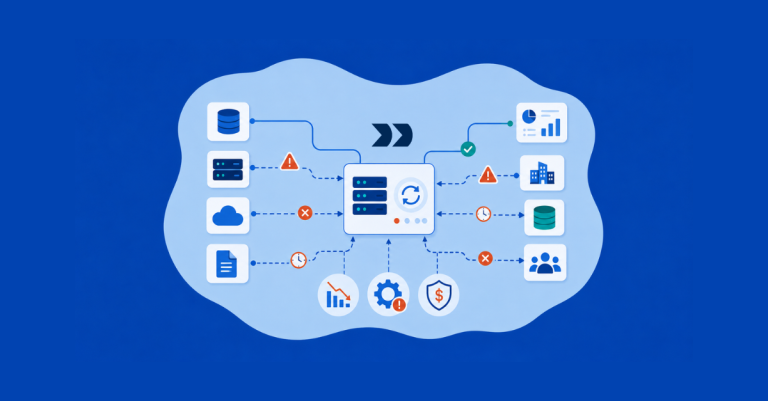
These metrics matter because delivery failure is not always binary. A file may arrive late. A payload may arrive with missing fields. An endpoint may accept data but reject part of it. A retry may create duplicates. A dashboard may refresh successfully while excluding the latest batch.
Accordingly, delivery reliability metrics should measure operational fitness, not only whether a job is completed. The question is whether the receiving system can trust and use what arrived.
Why Delivery Failures Create More Than Technical Downtime
Delivery failures create more than technical downtime because downstream teams often experience them as business problems. A report is missing figures. A dashboard looks stale. An AI model receives old features. A compliance workflow lacks the latest records. A procurement team cannot access updated supplier information. A revenue team questions whether pipeline data is current.
Gartner’s 2025 Data and Analytics Predictions state that by 2027, half of business decisions will be augmented or automated by AI agents for decision intelligence. As more decisions become AI-supported or automated, delivery reliability becomes more consequential because late or incomplete delivery can affect downstream action before teams identify the failure.
Delivery Failure Impact Spreads Across Dashboards, Reports, AI Workflows, and Business Operations
Delivery failure impact spreads when the same delivered dataset supports multiple consumers. A customer delivery feed may support dashboards, renewal forecasts, customer success workflows, and AI scoring. A product delivery feed may support ecommerce, marketplaces, internal search, product analytics, and sales enablement. A compliance reporting feed may support audit evidence, executive reporting, and risk alerts.
If delivery fails, each downstream consumer may show a different symptom. Analysts may see missing records. Business users may see stale dashboards. AI teams may see model drift. Operations teams may see incomplete workflow inputs. The common issue may be the same delivery failure, but without delivery lineage and monitoring, teams investigate separately.
At scale, delivery failure is not only a data operations incident. It becomes a cross-functional disruption.
Teams Lose Time Validating Whether Missing Data Is a Pipeline Issue or a Business Signal
Weak delivery reliability forces teams to ask the same question repeatedly: is the data missing because the business changed, or because delivery failed? A drop in supplier updates may look like market inactivity. A missing customer segment may look like churn. A delayed inventory file may look like stock instability. A failed product delivery may look like channel underperformance.
This uncertainty slows decisions. Analysts validate counts. Engineers inspect logs. Business teams request manual confirmation. Data operations teams rerun jobs. Executives delay interpretation until teams confirm whether the signal is real.
In practice, the delivery failure impact includes the time spent proving whether data can be trusted. That cost is often higher than the technical repair itself.
The Strategic Cost of Weak Delivery Reliability
Weak delivery reliability creates strategic cost because it weakens decision confidence. Enterprise leaders increasingly rely on data-fed systems to guide pricing, revenue planning, risk monitoring, product decisions, procurement, customer operations, and AI investment. If delivery is unreliable, those decisions become slower and less defensible.
IBM’s 2025 CDO Study emphasizes that organizations need decision-ready data to generate enterprise value from data and AI. Delivery reliability is part of that readiness because data is not decision-ready until it reliably reaches the systems where decisions are made. Organizations are now focusing on data resilience strategies for enterprises to ensure that their data remains accessible and reliable. This proactive approach helps mitigate risks associated with data loss and enhances overall decision-making processes. As a result, enterprises can confidently navigate market challenges while maintaining a competitive edge.
Decision Confidence Declines When Data Arrives Late, Incomplete, or Inconsistently Structured
Decision confidence declines when delivery behavior becomes unpredictable. A dashboard may refresh, but the underlying delivery may exclude late-arriving records. A report may be published, but the latest feed may have failed validation. An AI model may run, but its feature inputs may be stale. A downstream application may accept a file, but field mapping may be wrong.
These issues damage trust because business teams cannot easily distinguish reliable outputs from weakened ones. Once confidence declines, teams create checks outside the official data flow. They ask for extracts, compare spreadsheets, delay reporting, or request manual signoff.
As a result, weak data delivery reliability increases organizational friction. The data system may still operate, but trust in its outputs becomes conditional.
Business Teams Create Manual Workarounds When Delivery Systems Cannot Be Trusted
Manual workarounds are a common symptom of weak delivery reliability. Teams create backup spreadsheets, local exports, manual email attachments, one-off dashboard refresh checks, or parallel reporting processes. These workarounds may solve immediate frustration, but they weaken governance and create new inconsistency.
The problem is structural. If teams do not trust delivery, they build unofficial delivery paths. Those paths often lack lineage, access controls, validation, versioning, and audit logs. Over time, the organization creates more fragmentation while trying to compensate for delivery failures.
Therefore, delivery reliability is also a governance issue. Reliable delivery reduces the need for informal data movement that is harder to control.
How Weak Delivery Reliability Affects Enterprise Data Distribution
Enterprise data distribution is the organized movement of data into downstream systems, teams, and workflows. It may include API delivery, warehouse sharing, scheduled file exports, webhook events, message queues, dashboards, report automation, or direct application feeds. Weak delivery reliability affects each model differently, but the underlying risk is consistent: data does not arrive in a form the recipient can depend on.
NIST’s AI Risk Management Framework emphasizes governance, mapping, measurement, and management across AI systems. These principles also apply to enterprise data distribution because AI and analytics systems inherit risk from how data is delivered, validated, and monitored.
Endpoint Failures, Queue Delays, and Retry Gaps Create Downstream Instability
Delivery reliability depends on endpoint health, queue behavior, retry logic, and acknowledgement handling. If an endpoint is unavailable, records may need to queue. If the queue grows, downstream systems may receive stale data. Also, if retry logic is weak, failed deliveries may be lost. If retry logic is too aggressive, duplicates may appear.
A delivery workflow should not simply attempt to send data and assume success. It should check endpoint readiness, validation status, delivery policy, and acknowledgement.
def deliver_record(record, endpoint):
    if endpoint["status"] != "available":
        return {"delivered": False, "reason": "endpoint_unavailable", "endpoint": endpoint["name"]}

    missing = [field for field in endpoint["required_fields"] if not record.get(field)]
    if missing:
        return {"delivered": False, "reason": "missing_required_fields", "fields": missing}

    print(f"Delivering {record['dataset_id']} to {endpoint['name']}")
    return {"delivered": True, "endpoint": endpoint["name"]}


record = {
    "dataset_id": "pricing-feed-2026-06-17",
    "generated_at": "2026-06-17T08:00:00Z",
    "record_count": 184920,
    "file_format": "json",
}

endpoint = {
    "name": "revenue_dashboard",
    "status": "available",
    "required_fields": ["dataset_id", "generated_at", "record_count", "file_format"],
}

deliver_record(record, endpoint)
This example shows the operating principle. Delivery should validate both the record and the receiving endpoint before data is treated as successfully delivered.
Distribution Quality Declines When Delivery Logic Is Not Monitored Across Systems
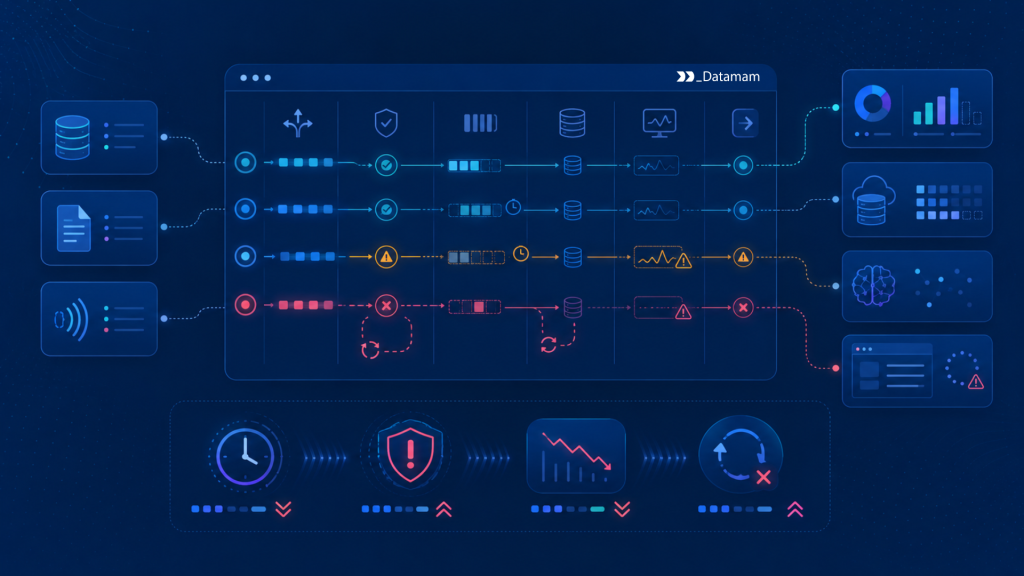
Distribution quality declines when delivery logic is not monitored across systems. A pipeline may complete successfully, but one endpoint may reject records. A downstream system may accept a file but process it late. A message queue may contain delayed events. A dashboard may refresh before the latest delivery has been completed.
Therefore, distribution quality should be monitored across the full delivery path. Teams need visibility into when data was produced, when it was delivered, which endpoint acknowledged it, which validation rules passed, and whether downstream consumption succeeded.
Without this visibility, delivery reliability remains assumed rather than proven. That assumption becomes risky when data supports critical business workflows.
The Infrastructure Layer Behind Reliable Data Delivery
Reliable data delivery requires infrastructure that can schedule, validate, route, queue, monitor, retry, acknowledge, and audit delivery events. Delivery cannot be managed as a final export step when downstream systems depend on it for daily operations.
The World Economic Forum’s 2025 analysis on scaling AI with strategy, data, and workforce readiness argues that strong data foundations are necessary to scale AI across enterprises. Delivery reliability is part of those foundations because AI and analytics systems depend on data arriving predictably into production workflows. Data flow from upstream sources plays a crucial role in ensuring that analytics systems receive timely and accurate information. When this flow is disrupted, it can lead to delays in decision-making and hinder overall business performance. Therefore, organizations must prioritize the optimization of their data pipelines to maintain a steady and reliable supply of information.
Scheduling, Validation, Queue Management, and Delivery Status Tracking Reduce Failure Exposure
Scheduling ensures that data is delivered at the required cadence. Validation ensures that payloads meet schema, completeness, and quality expectations before delivery. Queue management preserves records when endpoints are unavailable or throughput limits are reached. Delivery status tracking records whether data was delivered, rejected, retried, acknowledged, or escalated.
A simple delivery queue can classify records by status before they move downstream:
def route_delivery_event(event):
    if event["validation_status"] != "passed":
        return {"status": "blocked", "reason": "validation_failed", "delivery_id": event["delivery_id"]}

    if event["endpoint_status"] != "available":
        return {"status": "queued", "reason": "endpoint_unavailable", "delivery_id": event["delivery_id"]}

    if event["priority"] == "critical":
        return {"status": "send_now", "delivery_id": event["delivery_id"]}

    return {"status": "scheduled", "delivery_id": event["delivery_id"]}


event = {
    "delivery_id": "DEL-884201",
    "dataset": "supplier-risk-feed",
    "target_endpoint": "procurement_reporting",
    "validation_status": "passed",
    "endpoint_status": "available",
    "priority": "critical",
    "timestamp": "2026-06-17T09:30:00Z",
}

route_delivery_event(event)
This pattern shows how delivery reliability can be operationalized. A delivery event is not sent blindly. It is validated, checked against endpoint availability, prioritized, and routed according to business importance.
Observability, Metadata, and Lineage Help Teams Understand Delivery Impact Quickly
Observability systems such as Prometheus can monitor delivery latency, endpoint failures, retry rates, queue depth, throughput, and acknowledgement delays. Validation tools such as Great Expectations can check schema, completeness, uniqueness, and anomaly patterns before data moves. Metadata systems record dataset ownership, delivery cadence, endpoint requirements, data classification, and usage constraints.
Lineage shows which reports, dashboards, models, applications, and workflows depend on each delivery flow. This matters when delivery fails. If a supplier-risk feed is delayed, lineage helps identify affected procurement reports, risk dashboards, and compliance workflows. If a revenue feed is incomplete, teams can identify which forecasts and executive reports need review.
Infrastructure tools support this model. Airflow can orchestrate scheduled deliveries. Kafka can support event-driven distribution. Spark can process large datasets before delivery. dbt can structure delivery-ready models. Snowflake, BigQuery, and Databricks can support distribution from governed analytical environments into downstream systems.
Governance and Compliance Depend on Delivery Reliability
Delivery reliability is also a governance issue because delivery determines where data goes, who receives it, when it arrives, and whether usage is controlled. A governed dataset can become risky if it is delivered to the wrong endpoint, exposed to the wrong audience, distributed without required metadata, or reused outside approved boundaries.
The World Bank’s Digital Progress and Trends Report 2025 emphasizes foundational digital systems for responsible and scalable AI adoption. Within enterprises, reliable data delivery is part of that foundation because responsible analytics and AI require traceable, controlled distribution of data into downstream environments. Reliable enterprise data solutions play a crucial role in ensuring that data integrity is maintained throughout its lifecycle. These solutions provide the necessary tools for organizations to manage data delivery effectively while adhering to compliance standards. By leveraging such robust systems, businesses can enhance their decision-making processes and drive innovation while safeguarding sensitive information.
Delivery Controls Make Data Movement Defensible
Delivery controls make data movement defensible by preserving evidence. Teams need to know what was delivered, when delivery occurred, which endpoint received it, which validation checks passed, who had access, and whether downstream acknowledgement was captured.
This is especially important for compliance reporting, regulated workflows, customer data, vendor data, financial reporting, external data distribution, and AI systems. A dataset may be approved for one use case but not another. A report may require a specific delivery timestamp. A downstream system may need retention limits or access controls.
Accordingly, delivery reliability includes auditability. Reliable delivery is not only successful delivery. It is a provable delivery.
Cross-System Data Distribution Requires Access and Usage Controls
Cross-system data distribution requires controls around access, authentication, authorization, endpoint ownership, retention, privacy, and usage rights. Data delivered to a dashboard, API, file share, warehouse, application, or third-party environment should carry context about what it is, where it came from, how current it is, and how it may be used.
External and cross-border delivery flows need additional review. Data may move across vendors, regions, cloud environments, or legal jurisdictions. Delivery controls should account for data residency, contractual limits, platform policies, privacy rules, and sourcing restrictions where relevant.
Without these controls, delivery systems may increase reach while weakening governance.
Why Data Delivery Reliability Is Becoming an Executive Governance Issue
Data Delivery Reliability is becoming an executive governance issue because enterprise decisions increasingly depend on data arriving correctly into downstream workflows. Leaders rely on delivered data for executive dashboards, market intelligence, compliance reporting, revenue operations, procurement reporting, inventory updates, AI features, and product catalog distribution. If delivery is unreliable, critical decisions are exposed.
Executives do not need to manage individual delivery jobs. However, they need visibility into which delivery flows support critical decisions, which endpoints are fragile, which workflows lack monitoring, and where delivery failures could affect business outcomes.
Leaders Need Visibility into Which Delivery Flows Support Critical Business Decisions
Leadership visibility should focus on delivery dependency. Which data deliveries feed executive dashboards? Which supports AI models? Also, which flows deliver procurement or compliance reporting? Which endpoints support revenue operations? Which delivery jobs distribute product catalogs or inventory updates? As well as, which delivery failures would affect customer-facing systems?
This visibility helps leaders prioritize reliability investment. A low-risk delivery flow used for exploratory analysis may need basic monitoring. A production delivery flow supporting compliance, finance, AI, or customer operations requires stronger controls, ownership, alerting, and recovery planning.
In this context, delivery reliability becomes part of enterprise resilience. The organization cannot govern downstream decisions if it cannot prove that critical data arrived as expected.
Scalable Data Programs Require Reliability Standards, Ownership, Monitoring, and Continuous Review
Scalable data programs require formal delivery reliability standards. These standards should define delivery cadence, endpoint requirements, schema expectations, freshness thresholds, validation rules, retry behavior, queue handling, acknowledgement requirements, monitoring metrics, lineage capture, access controls, audit logs, and escalation procedures.
Ownership must be clear. Data engineering may operate pipelines. Data operations may manage delivery queues. Business teams define endpoint requirements. Governance teams define access and usage rules. Analytics and AI teams define downstream consumption needs. Compliance teams define evidence requirements.
Ultimately, Data Delivery Reliability determines whether enterprise data distribution can be trusted. Reliable data distribution preserves timing, completeness, and format. Delivery reliability metrics show whether data arrives fit for operational use. Delivery failure impact spreads across dashboards, AI workflows, reports, and business operations when the delivery layer is weak.
Organizations that manage delivery reliability as enterprise infrastructure will build more dependable downstream decision environments. Those that treat delivery as a final export step may continue producing data, but they will struggle to prove that data arrives complete, current, controlled, and ready for use.