Key Takeaways
- Enterprise Data Distribution determines whether prepared data can move reliably across business systems.
- Enterprise distribution systems require more than storage, pipelines, and dashboard access.
- Operational data distribution connects validated data to the workflows that depend on it.
- Distributed data delivery needs scheduling, routing, validation, queue management, endpoint acknowledgement, monitoring, lineage, and governance.
Enterprise data distribution is no longer a simple handoff between systems. In large organizations, distributed data supports dashboards, AI workflows, compliance reporting, procurement systems, revenue operations, inventory updates, product catalog publication, and executive decision-making. When distribution is weak, the issue does not stay inside the data team. It appears as late reports, stale dashboards, inconsistent outputs, failed deliveries, access gaps, and business teams questioning whether the data in front of them is reliable.
Enterprise Data Distribution refers to the controlled movement of prepared data into downstream systems, teams, applications, reports, models, and workflows. It includes enterprise distribution systems, operational data distribution, distributed data delivery, scheduling, validation, routing, queue management, endpoint acknowledgement, access controls, observability, lineage, metadata, and auditability. As data becomes more embedded in business execution, distribution needs stronger operational design rather than ad hoc exports or loosely monitored delivery jobs.
Enterprise Data Distribution Determines Whether Data Can Move Reliably Across Business Systems
Many enterprises have invested heavily in ingestion, transformation, warehouses, lakehouses, and analytics platforms. However, the operational value of data depends on the distribution layer that moves trusted outputs into business use. A dataset may be accurate in Snowflake, BigQuery, Databricks, or another governed environment, yet still fail to create value if it does not reach downstream systems correctly.
McKinsey’s State of AI 2025 reports that AI is widely used, but most organizations still have not embedded it deeply enough into workflows to realize material enterprise-level benefits. That matters for distribution design because AI, analytics, and operational systems require reliable movement of data into the workflows where decisions happen.
Enterprise Distribution Systems Require More Than Storage, Pipelines, and Dashboard Access
Enterprise distribution systems are often treated as extensions of storage or pipeline infrastructure. Teams may assume that if data lands in a warehouse or table, it is available for downstream use. However, availability inside a storage platform is not the same as operational distribution.
A revenue team may need a forecast-ready dataset delivered before review. A compliance team may need timestamped evidence packages. A procurement team may need supplier updates routed into reporting tools. A product team may need catalog records sent to ecommerce, marketplaces, search systems, and sales portals. Each use case has different timing, access, format, and validation requirements.
Therefore, enterprise distribution systems must manage delivery as an operating function. They need to answer what data was distributed, where it went, when it arrived, which validation checks passed, who had access, and whether the endpoint acknowledged receipt.
Operational Data Distribution Connects Prepared Data to the Workflows That Depend on It
Operational data distribution is the connection between prepared data and the business workflows that use it. It turns validated data into action-ready outputs for dashboards, applications, APIs, files, queues, reports, and AI pipelines.
This means distribution design must start from consumption requirements. A dashboard may need daily freshness. An inventory workflow may need low-latency updates. A compliance process may need immutability and audit logs. An AI system may need feature freshness and lineage. A product catalog workflow may need channel-specific validation before delivery.
In practice, operational distribution is not only about sending data. It is about ensuring that data reaches each downstream workflow in a condition the workflow can trust.
Why Weak Distribution Design Creates Downstream Instability
Weak distribution design creates downstream instability because consuming systems depend on delivery behavior. If data arrives late, incomplete, duplicated, or incompatible with endpoint requirements, downstream teams experience friction even when upstream data engineering appears healthy.
Gartner’s 2025 Data and Analytics Predictions state that half of business decisions will be augmented or automated by AI agents by 2027. As more decisions become AI-supported or automated, weak distribution design becomes more consequential because delayed or defective delivery can affect downstream action before teams identify the issue.
Distributed Data Delivery Fails When Timing, Format, Access, and Endpoint Requirements Are Not Coordinated
Distributed data delivery fails when systems are designed around movement rather than consumption. A file may be delivered successfully, but after the reporting window. A dashboard table may refresh, but with missing records. An API payload may be accepted, but without fields required by the downstream workflow. A queue may preserve messages, but deliver them too late for operational use.
Timing, format, access, and endpoint requirements must be coordinated before delivery scales. A procurement reporting endpoint may require supplier identifiers, risk ratings, source timestamps, and delivery acknowledgements. A revenue operations endpoint may require account IDs, owner mappings, forecast periods, and freshness thresholds. A product catalog endpoint may require approved attributes, image links, channel rules, and marketplace-specific fields.
Accordingly, delivery should be evaluated against endpoint requirements, not only job completion.
Business Teams Create Manual Workarounds When Distribution Systems Cannot Be Trusted
When distribution systems cannot be trusted, business teams create manual workarounds. Analysts export data into spreadsheets. Operations teams request one-off files. Compliance teams ask for separate evidence packages. Product teams manually check whether catalog updates reached each channel. Revenue teams compare dashboard numbers against CRM or billing systems.
These workarounds may solve immediate problems, but they increase fragmentation. Manual files often lack lineage. Local exports become stale. Different teams apply different filters. Access controls become harder to enforce. Audit trails weaken.
As a result, weak operational design creates a cycle: poor distribution reduces trust, reduced trust creates manual workarounds, and manual workarounds create more inconsistency.
The Strategic Cost of Poor Operational Distribution Design
Poor operational distribution design affects enterprise performance because it separates data production from data use. The organization may generate strong data assets, but if those assets are not distributed reliably, teams cannot act on them consistently.
IBM’s 2025 CDO Study frames the objective as accelerating growth with decision-ready data. Distribution design is part of decision readiness because data is not ready for decisions until it reaches the right downstream environment with the right structure, timing, access, and traceability. Data quality’s impact on performance cannot be underestimated. When data is inaccurate or inconsistent, it can lead to misguided decisions that ultimately harm organizational objectives. Ensuring high-quality data across all platforms enhances the reliability of insights, allowing teams to act swiftly and effectively.
Decision Quality Declines When Delivered Data Is Late, Incomplete, or Inconsistently Structured
Decision quality declines when distributed data is not dependable. A dashboard may show incomplete figures because a delivery job failed silently. A compliance report may miss evidence because an endpoint did not acknowledge receipt. An AI workflow may use stale inputs because feature delivery lagged. A product catalog system may publish incomplete data because endpoint-specific requirements were not validated.
These issues often appear as business uncertainty. Teams ask whether a drop in records reflects real market behavior or delivery failure. They question whether a dashboard is current. They delay decisions until someone confirms that the latest distribution succeeded.
At scale, poor distribution design reduces decision speed and increases the cost of trust. Teams spend time verifying outputs rather than acting on them.
Enterprise Performance Suffers When Distribution Logic Is Fragmented Across Teams and Systems
Fragmented distribution logic creates different delivery behaviors across teams. One team may use Airflow to schedule exports. Another may rely on manual files. Another may query a warehouse directly. Also, another may receive API payloads. Another may consume Kafka events. Without shared standards, these channels develop separate schemas, delivery timings, access rules, and quality expectations.
This fragmentation weakens enterprise performance because workflows become inconsistent. A revenue dataset may differ between a dashboard and a file export. A product dataset may differ between ecommerce and marketplace feeds. A compliance dataset may differ from the operational record used by the business.
Therefore, stronger operational design should standardize distribution patterns while still supporting different use cases. The objective is not one delivery method for every consumer. The objective is consistent governance, validation, monitoring, and ownership across all delivery methods.
How Stronger Distribution Design Supports AI, Analytics, and Operations
Stronger distribution design supports AI, analytics, and operations by making downstream data movement reliable, measurable, and governable. AI systems need fresh, validated features. Analytics teams need stable reporting inputs. Operational teams need delivery aligned with process timing. Compliance teams need traceable evidence.
NIST’s AI Risk Management Framework identifies govern, map, measure, and manage as core functions for trustworthy AI risk management. Those functions apply directly to distribution design because AI systems inherit risk from the delivered data that feeds training, inference, monitoring, and feedback loops.
AI and Analytics Workflows Require Reliable Delivery Paths, Freshness Controls, and Traceable Outputs
AI and analytics workflows require more than access to data. They require delivery paths that preserve freshness, schema stability, lineage, and quality status. A model may continue producing output even if its latest features are delayed. A dashboard may still load even if its most recent delivery is incomplete. A report may publish even if the source dataset changed format.
Freshness controls show whether data is current enough for the use case. Lineage shows which datasets, transformations, and deliveries influenced an output. Metadata records ownership, cadence, endpoint requirements, and access rules. Validation records show whether delivered data met quality thresholds.
In practice, AI and analytics reliability depends on delivery evidence. Teams need to know not only what data was available, but which version was delivered, when it arrived, and whether it passed controls.
Operational Teams Need Distribution Rules That Match Business Timing, Endpoint Constraints, and Access Policies
Operational teams need distribution rules that match how work actually happens. A revenue operations workflow may need updates before forecast review. A procurement workflow may need supplier-risk data before approvals. A product catalog workflow may need approved attributes before marketplace publication. An inventory workflow may need updates before replenishment decisions.
A delivery event should therefore evaluate validation status, endpoint status, access policy, and priority before sending data downstream.
def route_distribution_event(event):
    if event["validation_status"] != "passed":
        return {
            "status": "blocked",
            "reason": "validation_failed",
            "delivery_id": event["delivery_id"],
        }

    if event["access_policy_status"] != "approved":
        return {
            "status": "blocked",
            "reason": "access_policy_not_approved",
            "delivery_id": event["delivery_id"],
        }

    if event["endpoint_status"] != "available":
        return {
            "status": "queued",
            "reason": "endpoint_unavailable",
            "delivery_id": event["delivery_id"],
        }

    if event["priority"] == "critical":
        return {"status": "send_now", "delivery_id": event["delivery_id"]}

    return {"status": "scheduled", "delivery_id": event["delivery_id"]}


event = {
    "delivery_id": "DEL-908441",
    "dataset": "inventory-update-feed",
    "target_endpoint": "operations_dashboard",
    "validation_status": "passed",
    "access_policy_status": "approved",
    "endpoint_status": "available",
    "priority": "critical",
    "timestamp": "2026-06-17T09:30:00Z",
}

route_distribution_event(event)
This pattern shows how distributed data delivery becomes governed by operational logic. Data is not sent only because it exists. It is routed because validation, access, endpoint readiness, and business priority align.
The Infrastructure Layer Behind Enterprise Distribution Systems
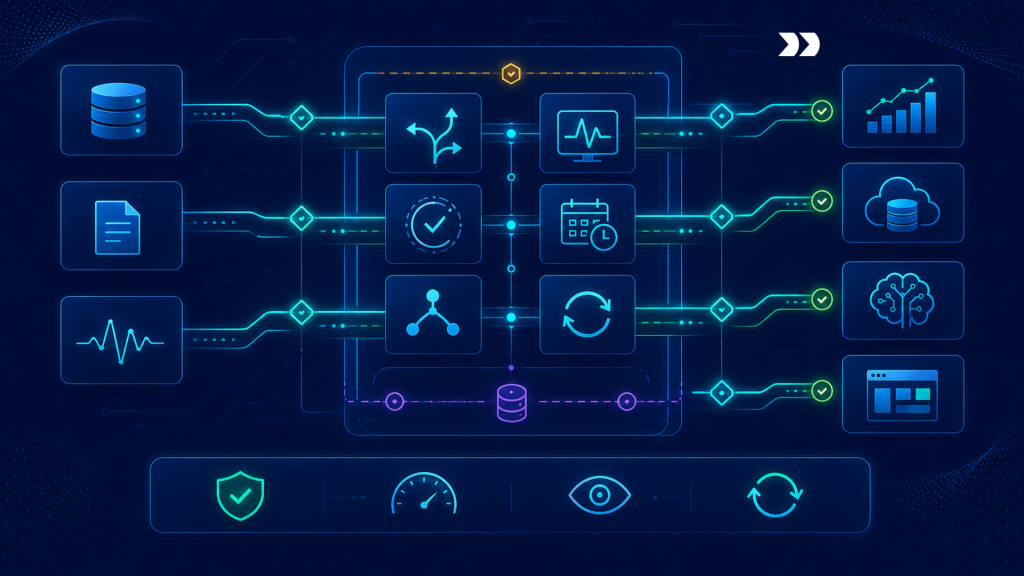
Enterprise distribution systems need infrastructure that can support scheduling, routing, validation, queue management, endpoint acknowledgement, access control, monitoring, metadata, lineage, and audit logs. Without that infrastructure, distribution remains a set of disconnected exports and delivery jobs.
Airflow can orchestrate scheduled delivery workflows and recovery tasks. Kafka can support event-driven distribution where timing and ordering matter. Spark can process high-volume datasets before delivery. dbt can create governed delivery-ready models. Snowflake, BigQuery, and Databricks can serve as controlled environments for downstream distribution. Great Expectations can validate schema, completeness, uniqueness, and threshold rules. Prometheus and data observability systems can monitor delivery health.
Scheduling, Routing, Validation, Queue Management, and Endpoint Acknowledgement Make Distribution Reliable
Scheduling ensures delivery occurs when the business process needs it. Routing ensures each dataset reaches the correct endpoint. Validation protects downstream systems from incomplete or malformed data. Queue management preserves records when endpoints are unavailable. Endpoint acknowledgement confirms that the receiving system accepted the data.
A distribution flow should not mark delivery as successful until endpoint requirements are satisfied.
def deliver_dataset(dataset, endpoint):
    missing = [field for field in endpoint["required_fields"] if dataset.get(field) is None]
    if missing:
        return {
            "delivered": False,
            "reason": "missing_required_fields",
            "fields": missing,
            "endpoint": endpoint["name"],
        }
    if endpoint["status"] != "available":
        return {
            "delivered": False,
            "reason": "endpoint_unavailable",
            "endpoint": endpoint["name"],
        }
    if dataset["record_count"] < endpoint["minimum_record_count"]:
        return {
            "delivered": False,
            "reason": "record_count_below_threshold",
            "endpoint": endpoint["name"],
        }
    print(f"Delivering {dataset['dataset_id']} to {endpoint['name']}")
    return {"delivered": True, "endpoint": endpoint["name"]}
This example reflects an important operational principle: distribution quality should be checked against the receiving endpoint, not only the source dataset.
Observability, Metadata, Lineage, and Audit Logs Make Distributed Data Delivery Measurable
Observability makes distributed data delivery measurable. Teams should monitor delivery success rate, latency, freshness, queue depth, retry volume, endpoint failures, acknowledgement delays, schema errors, duplicate delivery rates, and record rejection rates.
Metadata records dataset owner, delivery cadence, endpoint requirements, data classification, retention rules, access policy, and approved use cases. Lineage shows which dashboards, reports, models, workflows, and applications depend on each distribution path. Audit logs show what was delivered, when it was delivered, which controls passed, which endpoint received it, and which exceptions occurred.
Together, these controls allow enterprises to diagnose distribution issues quickly. If a dashboard is stale, teams can identify whether the cause was transformation delay, validation failure, endpoint unavailability, queue backlog, or downstream consumption failure.
Governance and Compliance Depend on Strong Distribution Design
Governance and compliance depend on strong distribution design because data movement creates exposure. A dataset may be controlled in the warehouse, but once distributed, it may reach different users, systems, vendors, regions, or use cases. Without governance built into distribution, enterprises may not know where data went or whether it was appropriate for the endpoint.
Cross-border data flows, third-party endpoints, customer data, financial records, supplier data, and external datasets require stronger controls. Distribution design should account for legal sourcing controls, data classification, access rights, privacy obligations, retention requirements, and jurisdictional restrictions. Data delivery challenges in business can significantly hinder operational efficiency. Effective strategies must be implemented to ensure that data is securely and timely delivered to its intended recipients. By addressing these challenges, organizations can enhance their overall data governance framework and improve compliance outcomes.
Distributed Data Delivery Requires Access, Usage, and Retention Controls
Distributed data delivery requires access controls that define who or what can receive data. It also requires usage controls that define whether data can be used for dashboards, AI training, operational automation, compliance evidence, redistribution, or external reporting. Retention controls define how long delivered data can remain in the receiving system.
These controls must be embedded into the distribution process. A file delivery should not bypass the access policy. An API feed should not send restricted fields to an unauthorized endpoint. A dataset intended for internal reporting should not be distributed to an AI training environment without approval.
Accordingly, operational design must include compliance architecture, not only delivery mechanics.
Auditability Makes Distribution Defensible During Incidents and Reviews
Auditability makes enterprise distribution defensible. During an incident, review, or compliance inquiry, teams need evidence of what data moved, which endpoint received it, which validation checks passed, which access policy applied, and which users or systems consumed it.
This evidence matters for compliance reporting, customer data workflows, financial reporting, AI governance, vendor delivery, and external data sourcing. Without auditability, teams may restore service but still lack proof that data movement was controlled.
Ultimately, audit logs, traceability, lineage, and delivery records turn distribution from an informal handoff into a governed operating system.
Why Enterprise Data Distribution Is Becoming an Executive Governance Issue
Enterprise Data Distribution is becoming an executive governance issue because distributed data now supports critical business decisions. Leaders rely on distribution flows for dashboards, compliance reporting, revenue operations, procurement decisions, inventory updates, product catalog publication, AI features, and market intelligence.
Executives do not need to manage each delivery path. However, they need visibility into which distribution flows support critical decisions, which endpoints are fragile, which workflows rely on manual workarounds, which delivery paths lack ownership, and where distribution creates compliance exposure. Enterprises are increasingly adopting enterprise data distribution solutions to enhance operational efficiency. These solutions facilitate seamless collaboration across departments and enable real-time access to vital information. By implementing robust distribution strategies, organizations can drive informed decision-making and mitigate risks associated with data management.
Leaders Need Visibility into Which Distribution Flows Support Critical Business Decisions
Leadership visibility should focus on distribution dependencies. Which delivery flows feed executive dashboards? Which supports AI models? Also, which serves compliance reporting? Which distribute supplier, inventory, product, revenue, or customer data? Which flows are time-sensitive? Also, which involves third-party or cross-border delivery? Which lack acknowledgement, monitoring, or fallback planning?
This visibility helps leaders prioritize infrastructure investment. A low-risk internal export may not need the same controls as a production flow supporting compliance, finance, AI, or customer operations. Critical distribution flows require stronger reliability standards, monitoring, ownership, lineage, and escalation.
In this context, distribution design becomes part of enterprise resilience. The organization cannot govern decision systems if it cannot govern how data reaches them.
Scalable Data Programs Require Distribution Standards, Ownership, Monitoring, and Continuous Review
Scalable data programs require distribution standards. These standards should define delivery cadence, endpoint requirements, schema expectations, validation rules, freshness thresholds, access controls, queue behavior, retry logic, acknowledgement requirements, lineage capture, audit logs, and escalation paths.
Ownership must be explicit. Data engineering may operate delivery infrastructure. Data operations may monitor delivery events. Business teams define endpoint requirements. Governance teams define access and usage rules. Analytics and AI teams define downstream consumption needs. Compliance teams define evidence and audit requirements.
Ultimately, Enterprise Data Distribution needs stronger operational design because data value depends on reliable downstream movement. Enterprise distribution systems must support more than storage and pipeline completion. Operational data distribution must align delivery with workflow timing, endpoint constraints, access policies, and governance requirements. Distributed data delivery must be measurable, traceable, and resilient.
Organizations that treat data distribution as enterprise infrastructure will build more dependable AI, analytics, reporting, compliance, and operational systems. Those that treat distribution as a final export step may continue producing useful data, but they will struggle to make that data consistently usable across the enterprise.