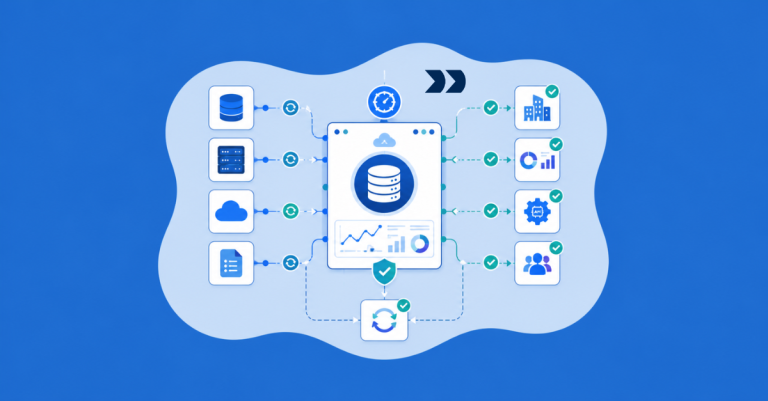
Data Delivery Services have become the final operating layer of enterprise data infrastructure. Data may be sourced, collected, validated, normalized, integrated, and prepared, but it still creates limited value if it does not reach the right destination in the right format, at the right time, with the right controls. Enterprise data delivery is therefore not a file transfer function. It is the distribution infrastructure that determines whether data becomes usable across analytics, AI, operations, risk, pricing, reporting, and strategic decision workflows.
Data Delivery Services as Enterprise Distribution Infrastructure
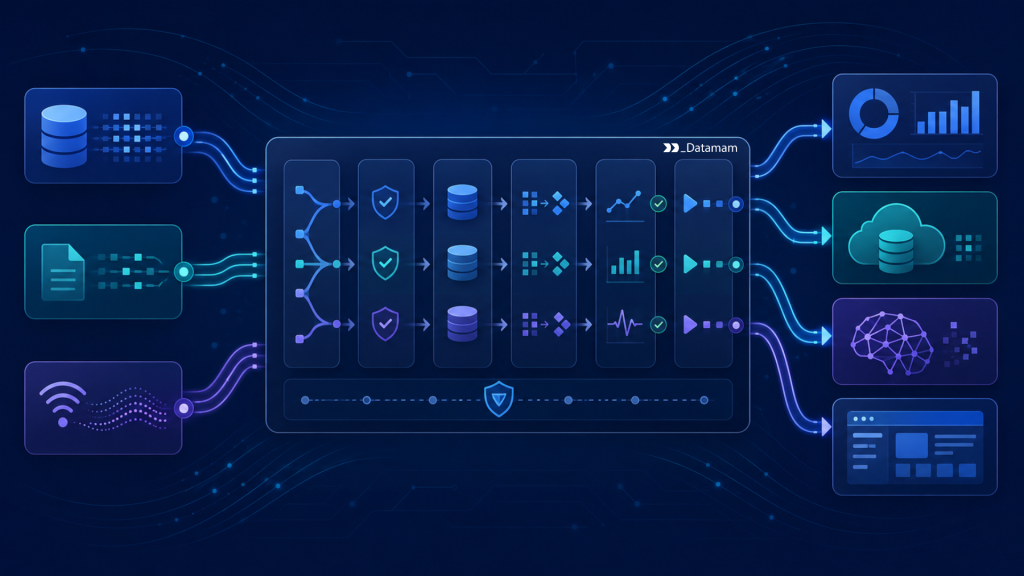
Enterprise data delivery is the layer that turns prepared data into operational consumption. It defines where data goes, how it is packaged, when it is refreshed, who can access it, how receipt is confirmed, and how failures are handled. Without that discipline, even high-quality data remains trapped upstream. Therefore, Data Delivery Services should be understood as distribution infrastructure. They connect data production with business usage and create the controlled pathway between upstream pipelines and downstream decision systems.
From Data Availability to Reliable Data Consumption
Data availability does not guarantee data consumption. A dataset can exist in a warehouse, API, storage bucket, shared folder, dashboard, or vendor feed while still failing to support business operations. Consumption requires delivery design. That design includes destination mapping, format preparation, refresh cadence, access control, confirmation, monitoring, and ownership. In practice, reliable data consumption begins when data delivery is engineered around how business teams, AI systems, dashboards, and operational platforms actually use the output.
Why Delivery Quality Determines Operational Data Value
Delivery quality determines whether upstream data work becomes business value. Data sourcing can identify the right inputs. Data collection can capture them. Also, data integration can connect systems. However, if delivery is delayed, incomplete, inaccessible, poorly formatted, or unmonitored, downstream teams still operate with uncertainty. A data delivery company is therefore evaluated by more than output generation. It is evaluated by reliability, timing discipline, destination readiness, failure visibility, and governance across recurring distribution workflows.
The Enterprise Data Distribution Gap
The enterprise data distribution gap appears when organizations have data pipelines but no reliable data delivery infrastructure. Data may be technically processed, but delivery paths remain inconsistent across teams, tools, schedules, and destinations. Some teams receive files. Others use APIs. Some dashboards refresh automatically. Others rely on manual uploads. AI teams request custom exports. Operations teams depend on email attachments or ad hoc reports. The result is distribution fragmentation, which weakens decision speed and trust.
Why Prepared Data Still Fails Without Delivery Control
Prepared data still fails when delivery control is weak. A clean dataset may arrive after the decision window has passed. A validated feed may reach one system but not another. A real-time signal may be delivered without access permissions for the team that needs it. A dashboard may refresh while the underlying delivery job silently fails. According to Gartner’s 2025 data and analytics predictions, by 2027, 50% of business decisions will be augmented or automated by AI agents, which will increase the need for governed data, analytics, and decision flows.
How Fragmented Distribution Creates Decision Latency
Fragmented distribution creates decision latency because downstream teams spend time checking whether data arrived, whether it is current, whether the format changed, whether the right version is available, and whether another system has a newer view. Analysts compare exports. AI teams wait for training data updates. Pricing teams wait for refreshed competitor feeds. Compliance teams request evidence of delivery history. As a result, data delivery solutions influence business speed directly. Distribution delays become decision delays.
Why Data Delivery Services Have Become Infrastructure
Data delivery becomes infrastructure when recurring decisions depend on consistent data distribution. This now applies across business intelligence, AI model development, real-time pricing, risk monitoring, customer operations, procurement, market intelligence, compliance workflows, and executive reporting. Once data delivery supports these workflows, it requires architecture, reliability controls, access governance, monitoring, confirmation, and operational accountability. Managed data delivery is no longer a convenience layer. It is a core reliability function in the enterprise data supply chain.
Enterprise Data Delivery Across BI, AI, Operations, and Strategy
Enterprise data delivery must support different consumption environments. BI teams need consistent datasets in dashboards and warehouses. AI teams need prepared data in training, evaluation, and monitoring environments. Operations teams need timely feeds in platforms where work is executed. Strategy teams need trusted recurring outputs for market and performance analysis. Each destination has different expectations for cadence, format, latency, access, and quality. Enterprise data delivery must therefore be designed around usage patterns, not only data generation.
Real-Time Data Delivery Across High-Frequency Decision Workflows
Real-time data delivery becomes important when decision windows are compressed. Pricing engines, fraud alerts, marketplace monitoring, inventory systems, operational dashboards, and AI-driven workflows may require data within minutes or seconds rather than days. However, real-time delivery increases complexity. It requires low-latency pipelines, delivery verification, monitoring, failover planning, schema stability, and access controls. McKinsey’s 2025 global AI survey found that nearly two-thirds of respondents had not yet begun scaling AI across the enterprise, even as AI use expanded. One implication is that AI scaling depends on operational foundations such as reliable data delivery.
Governance Requirements for Managed Data Delivery
Governance requirements apply to distribution because data movement creates risk. Enterprises must know what data was delivered, where it went, who could access it, when it arrived, whether it was transformed, and whether the destination confirmed receipt. This is especially important when data supports AI systems, regulated workflows, customer records, or financial operations. The NIST AI Risk Management Framework emphasizes structured risk management practices for AI systems, and reliable data delivery is part of the upstream control environment when AI depends on distributed data inputs.
| Enterprise Driver | What Changed | Why Data Delivery Infrastructure Is Required |
| Data-dependent decisions | Analytics, AI, pricing, operations, and risk workflows rely on recurring data outputs | Delivery must be reliable, timely, and destination-specific |
| Multi-destination consumption | Data must reach warehouses, APIs, dashboards, applications, and AI environments | Distribution paths must be mapped, monitored, and controlled |
| Real-time workflows | Business decisions increasingly depend on high-frequency data refreshes | Delivery timing, confirmation, and failure handling become operational requirements |
| Governance expectations | Data movement must be traceable, secure, and auditable | Delivery infrastructure must preserve lineage, access control, and receipt records |
| Scaling across teams | More teams and systems consume external and internal data | Delivery standards must prevent fragmented access, duplicated feeds, and inconsistent versions |
The Operating Model Behind Data Delivery Services
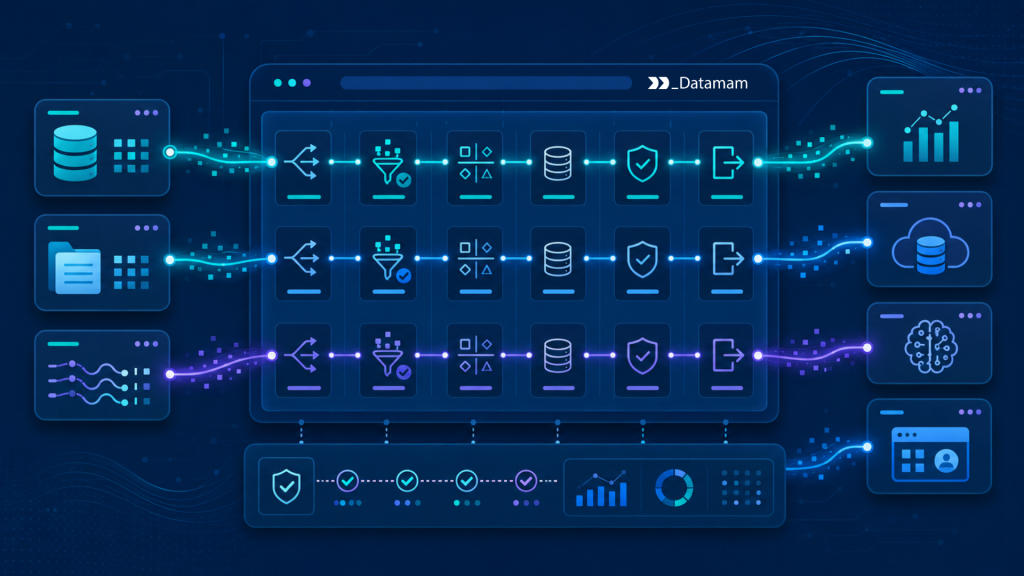
At enterprise scale, Data Delivery Services are not defined by sending files, exposing APIs, or updating dashboards. An operating model for controlled data distribution defines them. That model includes destination mapping, format preparation, scheduling, distribution, confirmation, monitoring, and governance. Each layer has a distinct responsibility. If one layer is weak, downstream teams receive delayed, incomplete, misformatted, unauthorized, or unverified data. Delivery architecture must therefore be designed before data consumption becomes mission-critical.
| Operating Layer | Core Responsibility | Enterprise Output |
| Destination Mapping Layer | Identify target systems, consumers, access requirements, and usage context | Clear delivery map aligned to business workflows |
| Format Preparation Layer | Package data as files, feeds, APIs, tables, streams, or system-specific outputs | Destination-ready data formats |
| Scheduling Layer | Define cadence, refresh windows, batch timing, and event triggers | Predictable delivery timing |
| Distribution Layer | Move data securely through approved delivery channels | Controlled enterprise data movement |
| Confirmation Layer | Verify receipt, completeness, and delivery status | Evidence that data reached the intended destination |
| Monitoring and Governance Layer | Track failures, latency, access, lineage, and audit records | Reliable and accountable distribution infrastructure |
Destination Mapping Layer for Business System Alignment
The destination mapping layer identifies where data must go and why. Destinations may include data warehouses, BI dashboards, cloud storage, APIs, CRM systems, ERP platforms, product systems, pricing tools, AI pipelines, feature stores, compliance databases, or external partner systems. Mapping should capture ownership, format expectations, refresh cadence, access permissions, downstream dependencies, and business use. Without destination mapping, delivery becomes reactive. Teams push data somewhere, then discover later that the output does not match how consumers need to use it.
Format Preparation Layer for System-Ready Outputs
The format preparation layer ensures that data is packaged for the destination. Some consumers need JSON through APIs. Others need tables in a warehouse, Parquet files in cloud storage, CSV extracts, event streams, dashboard-ready models, or application-specific payloads. Format preparation must also preserve schema consistency, metadata, identifiers, timestamps, and documentation. This layer is critical because the same dataset may need different forms for AI, analytics, operations, and compliance teams. Delivery quality depends on destination readiness.
Scheduling Layer for Cadence, Refresh, and Timing Control
The scheduling layer defines when data is delivered. Some workflows require hourly delivery. Others require daily refreshes, weekly files, real-time event triggers, or business-calendar timing. Scheduling must account for source availability, processing time, downstream consumption windows, dependency order, and operational risk. If data arrives too early, downstream systems may not be ready. If it arrives too late, decisions slow down. Delivery cadence should be designed around business usage, not only technical convenience.
Distribution Layer for Secure Data Movement
The distribution layer moves data through approved channels. This may include APIs, secure file transfer, cloud storage, warehouse loading, streaming platforms, application endpoints, or partner delivery environments. Security matters because distribution exposes data across systems and users. Access controls, encryption, credentials, network policies, and destination authorization must be managed. OECD’s 2025 work on trustworthy AI identifies data, digital infrastructure, governance, procurement, transparency, oversight, and risk management as key enablers and guardrails. Data delivery sits directly inside that operating perimeter.
Confirmation Layer for Delivery Verification and Receipt Control
The confirmation layer verifies that data arrived as expected. It checks delivery status, completeness, file size, record count, schema match, destination response, receipt confirmation, and failure conditions. Without confirmation, teams may assume a delivery succeeded when the destination received only partial data or rejected the output. Confirmation is especially important for managed data delivery because delivery is not complete when data leaves the pipeline. It is complete when the destination receives usable data.
Monitoring and Governance Layer for Reliability, Access, and Auditability
The monitoring and governance layer tracks delivery reliability over time. It should measure success rate, latency, missed schedules, failed destinations, access exceptions, schema changes, data freshness, and audit history. Governance should record ownership, delivery purpose, permitted consumers, retention expectations, and escalation paths. Deloitte’s 2026 State of AI in the Enterprise report describes enterprise AI adoption as moving from ambition toward activation, which increases the need for industrialized data and operating processes. Delivery infrastructure is one of those operating processes.
Enterprise Risks Created by Weak Data Delivery Operations
Weak data delivery operations create risks that appear outside the data team. Business units may make decisions on stale data. AI teams may train models on incomplete updates. Compliance teams may lack evidence of where data moved. Operations teams may manually check feeds that should be automated. The risk is structural. If the enterprise cannot reliably distribute data, every downstream workflow that depends on data becomes less predictable, less efficient, and more difficult to govern.
Decision Latency From Delayed Data Availability
Decision latency occurs when data is prepared but not available when teams need it. A pricing team may wait for refreshed competitor feeds. A risk team may wait for regulatory updates. An AI team may wait for a dataset refresh before retraining. A strategy team may wait for market intelligence outputs. In each case, the delay is not caused by a lack of data. It is caused by weak delivery control. Enterprise data delivery reduces this risk by aligning data refresh with decision cadence.
Operational Disruption From Failed or Incomplete Deliveries
Operational disruption occurs when deliveries fail, arrive incomplete, or reach the wrong destination. A dashboard may refresh with partial records. A warehouse table may miss a scheduled load. An external partner may receive an outdated file. An AI pipeline may consume the wrong version. These failures create manual investigation and downstream uncertainty. Strong delivery infrastructure uses confirmation, monitoring, and exception handling to identify failure conditions before business teams discover them through inconsistent outputs.
Data Inconsistency from Uncontrolled Distribution Paths
Data inconsistency emerges when the same dataset is distributed through multiple uncontrolled paths. One team receives a file. Another consumes an API. A dashboard uses a transformed table. An AI team uses a copy from storage. If these paths are not governed, teams may operate with different versions, schemas, or refresh timing. The result is conflicting reports and weak trust. Data delivery solutions reduce inconsistency by standardizing distribution logic and preserving delivery lineage.
Compliance Exposure from Weak Access and Delivery Tracking
Compliance exposure increases when enterprises cannot prove where data was delivered, who accessed it, and whether distribution followed policy. This matters for sensitive data, customer records, regulated workflows, licensed external data, and AI datasets. OECD’s 2025 policy brief on data access and sharing in the age of AI emphasizes balancing data access with legal, technical, and organizational safeguards. Delivery governance is the practical mechanism that applies those safeguards across data distribution.
Scaling Fragility Across Destinations, Formats, and Frequencies
Scaling fragility appears when delivery expands across more destinations, formats, teams, and refresh schedules without a structured model. A process that works for one dashboard may fail when extended to APIs, warehouses, external partners, and AI workflows. Each new destination introduces permissions, schema expectations, timing dependencies, and monitoring requirements. Managed data delivery reduces fragility by creating reusable delivery patterns. This allows the enterprise to scale consumption without rebuilding distribution logic for every use case.
Build vs Buy Decisions for Data Delivery Services
The build-versus-buy decision for Data Delivery Services should be evaluated as an operating model choice. Internal teams may manage delivery when the scope is narrow, destinations are stable, and refresh cadence is limited. However, enterprise-scale delivery requires reliability engineering, scheduling discipline, access control, monitoring, confirmation, documentation, and support. The decision should account for long-term ownership of delivery risk, not only the ability to move data between systems.
| Evaluation Area | Build Internally | Managed Data Delivery Capability |
| Best Fit | Narrow delivery scope, stable destinations, and limited refresh requirements | Multi-destination, high-frequency, governed enterprise data distribution |
| Cost Profile | Lower visible start cost, higher hidden monitoring and support burden | Structured cost with operational accountability |
| Control | Full internal ownership of delivery logic and destinations | Shared model with documented governance and handoff |
| Scalability | Limited by internal capacity and delivery architecture maturity | Designed for expansion across formats, systems, teams, and use cases |
| Risk Ownership | Delivery failures, access issues, and continuity risk remain internal | Risk is distributed through monitoring, service expectations, and managed operations |
When Internal Data Delivery Operations Are Rational
Internal data delivery operations are rational when the organization has stable destinations, limited frequency requirements, and strong internal data engineering ownership. A weekly extract to a known internal system, a controlled dashboard refresh, or a single warehouse load may be appropriate for internal management. Internal ownership may also make sense when delivery logic is highly proprietary or tied to sensitive internal workflows. However, internal delivery still requires documentation, monitoring, access control, and escalation procedures.
Where Internal Delivery Models Break at Scale
Internal delivery models break when every new destination, data consumer, or refresh cadence creates custom work. Data teams must manage file exports, API delivery, warehouse loads, permissions, transformation variants, notification logic, failure handling, and stakeholder support. Over time, delivery maintenance competes with analytics, AI, product, and platform work. McKinsey’s 2025 State of AI survey shows that many organizations have not yet scaled AI broadly across the enterprise. Weak delivery infrastructure is one of the practical barriers that can keep AI and analytics from moving beyond isolated workflows.
Total Cost Beyond Files, Feeds, APIs, and Dashboards
The total cost of data delivery extends beyond building a file export, feed, API, or dashboard connection. It includes destination mapping, format management, scheduling, monitoring, confirmation, access control, data freshness tracking, issue resolution, documentation, stakeholder support, and change management. Initial delivery setup is visible. Long-term reliability work is often underestimated. Data delivery platform costs should therefore be evaluated together with operational burden, failure cost, and internal resource allocation.
Risk Allocation Across Delivery Reliability, Governance, and Continuity
Risk allocation determines who is responsible when data does not arrive, arrives late, arrives incomplete, reaches the wrong destination, or violates access expectations. Internal delivery concentrates that responsibility inside the organization. Managed data delivery distributes responsibility through operating controls, monitoring, service expectations, documentation, and escalation processes. The strategic question is not whether internal teams can build delivery workflows. It is whether they should own every reliability dependency as data consumption expands across the enterprise.
Data Delivery Platforms vs Managed Data Delivery Infrastructure
A data delivery platform can provide useful tooling for scheduling, orchestration, API publishing, file distribution, warehouse loading, or stream delivery. However, platform access is not the same as delivery assurance. Enterprises still need destination mapping, governance rules, reliability standards, failure management, access control, and operational ownership. Tools provide delivery capability. Managed data delivery infrastructure provides accountability. This distinction matters when data distribution becomes critical to daily operations, AI workflows, executive reporting, and customer-facing systems.
Why Platform Access Is Not the Same as Delivery Assurance
Platform access means a team can configure delivery. Delivery assurance means the enterprise knows that the right data reached the right destination at the right time and in the expected condition. A platform may schedule a job, but it may not define business priority, confirm downstream usability, assign ownership, or evaluate impact when delivery fails. Data delivery services add operational design around the platform so that distribution is governed, monitored, documented, and aligned with business consumption.
The Ownership Gap Between Delivery Tools and Reliable Distribution
The ownership gap appears when tools are available, but no team owns the full distribution lifecycle. Data engineering may own pipelines. Analytics may own dashboards. Security may own access. Business teams may own consumption requirements. Vendors may own external feeds. Without a clear operating model, delivery failures become difficult to resolve. Managed data delivery closes this gap by defining responsibility across destination mapping, scheduling, distribution, confirmation, monitoring, and incident response.
Industry Applications of Data Delivery Services
Industry applications vary because each sector has different delivery destinations, latency expectations, compliance requirements, and operating workflows. Retail teams need pricing, inventory, product, and marketplace data delivered into commerce and analytics systems. Financial services teams need governed delivery into risk, compliance, and reporting environments. AI and technology teams need data distributed into model pipelines and product platforms. Legal, government, and compliance teams need traceable delivery of documents, public records, regulatory updates, and monitoring outputs.
Retail and E-Commerce Data Distribution
Retail and e-commerce data delivery supports pricing tools, product information systems, marketplace operations, inventory platforms, digital shelf dashboards, promotion tracking, and executive reporting. Delivery must account for high SKU volume, frequent changes, regional differences, and multiple destination systems. Weak delivery creates stale pricing, inaccurate availability, inconsistent product records, and delayed merchandising decisions. Strong delivery infrastructure can reduce manual export and reconciliation effort by 30-60% in recurring workflows where teams previously relied on spreadsheets or manual refresh checks. Expert web scraping techniques for businesses can enhance data gathering and analysis. By automating the extraction of market intelligence, companies can quickly adapt their strategies and optimize pricing. This adaptability allows for better competitive positioning in a rapidly evolving digital marketplace.
Financial Services Data Delivery and Risk Operations
Financial services data delivery supports risk models, compliance systems, regulatory monitoring, fraud workflows, customer review processes, audit reporting, and executive dashboards. Delivery reliability is critical because data may influence risk classification, monitoring alerts, or compliance evidence. Access control and lineage are equally important. A delayed or undocumented delivery can create audit difficulty and operational risk. Enterprise data delivery creates value by combining secure distribution with traceable delivery history and defined escalation paths.
AI and Technology Data Pipeline Delivery
AI and technology teams require reliable delivery into data lakes, feature stores, vector databases, model training environments, evaluation pipelines, analytics tools, and product systems. Data delivery affects model freshness, evaluation accuracy, monitoring quality, and production readiness. KPMG’s 2025 global study on trust in AI found that although AI use is widespread, only 46% of people globally are willing to trust AI systems. For enterprise AI leaders, reliable delivery and traceable data movement are part of building that trust.
Legal, Government, and Compliance Data Distribution
Legal, government, and compliance workflows often depend on public records, regulatory updates, court filings, procurement notices, sanctions data, policy changes, and jurisdiction-specific monitoring outputs. Delivery must be traceable, complete, and timed around review workflows. Missed delivery may delay legal research, compliance monitoring, or public sector opportunity review. In these environments, delivery confirmation and auditability matter as much as speed. Teams need evidence that the correct data was delivered and available for review.
Business Outcomes from Enterprise Data Delivery Infrastructure
The business value of enterprise data delivery infrastructure should be measured by data availability, distribution reliability, manual work reduction, governance strength, decision speed, and scalability. These outcomes depend on destination complexity, source cadence, internal ownership, downstream adoption, and operating maturity. However, when delivery infrastructure is designed well, the organization reduces friction at the final step where data becomes usable. Data delivery is where upstream effort either becomes operational value or remains infrastructure overhead.
Faster Data Availability Across Decision Systems
Data availability improves when delivery workflows are mapped to destination requirements and business cadence. Teams receive data when decisions need to happen, not when a manual process happens to finish. Pricing teams can review updated feeds. AI teams can access refreshed datasets. Risk teams can see new alerts. Executives can rely on dashboards with current data. In recurring workflows, mature delivery infrastructure can reduce delivery-related delays by 20-40%, especially where prior distribution depended on manual supervision.
Higher Reliability Across Recurring Data Workflows
Reliability improves when delivery includes confirmation, monitoring, retries, and exception handling. Recurring data workflows should not depend on informal checks or users discovering missing updates. Delivery infrastructure should identify failed jobs, incomplete outputs, delayed refreshes, access issues, and schema mismatches. This improves trust in recurring reports, models, feeds, and operational systems. Reliability is especially important when data delivery supports daily operations rather than occasional analysis.
Lower Manual Reconciliation and Delivery Supervision
Manual reconciliation declines when delivery workflows are standardized and monitored. Analysts no longer need to check whether files arrived. Engineers no longer need to manually confirm job completion. Operations teams no longer need to compare outputs across destinations. Compliance teams no longer need to reconstruct delivery history. The practical result is reduced operational overhead and better use of skilled teams. Delivery supervision should be handled by infrastructure, not by recurring human inspection.
Stronger Governance Across Data Distribution Channels
Governance improves when data distribution is documented, controlled, and auditable. Enterprises should know which data products are delivered, which systems consume them, who has access, how often they refresh, and what happens when delivery fails. OECD’s data governance guidance reinforces the importance of responsible data use, governance, and structured oversight. For enterprise delivery, that means governance must extend beyond data storage into distribution channels and consumption environments.
More Reliable Scaling Across Destinations and Use Cases
Scaling becomes more reliable when delivery patterns are reusable. A mature model can support new dashboards, warehouses, AI systems, external partners, business units, and regional teams without rebuilding distribution from scratch. Without reusable patterns, every new destination creates custom scheduling, format, access, monitoring, and support work. With disciplined delivery infrastructure, new use cases benefit from existing standards and operational controls. This creates leverage across the entire data supply chain.
Data Delivery Services as an Operational Control Point
Data delivery is an operational control point because it determines when data becomes available for action. Upstream data quality matters, but downstream timing determines responsiveness. A decision team cannot use data that arrives after a meeting. A model cannot retrain on data that was not delivered. A compliance system cannot review updates it did not receive. Delivery, therefore, sits at the boundary between data production and enterprise execution.
Why Delivery Timing Shapes Business Responsiveness
Delivery timing shapes business responsiveness because many enterprise decisions are time-sensitive. A late pricing feed can reduce margin visibility. A delayed risk update can weaken monitoring. A missed regulatory delivery can slow the compliance response. A late AI dataset can delay retraining. Timing should therefore be treated as a design requirement. Real-time data delivery is not always necessary, but the delivery cadence must match the decision cadence. Misalignment creates avoidable latency.
How Delivery Monitoring Supports AI and Analytics Reliability
Delivery monitoring supports AI and analytics reliability by confirming that data arrived, remained fresh, and matched the expected structure. AI and analytics systems often continue running even when upstream deliveries degrade. This creates a silent risk. A dashboard may refresh with partial data. A model may use stale features. A report may exclude a missing source. Monitoring provides the visibility needed to detect these conditions early. Gartner’s 2025 analytics outlook predicts that 75% of new analytics content will be contextualized for intelligent applications through generative AI by 2027, increasing the importance of reliable delivery into analytics environments.
Commercial Evaluation Criteria for a Data Delivery Company
Enterprise buyers should evaluate a data delivery company by delivery assurance, not by output generation alone. The provider should demonstrate how it maps destinations, prepares formats, schedules refreshes, secures movement, confirms receipt, monitors failures, documents access, and supports operational handoff. It should also understand how delivery affects business workflows. A strong delivery partner reduces uncertainty at the final mile of the data supply chain, where outputs become usable for decision systems.
Evidence of Delivery Mapping and Destination Readiness
A serious delivery capability should show evidence of destination mapping and readiness assessment. This includes identifying consumer systems, required formats, schema expectations, refresh cadence, access controls, delivery windows, ownership, and downstream dependencies. Delivery should not begin with a generic output format. It should begin with the question of how the destination will consume the data. That is what separates managed data delivery from simple data export.
Monitoring, Confirmation, and Failure Management Standards
Monitoring, confirmation, and failure management standards should be part of the delivery model from the beginning. Buyers should assess how delivery failures are detected, how incomplete outputs are handled, how retries work, how destination receipt is confirmed, how latency is measured, and how incidents are escalated. Strong failure management prevents silent degradation. It also gives business teams confidence that delivery workflows are actively managed rather than assumed to be functioning.
Security, Access Control, and Operational Handoff Quality
Security, access control, and operational handoff quality determine whether delivery infrastructure can scale safely. Buyers should expect permission models, authentication controls, encryption standards, destination ownership, audit records, retention expectations, and runbook documentation. Handoff should include enough detail for internal teams to understand delivery logic, timing, failure paths, and escalation procedures. Durable delivery infrastructure depends on clear ownership as much as on technical execution.
Conclusion: Data Delivery Services as Enterprise Distribution Infrastructure
Data Delivery Services have become an enterprise distribution infrastructure because modern organizations rely on data reaching the right destinations with reliability, timing, security, and governance. Sourcing, collection, integration, and preparation create value only when data is distributed to the systems where decisions, analytics, AI workflows, and operations actually happen.
The enterprise advantage is not simply producing more data outputs. It is creating controlled delivery pathways that reduce latency, improve reliability, strengthen governance, and make data consumption scalable across teams and systems. Strong delivery infrastructure ensures that data is not only available but usable.
Ultimately, enterprise data value depends on distribution quality. Organizations that treat data delivery as infrastructure build stronger foundations for decision speed, AI readiness, compliance visibility, operational execution, and long-term data scalability.
Strategic Consultation for Enterprise Data Delivery Readiness
A strategic consultation should clarify whether the organization’s current delivery model can support its data consumption requirements. Many enterprises already have pipelines, dashboards, APIs, warehouses, and internal data teams, but still lack reliable destination mapping, delivery confirmation, monitoring, access governance, and failure management. The assessment should identify where delivery gaps, timing issues, manual supervision, inconsistent formats, or weak ownership limit downstream value.
Assessing Delivery Reliability, Timing, and Governance Gaps
A delivery readiness assessment should begin by mapping critical data outputs to destination systems and business workflows. This includes reviewing who consumes the data, how often it must refresh, what format is required, how delivery is confirmed, what access controls apply, and how failures are escalated. The assessment should identify where delivery is delayed, duplicated, unmonitored, or unsupported. From there, leadership can distinguish a data quality issue from a delivery infrastructure issue.
Evaluating Internal, External, and Managed Data Delivery Models
The final step is evaluating whether data delivery should remain internal, be supported by external specialists, or operate through a managed data delivery model. The decision should consider destination complexity, refresh frequency, compliance exposure, internal capacity, required service levels, and total cost of ownership. Submit an inquiry when the objective is to clarify the right delivery operating model before expanding data products, AI workflows, or enterprise distribution commitments.