Key Takeaways
- Data Availability Strategy determines whether downstream teams can access data when they need it.
- Downstream data access depends on how data is prepared, validated, scheduled, and delivered before consumption.
- Data availability planning reduces gaps across dashboards, reports, applications, AI workflows, and operational systems.
- Delivery access continuity requires upstream controls, not last-minute distribution fixes.
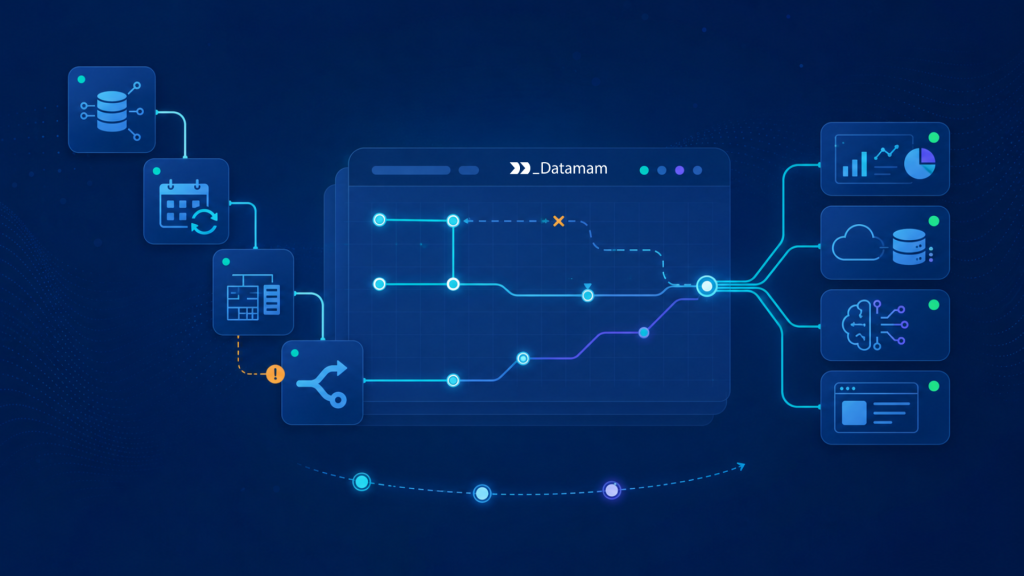
Downstream data availability is often discussed as an access problem. A dashboard is unavailable. A report is missing the latest records. An AI workflow cannot access the right features. A compliance team cannot retrieve evidence before review. However, availability failures usually begin earlier than the point of consumption. Data becomes unavailable downstream when upstream preparation, validation, scheduling, routing, access control, endpoint readiness, or delivery monitoring is weak.
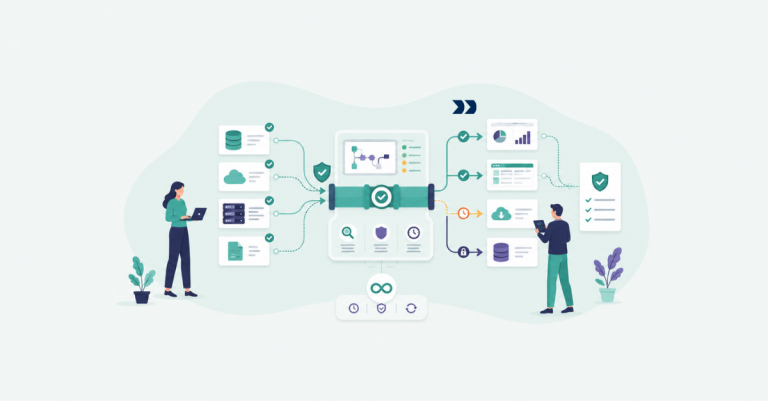
Data Availability Strategy defines how enterprises ensure that data remains accessible, current, validated, governed, and usable across downstream systems. It includes downstream data access, data availability planning, delivery access continuity, freshness controls, endpoint coordination, metadata, lineage, observability, audit logs, and ownership. As enterprises rely more heavily on dashboards, AI systems, compliance reporting, procurement workflows, revenue operations, and product distribution, availability must be designed before delivery reaches the consuming system.
Data Availability Strategy Determines Whether Downstream Teams Can Access Data When They Need It
Enterprise teams often measure availability at the end of the data journey. They ask whether a dashboard was loaded, whether a table was accessible, whether a report was published, or whether an application received the latest feed. However, downstream access is only the visible result of upstream decisions.
A dataset may be technically present in Snowflake, BigQuery, Databricks, or another analytical environment, yet still unavailable to the team that needs it. Access permissions may be missing. Validation may have failed. Delivery may be delayed. The endpoint may be unavailable. The data may not meet freshness thresholds. The latest version may not have been routed to the correct consuming system.
McKinsey’s State of AI 2025 reports that AI is widely used across organizations, but most companies have not embedded AI deeply enough into workflows and processes to realize material enterprise-level benefits. That gap reinforces the importance of availability: AI and analytics cannot become operational when trusted data is difficult to access inside business workflows.
Downstream Data Access Depends on How Data Is Prepared, Validated, and Delivered Before Consumption
Downstream data access depends on upstream design. A business team may ask why a report is missing records, but the cause may be a validation block before delivery. A model team may ask why features are stale, but the cause may be queue delay. A compliance team may ask why evidence is not available, but the cause may be incomplete delivery acknowledgement or missing access rights.
This means availability cannot be solved only by giving more users access to storage. Access must be aligned with data readiness. If data is incomplete, stale, duplicated, or unapproved, making it accessible may increase risk. If data is valid but not routed to the correct endpoint, access remains functionally broken.
In practice, downstream access begins with upstream controls that decide whether data is ready, where it should go, who can use it, and which systems must receive it.
Data Availability Planning Reduces Gaps Across Dashboards, Reports, Applications, and AI Workflows
Data availability planning defines how data remains available across downstream environments. It should specify delivery cadence, freshness expectations, access roles, endpoint requirements, validation rules, queue behavior, retry policies, acknowledgement handling, fallback options, and escalation paths.
Dashboards may need daily availability before executive review. AI workflows may need feature availability before inference. Compliance reports may need timestamped evidence before audit preparation. Product systems may need validated catalog data before publication windows. Revenue operations may need account updates before forecasting.
Accordingly, data availability planning should begin with the decision or workflow that depends on the data. The design question is not simply where the data should be stored. It is where the data must be available, by when, under which controls, and with what proof.
Why Availability Problems Usually Begin Before Delivery
Availability problems often appear downstream, but the root cause usually sits upstream. A delivery job may not start because scheduling is unclear. A dataset may not be released because validation fails. An endpoint may not receive data because the access credentials have expired. A queue may hold records because the consuming system is unavailable. A user may not access data because role-based permissions were not aligned with the workflow.
Gartner’s 2025 Data and Analytics Predictions state that by 2027, half of business decisions will be augmented or automated by AI agents for decision intelligence. As decision workflows become more automated, upstream availability failures become more consequential because downstream systems may continue operating without the latest trusted inputs.
Missing Validation, Weak Scheduling, and Poor Endpoint Readiness Create Downstream Access Failures
Missing validation creates access risk because downstream teams may receive data that should have been blocked. Weak scheduling creates timing gaps because data may arrive after the workflow needs it. Poor endpoint readiness creates delivery failures because the receiving system may be unavailable, unauthorized, overloaded, or incompatible with the latest format.
These issues are often misread as downstream access problems. A dashboard user sees stale data. An AI engineer sees missing features. A procurement team sees no supplier updates. However, the access failure may have started with a missed upstream control.
At scale, this distinction matters. Fixing the dashboard does not solve the scheduling issue. Expanding permissions does not solve failed validation. Rerunning a report does not solve endpoint readiness.
Delivery Access Continuity Depends on Upstream Controls, Not Last-Minute Distribution Fixes
Delivery access continuity means downstream systems can continue receiving and accessing data even when normal conditions change. Endpoints may fail. Credentials may expire. Data volume may spike. Validation may detect anomalies. Delivery queues may grow. External systems may slow down. Governance policies may change.
Continuity depends on upstream controls: fallback routing, queue management, retry logic, endpoint checks, freshness thresholds, access verification, and escalation paths. If these controls do not exist before failure, teams improvise during incidents.
Therefore, delivery access continuity should not rely on last-minute exports or emergency permissions. Those fixes may restore access temporarily, but they often weaken governance, lineage, and auditability.
The Strategic Cost of Weak Data Availability Planning
Weak data availability planning creates strategic cost because teams lose speed, confidence, and consistency. Data may exist somewhere, but if the right team cannot access it in the right form at the right time, decision quality declines.
IBM’s 2025 CDO Study emphasizes that leading organizations create value by using the most valuable data to deliver specific business outcomes, rather than simply accessing more data. Availability planning is part of that outcome focus because valuable data must be reachable inside the workflow that uses it. Effective enterprise data distribution strategies can significantly enhance an organization’s ability to respond to market changes. By ensuring that data is not only available but also distributed strategically, teams can make quicker and more informed decisions. Ultimately, prioritizing these strategies leads to a more agile and data-driven business environment.
Business Teams Lose Speed When Critical Data Is Unavailable During Decision Windows
Business teams work inside decision windows. Revenue forecasts close at a specific time. Compliance teams prepare evidence before review. Procurement teams assess suppliers before approvals. Product teams update channels before publication cycles. Inventory teams act before stock conditions change.
If data is unavailable during those windows, teams face two poor options: delay the process or proceed without current information. Delaying slows the business. Proceeding increases decision risk.
In practice, weak data availability planning creates decision drag. Teams may still get the data later, but late access changes the value of the information. Data that arrives after the decision window becomes historical context rather than operational input.
Operational Workflows Become Fragile When Availability Depends on Manual Checks or Ad Hoc Exports
Manual checks and ad hoc exports are symptoms of weak availability design. A team asks for a spreadsheet because the dashboard is stale. An analyst sends a file because the application feed failed. A data engineer manually grants access because role-based permissions were not planned. A business owner requests confirmation because the delivery status is unclear.
These workarounds restore access temporarily, but they create new risks. Manual files may lack lineage. Local exports may bypass access controls. Emergency permissions may exceed approved use. Spreadsheet copies may become stale. Different teams may work from different versions.
As a result, operational workflows become fragile. They depend on people noticing gaps and manually restoring access, rather than on infrastructure designed for continuity.
How Upstream Design Shapes Downstream Data Access
Upstream design determines whether downstream data access is reliable, governed, and measurable. It defines how datasets are prepared, validated, scheduled, routed, delivered, acknowledged, and made available to users or systems. Without upstream design, downstream access becomes inconsistent.
NIST’s AI Risk Management Framework identifies govern, map, measure, and manage as core functions for responsible AI risk management. Those same functions apply to availability because downstream AI and analytics systems need governed, mapped, measured, and managed access to trusted data. Weak data delivery challenges in businesses can lead to significant inefficiencies and missed opportunities. Organizations must prioritize addressing these issues to enhance their operational workflows. By implementing robust data delivery strategies, companies can ensure a more reliable and effective use of their data resources.
Availability Requires Reliable Scheduling, Queue Management, Endpoint Routing, and Status Tracking
Reliable availability requires scheduling, queue management, endpoint routing, and status tracking. Scheduling ensures data is prepared before the consuming workflow needs it. Queue management preserves records when endpoints are unavailable. Routing ensures data reaches the right system. Status tracking shows whether delivery was blocked, queued, sent, acknowledged, or failed.
A delivery event should not be treated as available until validation, endpoint readiness, and access checks pass. Effective endpoint management strategies for enterprises are crucial for maintaining the integrity of data flow. By implementing robust policies and tools, organizations can enhance their operational efficiency and minimize disruptions. Furthermore, training staff on these strategies helps ensure that all team members are prepared to handle endpoint challenges effectively.
def evaluate_availability_event(event):
    if event["validation_status"] != "passed":
        return {
            "availability": "blocked",
            "reason": "validation_failed",
            "delivery_id": event["delivery_id"],
        }

    if event["access_policy_status"] != "approved":
        return {
            "availability": "blocked",
            "reason": "access_policy_not_approved",
            "delivery_id": event["delivery_id"],
        }

    if event["endpoint_status"] != "available":
        return {
            "availability": "queued",
            "reason": "endpoint_unavailable",
            "delivery_id": event["delivery_id"],
        }

    return {"availability": "ready_for_delivery", "delivery_id": event["delivery_id"]}


event = {
    "delivery_id": "DEL-719420",
    "dataset": "compliance-evidence-feed",
    "target_endpoint": "audit_reporting_portal",
    "validation_status": "passed",
    "access_policy_status": "approved",
    "endpoint_status": "available",
    "timestamp": "2026-06-17T08:30:00Z",
}

evaluate_availability_event(event)
This example shows the upstream logic behind downstream availability. Data is not considered ready simply because it exists. It becomes available when validation, access policy, and endpoint readiness align.
Data Access Breakdowns Often Reflect Weak Lineage, Metadata, Ownership, or Governance Controls
Data access breakdowns often reflect weak context. A dataset may exist, but teams may not know which version is current, who owns it, which endpoint should receive it, what freshness threshold applies, or which users are approved to access it. Without lineage and metadata, availability becomes difficult to interpret.
Lineage shows which dashboards, reports, models, applications, and workflows depend on each dataset or delivery flow. Metadata records owner, cadence, classification, endpoint requirements, retention rules, freshness thresholds, and access policies. Governance controls define which teams can use the data and for which purposes.
When these controls are missing, access failures become harder to resolve. Teams may restore access technically without knowing whether the restored data is current, approved, or appropriate for the use case.
The Infrastructure Layer Behind Availability Continuity
Availability continuity depends on infrastructure that can detect, prevent, and recover from access failures. This includes orchestration, validation, delivery routing, queue handling, observability, audit logging, access control, and metadata management.
Airflow can orchestrate scheduled availability workflows. Kafka can support event-driven delivery when downstream systems require continuous updates. Spark can process high-volume datasets before distribution. DBT can create governed delivery-ready models. Snowflake, BigQuery, and Databricks can serve controlled datasets to downstream systems. Great Expectations can validate schema, completeness, uniqueness, and threshold rules. Prometheus and data observability systems can monitor availability metrics such as freshness, endpoint status, queue depth, latency, and delivery failures.
Validation, Freshness Checks, Delivery Monitoring, and Endpoint Acknowledgement Protect Availability
Validation prevents incomplete or malformed data from becoming available downstream. Freshness checks ensure that the dataset is current enough for the use case. Delivery monitoring shows whether the data moved as expected. Endpoint acknowledgement confirms that the receiving system accepted the delivery.
A freshness-aware availability check can prevent stale data from being treated as ready.
def check_dataset_freshness(dataset, availability_policy):
    if dataset["age_minutes"] > availability_policy["max_age_minutes"]:
        return {
            "available": False,
            "reason": "freshness_threshold_exceeded",
            "dataset_id": dataset["dataset_id"],
        }

    if dataset["validation_status"] != "passed":
        return {
            "available": False,
            "reason": "validation_failed",
            "dataset_id": dataset["dataset_id"],
        }

    return {"available": True, "dataset_id": dataset["dataset_id"]}


dataset = {
    "dataset_id": "inventory-update-feed",
    "age_minutes": 18,
    "validation_status": "passed",
}

availability_policy = {
    "use_case": "inventory_operations",
    "max_age_minutes": 30,
}

check_dataset_freshness(dataset, availability_policy)
This pattern ties availability to business requirements. A dataset that is fresh enough for monthly reporting may not be fresh enough for inventory operations or pricing decisions.
Observability, Audit Logs, and Access Controls Make Availability Measurable and Defensible
Observability makes availability measurable. Teams should monitor freshness, endpoint availability, delivery success rate, queue depth, access failures, validation blocks, permission denials, acknowledgement delays, and recovery time. These metrics show whether downstream data access is reliable or only assumed.
Audit logs make availability defensible. They record when data was produced, validated, delivered, acknowledged, accessed, or blocked. Access controls determine who can use the data, through which system, and under which policy.
Together, these controls support operational continuity and governance. They help teams prove not only that data existed, but that it was available, current, controlled, and delivered to the correct downstream environment.
Governance and Compliance Depend on Availability Design
Governance and compliance depend on availability design because access must be controlled, timely, traceable, and appropriate. A compliance team needs data to be available before review, but only in an approved form. An AI workflow needs accessible features, but only if use is permitted. A business team needs dashboards, but access must align with role and classification.
Availability without governance creates exposure. Governance without availability creates friction. Mature data programs need both.
Cross-System Availability Requires Access, Retention, and Usage Rules
Cross-system availability requires clear access, retention, and usage rules. A dataset delivered to a dashboard may require role-based access. A feed delivered into an AI workflow may require training-use approval. A file delivered to a vendor may require contractual restrictions and retention limits. A cross-border delivery may require jurisdictional review.
These rules should be embedded upstream. Data availability planning should define who can access the data, where it can be delivered, how long it can be retained, and what it can be used for before the data reaches downstream systems.
Accordingly, availability is not just uptime. It governs access to usable data under the right conditions.
Delivery Access Continuity Requires Auditability Across the Full Path
Delivery access continuity requires auditability across the full path from data preparation to downstream access. Teams need to know which source produced the data, which validation checks passed, which delivery route was used, which endpoint acknowledged receipt, which users or systems accessed it, and whether any exceptions occurred.
This is especially important for compliance reporting, customer data, financial workflows, procurement risk, AI systems, and third-party data distribution. If access is challenged, the organization should be able to show how availability was maintained and controlled.
Without auditability, availability becomes difficult to defend. The data may have been accessible, but the enterprise may not be able to prove the conditions under which it was made available.
Why Data Availability Strategy Is Becoming an Executive Governance Issue
Data Availability Strategy is becoming an executive governance issue because critical decisions depend on downstream access to current, validated, and controlled data. Leaders rely on dashboards, reports, AI workflows, compliance evidence, procurement systems, revenue operations, inventory updates, and product catalog distribution. If the data is unavailable when needed, decision speed and trust decline.
Executives do not need to manage delivery jobs or permissions one by one. However, they need visibility into which availability flows support critical decisions, where access continuity is fragile, which workflows rely on manual recovery, and which datasets lack freshness or governance standards.
Leaders Need Visibility into Which Delivery Flows Support Critical Downstream Access
Leadership visibility should focus on critical downstream access points. Which datasets feed executive dashboards? Which feeds support AI models? Also, which deliveries support compliance reporting? Which flows make procurement, inventory, revenue, or product data available to operating teams? Which access paths are manual? Also, which ones have no freshness threshold, acknowledgement, or recovery plan?
This visibility helps leaders prioritize infrastructure investment. A noncritical research dataset may tolerate occasional delay. A production data flow supporting compliance, finance, customer operations, AI, or inventory decisions requires stronger availability controls, monitoring, ownership, and continuity planning.
In this context, availability becomes part of enterprise resilience. The organization cannot govern decision systems if it cannot ensure that required data is available when those systems need it.
Scalable Data Programs Require Availability Standards, Ownership, Monitoring, and Continuous Review
Scalable data programs require availability standards. These standards should define delivery windows, freshness thresholds, access policies, endpoint requirements, validation rules, queue behavior, retry logic, acknowledgement expectations, audit logging, escalation paths, and recovery procedures.
Ownership must be explicit. Data engineering may operate pipelines. Data operations may manage delivery queues. Governance teams define access and usage rules. Business teams define decision timing. Analytics and AI teams define consumption needs. Compliance teams define evidence requirements.
Ultimately, downstream availability starts upstream because data access is the result of preparation, validation, scheduling, delivery, access control, and monitoring. Data Availability Strategy makes those dependencies visible. Downstream data access improves when upstream delivery paths are planned. Data availability planning reduces gaps across systems. Delivery access continuity depends on controls built before failure occurs.
Organizations that treat availability as upstream infrastructure will build more dependable analytics, AI, compliance, reporting, and operational workflows. Those that treat availability as a downstream access request may continue storing valuable data, but they will struggle to make it consistently available where decisions actually happen.