Key Takeaways
- Data Distribution Strategy determines whether data reaches the right systems in the right form.
- A data distribution model defines how data moves across dashboards, applications, APIs, files, and workflows.
- Distribution channel planning reduces fragmentation across teams, endpoints, and downstream systems.
- Enterprise distribution design requires scheduling, routing, validation, queue management, observability, metadata, lineage, and governance.
Data distribution strategy is often underestimated because teams assume that once data has been collected, cleaned, transformed, and stored, the hardest work is complete. However, enterprise value depends on whether that data reaches the right systems, teams, dashboards, models, and workflows in the right format and at the right time. A dataset that remains difficult to access, poorly routed, inconsistently delivered, or manually moved between teams is not yet operational infrastructure.
Data Distribution Strategy defines how data moves from controlled data environments into downstream consumption points. It includes the data distribution model, distribution channel planning, enterprise distribution design, delivery cadence, endpoint compatibility, access control, validation, routing, queue management, metadata, lineage, monitoring, and delivery status tracking. As enterprises depend more heavily on AI, analytics, compliance reporting, revenue operations, procurement, and product workflows, distribution design becomes a strategic performance issue.
Data Distribution Strategy Determines Whether Data Reaches the Right Systems in the Right Form
Enterprise data programs often focus heavily on ingestion and transformation. Teams ask whether data can be collected, normalized, stored, and queried. Those steps matter, but they do not complete the operating model. The final question is whether the data can be distributed to the systems where business work happens.
McKinsey’s State of AI 2025 shows that many organizations use AI but still struggle to embed it deeply into workflows and generate scaled value. That gap is relevant to data distribution because AI, analytics, and operations do not scale from stored data alone. They scale when trusted data can move reliably into the workflows that depend on it.
A Data Distribution Model Defines How Data Moves Across Dashboards, Applications, APIs, Files, and Workflows
A data distribution model defines the channels through which data moves after processing. Some consumers need warehouse tables. Others need APIs, SFTP files, webhooks, message queues, dashboard extracts, or direct application feeds. A compliance team may need scheduled evidence packages. A revenue operations team may need daily account updates. A product team may need validated catalog attributes delivered into ecommerce and marketplace systems.
Each channel has different requirements. APIs may need authentication, rate limits, schema contracts, and error handling. Files may need naming conventions, delivery windows, encryption, and acknowledgement. Dashboards may need freshness controls. Message queues may need ordering, retry logic, and duplicate handling.
In practice, distribution strategy turns processed data into usable enterprise output. Without a clear model, teams may have data available but still struggle to use it consistently.
Distribution Channel Planning Reduces Fragmentation Across Business Teams and Downstream Systems
Distribution channel planning helps teams avoid fragmented delivery patterns. Without planning, one team may receive CSV files, another may query the warehouse directly, another may request API access, and another may ask for manual exports. Over time, these delivery paths create different versions of the same data.
Fragmented distribution weakens governance and trust. Teams may work from different refresh windows, different schemas, different filters, or different access rules. A dashboard may show one number, a file export may show another, and an operational application may hold a third version.
Accordingly, distribution channel planning should define which systems receive which datasets, by which method, on which schedule, with which validation rules, and under which access controls.
Why Weak Distribution Planning Creates Hidden Enterprise Cost
Weak distribution planning creates hidden costs because downstream teams compensate manually. They reformat files, validate fields, reconcile versions, request new exports, build local transformations, or maintain side workflows. These activities may appear small, but at enterprise scale they become a recurring operational burden.
Gartner’s 2025 Data and Analytics Predictions state that a growing share of business decisions will be augmented or automated by AI agents for decision intelligence. As more decisions become automated or AI-supported, weak distribution planning becomes more expensive because downstream systems depend on reliable delivery patterns.
Teams Lose Time Reformatting, Revalidating, and Manually Moving Data Between Systems
When distribution is not designed properly, teams rebuild delivery logic locally. Analysts reshape files before loading them into dashboards. Operations teams manually upload data into internal systems. Compliance teams request separate evidence exports. AI teams recreate datasets from warehouse tables because delivery-ready versions do not exist.
This creates duplicate effort. It also increases the risk because each team may apply different assumptions. One team may filter inactive records. Another may include them. One system may require UTC timestamps. Another may receive local time. One team may use the latest validated data. Another may use a stale export.
A mature distribution model reduces this rework by delivering data in the format each consumer actually needs.
Poor Distribution Design Creates Delivery Delays, Access Gaps, and Conflicting Data Versions
Poor distribution design creates delays because data has to be adjusted after it is produced. The dataset exists, but the endpoint cannot consume it. The file is complete, but access permissions are wrong. The API payload is valid, but the downstream system expects a different field name. The dashboard is ready, but the delivery job runs after the reporting window.
These issues create conflicting versions of data. A business team may use yesterday’s file because today’s delivery failed. A model may use a warehouse table that differs from the dashboard extract. A compliance report may rely on a manually prepared version because the automated delivery path was incomplete.
Therefore, distribution design must be treated as part of the data lifecycle, not as a final export task.
The Strategic Impact of Enterprise Distribution Design
Enterprise distribution design changes how data supports business performance. Strong distribution makes data available where decisions happen. Weak distribution leaves data trapped inside platforms, dependent on manual movement, or delivered inconsistently across teams.
IBM’s 2025 CDO Study emphasizes the importance of decision-ready data for enterprise AI and analytics value creation. Distribution design is part of decision readiness because data is not ready for decisions until it can reach the decision environment reliably. Data quality impact on business success cannot be overstated. High-quality data fosters trust among stakeholders and enhances decision-making processes. Conversely, poor data quality can lead to misguided strategies and lost opportunities, ultimately threatening a business’s competitive edge.
Data Becomes More Valuable When Distribution Matches Business Decision Timing
Different decisions operate on different timelines. Executive dashboards may need daily delivery before leadership meetings. Inventory updates may need near-real-time distribution. Compliance reporting may need scheduled evidence delivery with audit logs. Product catalog updates may need channel-specific publication windows. Market intelligence workflows may need recurring delivery before pricing or strategy reviews.
Distribution strategy should match these decision rhythms. A dataset delivered too late may still be accurate, but operationally useless. A product update delivered after marketplace cutoffs may delay sales. A compliance feed delivered after the reporting deadline may create governance friction. An AI feature update delivered after inference may weaken model behavior.
In this context, timing is not only a technical SLA. It is a business requirement.
Reliable Distribution Channels Improve Trust Across Analytics, AI, Reporting, and Operations
Reliable distribution channels improve trust because teams know what data they will receive, when they will receive it, and how it will be structured. This reduces uncertainty across analytics, AI, reporting, and operations.
A trusted channel includes validation before delivery, endpoint-specific formatting, delivery status tracking, acknowledgement handling, access control, and lineage. When these controls are present, downstream teams do not need to question whether a missing record reflects a delivery failure or a real business condition.
Reliable distribution also reduces informal workarounds. Teams are less likely to request manual extracts or maintain shadow spreadsheets when official delivery channels are dependable.
How Data Distribution Strategy Affects Downstream Performance
Data distribution strategy affects downstream performance because each consuming system has different requirements. A dashboard, AI model, compliance report, procurement workflow, revenue operations process, and product catalog system cannot always use the same delivery pattern.
NIST’s AI Risk Management Framework emphasizes governance, mapping, measurement, and management across AI systems. Those same principles apply to distribution because downstream systems inherit risk from how data is delivered, validated, and monitored.
Dashboards, AI Models, Compliance Reports, and Operational Workflows Require Different Delivery Patterns
Dashboards need freshness, consistency, and stable metric definitions. AI models need validated inputs, feature freshness, lineage, and versioning. Compliance reports need auditability, access controls, timestamped delivery, and traceable evidence. Operational workflows need delivery that matches process timing and endpoint constraints.
For example, a compliance report may require a signed file delivery with immutable timestamps. A dashboard may need a refreshed warehouse table. An AI workflow may need feature data pushed into a model environment. A product catalog system may need records routed by channel based on approval state and required fields.
A single dataset may therefore require several distribution paths. Strategy determines how those paths remain consistent without becoming disconnected versions of truth.
One Dataset May Need Multiple Distribution Paths With Different Quality and Access Controls
One dataset can support many downstream uses. A supplier-risk dataset may feed procurement dashboards, compliance reports, risk alerts, and executive reporting. A product catalog dataset may feed e-commerce, marketplaces, sales portals, analytics, and search. A customer dataset may feed CRM enrichment, billing workflows, support systems, AI scoring, and revenue dashboards.
Each path may require different controls. Some endpoints require full records. Others require filtered fields. Some require personally identifiable information restrictions. Others require aggregated views. Some need real-time delivery. Others need scheduled delivery.
A distribution event should therefore evaluate endpoint readiness, required fields, and delivery priority before sending data.
def route_distribution_event(event):
    if event["validation_status"] != "passed":
        return {
            "status": "blocked",
            "reason": "validation_failed",
            "delivery_id": event["delivery_id"],
        }

    if event["endpoint_status"] != "available":
        return {
            "status": "queued",
            "reason": "endpoint_unavailable",
            "delivery_id": event["delivery_id"],
        }

    if event["priority"] == "critical":
        return {"status": "send_now", "delivery_id": event["delivery_id"]}

    return {"status": "scheduled", "delivery_id": event["delivery_id"]}


event = {
    "delivery_id": "DEL-884201",
    "dataset": "supplier-risk-feed",
    "target_endpoint": "procurement_reporting",
    "validation_status": "passed",
    "endpoint_status": "available",
    "priority": "critical",
    "timestamp": "2026-06-17T09:30:00Z",
}

route_distribution_event(event)
This example shows how distribution strategy becomes operational logic. Delivery is not simply pushed downstream. It is validated, checked against endpoint status, prioritized, and routed based on business importance.
The Infrastructure Layer Behind Scalable Data Distribution
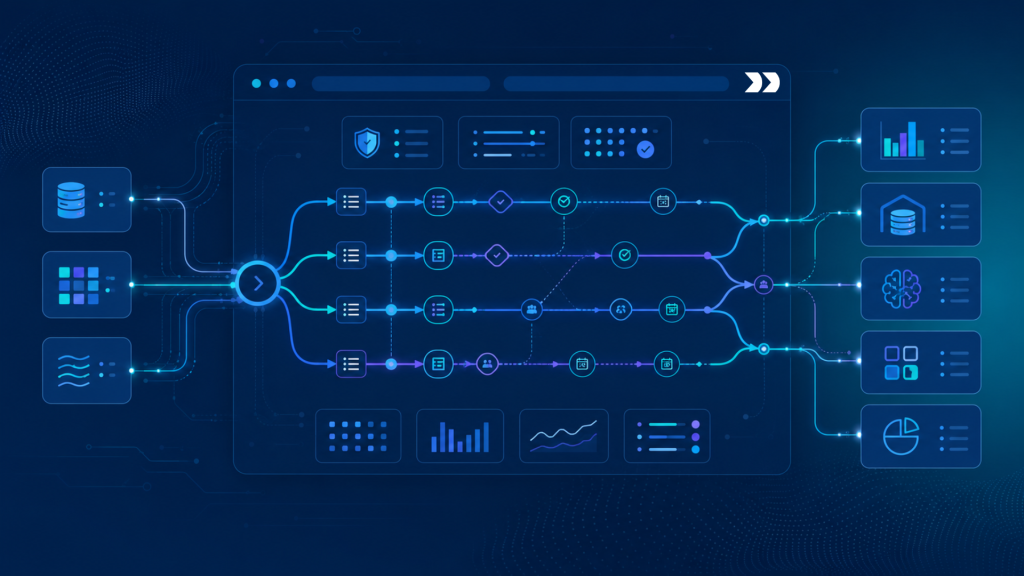
Scalable data distribution requires infrastructure that can schedule delivery, validate payloads, route data to multiple endpoints, manage queues, monitor status, capture acknowledgements, and preserve lineage. Without this layer, distribution becomes dependent on manual exports and undocumented handoffs.
The World Economic Forum’s 2025 analysis on scaling AI with strategy, data, and workforce readiness argues that strong data foundations are necessary for enterprise AI scale. Data distribution is part of those foundations because AI and analytics systems require dependable delivery into production workflows.
Scheduling, Routing, Validation, Queue Management, and Endpoint Controls Make Distribution Reliable
Scheduling ensures delivery occurs when downstream systems need the data. Routing determines which endpoints receive which datasets. Validation checks whether the dataset meets completeness, schema, and quality requirements before delivery. Queue management preserves records when endpoints are unavailable. Endpoint controls ensure that the receiving system can accept the data.
A delivery function should validate both the dataset and the endpoint before marking distribution as successful. Data delivery latency challenges can significantly impact overall system performance. Addressing these issues requires a thorough analysis of the entire data pipeline. By implementing more efficient routing and compression techniques, organizations can mitigate these delays.
def deliver_dataset(dataset, endpoint):
    missing = [field for field in endpoint["required_fields"] if not dataset.get(field)]
    if missing:
        return {"delivered": False, "reason": "missing_required_fields", "fields": missing}

    if endpoint["status"] != "available":
        return {"delivered": False, "reason": "endpoint_unavailable", "endpoint": endpoint["name"]}

    print(f"Delivering {dataset['dataset_id']} to {endpoint['name']}")
    return {"delivered": True, "endpoint": endpoint["name"]}


dataset = {
    "dataset_id": "catalog-feed-2026-06-17",
    "generated_at": "2026-06-17T08:00:00Z",
    "record_count": 48291,
    "file_format": "json",
}

endpoint = {
    "name": "marketplace_catalog_sync",
    "status": "available",
    "required_fields": ["dataset_id", "generated_at", "record_count", "file_format"],
}

deliver_dataset(dataset, endpoint)
This pattern reflects the core principle of enterprise distribution design: data should not be considered delivered until endpoint requirements are satisfied.
Observability, Metadata, Lineage, and Delivery Status Tracking Help Teams Manage Distribution at Scale
Observability systems such as Prometheus can track delivery latency, endpoint failures, retry rates, queue depth, throughput, and acknowledgement delays. Validation tools such as Great Expectations can test schema, completeness, uniqueness, and anomaly patterns before delivery. Metadata systems record dataset ownership, delivery cadence, data classification, endpoint requirements, and usage constraints.
Lineage shows which reports, dashboards, models, applications, and workflows depend on each distribution path. Delivery status tracking shows whether the data was delivered, blocked, queued, retried, acknowledged, or escalated.
Infrastructure tools support this model. Airflow can orchestrate scheduled distribution workflows. Kafka can support event-driven delivery. Spark can prepare large datasets before distribution. dbt can create delivery-ready models. Snowflake, BigQuery, and Databricks can serve as governed environments from which data is distributed downstream.
Governance and Compliance Depend on Distribution Strategy
Distribution strategy is also a governance issue. Once data leaves a controlled environment, the enterprise must know where it went, who received it, which version was delivered, what access rules applied, and whether the endpoint was approved for that data. Without distribution governance, even high-quality data can create compliance and control exposure.
The World Bank’s Digital Progress and Trends Report 2025 emphasizes foundational digital systems for responsible and scalable AI adoption. Within enterprises, governed data distribution is part of that foundation because responsible AI and analytics depend on controlled data movement.
Distribution Controls Make Data Movement Defensible
Distribution controls create evidence that data moved appropriately. Teams need delivery logs, endpoint records, validation results, access decisions, timestamps, file checksums where relevant, and acknowledgement status. This evidence matters for compliance reporting, audit review, customer data workflows, vendor reporting, and AI governance.
A delivery may be technically successful but still inappropriate if it reaches the wrong endpoint, includes restricted fields, or lacks required metadata. Therefore, distribution controls should define what data can move, where it can move, who can access it, and how usage is recorded.
In practice, defensible distribution depends on traceability. The enterprise should be able to explain not only what data exists, but where it was delivered and why.
Cross-System Distribution Requires Access, Retention, and Usage Rules
Cross-system distribution often involves different access, retention, and usage requirements. A dataset sent to a dashboard may require role-based access. A file sent to a vendor may require contractual restrictions. A feed delivered to an AI workflow may require training-use approval. A cross-border delivery may require residency, privacy, or transfer review.
Distribution strategy should account for these differences before delivery paths scale. Data classification, endpoint approval, legal review, sourcing controls, and retention policies should be embedded into the distribution model.
Accordingly, enterprise distribution design is not only about efficiency. It is also about controlled data movement across systems, teams, and jurisdictions.
Why Data Distribution Strategy Is Becoming an Executive Governance Issue
Data Distribution Strategy is becoming an executive governance issue because enterprise decisions depend on whether data reaches downstream systems reliably and appropriately. Leaders rely on distributed data for dashboards, compliance reporting, revenue operations, procurement reporting, product catalog workflows, inventory updates, AI models, and market intelligence.
Executives do not need to manage every delivery job. However, they need visibility into which distribution flows support critical decisions, which endpoints are fragile, which delivery paths lack ownership, and where manual distribution still creates risk. Reliable data distribution strategies are crucial for ensuring that information flows seamlessly across various departments. By implementing these strategies, organizations can enhance decision-making processes and boost operational efficiency. Ultimately, a focus on reliable data distribution strategies empowers leaders to navigate complexities with confidence and agility.
Leaders Need Visibility into Which Distribution Flows Support Critical Business Decisions
Leadership visibility should focus on distribution dependency. Which data feeds support executive reporting? Which distribution paths feed AI models? Also, which endpoints support revenue operations, procurement, compliance, product catalog publication, or inventory workflows? Which deliveries are time-sensitive? Which are manual? Also, which lacks acknowledgement or monitoring?
This visibility helps leaders prioritize infrastructure investment. A low-risk internal distribution path may need basic monitoring. A production distribution flow supporting compliance, finance, AI, or customer operations requires stronger controls, ownership, lineage, and recovery planning.
In this context, distribution strategy becomes part of enterprise resilience. The organization cannot govern decision systems if it cannot see how critical data reaches them.
Scalable Data Programs Require Distribution Standards, Ownership, Monitoring, and Continuous Review
Scalable data programs require distribution standards. These standards should define delivery cadence, endpoint requirements, schema expectations, validation rules, access controls, queue behavior, retry logic, acknowledgement requirements, freshness thresholds, lineage capture, audit logs, and escalation procedures.
Ownership must be clear. Data engineering may operate pipelines. Data operations may manage delivery queues. Business teams define endpoint needs. Governance teams define access and usage rules. Analytics and AI teams define consumption requirements. Compliance teams define evidence standards.
Ultimately, Data Distribution Strategy matters because data cannot create enterprise value unless it reaches the right systems in the right form. A data distribution model defines how data moves. Distribution channel planning reduces fragmentation. Enterprise distribution design ensures that data delivery is reliable, governed, observable, and aligned with business decision timing.
Organizations that treat distribution as infrastructure will build more dependable AI, analytics, reporting, and operational workflows. Those that treat distribution as a final export step may continue producing strong data, but they will struggle to make that data usable across the enterprise.