
Key Takeaways
- How Construction Data Sourcing helps firms identify project opportunity data before late-stage procurement
- Why construction bid data must be collected continuously across tenders, permits, planning records, and owner activity
- How construction market data supports bid planning, regional prioritization, pipeline forecasting, and resource allocation
- Why bid tracking data requires normalization, validation, governance, lineage, and auditability
- How structured data pipelines improve bid intelligence, reduce manual research, and support more disciplined pursuit decisions
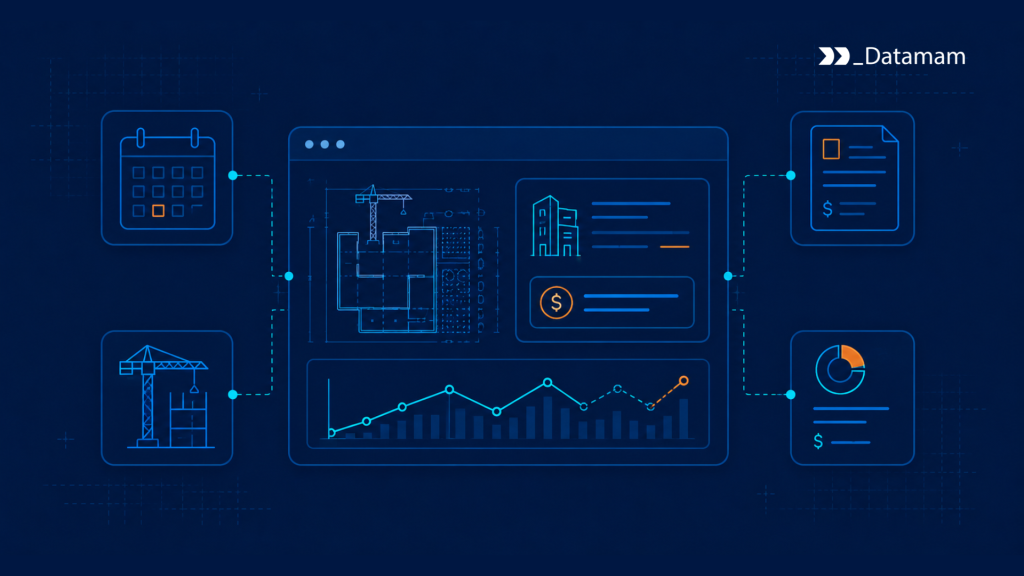
Construction bid intelligence programs depend on timely visibility into projects before, during, and after formal procurement. Internal CRM data, bid history, backlog reports, and estimator notes remain essential, but they rarely show the full market. Project opportunities form across permits, planning applications, public tenders, owner announcements, infrastructure funding, design awards, development filings, and competitor activity. Construction Data Sourcing gives contractors, suppliers, subcontractors, equipment providers, and construction services firms a structured way to monitor external project opportunity data and turn it into bid planning intelligence.
The Bid Visibility Gap in Construction Markets
Construction markets are fragmented by geography, owner type, asset class, procurement method, and project stage. A contractor may know its internal pipeline but still miss early signs of future work in adjacent markets. Deloitte’s 2025 Engineering and Construction Industry Outlook highlights labor constraints, technology adoption, financial conditions, and policy shifts as major forces shaping construction demand. In this environment, bid visibility requires more than CRM updates and relationship notes.
Project signals often appear externally long before a formal bid package is issued. A planning application may show an owner’s intent. A permit record may indicate scope movement. A design award may identify early project partners. A public funding notice may reveal infrastructure demand. Construction Data Sourcing brings these signals into one intelligence layer so commercial teams can identify opportunities earlier and evaluate them with a stronger market context.
Why Internal CRM and Bid History Lag Behind the Market
Internal CRM data shows opportunities already discovered by the business development team. Bid history shows where the firm competed in the past. Backlog shows committed work. These systems are necessary for internal control, but they do not fully capture emerging construction market data. They may miss projects that are still in planning, regions where owner activity is increasing, or asset classes where demand is shifting.
As a result, firms can become overdependent on familiar accounts, recurring bid channels, or late-stage tender platforms. That creates pipeline concentration risk. By the time an opportunity reaches a public bid board, competitors may already have relationships, project context, and positioning advantages. Construction bid intelligence must therefore begin earlier than the formal invitation to bid.
How External Project Signals Improve Bid Planning
External project signals help construction teams understand where work is forming. These signals include planning submissions, zoning activity, permit applications, public procurement notices, infrastructure funding, environmental filings, design firm announcements, owner press releases, and material demand indicators. When structured into project opportunity data, they help business development and estimating teams evaluate which opportunities are real, which are delayed, and which deserve early pursuit.
In practice, external intelligence improves bid planning by giving teams more time. More time means better owner research, stronger partner selection, earlier subcontractor engagement, more accurate capacity planning, and more disciplined bid/no-bid decisions. It also helps leadership understand whether the pipeline is growing because of real market activity or simply because internal teams are logging more prospects.
Construction Data as a Bid Intelligence Layer
Construction Data Sourcing becomes valuable when it creates a repeatable bid intelligence layer rather than a collection of disconnected project lists. Bid intelligence programs need construction bid data, project opportunity data, bid tracking data, and construction market data organized around commercial decisions. This layer does not replace estimator judgment, relationship development, or construction bidding software. Instead, it improves them by providing broader and earlier visibility into market activity.
KPMG’s Global Construction Survey 2025/2026 emphasizes how engineering, construction, and real estate leaders are navigating delivery model changes, technology adoption, and growth uncertainty. Those pressures make structured market visibility more important because firms need to allocate pursuit resources carefully.
Monitoring Construction Bid Data Across Public and Private Sources
Construction bid data appears across public tender portals, owner websites, government procurement systems, bid boards, subcontractor networks, industry publications, and private invitation channels. Each source may publish different fields, timelines, documents, addenda, and award updates. Monitoring these sources manually can quickly overwhelm business development and estimating teams.
A structured sourcing pipeline can collect bid notices, closing dates, owner details, project descriptions, estimated values, site locations, procurement methods, addenda, and award outcomes. This makes bid tracking data more complete and easier to use. It also reduces the risk that teams miss deadline changes, scope updates, or new opportunities in markets where coverage depends on manual checking.
Tracking Project Opportunity Data Before Formal Tender
The most valuable project opportunity data often appears before tender. Early-stage indicators may include land acquisitions, zoning changes, planning applications, feasibility studies, environmental review, infrastructure grants, design awards, and financing announcements. These signals help firms understand which projects may become bid opportunities months before formal procurement begins.
Tracking early-stage data changes the pursuit process. Instead of reacting to bid notices, teams can identify owners, monitor project progression, build relationships, and prepare capabilities before the market becomes crowded. This is especially useful in sectors where preconstruction involvement, owner trust, or specialized qualifications influence award outcomes.
Interpreting Construction Market Data for Pursuit Strategy
Construction market data helps firms decide where to focus commercial effort. A region may show increasing healthcare projects, while another may be driven by data centers, infrastructure, manufacturing, or multifamily housing. A segment may appear active but carry a margin risk due to labor shortages or material cost pressure. Bid volume alone does not tell the full story.
Bid intelligence programs should connect opportunity volume to market conditions. That includes regional demand, owner activity, procurement patterns, competitor saturation, labor capacity, material exposure, and historical award behavior. This broader context helps firms avoid chasing every opportunity and instead prioritize bids aligned with capacity, margin targets, and strategic positioning.
Infrastructure Requirements for Construction Data Sourcing
Construction Data Sourcing depends on infrastructure that can collect, normalize, validate, and deliver external project signals into bid intelligence workflows. The objective is not simply to collect more project records. Construction teams need decision-ready datasets that connect opportunities to owners, locations, asset classes, procurement stages, bid dates, values, documents, and award outcomes.
A bid intelligence program must therefore separate credible opportunity signals from noise. Without a structured infrastructure, teams may spend more time cleaning project lists than evaluating bid strategy.
Continuous External Data Collection Across Construction Sources
Construction-relevant sources include tender portals, planning systems, permit databases, zoning boards, infrastructure funding sites, owner announcements, bid boards, legal notices, commercial project databases, and industry news. These sources differ by jurisdiction, format, update cadence, and data quality. Continuous data collection systems use APIs, scheduled crawlers, browser automation, document parsing, and change detection to capture updates.
At scale, this enables firms to monitor construction bid data, project opportunity data, bid tracking data, and construction market data without relying only on manual searches. Continuous collection is especially valuable when bid deadlines, addenda, and project statuses change frequently.
Normalizing Projects, Owners, Locations, and Bid Stages
External construction data is rarely consistent. A project may appear under different names across planning, permit, tender, and award sources. Owners may use subsidiaries or public agencies with inconsistent naming. Locations may be listed as addresses, parcels, coordinates, municipalities, or regions. Bid stages may be described differently across procurement systems.
Normalization aligns project identifiers, owner entities, addresses, regions, asset classes, procurement methods, bid stages, estimated values, due dates, and source metadata. This prevents duplicate records, missed project connections, and misleading pipeline counts. Reliable construction market data depends on consistent definitions before analysis begins.
Validating Construction Data Before Bid Use
Validation is critical because poor project data can waste estimating resources. Data quality controls should identify duplicate projects, stale bid notices, missing due dates, inconsistent values, changed deadlines, invalid locations, broken document links, and conflicting project status. For example, a project may appear active on one portal but delayed or canceled in another source.
Validation should occur before external data enters dashboards, construction bidding software, CRM systems, or executive pipeline reviews. Bid intelligence requires data that teams can trust when allocating estimating time, contacting owners, and preparing a pursuit strategy.
Technology Stack Behind Bid Intelligence Systems
Bid intelligence systems operate as coordinated data pipelines rather than isolated lead lists. They must collect construction market data, process project and bid information, store historical observations, and preserve governance evidence. The stack must support both broad market coverage and timely alerts for high-priority opportunities. U.S. Census construction spending data provides official monthly reporting on construction put in place, reinforcing the importance of structured construction market indicators for planning and forecasting.
Enterprise bid intelligence also needs integration with CRM platforms, construction bidding software, BI dashboards, document repositories, and estimating workflows. The value appears when sourced data becomes usable inside the tools where teams already make pursuit decisions.
Collection and Orchestration Using Playwright, Airflow, and Kafka
Collection layers may use Playwright or headless Chromium to extract data from dynamic tender portals, planning systems, permit pages, and bid boards where APIs are unavailable. Apache Airflow can orchestrate recurring collection jobs, retries, dependencies, document downloads, and quality checks across jurisdictions and source types. Kafka can support event-based ingestion where new bid notices, deadline changes, or addenda require fast downstream alerts.
This stack helps firms move from manual bid board checking to repeatable market monitoring. It also supports consistent collection logic across regions, which is essential when teams compare opportunity flow across markets.
Processing and Transformation Through Spark, dbt, and Construction ETL Pipelines
Processing layers transform raw project records into structured bid intelligence datasets. Spark can support the distributed processing of large permit, tender, project document, pricing, and market datasets. DBT can manage standardized transformation logic, documentation, and analytical models for project, owner, and bid tracking data.
Construction ETL and ELT pipelines can classify asset types, deduplicate project records, normalize owners, map locations, parse bid dates, extract document metadata, and enrich projects with market indicators. This makes construction market analysis repeatable rather than dependent on individual analyst interpretation.
Storage, Analytics, and Governance in Snowflake, BigQuery, or Databricks
Structured construction intelligence datasets are commonly stored in Snowflake, BigQuery, or Databricks, where analysts can query project pipelines, bid trends, owner activity, regional demand, and win-loss history. These environments can support dashboards for business development, estimating, finance, and executive teams.
Governance controls should include access permissions, audit logs, lineage tracking, source documentation, retention policies, and role-based controls. These controls matter because bid intelligence influences revenue forecasts, staffing plans, subcontractor engagement, bonding capacity, and strategic market entry decisions.
Commercial Impact of Construction Data Sourcing
The commercial value of Construction Data Sourcing appears when external visibility improves bid selection, pipeline forecasting, and pursuit discipline. Better intelligence can help firms identify opportunities earlier, reduce missed bids, prioritize higher-fit projects, and allocate estimating resources more effectively. The outcome is not guaranteed win-rate improvement. It is stronger market coverage, better decision timing, and more disciplined pursuit management.
Bid intelligence programs also improve cross-functional alignment. Business development, estimating, operations, finance, and leadership can work from a shared view of opportunity flow rather than disconnected spreadsheets or inconsistent market assumptions.
Improving Pipeline Visibility with Early Project Signals
Pipeline visibility improves when firms monitor project formation before formal tender. Planning applications, permits, funding announcements, owner activity, and design awards can show which projects are moving toward procurement. This gives teams more time to assess owner fit, project complexity, delivery model, and regional capacity.
Construction Data Sourcing helps firms understand whether pipeline growth is supported by real market signals. It can also reveal where internal pipeline confidence is too high because projects are delayed, duplicated, underfunded, or poorly aligned with the firm’s capabilities.
Strengthening Bid Strategy with Market and Opportunity Context
Bid strategy improves when teams understand both the opportunity and the surrounding market. Project value, owner history, delivery method, competitor activity, labor availability, material exposure, and schedule pressure all influence whether a bid is attractive. External data can help firms evaluate whether a project fits margin expectations and operational capacity.
When integrated with construction bidding software, construction bid data can support bid/no-bid scoring, pursuit sequencing, estimator workload planning, and executive review. The goal is not to automate judgment. It is to give decision-makers a better context before resources are committed.
Reducing Manual Research Across Business Development and Estimating
Business development and estimating teams often spend significant time checking bid boards, reading public notices, searching permit portals, downloading documents, and reconciling project details manually. Continuous data pipelines reduce this workload by standardizing collection, project classification, status monitoring, and reporting.
The operational value is consistency. When every team member tracks projects differently, bid tracking data becomes fragmented. A structured sourcing system creates a common foundation for opportunity review, resource planning, and pipeline forecasting. Data sourcing strategies for growth are essential to enhance decision-making efficiency. By leveraging advanced analytics and real-time data acquisition, organizations can better identify market opportunities. This proactive approach not only aids in resource allocation but also drives competitive advantage in a rapidly evolving landscape.
Risk Exposure When Bid Intelligence Is Incomplete
Incomplete bid intelligence creates commercial and operational risk. Firms may discover projects too late, pursue low-probability opportunities, miss deadline changes, double-count project value, underestimate competitor pressure, or allocate estimating resources inefficiently. In construction, pursuit decisions affect revenue planning, capacity, subcontractor coordination, and margin discipline.
The risk is not simply missing an opportunity. It is building commercial forecasts on incomplete construction market data. A bid intelligence program reduces this risk by making market activity observable, comparable, and traceable.
Delayed Detection of Project Opportunities and Bid Changes
Delayed opportunity detection reduces a firm’s ability to shape pursuits early. If a project is discovered only after a bid notice is published, the team may have limited time to understand owner priorities, evaluate scope, select partners, or prepare a competitive proposal. Deadline changes and addenda can also create risk if teams rely on manual monitoring.
Construction Data Sourcing helps detect new opportunities, stage changes, document updates, and bid deadline movement earlier. This improves the reliability of bid tracking data and reduces the chance that teams work from outdated project information.
Misreading Market Demand and Resource Requirements
Market demand can be misread when firms rely only on internal CRM and backlog. A strong internal pipeline may hide weakening regional demand, while a temporary slowdown may obscure growth in adjacent sectors. Labor constraints, material pressure, and subcontractor availability can also change bid economics.
Construction market data helps teams understand whether opportunity flow is broad-based, segment-specific, region-specific, or driven by temporary funding cycles. This helps leadership align pursuit volume with staffing, equipment, bonding, and delivery capacity.
Governance Gaps in Project and Bid Data Use
Project and bid data often come from public portals, commercial sources, owner communications, and manually reviewed documents. If source documentation, transformation logic, and status updates are not governed, teams may struggle to explain pipeline assumptions. This matters when bid intelligence informs revenue forecasts, market entry decisions, or board-level reporting.
Governance controls should document source approval, update cadence, data lineage, validation checks, and access rights. Without these controls, project opportunity data becomes difficult to reproduce or defend during commercial review. Effective data sourcing techniques in audience insights allow organizations to better understand customer preferences and behavior. By leveraging comprehensive datasets, teams can identify trends that inform strategic decision-making. This approach enhances the accuracy of forecasts and guides marketing strategies for optimal impact.
Governance Requirements for Construction Bid Intelligence
Construction bid intelligence must be governed because it influences revenue expectations, resource allocation, market strategy, and proposal investment. Data may come from tender portals, permitting systems, owner announcements, commercial feeds, project documents, and internal bid outcomes. Each source carries different reliability levels, update patterns, and usage constraints.
OECD AI Principles provide a useful governance reference for AI-enabled decision systems, including transparency, robustness, accountability, and responsible data handling. These principles apply when automated data collection, scoring, or AI-assisted analysis supports bid prioritization and project selection.
Source Documentation, Access Controls, and Audit Logs
Construction intelligence datasets should include clear documentation of source, update frequency, coverage, data owner, project status definition, and known limitations. Access controls should restrict sensitive pursuit data, owner notes, pricing assumptions, and bid strategy outputs. Audit logs should record who accessed, transformed, exported, or used bid intelligence datasets.
These controls help teams demonstrate that commercial decisions are based on approved sources and consistent analytical processes. They also reduce the risk that sensitive opportunity or bid strategy data is distributed too broadly.
Data Lineage Across Project, Bid, and Market Datasets
Data lineage allows teams to understand how each project signal moved from source to analysis. Traceability should cover source record, project identifier, owner normalization, location mapping, bid date extraction, stage classification, validation result, and dashboard publication. This matters because pipeline assumptions can be challenged by finance, operations, executives, or bid teams.
Lineage also supports debugging. If a project appears twice or has the wrong deadline, teams can determine whether the issue came from source data, parsing logic, duplicate matching, manual editing, or delayed updates.
Cross-Regional Data Considerations in Construction Monitoring
Construction market monitoring often crosses cities, states, countries, owners, and procurement systems. Each market may define project stages, public procurement rules, planning records, permits, and award disclosures differently. A data approach that works in one jurisdiction may require adjustment in another.
Cross-regional controls should document source rights, update frequency, jurisdiction coverage, language handling, storage location, and permitted use. This reduces the risk that construction bid data becomes analytically useful but operationally inconsistent across markets.
Evaluating Construction Data Sourcing Readiness
Construction Data Sourcing becomes valuable when it supports repeatable bid decisions, not simply when project records exist. Readiness depends on source coverage, project matching quality, owner normalization, bid date accuracy, validation controls, governance, and integration with commercial workflows. Firms should evaluate whether external intelligence supports the regions, asset classes, owners, and procurement channels that matter most.
A readiness review helps identify where bid visibility is delayed, where construction bid data is unreliable, and where teams still depend on manual monitoring. Coverage mapping techniques for data sourcing are crucial for enhancing visibility and ensuring more informed decision-making. By systematically analyzing available data sources, firms can uncover gaps and deficiencies in their current data strategies. Additionally, leveraging these techniques allows for a more comprehensive understanding of market dynamics, leading to optimized bidding processes.
How Construction Teams Assess Bid Data Quality
A structured assessment should evaluate source coverage, project completeness, owner matching, duplicate rates, address accuracy, bid date reliability, document availability, status freshness, asset classification, and award tracking. It should also review missing metadata, conflicting values, source reliability, and update frequency.
For bid intelligence, data quality must be evaluated in commercial terms. A dataset may contain thousands of project records while still lacking the project opportunity data, bid tracking data, or construction market data needed to support pursuit decisions.
When Firms Need a Bid Intelligence Infrastructure Review
An infrastructure review becomes useful when teams rely on manual bid board checks, disconnected spreadsheets, inconsistent CRM entries, fragmented vendor feeds, or unclear project-stage definitions. The review should assess intake workflows, source coverage, normalization logic, validation controls, storage architecture, lineage tracking, governance posture, and integration readiness.
The output should clarify where data risk accumulates, where construction market intelligence may be incomplete, and which infrastructure improvements would make bid planning more reliable for business development, estimating, and executive pipeline review.
Conclusion: Construction Data Sourcing as Bid Intelligence Infrastructure
Construction markets are increasingly competitive, uneven, and dependent on external signals that appear before internal CRM systems can reflect them. Internal bid history, backlog, and sales notes remain essential, but they are not sufficient for understanding construction bid data, project opportunity data, construction market data, and bid tracking data as they develop. Construction Data Sourcing gives firms a structured way to convert fragmented project signals into bid intelligence.
Ultimately, organizations that treat construction data as governed market infrastructure will be better positioned to identify opportunities earlier, allocate estimating resources more effectively, strengthen bid/no-bid decisions, and build more defensible revenue pipelines.