
Key Takeaways
- How Insurance Data Sourcing helps organizations monitor competitor policy data before product or pricing changes affect portfolio performance
- Why insurance market data must be collected continuously across competitor websites, regulator filings, broker channels, and digital quote journeys
- How insurance pricing data supports product positioning, rate monitoring, underwriting appetite analysis, and commercial strategy
- Why insurance product tracking requires normalization, validation, governance, lineage, and cross-border data controls
- How structured competitive tracking systems reduce manual research, improve market visibility, and support faster product and pricing decisions
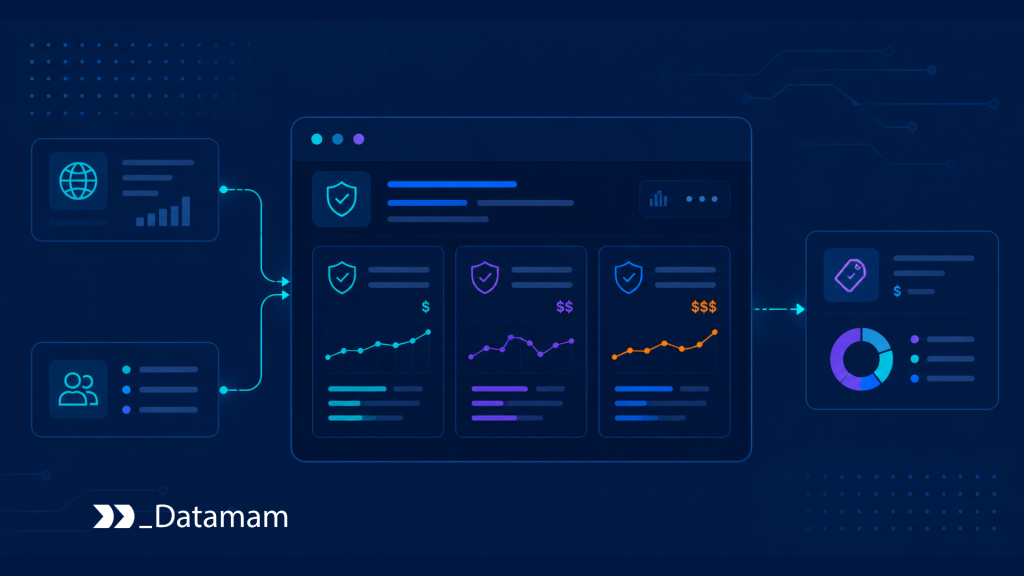
Insurance markets are increasingly shaped by pricing pressure, product redesign, regulatory movement, digital distribution, customer switching behavior, and regional risk volatility. Internal policy administration systems, claims data, broker feedback, and renewal results remain essential, but they do not fully show how competitors are changing product terms, pricing structures, coverage availability, exclusions, or digital quote flows. Insurance Data Sourcing gives carriers, brokers, reinsurers, insurtech firms, and product strategy teams a structured way to monitor external insurance market data and convert it into competitive tracking intelligence.
The Competitive Visibility Gap in Insurance Markets
Insurance teams often understand their own book deeply while having limited structured visibility into how competitors are changing in the market. A carrier may know its renewal rate, claims ratio, product mix, and quote conversion, but still lack timely insight into competitor deductibles, exclusions, product bundles, regional availability, quote paths, or pricing movement. Deloitte’s 2026 Global Insurance Outlook highlights the pressure insurers face from uncertainty, technology modernization, customer expectations, and catastrophe-related volatility.
This visibility gap matters because insurance competition is not expressed only through premium levels. It also appears in underwriting appetite, product terms, optional coverages, customer eligibility rules, policy language, distribution partnerships, and digital experience. Without systematic external monitoring, product and pricing teams may detect competitive movement only after broker feedback, lost quotes, or renewal leakage makes the issue visible internally.
Why Internal Policy and Claims Data Lag Behind Market Movement
Internal insurance systems are designed to manage an insurer’s own portfolio. They show written premiums, quote activity, claims experience, cancellations, endorsements, policyholder behavior, and renewal outcomes. These datasets are necessary for actuarial analysis and operational control, but they do not show which competitor changed its product wording last week or which carrier expanded eligibility in a target segment.
As a result, strategy teams may misinterpret internal performance. A decline in quote conversion may reflect internal pricing issues, but it may also reflect competitor pricing data shifting in a key region. A product line may appear stable internally while competitors are introducing new coverage options that will affect future demand. Insurance Data Sourcing closes this gap by monitoring the external market directly.
How External Insurance Signals Improve Competitive Tracking
External insurance signals help teams understand how market conditions are forming before internal results fully reflect them. These signals can include public product pages, quote journeys, regulator filings, policy documents, broker portals, comparison sites, customer reviews, claim service messaging, rate announcements, and competitor eligibility language. When organized into insurance market data, these signals help teams evaluate whether a competitor is expanding, withdrawing, repricing, or repositioning.
In practice, external intelligence improves decision timing. Product leaders can identify coverage changes earlier. Pricing teams can detect market pressure faster. Underwriting teams can monitor competitor appetite. Distribution teams can understand how carriers are positioning products to customers and brokers. The result is not simply more data. It is a better commercial context.
Insurance Data as a Competitive Intelligence Layer
Insurance Data Sourcing becomes valuable when it creates a repeatable competitive intelligence layer rather than a folder of competitor screenshots. Competitive tracking systems need insurance market data, competitor policy data, insurance pricing data, and insurance product tracking organized around business decisions. This layer does not replace actuarial judgment, underwriting expertise, or broker relationships. Instead, it strengthens those functions with structured external evidence.
OECD’s Global Insurance Market Trends 2025 provides a cross-country view of insurance market data, reinforcing the importance of structured market visibility for insurers, regulators, researchers, and policy stakeholders.
Monitoring Competitor Policy Data Across Public and Semi-Public Sources
Competitor policy data appears across product pages, policy documents, state or national filing systems, broker materials, quote flows, comparison websites, and customer-facing coverage explanations. These sources reveal changes in exclusions, limits, deductibles, optional riders, eligibility rules, bundling logic, and claims process messaging. However, they are rarely standardized.
A structured sourcing pipeline can collect and classify competitor policy data across markets, product lines, and time periods. This allows product teams to identify whether competitors are tightening terms, broadening coverage, simplifying digital onboarding, or creating segment-specific offerings. Without this structure, competitor reviews remain manual, partial, and difficult to compare.
Tracking Insurance Pricing Data Across Products and Regions
Insurance pricing data is difficult to monitor because premiums depend on risk factors, geography, coverage limits, deductibles, policyholder attributes, discounts, and channel conditions. Even so, structured tracking can provide useful market signals when scenarios are controlled carefully. Quote journeys, filed rates, broker examples, comparison platforms, and public pricing references can help teams monitor relative market movement.
Insurance Data Sourcing must preserve the conditions behind each pricing observation. A premium is not meaningful unless teams know the product, location, profile, coverage level, deductible, date, channel, and assumptions used. When normalized properly, insurance pricing data helps teams detect directional movement, regional pressure, and competitive positioning changes.
Interpreting Insurance Product Tracking for Strategy Teams
Insurance product tracking helps strategy teams understand how competitors are changing their market approach. A carrier may introduce a cyber endorsement, adjust home insurance exclusions, expand telematics discounts, revise small-business packages, or change quote flow requirements. These changes may signal a strategic shift before market share movement becomes visible.
Competitive tracking systems should connect product changes to commercial interpretation. Is a competitor expanding into a profitable segment? Is it reducing exposure in a high-risk region? Also, is it adding optional coverage to justify higher pricing? Is it simplifying customer onboarding? Product tracking becomes useful when it links external changes to potential business impact.
Infrastructure Requirements for Insurance Data Sourcing
Insurance Data Sourcing depends on infrastructure that can collect, normalize, validate, and deliver competitor signals into strategy, pricing, product, underwriting, and distribution workflows. The goal is not to collect every competitor page or document. Insurance teams need decision-ready intelligence that separates meaningful market movement from routine website updates or isolated promotional language. KPMG’s 2025 Insurance CEO Outlook emphasizes AI investment, risk management, and resilience across insurance leadership priorities.
This operating environment increases the need for reliable external data foundations. If competitive tracking systems feed product decisions, pricing analysis, or AI-assisted workflows, the data must be traceable, comparable, and governed. Otherwise, teams may act on incomplete or misleading external signals.
Continuous External Data Collection Across Insurance Sources
Insurance-relevant sources include competitor websites, quote journeys, policy documents, regulatory filings, broker portals, comparison platforms, app stores, customer review sites, product announcements, and market reports. These sources differ by format, frequency, accessibility, and reliability. Continuous collection systems use APIs, scheduled crawlers, browser automation, document parsing, and change detection to capture relevant updates.
At scale, this enables teams to monitor competitor policy data, insurance pricing data, and insurance product tracking without relying on manual research cycles. Continuous collection is especially valuable in lines where pricing, eligibility, or coverage language changes frequently due to risk volatility or regulatory pressure.
Normalizing Products, Markets, Policies, and Pricing Scenarios
External insurance data is rarely comparable in raw form. Product names differ by carrier. Coverage categories may use different wording. Deductibles, limits, endorsements, exclusions, and discounts may be structured differently. Pricing scenarios may vary by location, risk profile, term length, and channel. Without normalization, competitive comparisons can become misleading.
Normalization aligns product taxonomy, geography, policy components, coverage limits, deductible levels, eligibility criteria, pricing assumptions, and quote timestamps. This allows teams to compare similar products and scenarios across carriers. Reliable insurance market data depends on consistent definitions before analysis begins.
Validating Insurance Data Before Competitive Analysis
Validation is critical because inaccurate competitor data can distort product and pricing decisions. Data quality controls should identify stale pages, duplicate policy documents, missing fields, failed quote paths, abnormal premium changes, inconsistent scenario inputs, and source structure changes. For example, a missing coverage item may reflect a scraping issue rather than a true product change.
Validation should occur before external data enters pricing dashboards, product comparison matrices, market reports, or executive planning workflows. Competitive intelligence is only useful when teams trust that the underlying data reflects real market behavior and not collection errors.
Technology Stack Behind Insurance Competitive Tracking Systems
Insurance competitive tracking systems operate as coordinated data pipelines rather than isolated monitoring tools. They must collect external insurance data, process policy and pricing details, store historical changes, and preserve governance evidence. The stack must support both scheduled monitoring and targeted deep dives when a product line, region, or competitor becomes strategically important.
In enterprise environments, these systems should integrate with BI dashboards, product management workflows, pricing analysis tools, underwriting reviews, and strategy reporting. The value appears when external intelligence is available, where decisions are made, not trapped inside analyst spreadsheets.
Collection and Orchestration Using Playwright, Airflow, and Kafka
Collection layers may use Playwright or headless Chromium to capture data from dynamic quote flows, competitor websites, broker portals, and comparison pages where APIs are unavailable. Apache Airflow can orchestrate recurring collection jobs, retries, source dependencies, scenario runs, and quality checks across carriers and product lines. Kafka can support streaming ingestion when quote changes, product updates, or regulatory filings need rapid processing.
This stack helps teams move from manual competitor checking to repeatable intelligence operations. It also supports consistent scenario execution, which is essential when comparing insurance pricing data across multiple carriers or regions.
Processing and Transformation Through Spark, dbt, and Insurance ETL Pipelines
Processing layers transform raw competitor signals into structured datasets. Spark can support the distributed processing of large policy document collections, quote observations, review data, product pages, and regulatory filing records. DBT can manage standardized transformation logic, documentation, and analytical models for product, pricing, and market intelligence.
Insurance ETL and ELT pipelines can classify policy features, extract coverage terms, normalize carrier names, map products to taxonomies, identify exclusions, convert quote observations into comparable scenarios, and track changes over time. This makes competitive analysis repeatable rather than dependent on manual interpretation.
Storage, Analytics, and Governance in Snowflake, BigQuery, or Databricks
Structured insurance intelligence datasets are commonly stored in Snowflake, BigQuery, or Databricks, where analysts can query competitor product changes, pricing movement, market coverage, and historical trends. Dashboards can support product comparisons, regional pricing reviews, underwriting appetite monitoring, and strategy updates.
Governance controls should include access permissions, audit logs, data lineage, source documentation, scenario definitions, retention policies, and role-based controls. These controls matter because competitive tracking may influence pricing decisions, product design, underwriting appetite, and market entry strategy. Traceability makes assumptions easier to review and defend.
Commercial Impact of Insurance Data Sourcing
The commercial value of Insurance Data Sourcing appears when external visibility improves product decisions, pricing response, and competitive positioning. Better intelligence can help teams detect competitor policy changes earlier, evaluate market pricing pressure, monitor product availability, and identify where coverage innovation is changing customer expectations. The outcome is not automatic market share growth. It is better decision timing, fewer blind spots, and stronger alignment between strategy, pricing, underwriting, and distribution.
For insurance leaders, the practical benefit is operational confidence. Teams can discuss competitor movement with structured evidence rather than anecdotal broker feedback or manual website checks.
Improving Product Positioning with Competitor Policy Data
Product positioning improves when teams understand how competitor policy data is changing. If rivals add new endorsements, simplify exclusions, expand eligibility, or create bundled coverage, product managers can evaluate whether the organization’s own offering remains competitive. Conversely, if competitors withdraw coverage or tighten terms, underwriting teams may reassess market appetite and risk selection.
This does not mean copying competitor products. It means understanding market direction. Product teams can decide whether to differentiate on breadth of coverage, price, service, claims support, digital experience, or specialized segments with better external evidence.
Supporting Pricing Decisions with Market Evidence
Pricing decisions improve when internal actuarial analysis is supported by external insurance pricing data. If quote conversion falls in a region, teams can assess whether competitors reduced premiums, changed deductibles, expanded discounts, or altered eligibility criteria. If a competitor increases pricing, teams can evaluate whether the movement reflects broader market hardening or carrier-specific loss experience.
This supports more disciplined pricing reviews. Teams can distinguish competitor pressure from internal portfolio issues and evaluate whether pricing adjustments are necessary, premature, or strategically avoidable.
Reducing Manual Research Across Product and Strategy Teams
Insurance analysts often spend significant time reviewing competitor websites, collecting policy documents, testing quote scenarios, checking regulator filings, and compiling comparison tables manually. Continuous data pipelines reduce this workload by standardizing collection, classification, normalization, and recurring reporting.
The operational value is consistency as much as time savings. When every analyst evaluates competitors differently, insights become hard to compare. Structured sourcing creates a common intelligence foundation for product, pricing, underwriting, distribution, and executive teams.
Risk Exposure When Competitive Tracking Is Incomplete
Incomplete competitive tracking creates commercial and operational risk. Insurers may miss product changes, respond late to pricing pressure, underestimate competitor availability, or misunderstand why customers are switching. In volatile markets, delayed competitive visibility can affect quote conversion, renewal retention, product development, and regional appetite decisions.
The risk is not only missed information. It is strategic misinterpretation. A team may assume a product is underperforming because of brand weakness when the real issue is competitor coverage expansion or pricing movement. Insurance Data Sourcing reduces this risk by making market changes observable, comparable, and traceable.
Delayed Detection of Product and Policy Changes
Competitor policy changes may appear quietly in revised documents, updated quote journeys, broker materials, or filing updates. A competitor may add coverage, remove an exclusion, change deductible options, alter eligibility rules, or update claims service language without major public announcements. If teams detect these changes late, product and distribution responses may lag.
Insurance product tracking helps identify these changes earlier. Continuous monitoring can detect document updates, quote flow changes, new product language, regional availability shifts, and revised coverage details. This gives product leaders more time to evaluate competitive implications.
Misreading Pricing Pressure and Market Appetite
Pricing pressure can be misread when teams lack external context. A premium change may reflect inflation, claims experience, rate filings, risk appetite, promotional strategy, or competitor repositioning. Without structured insurance pricing data, teams may overreact to isolated signals or underreact to broad market movement.
Competitive tracking helps separate temporary pricing noise from strategic movement. By monitoring controlled scenarios over time, teams can identify whether market appetite is tightening, softening, or fragmenting by region, product, or customer segment.
Governance Gaps in Insurance Market Data Use
Insurance market data can create governance issues if sources, scenario definitions, transformation logic, and usage rights are not documented. Product and pricing teams may use external data in strategic decisions, market reports, or executive reviews. If the data cannot be reproduced or explained, confidence declines.
Governance controls should document source approval, collection cadence, scenario assumptions, validation checks, data lineage, and access rights. This is especially important when competitive tracking supports regulated pricing discussions, product filings, or cross-border market analysis. Energy data collection strategies for monitoring can also enhance the accuracy of risk assessments in the insurance sector. By leveraging real-time data, companies can adjust their models to reflect current market conditions more effectively. This proactive approach not only fosters better decision-making but also helps in maintaining compliance with regulatory standards.
Governance Requirements for Insurance Competitive Intelligence
Insurance competitive intelligence must be governed because it can influence pricing, underwriting, product design, and distribution strategy. Data may come from competitor websites, public filings, broker materials, comparison platforms, customer reviews, and regulatory sources. Each source carries different reliability levels, update patterns, and usage constraints.
These principles are relevant when insurers use automated monitoring or AI-assisted analysis in competitive tracking programs. Fare intelligence system data sources are essential for insurers to gain insights into market trends. Proper evaluation of these sources ensures that companies can maintain a competitive edge. Additionally, leveraging advanced analytics on this data can enhance decision-making processes and improve overall performance.
Source Documentation, Access Controls, and Audit Logs
Insurance intelligence datasets should include clear documentation of source, update frequency, product scope, market coverage, scenario assumptions, data owner, and known limitations. Access controls should restrict sensitive pricing analysis, strategy outputs, market entry assessments, and competitor comparison reports. Audit logs should record who accessed, transformed, exported, or used competitive intelligence datasets.
These controls help teams demonstrate that strategic decisions are based on approved sources and consistent analytical processes. They also reduce the risk that sensitive competitive intelligence is distributed too broadly across the organization.
Data Lineage Across Policy, Pricing, and Product Datasets
Data lineage allows teams to understand how each market signal moved from source to analysis. Traceability should cover source record, product identifier, policy document version, quote scenario, timestamp, carrier mapping, transformation logic, validation result, and dashboard publication. This matters because product and pricing assumptions may be challenged internally.
Lineage also supports debugging. If a competitor’s premium appears wrong or a policy feature is misclassified, teams can determine whether the issue came from source data, parsing logic, scenario setup, taxonomy mapping, or outdated documents. Data sourcing solutions for enterprises can streamline the data retrieval process, ensuring that accurate and relevant information is readily available. By implementing these solutions, organizations can enhance their decision-making capabilities and drive operational efficiency across various departments. This improvement in data management ultimately leads to better strategic insights and a competitive edge in the market.
Cross-Border Data Considerations in Insurance Tracking
Insurance markets vary by jurisdiction, regulation, product terminology, distribution model, and public disclosure requirements. A tracking approach that works in one country may require changes in another. Policy wording, rate filings, broker documentation, and comparison-site availability may differ significantly across markets.
Cross-border controls should document source rights, jurisdiction coverage, storage location, access permissions, language handling, and permitted use. This reduces the risk that insurance market data becomes analytically useful but operationally inconsistent or legally constrained across regions.
Evaluating Insurance Data Sourcing Readiness
Insurance Data Sourcing becomes valuable when it supports repeatable competitive decisions, not simply when external data exists. Readiness depends on source coverage, product taxonomy, scenario consistency, policy extraction quality, pricing normalization, validation controls, governance, and workflow integration. Teams should evaluate whether competitive intelligence supports the product lines, regions, customer segments, and strategic questions that matter most.
A readiness review helps identify where competitive visibility is delayed, where competitor policy data is incomplete, and where analysts still depend on manual tracking.
How Insurance Teams Assess Market Data Quality
A structured assessment should evaluate carrier coverage, product coverage, policy document completeness, quote scenario consistency, price observation quality, region coverage, update frequency, duplicate rates, and source reliability. It should also review taxonomy accuracy, missing fields, abnormal changes, stale data, and validation workflows.
For insurance competitive intelligence, quality must be evaluated in commercial terms. A dataset may contain many competitor pages while still lacking the insurance pricing data, policy terms, or product tracking detail needed to support strategic decisions.
When Organizations Need a Competitive Tracking Infrastructure Review
An infrastructure review becomes useful when teams rely on manual website checks, disconnected spreadsheets, inconsistent quote scenarios, fragmented vendor feeds, or unclear policy comparison rules. The review should assess intake workflows, source coverage, normalization logic, validation controls, storage architecture, lineage tracking, governance posture, and integration readiness.
The output should clarify where data risk accumulates, where insurance product tracking may be incomplete, and which infrastructure improvements would make competitive monitoring more reliable for product, pricing, and strategy teams.
Conclusion: Insurance Data Sourcing as Competitive Tracking Infrastructure
Insurance markets are becoming more dynamic, more data-intensive, and more dependent on external competitive signals. Internal policy, claims, and quote data remain essential, but they are not sufficient for understanding insurance market data, competitor policy data, insurance pricing data, and product changes as they develop. Insurance Data Sourcing gives carriers and insurance market participants a structured way to convert external signals into competitive intelligence.
Ultimately, organizations that treat insurance data as governed competitive tracking infrastructure will be better positioned to identify product shifts earlier, evaluate pricing pressure with evidence, improve market responsiveness, and make more defensible strategic decisions.