Key Takeaways
- API Lifecycle Management defines how APIs are designed, approved, published, monitored, changed, deprecated, retired, and audited across enterprise systems.
- API retirement planning prevents legacy endpoints from remaining active after their business purpose, security posture, or consumer base has changed.
- API change governance helps teams control breaking changes, consumer migration, release timing, version compatibility, and downstream impact.
- Interface lifecycle control connects API ownership, documentation, authentication, observability, dependency tracking, and release management into one operating model.
- Reliable lifecycle management requires API catalogs, consumer registries, review cycles, audit trails, deprecation policies, and escalation paths.
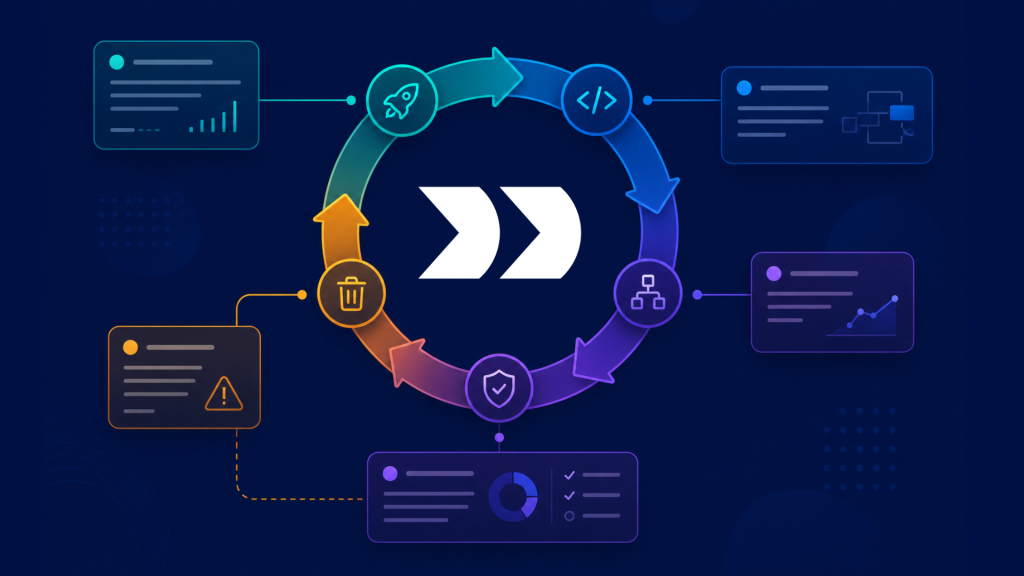
Enterprise APIs often outlive the projects that created them. A customer endpoint built for CRM synchronization may later support billing, support, analytics, and AI workflows. A product API created for e-commerce may become part of marketplace publishing and inventory coordination. A partner integration may remain active long after the original business process has changed. Over time, the API portfolio becomes difficult to govern unless every interface has a managed lifecycle.
API Lifecycle Management creates the operating model for controlling APIs from creation through retirement. It defines how APIs are proposed, designed, secured, published, monitored, changed, deprecated, and removed.
In enterprise system coordination, APIs are not isolated technical assets. They are interfaces between business processes. If their lifecycle is unmanaged, downstream systems inherit unstable contracts, undocumented dependencies, outdated credentials, and operational risk.
Why API Lifecycle Management Matters in Enterprise Coordination
API Lifecycle Management matters because APIs are shared infrastructure. They connect ERP, CRM, warehouse, BI, AI, payment, marketplace, booking, product, supplier, workforce, and customer systems. A lifecycle decision in one API can affect many consuming workflows.
Deloitte’s API governance guidance argues that enterprise API strategy should standardize how APIs are designed, published, secured, and reused as AI and cross-system workflows scale. Lifecycle management is the control layer that keeps those standards active after APIs move into production. Api authentication practices in enterprise integration are critical to ensure secure interactions among various systems. Implementing robust authentication mechanisms can help mitigate risks associated with unauthorized access. Moreover, organizations must regularly review and update their authentication protocols to adapt to evolving security threats.
Why APIs Need Lifecycle Ownership
APIs need lifecycle ownership because they change over time. Business requirements shift. Consumers are added. Security policies evolve. Data contracts change. Authentication methods are rotated. Old versions become unsupported. Some endpoints become critical infrastructure while others become dormant.
Without ownership, no team is clearly responsible for whether an API remains fit for purpose. The endpoint may still be reachable, but documentation may be outdated, consumers may be unknown, and retirement may be unsafe because dependencies are not visible.
Lifecycle ownership should identify the API owner, business domain owner, platform owner, security contact, and consumer escalation path. This ownership model turns APIs from unmanaged endpoints into governed enterprise interfaces.
How Unmanaged APIs Become an Integration Risk
Unmanaged APIs create risk through drift. An API may continue operating with outdated schemas, weak authentication, unsupported versions, undocumented consumers, or obsolete business logic. Because the API still responds, the risk may remain invisible until a system change breaks a downstream workflow.
The risk is not only technical. A dormant API can expose data unnecessarily. A deprecated endpoint can support critical consumers without anyone knowing. An old interface can bypass newer security controls. A retired business process can leave active credentials behind.
NIST’s Guidelines for API Protection for Cloud-Native Systems describe APIs as integration mechanisms for modern enterprise IT systems and emphasize the need to identify risks across phases of the API lifecycle. That lifecycle view is essential when APIs support operational business processes rather than isolated applications.
API Lifecycle Stages Across Enterprise Systems
A lifecycle model defines the stages an API passes through. This usually includes proposal, design, review, build, test, publish, operate, change, deprecate, retire, and archive.
The lifecycle should be visible in the API catalog. Teams should know whether an interface is experimental, production-ready, deprecated, restricted, or retired.
Designing APIs with Lifecycle Controls from the Beginning
Lifecycle control should begin before the API is built. The design stage should define the API’s purpose, owner, consumers, data domain, authentication model, schema expectations, versioning model, logging requirements, support level, and retirement conditions.
If these controls are not defined early, they become difficult to add later. For example, a consumer registry is easier to maintain when consumers register before access is granted. Versioning is easier when the first release follows a standard. Retirement is safer when the API has known ownership and dependency records.
In practice, lifecycle-ready APIs are easier to govern because operational controls are part of the design, not added after incidents.
Moving APIs from Experimental to Production Use
Not every API should enter production with the same level of control. Experimental APIs may support limited testing, internal pilots, or temporary workflows. Production APIs need stronger security, documentation, monitoring, support, versioning, and consumer management.
The transition from experimental to production should require approval. Teams should confirm that schemas are stable, authentication is approved, consumers are registered, observability is configured, owners are assigned, and rollback paths exist.
This prevents pilot interfaces from quietly becoming production dependencies without governance review.
Managing Active APIs During Operational Use
Active APIs require continuous management. Teams should monitor performance, error rates, consumer usage, security events, schema changes, version adoption, credential status, and downstream incidents.
A lifecycle record should show the API’s current state, supported versions, active consumers, owner, last review date, known risks, and planned changes. This gives architecture, security, and data teams a shared view of interface health.
Active lifecycle management is what keeps APIs reliable after launch. Without it, APIs degrade into undocumented dependencies.
API Change Governance for Stable Interfaces
API change governance defines how interface changes are proposed, reviewed, tested, released, and communicated. It helps teams evolve APIs without breaking consumers.
API change governance should distinguish minor updates, compatible changes, breaking changes, emergency changes, and retirement actions.
Classifying API Changes Before Release
API changes should be classified before release. A change may affect schema, authentication, rate limits, endpoint behavior, response timing, error format, version support, or business meaning. Each type of change carries different risks.
A simple lifecycle change classifier may look like this:
API_CHANGE_RULES = {
    "breaking_changes": ["remove_endpoint", "remove_field", "change_auth_method", "change_required_scope"],
    "review_required": ["change_rate_limit", "change_error_format", "add_required_field"],
    "standard_changes": ["add_optional_field", "update_documentation", "add_response_metadata"],
}


def classify_lifecycle_change(change):
    change_type = change.get("change_type")

    if change_type in API_CHANGE_RULES["breaking_changes"]:
        return {"path": "architecture_review", "consumer_notice": "required"}

    if change_type in API_CHANGE_RULES["review_required"]:
        return {"path": "governance_review", "consumer_notice": "conditional"}

    if change_type in API_CHANGE_RULES["standard_changes"]:
        return {"path": "standard_release", "consumer_notice": "release_notes"}

    return {"path": "manual_review", "consumer_notice": "required"}
This follows the same pattern as the previous snippets: a policy object, a small function, and clear routing. The operational point is that API changes should be classified before they reach production.
Coordinating Change Windows with Consumers
Change windows should reflect consumer risk. A reporting API may tolerate planned changes during normal release windows. A payment, order, booking, or customer API may require tighter coordination because downstream processes depend on stable behavior.
Consumer notification should include what is changing, why it is changing, who is affected, what testing is required, when the change goes live, and what rollback path exists. Critical consumers should not discover interface changes through production failure.
API change governance should also require release coordination across teams. Producers, consumers, security, data operations, and business owners may all need to review high-impact changes.
Preventing Informal Interface Drift
Interface drift occurs when API behavior changes without formal release control. A field becomes nullable. A status value changes meaning. A response becomes slower because of a backend dependency. An authentication scope becomes broader than intended. None of these changes may look like a major release, but each can affect consumers.
Drift is prevented through monitoring, contract checks, consumer feedback, release approval, and periodic lifecycle review. The API lifecycle should make uncontrolled change visible before it becomes downstream instability.
API Retirement Planning and Deprecation Control
API retirement planning defines how old, redundant, risky, or obsolete APIs are removed safely. Retirement is often harder than release because unknown consumers may still depend on the endpoint.
A mature lifecycle model treats retirement as a controlled process, not a cleanup task.
Identifying APIs Ready for Deprecation
APIs may be ready for deprecation when they no longer support an active business process, have been replaced by a newer version, expose unnecessary data, use outdated security controls, or have no active registered consumers.
However, low traffic does not always mean low risk. A low-volume endpoint may support a monthly finance process, quarterly compliance report, partner reconciliation, or emergency workflow. Retirement decisions should therefore consider business criticality, not only request volume.
Deloitte’s engineering the agentic enterprise highlights that agents and APIs require lifecycle policies such as registration, auditing, and retirement. That same principle applies to enterprise API portfolios, where old interfaces can remain active long after their original use case changes.
Managing Deprecation Notices and Migration Paths
Deprecation should include notice, replacement guidance, support window, migration instructions, test access, and escalation contact. Consumers should know when the endpoint will stop being supported and what they must do before that date.
A deprecation notice should also explain whether the old endpoint will be blocked, redirected, rate-limited, or left available under exception. If the API supports external partners, deprecation may require contractual or commercial coordination.
The goal is to remove legacy interfaces without creating surprise outages.
Retiring APIs Without Breaking System Coordination
Retirement should occur only after active consumers are identified and migration status is confirmed. If consumers remain, the endpoint may need an exception, extended support, or targeted migration assistance.
A controlled retirement check may look like this:
API_RETIREMENT_RULES = {
    "required_checks": ["consumer_scan", "replacement_available", "security_review", "rollback_plan"],
    "blocked_statuses": ["active_critical_consumer", "migration_incomplete"],
}


def approve_api_retirement(api_record):
    missing = [check for check in API_RETIREMENT_RULES["required_checks"] if check not in api_record.get("completed_checks", [])]

    if missing:
        return {"approved": False, "reason": "missing_retirement_checks", "checks": missing}

    if api_record.get("status") in API_RETIREMENT_RULES["blocked_statuses"]:
        return {"approved": False, "reason": "retirement_blocked_by_dependency"}

    if api_record.get("consumer_count", 0) > 0 and not api_record.get("consumer_migration_complete"):
        return {"approved": False, "reason": "consumer_migration_not_complete"}

    return {"approved": True}
This keeps retirement operational. The API is not removed simply because a team wants to clean up the portfolio. It is retired only when dependency, replacement, security, and migration checks are complete.
Interface Lifecycle Control Across API Portfolios
Interface lifecycle control connects design, release, monitoring, change, deprecation, and retirement into one operating model. It ensures that APIs remain reliable across their entire lifespan.
This is especially important when APIs are reused across many systems and business units.
Maintaining API Catalogs and Consumer Registries
An API catalog should show each API’s lifecycle status, owner, supported versions, authentication requirements, data domain, consumers, documentation, review date, and retirement plan. A consumer registry should show which systems, partners, jobs, applications, and workflows use each API.
These records support change governance. If an API changes, teams know who is affected. If an API is deprecated, teams know who must migrate. Also, if a security issue appears, teams know where the API is used.
Without catalogs and consumer registries, lifecycle decisions become guesswork.
Connecting Lifecycle Status to Security and Observability
Lifecycle status should connect to security and observability controls. Deprecated APIs should be monitored closely. Experimental APIs should have limited access. Retired APIs should reject traffic. Production APIs should have defined alerting, tracing, access controls, and ownership.
Observability also supports lifecycle decisions. APIs with no traffic may be candidates for retirement. APIs with repeated errors may need redesign. Also, APIs with growing traffic may need stronger support levels.
The 2025 OECD report on the Digital Government Index and the Open, Useful and Re-usable Data Index emphasizes coherent and trustworthy systems and governance structures for modern digital transformation. Interface lifecycle control supports the same operating logic in enterprise API environments: shared systems need clear governance to remain reliable across organizational boundaries.
Controlling Shadow APIs and Unregistered Interfaces
Shadow APIs are interfaces that exist outside formal governance. They may be created for temporary use, internal testing, old integrations, or team-specific shortcuts. Over time, they can become production dependencies without documentation, monitoring, or ownership.
Lifecycle control should include API discovery and registration. Unknown endpoints should be reviewed, classified, secured, documented, or retired. Unregistered interfaces should not remain active indefinitely.
Shadow API control is important because unmanaged interfaces can bypass standard authentication, schema review, observability, and retirement processes.
Technology and Integration Considerations
API Lifecycle Management depends on tools that support catalogs, gateways, CI/CD, observability, security controls, dependency tracking, and audit trails. The tooling should support governance without blocking productive API delivery.
The objective is to make lifecycle status visible and enforceable. Api integration for business scalability is essential for optimizing resource allocation. It enables businesses to expand their operations efficiently while maintaining control over their systems. By leveraging effective API strategies, companies can accelerate innovation and enhance their competitive advantage in the market.
Using API Gateways, Catalogs, CI/CD, and Observability Systems
API gateways can enforce lifecycle policies such as version routing, authentication, rate limits, deprecation warnings, and endpoint blocking. API catalogs can store ownership, documentation, lifecycle status, and consumer information. CI/CD pipelines can require tests and approvals before release. Observability systems can monitor usage, latency, errors, and deprecated-version traffic.
These systems should be connected. A deprecated API in the catalog should be visible in gateway policies and observability dashboards. A retired API should not remain reachable in production. A new API should not be published without ownership and review metadata.
This turns lifecycle management from documentation into active control.
Connecting API Lifecycle Metadata to Data Systems
APIs often feed data warehouses, BI dashboards, AI workflows, and operational data products. Lifecycle metadata should therefore connect to data lineage and downstream systems.
If an API version is deprecated, teams should know which warehouse tables, dashboards, features, and workflows depend on it. If an endpoint is retired, downstream assets should be reviewed. Also, if a new API replaces an old one, lineage should show which data flows changed.
This is where API lifecycle control becomes data infrastructure control. Interface changes affect data reliability.
Governance and Auditability in API Lifecycle Management
Governance defines who can approve APIs, release changes, deprecate versions, retire endpoints, and accept lifecycle risk. Auditability preserves evidence that lifecycle decisions were controlled.
The OECD’s data governance work describes governance as the technical, policy, and regulatory frameworks required to manage data across its value cycle. API Lifecycle Management fits that model because APIs control how data is accessed, exchanged, changed, monitored, and retired across enterprise systems.
Creating Ownership, Review Cycles, and Escalation Paths
Each production API should have an owner, review cycle, and escalation path. Ownership should include technical owner, business owner, security contact, and integration owner where appropriate.
Review cycles should evaluate lifecycle status, consumer list, version support, authentication posture, error history, documentation quality, retirement candidates, and known risks. High-impact APIs should be reviewed more frequently than low-risk internal endpoints.
Escalation paths should define who responds to breaking changes, deprecated-version use, retirement objections, security concerns, and consumer migration delays.
Maintaining Audit Trails for Lifecycle Decisions
Audit trails should capture API creation, approval, release, version changes, documentation updates, consumer onboarding, deprecation notices, retirement approvals, access changes, and exception decisions.
Auditability matters when APIs support payments, bookings, customer updates, product publishing, supplier workflows, AI systems, compliance processes, or executive reporting. Teams should be able to show when an API changed, who approved it, which consumers were affected, and what controls were applied.
Lifecycle audit trails provide procurement and governance reassurance because they show that APIs are managed as controlled enterprise assets.
Conclusion: Turning API Lifecycles into Controlled Integration Infrastructure
API Lifecycle Management helps enterprises coordinate APIs across design, release, operation, change, deprecation, retirement, and audit. It prevents APIs from becoming unmanaged technical assets after launch.
Strong api change governance makes interface updates predictable. API retirement planning removes obsolete endpoints without breaking consumers. Interface lifecycle control connects catalogs, gateways, consumer registries, observability, security, and lineage into one operating model. Together, these controls protect ERP, CRM, warehouse, BI, AI, marketplace, payment, product, supplier, booking, workforce, and customer workflows from unmanaged API changes.
The capability matters because APIs are long-lived integration contracts. If their lifecycle is unmanaged, enterprise systems inherit drift, hidden dependencies, security exposure, and operational instability. When lifecycle controls are clear, APIs become a reliable infrastructure for coordinated enterprise operations.
A structured review can help evaluate whether current API workflows have reliable API Lifecycle Management, api retirement planning, api change governance, interface lifecycle control, and audit-ready lifecycle oversight. You can run an external data infrastructure audit with our team to review your current setup and understand what is required to build reliable, enterprise-scale API integration infrastructure.