Key Takeaways
- API Authentication Design defines how systems, services, users, partners, and applications prove identity before accessing enterprise APIs.
- API access control should enforce least privilege, endpoint-level permissions, token scopes, service identity, and consumer-specific authorization rules.
- Token-based authentication requires clear controls for token issuance, validation, expiration, rotation, revocation, and scope enforcement.
- Integration security design should account for machine-to-machine access, partner integrations, internal services, API gateways, audit trails, and credential risk.
- API credential management requires ownership, lifecycle review, secret storage, rotation policies, access monitoring, and retirement controls.
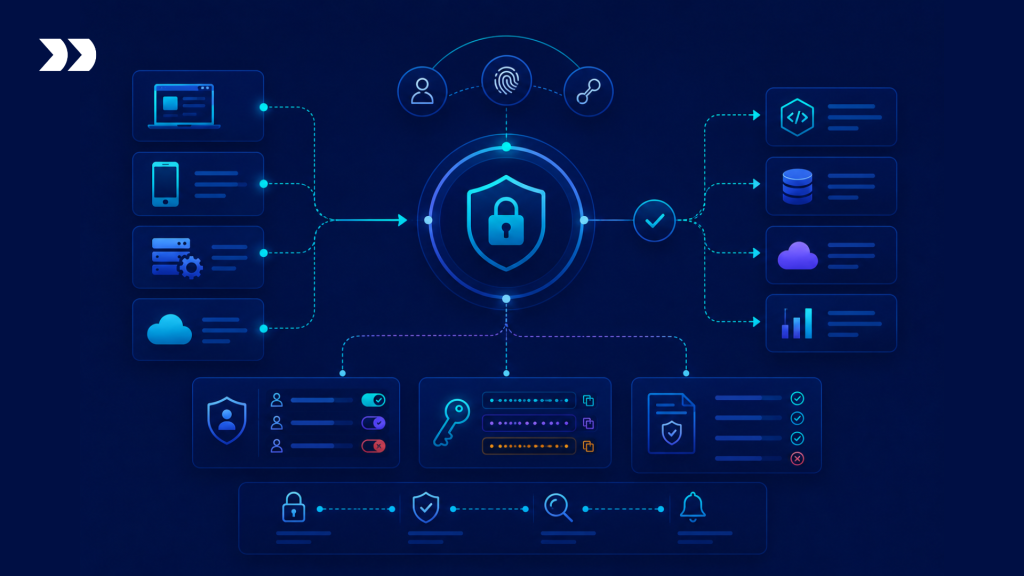
Enterprise API integrations depend on trust between systems. A CRM system may call a billing API. A marketplace connector may update product availability. A payment processor may send the transaction status. A supplier system may request shipment data. An AI workflow may consume customer or product attributes through an internal API. Each interaction requires the API to know who is calling, what the caller is allowed to access, and whether the credential is still valid.
API Authentication Design creates the control structure for that trust. Design defines how identities are verified, how tokens are validated, how credentials are stored, how access is scoped, and how authentication failures are handled.
In enterprise integration environments, authentication is not only a security layer. It is an operational reliability function. If authentication design is weak, APIs can expose sensitive data, allow excessive access, break integrations during token expiry, or make credential incidents difficult to trace.
Why API Authentication Design Matters in Enterprise Integration
API Authentication Design matters because APIs now connect internal systems, external partners, SaaS platforms, data workflows, AI systems, and customer-facing applications. Authentication failure can stop operations. Over-permissive authentication can create security and compliance exposure.
NIST’s 2025 Guidelines for API Protection for Cloud-Native Systems describe APIs as the mechanism used to integrate and communicate with modern enterprise IT application systems that support business processes. That makes authentication and access control part of core integration architecture, not a secondary implementation detail. Api integration benefits for businesses include increased efficiency and streamlined workflows by allowing different systems to communicate seamlessly. By implementing robust API strategies, companies can enhance their service offerings and create more personalized experiences for their customers. Ultimately, the right integration approach can lead to improved decision-making and greater agility in responding to market demands.
Why API Access Must Be Explicitly Controlled
API access should not be granted only because a system can reach an endpoint. Each caller should have a defined identity, approved use case, permitted endpoints, allowed methods, and restricted data scope. This is especially important when APIs expose customer, product, order, payment, supplier, employee, or operational records.
Weak access control often starts with convenience. One token is reused by multiple systems. A service account is granted broad permissions. Partner credentials remain active after the integration changes. Internal APIs are trusted because they sit behind a private network. Over time, these shortcuts become unmanaged access paths.
API access control should enforce least privilege. A marketplace connector that updates inventory should not access billing data. A reporting workflow should not modify operational records. A supplier API consumer should not call internal customer endpoints. The authentication model should make these boundaries enforceable.
How Poor Authentication Design Creates Operational Risk
Poor authentication design creates operational risk in several ways. Tokens may expire without renewal workflows, causing production failures. You may share Credentials across teams, making incidents difficult to trace. Over-scoped tokens may allow access beyond intended use. Long-lived secrets may remain active after the system that used them has been retired.
These risks are both technical and organizational. A failed token rotation can break an order workflow. A leaked API key can expose customer data. An unknown service account can prevent incident teams from identifying which system made a request.
Deloitte’s API governance guidance for agentic AI emphasizes that API strategy should standardize how APIs are designed, published, secured, and reused as AI and enterprise integration move into production. Authentication design is one of the controls that makes this standardization enforceable.
API Access Control Across Enterprise Systems
API access control defines which consumers can call which endpoints and what they can do after authentication succeeds. Authentication answers who is calling. Authorization answers what that caller may access.
A reliable design must handle internal service calls, partner access, machine-to-machine workflows, user-delegated access, and automated system processes. Api management strategies for enterprises are crucial for maintaining security and efficiency in their applications. These strategies help organizations enforce policy compliance and optimize their API performance. By implementing effective management, enterprises can ensure that their APIs remain scalable and resilient in a rapidly changing technological landscape.
Defining Consumers, Scopes, Endpoints, and Allowed Actions
Each API consumer should be registered with a clear identity. The registry should define consumer name, owning team, business purpose, permitted endpoints, allowed methods, required scopes, credential type, rotation policy, and escalation contact.
Scopes should be specific enough to enforce business boundaries. A token may allow product:read, product:update, order:read, or payment:refund. Broad scopes such as admin or full_access should be tightly restricted and monitored.
A simple access-control pattern may look like this:
API_ACCESS_RULES = {
    "marketplace_connector": {
        "allowed_endpoints": ["/products", "/inventory"],
        "required_scopes": ["product:write", "inventory:write"],
    },
    "finance_reporting": {
        "allowed_endpoints": ["/invoices", "/payments"],
        "required_scopes": ["finance:read"],
    },
}


def authorize_api_request(consumer, endpoint, token_scopes):
    rules = API_ACCESS_RULES.get(consumer)

    if not rules:
        return {"authorized": False, "reason": "unknown_consumer"}

    if endpoint not in rules["allowed_endpoints"]:
        return {"authorized": False, "reason": "endpoint_not_allowed"}

    missing = [scope for scope in rules["required_scopes"] if scope not in token_scopes]
    if missing:
        return {"authorized": False, "reason": "missing_required_scopes", "scopes": missing}

    return {"authorized": True}
This follows the same structure as the earlier examples: a policy object, a short function, and a clear allow, block, or route decision. The purpose is to show how access rules become operational controls.
Separating Internal, Partner, and Customer-Facing API Access
Internal APIs, partner APIs, and customer-facing APIs should not share the same authentication design. Internal APIs may rely on service identity, network controls, and internal policy enforcement. Partner APIs require stronger contract-aware access controls, credential lifecycle review, and usage monitoring. Customer-facing APIs may require user consent, federation, session controls, and abuse protection.
Mixing these patterns creates risk. A partner integration should not receive internal service credentials. A customer-facing token should not access administrative endpoints. An internal workflow should not bypass authentication because it runs behind a firewall.
At scale, API access control should be designed by consumer type and business risk. This keeps authentication policies aligned with how the API is actually used.
Applying Least Privilege to Machine-to-Machine Integrations
Many enterprise integrations are machine-to-machine. These include ERP-to-CRM sync, marketplace feeds, payment coordination, warehouse updates, supplier APIs, workforce systems, and product information exchange. These integrations often use service accounts, API keys, OAuth client credentials, certificates, or managed identities.
Machine identities should follow least privilege. Each integration should have its own credentials where possible. Credentials should be scoped to specific endpoints and actions. You should avoid Shared credentials because they reduce traceability and increase the blast radius.
KPMG’s managed identity services perspective describes identity and access management as a control layer for workforce, privileged, customer, and partner access across increasingly complex cloud and AI environments. API machine identities should be governed with the same discipline because they often operate continuously and with high system privileges.
Token-Based Authentication and Credential Lifecycle
Token-based authentication is common in enterprise API environments because it allows systems to issue time-bound, scoped credentials instead of sharing permanent passwords. However, tokens only improve security when issuance, validation, rotation, and revocation are controlled.
A token should represent a specific identity, scope, expiry, issuer, audience, and policy context. It should not become a permanent pass to the API.
Validating Token Scope, Expiry, Issuer, and Audience
Token validation should happen before business logic executes. The API should confirm that the token is active, issued by a trusted authority, intended for the target API, not expired, and scoped for the requested action.
A compact token validation pattern can look like this:
TOKEN_POLICY = {
    "trusted_issuer": "enterprise_identity_provider",
    "required_audience": "product_api",
    "blocked_clients": ["retired_partner_app"],
}


def validate_token(token_claims, required_scope):
    if token_claims.get("issuer") != TOKEN_POLICY["trusted_issuer"]:
        return {"valid": False, "reason": "untrusted_issuer"}

    if token_claims.get("audience") != TOKEN_POLICY["required_audience"]:
        return {"valid": False, "reason": "invalid_audience"}

    if token_claims.get("client_id") in TOKEN_POLICY["blocked_clients"]:
        return {"valid": False, "reason": "blocked_client"}

    if required_scope not in token_claims.get("scopes", []):
        return {"valid": False, "reason": "missing_required_scope"}

    return {"valid": True}
The example is intentionally simple. In production, token validation would also handle signatures, expiration, replay protection, key rotation, and issuer metadata. The operating idea is that token claims should be inspected before the API accepts the request.
Managing Expiration, Refresh, Rotation, and Revocation
Tokens should expire. Long-lived credentials increase the risk that exposed tokens remain usable for too long. Short-lived tokens reduce exposure but require reliable refresh workflows so integrations do not fail unexpectedly.
Credential rotation should be planned. API keys, client secrets, certificates, and service credentials should rotate on defined schedules or after specific risk events. Revocation should be available when credentials are compromised, integrations are retired, or partners lose access.
NIST’s 2025 Digital Identity Guidelines define technical requirements and recommendations across authentication, authenticators, federation, and related assertions. For API integrations, those principles reinforce the need to manage credentials as lifecycle-controlled identity assets rather than static configuration values.
Preventing Token Reuse Across Unrelated Integrations
Token reuse is a common enterprise risk. A single credential may be copied across jobs, partner integrations, dashboards, and scripts because it is easier than registering each consumer properly. This creates poor traceability and an excessive blast radius.
Each integration should use its own credentials or service identity. If a credential is compromised, teams should know which workflow is affected. If an integration is retired, its credential should be disabled without breaking unrelated systems.
This separation also improves auditability. Logs can identify which consumer called which endpoint, when, and with which scope.
Integration Security Design for API Environments
Integration security design connects authentication with broader operational controls. Authentication alone is not enough. APIs also need gateway enforcement, monitoring, secrets management, network controls, logging, and incident response.
The objective is to make access safe, visible, and recoverable.
Using API Gateways and Identity Providers as Enforcement Points
API gateways and identity providers are common enforcement points for enterprise authentication. The identity provider issues and validates credentials. The gateway can enforce authentication policy, route requests, apply rate limits, inspect headers, and reject unauthorized calls before they reach backend systems.
This design reduces duplicated security logic across services. Instead of every API implementing access policy differently, common controls can be applied consistently.
However, gateways and identity providers do not remove application responsibility. Backend services should still validate critical assumptions, especially for sensitive actions. Defense-in-depth matters when APIs support payments, customer data, product publishing, supplier access, or regulated workflows.
Protecting Credentials in Storage, Deployment, and Runtime
API credentials should not be hardcoded into scripts, notebooks, repositories, or deployment files. They should be stored in approved secret managers, environment-specific vaults, or managed identity systems.
Credential handling should cover storage, deployment, runtime access, rotation, and retirement. Teams should know who can read a secret, which service uses it, when it was last rotated, and whether it is still active.
A credential that is technically valid but operationally unknown is a governance problem. API credential management should make secrets visible to authorized owners without exposing them broadly.
Handling Authentication Failures Without Leaking Sensitive Details
Authentication failure responses should be controlled. An API should not reveal whether a client ID exists, which scope is missing in excessive detail, whether a token was structurally valid, or which credential policy failed if that information could help an attacker.
Internal logs can capture detailed failure reasons for authorized operators. External responses should remain safe and consistent.
Authentication failure monitoring should also detect patterns: repeated invalid tokens, expired credentials, unknown clients, endpoint probing, unusual scope requests, and geographic anomalies. These signals can indicate misconfiguration or abuse.
API Credential Management Across the Lifecycle
API credential management ensures that credentials are created, assigned, rotated, monitored, and retired under control. This is especially important in environments with many internal services, partners, contractors, SaaS applications, and automated workflows.
A credential should have an owner and a purpose. If neither is known, the credential should not remain active.
Creating Credential Ownership and Registration Records
Every API credential should be registered. The registration should include consumer name, owner, business purpose, access scope, environment, issue date, expiration date, rotation schedule, last-used timestamp, and retirement status.
This registry helps teams answer practical questions. Which credentials access payment APIs? Which partner apps can update product data? Also, which keys have not been used in 90 days? Which tokens have broad access? Which credentials must rotate before a compliance review?
Without credential records, enterprises rely on scattered knowledge across engineers, tickets, and configuration files. That does not scale.
Rotating and Retiring Credentials Without Breaking Operations
Credential rotation should be operationally safe. Teams should support overlapping credentials during transition, test new credentials before disabling old ones, and monitor usage after rotation.
Retirement should occur when an integration is decommissioned, a partner relationship ends, an API version is retired, or a credential is no longer used. Dormant credentials should not remain active because they provide unnecessary access.
Rotation and retirement should be treated as normal API lifecycle tasks, not emergency actions.
Operational Controls for Authentication Reliability
Authentication reliability requires monitoring, alerting, and failure analysis. A secure authentication design that frequently breaks integrations is not operationally mature. A reliable design that grants excessive access is not secure. The architecture must balance both.
Operational controls help teams detect risk and prevent authentication from becoming a hidden point of failure. Api observability in operational integration is crucial for maintaining the health of authentication systems. It allows teams to gain insights into the performance and reliability of integrated services. By implementing robust observability practices, organizations can proactively identify issues and enhance security measures across their operational landscape.
Monitoring Authentication Failures, Scope Errors, and Token Expiry
Monitoring should track authentication failures, authorization denials, expired tokens, invalid issuers, missing scopes, unknown clients, blocked credentials, and suspicious request patterns.
Not all failures mean an attack. Some indicate expired credentials, misconfigured services, incomplete deployment, or consumer migration issues. The monitoring model should distinguish expected operational issues from security concerns.
Authentication telemetry should connect to API observability. Teams need to know which endpoint failed, which consumer was affected, what scope was missing, and whether the issue is isolated or systemic.
Reviewing Access Patterns and Over-Permissioned Consumers
Access reviews should identify consumers with broader access than required. This includes tokens with administrative scopes, credentials that reach unused endpoints, partner integrations with outdated permissions, and internal services calling APIs outside their approved purpose.
Over-permissioned consumers increase risk. If the credential is compromised, the attacker inherits unnecessary access. If the integration malfunctions, it can affect more systems than intended.
Access pattern review should be part of API governance. It should not occur only after incidents.
Technology and Integration Considerations
API Authentication Design depends on identity providers, API gateways, secret management systems, observability tools, catalogs, and audit platforms. These systems should work together so authentication policy is enforceable and reviewable.
Authentication should be designed as an integration capability, not as a separate security configuration for each API.
Connecting Authentication Metadata to API Catalogs and Integration Records
API catalogs should store authentication requirements for each endpoint. This may include credential type, supported grant type, required scopes, token audience, rate limits, consumer registration process, owner, and escalation contact.
Integration records should identify which consumers use which credentials and which endpoints they call. This helps during rotation, incident response, and access review.
When authentication metadata is visible, integration teams can plan safely. They know what credentials are needed, what access is allowed, and who owns approval.
Preserving Authentication Events in Logs and Audit Systems
Authentication events should be logged with enough context for investigation. Logs may include consumer ID, endpoint, request ID, authentication result, failure reason category, token issuer, scope result, timestamp, and source environment.
Sensitive token values should never be logged. The objective is traceability, not credential exposure.
Audit systems should preserve credential issuance, rotation, revocation, access changes, emergency grants, and failed authentication patterns. These records support compliance, incident response, and operational review.
Governance and Auditability in API Authentication Design
Governance defines who can issue credentials, approve scopes, change access rules, revoke tokens, and review authentication risk. Auditability preserves the evidence that these controls were followed.
The OECD’s data governance work describes governance as the technical, policy, and regulatory structures needed to manage data across its value cycle. API Authentication Design fits that model because access decisions determine how data is reached, used, protected, and monitored across the integration environment.
Creating Ownership, Review Cycles, and Escalation Paths
API authentication should have defined ownership. Security teams may own policy. Platform teams may own gateway enforcement. Identity teams may own token issuance. API owners may own endpoint access rules. Business owners may approve sensitive use cases.
Review cycles should occur when new consumers are added, scopes change, credentials rotate, partners onboard, endpoints expose sensitive data, or incidents occur. High-risk APIs should receive stronger review than low-risk internal endpoints.
Escalation paths should define who responds to leaked credentials, failed rotations, unauthorized access attempts, expired production tokens, and emergency access requests.
Maintaining Audit Trails for Credentials, Tokens, and Access Changes
Audit trails should capture credential creation, scope assignment, token policy changes, rotation events, revocations, access denials, exception approvals, and endpoint permission changes.
Auditability matters when APIs support financial processes, customer data, product publishing, supplier workflows, AI systems, or external partner access. Teams should be able to show who had access, why access was approved, when it changed, and when it was revoked.
This is what turns authentication from a technical gate into an enterprise control.
Conclusion: Turning API Authentication into Controlled Integration Infrastructure
API Authentication Design determines whether enterprise APIs can be trusted as integration infrastructure. It defines how systems prove identity, how access is scoped, how tokens are validated, how credentials are managed, and how authentication failures are monitored.
Strong API access control enforces least privilege across internal services, partners, machine-to-machine workflows, and customer-facing APIs. Token-based authentication supports secure, time-bound access when token lifecycle, scope, expiry, rotation, and revocation are managed properly. Integration security design connects authentication to gateways, identity providers, secret management, logs, audit trails, and governance review.
The capability matters because APIs are operational entry points into enterprise systems. ERP, CRM, warehouse, BI, AI, marketplace, payment, product, supplier, workforce, and order workflows can only remain reliable if authentication is secure, traceable, and operationally controlled.
A structured review can help evaluate whether current API workflows have a reliable API Authentication Design, api access control, token-based authentication, integration security design, and api credential management. You can run an external data infrastructure audit with our team to review your current setup and understand what is required to build reliable, enterprise-scale API integration infrastructure.