Key Takeaways
- Enterprise Data Transition determines whether modernization becomes a stable business operation.
- Enterprise transition planning connects data movement, business rules, systems, users, and cutover readiness.
- Operational transition design reduces disruption across migration, validation, reconciliation, go-live, and post-cutover support.
- Enterprise change coordination fails when data, process, platform, and user dependencies are planned separately.
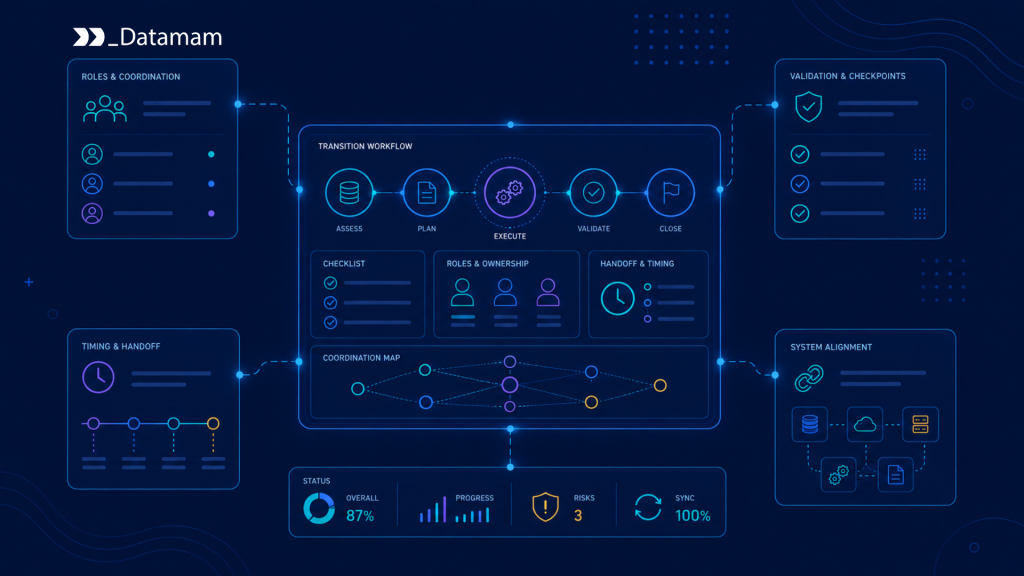
Enterprise data transition is often treated as a migration milestone. Records move, systems switch, users receive access, and the project is marked as complete. However, enterprise modernization does not succeed when data is moved. It succeeds when the business can operate from the new environment with stable workflows, trusted reporting, approved controls, and clear ownership.
Enterprise Data Transition refers to the controlled movement of data, business rules, dependencies, access rights, reports, integrations, and operating processes from current-state systems into a future-state environment. It includes enterprise transition planning, operational transition design, enterprise change coordination, source-to-target mapping, validation, reconciliation, parallel runs, cutover gates, rollback planning, lineage, audit logs, and governance.
Enterprise Data Transition Determines Whether Modernization Becomes Stable Business Operation
Modernization programs often focus on the target platform: a new ERP, CRM, cloud warehouse, finance system, ecommerce platform, healthcare records system, or support environment. However, the platform is only one part of the transition. The business also needs trusted data, working integrations, approved access, reconciled reports, trained users, and continuity across downstream workflows.
A technically completed migration can still create operational instability. Customer records may move, but account ownership may not reconcile. Financial records may load, but reporting balances may differ. Product records may appear in the target system, but marketplace feeds may reject missing attributes. Cloud warehouse tables may populate, but dashboards and AI features may not match legacy outputs.
McKinsey’s State of AI 2025 highlights that many organizations are still early in scaling AI and capturing enterprise-level value, with stronger outcomes tied to workflow redesign and data infrastructure maturity. Also, enterprise transition design matters for the same reason: modernization value depends on whether new systems can support real workflows, not only whether data can be loaded.
Enterprise Transition Planning Connects Data Movement, Business Rules, Systems, and Cutover Readiness
Enterprise transition planning should connect the technical migration with the operating model that follows it. Teams need to define which data domains move, which business rules apply, which target-system constraints matter, which reports must reconcile, which workflows depend on migrated data, which users need access, and what evidence is required before cutover.
This planning must include business-rule approval. A source field may appear easy to map, but its meaning may vary across teams. A customer lifecycle field may mean sales status in one process and billing status in another. A product category may reflect historical merchandising logic that does not fit the new platform. A finance code may be valid in the legacy system but invalid under the future-state chart of accounts.
In practice, transition planning gives teams a shared operating view. It shows what will move, what will change, what will be retired, what requires approval, and what must be proven before the business can operate from the new environment.
Operational Transition Design Reduces Disruption Across Migration, Validation, Reconciliation, and Go-Live
Operational transition design defines how migration steps connect to business readiness. It should cover profiling, transformation, validation, reconciliation, user acceptance, parallel runs, cutover gates, rollback criteria, access approval, and post-transition monitoring.
Without this design, migration activity can appear successful while transition risk remains unresolved. Data may load into the target system, but reconciliation may be incomplete. Reports may pass sample testing, but full historical outputs may differ. Users may receive access, but permissions may not match governance requirements. Integrations may work in test, but fail under production volume.
Therefore, operational design prevents go-live from becoming a calendar decision. It turns transition into an evidence-based sequence where each step proves readiness for the next.
Why Weak Transition Design Creates Modernization Risk
Weak transition design creates modernization risk because it separates system deployment from business continuity. Teams may configure the platform, load data, and test selected workflows, but still fail to coordinate all the dependencies required for stable operation.
Gartner’s 2025 Data and Analytics Predictions point to the growing role of decision intelligence and AI agents in business decisions. As more workflows become automated or AI-supported, transition defects can affect decisions quickly. Bad mappings, incomplete records, access gaps, or broken integrations may flow directly into dashboards, models, and operational systems.
Enterprise Change Coordination Fails When Data, Process, Platform, and User Dependencies Are Planned Separately
Enterprise change coordination fails when teams manage transition work in separate lanes. Data teams handle mapping and loading. Platform teams configure the target system. Business teams prepare users. Governance teams review access. Reporting teams rebuild dashboards. Integration teams update connected systems.
Each workstream may progress, but the transition can still fail if dependencies are not coordinated. A mapping change may affect reports. A permission decision may affect compliance. A duplicate-record rule may affect customer operations. A target-system constraint may change a business workflow. A delayed integration may prevent day-one operations.
Accordingly, enterprise transition planning must connect data, process, platform, and users into one readiness model. The business cannot transition safely if each dependency is managed in isolation.
Business Teams Lose Confidence When Transition Logic Is Not Clear Before Cutover
Business teams lose confidence when they cannot explain how legacy values become future-state values. If customer statuses change, product categories shift, supplier records merge, or finance codes transform, users need to understand the logic. Without that clarity, the new system appears unreliable even when the migration technically succeeded.
A transition check should expose whether required rules are approved before records move:
TRANSITION_RULES = {

    "customer_status": "approved",

    "billing_country": "approved",

    "tax_region": "pending",

}


REQUIRED_RULES = ["customer_status", "billing_country", "tax_region"]


def check_transition_readiness(record):

    pending = [

        rule for rule in REQUIRED_RULES

        if TRANSITION_RULES.get(rule) != "approved"

    ]


    if pending:

        return {

            "ready": False,

            "reason": "transition_rules_pending",

            "rules": pending,

            "record_id": record["record_id"],

        }


    return {"ready": True, "record_id": record["record_id"]}


record = {

    "record_id": "CUST-88412",

    "source_system": "legacy_crm",

    "target_system": "new_crm",

}


check_transition_readiness(record)
This pattern shows that operational transition design should block records tied to unresolved business rules. Moving them anyway transfers uncertainty into production.
The Strategic Cost of Poor Enterprise Data Transition
Poor enterprise data transition weakens modernization outcomes because users may not trust the future-state environment. The new system may go live, but teams may continue comparing outputs against legacy systems, maintaining spreadsheets, requesting manual extracts, or delaying decisions until migrated values are confirmed.
IBM’s 2025 CDO Study emphasizes decision-ready data as a foundation for value creation from data and AI. Enterprise transition design supports that objective because modern platforms cannot produce decision-ready outputs if the transition leaves data meaning, access, lineage, or reconciliation unresolved. Data transition challenges for businesses can significantly hinder the adoption of new technologies. Organizations must prioritize strategies that streamline this process to avoid pitfalls that could lead to data discrepancies and user dissatisfaction. Addressing these issues early will help ensure that teams have the tools they need to trust and leverage new data environments effectively.
Modernization Outcomes Decline When Migrated Data Does Not Support Day-One Operations
Modernization outcomes decline when migrated data cannot support day-one operations. A CRM transition may fail if users cannot trust account hierarchy, lifecycle status, ownership, or consent fields. An ERP transition may fail if balances, suppliers, cost centers, inventory, or tax classifications do not reconcile. A cloud warehouse transition may fail if dashboards, metric definitions, or AI feature tables differ without explanation.
These issues may not stop the system from launching. However, they reduce adoption and slow operational confidence. Teams may treat the new system as provisional until they rebuild trust manually.
At scale, transition success is measured by operating stability. If the business cannot rely on the new environment immediately after cutover, the transition remains incomplete.
Executive Confidence Weakens When Teams Cannot Prove Transition Readiness with Evidence
Executives need evidence before approving transition. They need to know which domains are ready, which mappings are approved, which exceptions remain open, which reports reconcile, which integrations are tested, which access controls are active, and whether rollback criteria are credible.
Without this evidence, leaders are asked to approve go-live based on project status rather than operational readiness. That creates governance risk. A project can be on schedule while still carrying unresolved transition exposure.
In this context, enterprise data transition becomes an executive control point. It gives leadership a way to distinguish technical completion from business readiness.
How Enterprise Data Transition Affects ERP, CRM, Cloud, and Analytics Programs
Enterprise data transition affects each modernization program differently. ERP transition carries finance, procurement, inventory, supplier, tax, and compliance risk. CRM transition carries customer identity, revenue operations, account ownership, consent, and support risk. Cloud warehouse transition carries analytics, AI, historical reporting, metric definition, and lineage risk.
The NIST AI Risk Management Framework is organized around govern, map, measure, and manage functions. Those concepts apply directly to enterprise transition because migrated data often becomes the foundation for AI, analytics, automated workflows, and executive reporting after modernization. Successful implementation of enterprise system modernization strategies requires a thorough understanding of the organization’s current systems and processes. By prioritizing the most critical areas for modernization, companies can align their technology investments with their long-term goals. This strategic approach not only enhances operational efficiency but also positions the organization for future growth and innovation.
Source-to-Target Mapping Must Preserve Business Meaning Across Enterprise Platforms
Source-to-target mapping must preserve business meaning, not only field structure. A field with the same name may carry different meaning across systems. A value that was acceptable in the source system may be invalid in the target environment. A legacy category may need to map into a new hierarchy. A status value may need business approval before it can move.
A mapping validation function can catch common transition risks early:
FIELD_MAPPING = {

    "legacy_account_id": "customer_id",

    "company_name": "legal_name",

    "account_status": "status",

    "billing_country": "primary_country",

}


STATUS_MAPPING = {

    "active": "active",

    "inactive": "inactive",

    "archived": "inactive",

    "suspended": "suspended",

}


def validate_transition_mapping(source_record):

    missing = [field for field in FIELD_MAPPING if not source_record.get(field)]

    if missing:

        return {"valid": False, "reason": "missing_source_fields", "fields": missing}


    status = source_record["account_status"].lower()

    if status not in STATUS_MAPPING:

        return {"valid": False, "reason": "unmapped_status", "value": status}


    return {"valid": True, "target_status": STATUS_MAPPING[status]}
This example shows why transition requires business logic. The goal is not to move values mechanically. The goal is to preserve meaning across enterprise platforms.
Validation, Reconciliation, and Parallel Runs Make Operational Transition Risk Visible Before Go-Live
Validation confirms that records meet target requirements. Reconciliation compares source and target outputs. Parallel runs compare legacy and future-state behavior before the business depends fully on the new environment.
For ERP programs, reconciliation may compare balances, transaction totals, suppliers, cost centers, and inventory values. For CRM programs, it may compare account counts, lifecycle stage, ownership, hierarchy, and opportunity totals. Also, for cloud warehouse programs, it may compare dashboard metrics, row counts, historical reporting outputs, and feature tables.
Parallel runs are especially important because they show whether the new environment can support expected operations before the old one is retired. They also reveal whether differences are caused by business-rule changes, data quality issues, mapping errors, or timing gaps.
The Infrastructure Layer Behind Operational Transition Design
Operational transition design requires infrastructure that can profile, map, validate, reconcile, route exceptions, track batches, monitor cutover, and preserve audit evidence. Manual spreadsheets may help during planning, but enterprise-scale transition needs repeatable controls.
Airflow can orchestrate transition batches, validations, and reruns. Spark can process large legacy datasets. dbt can define transformation logic and target-model tests. Snowflake, BigQuery, and Databricks can support staging, reconciliation, and analytics comparison. Great Expectations can validate schema, completeness, uniqueness, allowed values, and threshold rules. Metadata systems and lineage tools can show how transitioned fields affect downstream reports, models, workflows, and integrations.
Profiling, Batch Controls, Exception Routing, and Cutover Gates Improve Transition Control
Profiling exposes source-system conditions early. Batch controls show which records were extracted, transformed, loaded, rejected, retried, or approved. Exception routing assigns issues to the right owner. Cutover gates prevent go-live until defined evidence is available.
def evaluate_transition_gate(summary):

    if summary["critical_exceptions"] > 0:

        return {"ready": False, "reason": "critical_exceptions_open"}


    if summary["reconciliation_variance"] > summary["allowed_variance"]:

        return {"ready": False, "reason": "reconciliation_variance_too_high"}


    if summary["access_review"] != "approved":

        return {"ready": False, "reason": "access_review_not_approved"}


    if summary["rollback_plan"] != "approved":

        return {"ready": False, "reason": "rollback_plan_not_approved"}


    return {"ready": True, "decision": "approved_for_cutover"}


summary = {

    "critical_exceptions": 0,

    "reconciliation_variance": 0.06,

    "allowed_variance": 0.10,

    "access_review": "approved",

    "rollback_plan": "approved",

}


evaluate_transition_gate(summary)
This type of gate makes operational transition readiness measurable. It prevents teams from treating go-live as a project date rather than a controlled decision.
Metadata, Lineage, Audit Logs, and Access Controls Make Enterprise Change Coordination Defensible
Metadata records source fields, target fields, business definitions, owners, classifications, retention rules, and approved mappings. Lineage shows where data came from, how it changed, and which downstream systems depend on it. Audit logs record extraction, transformation, validation, exception handling, approval, loading, reconciliation, access review, and cutover decisions.
Access controls ensure that sensitive data is moved only into approved target environments and made available only to authorized users or systems. This matters for customer data, financial records, employee data, healthcare records, third-party data, and cross-border transition scenarios.
Ultimately, enterprise change coordination becomes defensible when teams can explain what changed, why it changed, who approved it, and which controls passed before production transition.
Why Enterprise Data Transition Is Becoming an Executive Governance Issue
Enterprise Data Transition is becoming an executive governance issue because modernization now affects finance, compliance, AI readiness, analytics trust, customer experience, employee workflows, product operations, and business continuity. A transition issue can quickly become a reporting issue, customer issue, compliance issue, or operational disruption.
Executives do not need to manage mapping logic directly. However, they need visibility into which data domains, workflows, and systems carry transition risk. They need to know which rules are approved, which exceptions remain open, which dependencies are ready, and whether the business can operate from the new environment after cutover. Data mapping techniques for migration are crucial for ensuring that all relevant information is accurately transferred. Proper documentation of these techniques can also aid in identifying potential bottlenecks before they arise. By implementing a robust strategy, organizations can enhance their overall transition efficiency and minimize disruptions.
Leaders Need Visibility into Which Data Domains, Workflows, and Systems Carry Transition Risk
Leadership visibility should focus on risk concentration. Which data domains are most critical? Which workflows depend on transitioned data on day one? Also, which mappings remain unresolved? Which reports must reconcile before go-live? Which integrations are not fully tested? As well as which access controls remain pending? Which systems would be affected if rollback is required?
This visibility helps leaders distinguish project progress from transition readiness. A platform can be configured, and a migration can be technically advanced while operational readiness remains incomplete.
In practice, transition governance should give executives a clear view of readiness, unresolved risk, accepted exceptions, and cutover evidence.
Scalable Modernization Programs Require Transition Standards, Ownership, Testing, and Continuous Review
Scalable modernization programs require transition standards. These standards should define profiling requirements, mapping approval, validation rules, reconciliation thresholds, exception ownership, parallel run criteria, access controls, audit logging, lineage capture, rollback planning, dependency review, and cutover signoff.
Ownership must be explicit. Data engineering operates transition pipelines. Business owners approve rules and mappings. Governance teams define access, retention, and usage controls. Compliance teams define evidence requirements. Operations teams define continuity expectations. Analytics and AI teams define downstream consumption needs. Executives approve transition risk.
Ultimately, Enterprise Data Transition needs stronger operational design because modernization is not only a system event. It is a coordinated movement of data, rules, access, workflows, dependencies, and trust into a new operating environment. Enterprise transition planning connects those pieces before cutover. Operational transition design makes readiness measurable. Enterprise change coordination ensures that the business can operate from the future-state system with confidence.
Organizations that treat transition as governance infrastructure will modernize with stronger continuity and control. Those that treat it as a technical milestone may complete migration tasks, but they will struggle to prove that the enterprise is ready to rely on the new system.