Key Takeaways
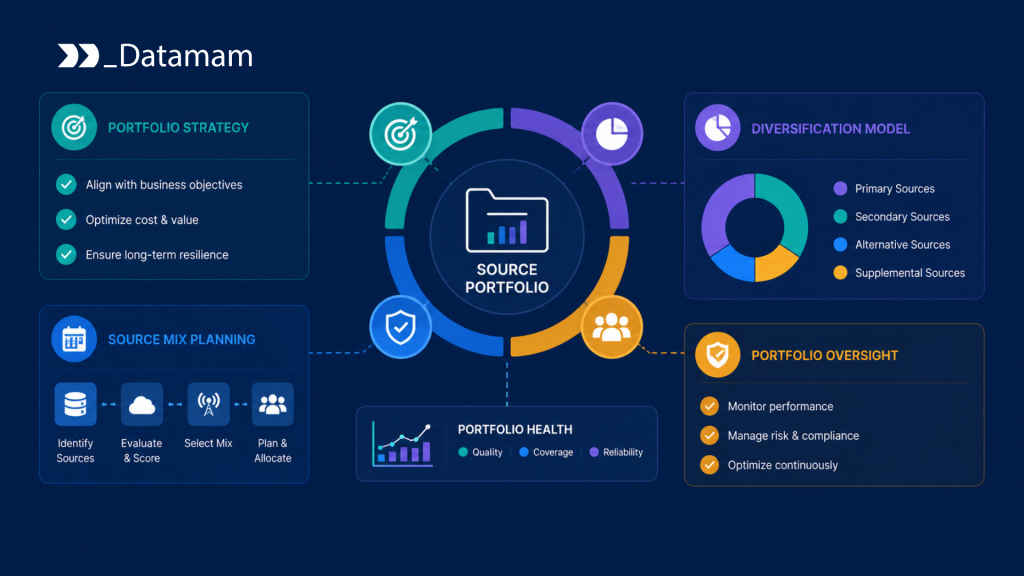
- Source Portfolio Management helps enterprises govern external sources as a controlled portfolio rather than a disconnected sourcing list.
- A source portfolio strategy aligns source selection with business use cases, coverage needs, authority, freshness, cost, and operational risk.
- A portfolio diversification model reduces dependency on single vendors, platforms, access methods, or source types.
- Source mix planning helps enterprises combine public, vendor, partner, API, and web-based sources based on reliability and decision value.
- Data portfolio oversight requires scorecards, review cycles, source retirement rules, ownership controls, audit logs, and governance metadata.
External data sourcing programs often begin with source acquisition, but they become difficult to manage when sources accumulate without portfolio discipline. Teams add vendors, public sources, APIs, partner feeds, and web-based inputs to solve immediate use cases. Over time, the source environment becomes larger, more expensive, harder to govern, and more difficult to evaluate.
Source Portfolio Management provides the operating model for managing external data sources as a strategic portfolio. It defines which sources should be retained, prioritized, diversified, monitored, replaced, or retired. In enterprise sourcing operations, this is not a procurement exercise. It is a data infrastructure control that shapes reliability, coverage, cost, risk, and downstream trust.
The objective is to ensure that the external source base remains fit for purpose as business use cases, market conditions, vendor performance, and governance requirements change.
Why Source Portfolio Management Matters in Data Sourcing
External sources create operational dependency. A source may support pricing analysis, market intelligence, AI training data, compliance monitoring, supplier risk workflows, or executive reporting. As more teams depend on external inputs, unmanaged source growth becomes a reliability and governance issue.
According to Gartner’s 2025 data and analytics trends, data and analytics are expanding from specialist teams into broader organizational use, increasing the need for stronger governance and operational control. Source Portfolio Management supports control by making external source dependencies visible, reviewable, and manageable. Data sourcing strategies for enterprises are essential for optimizing resource allocation and ensuring compliance. Effective implementation of these strategies can lead to improved data quality and reliability across various teams. By prioritizing a comprehensive approach, organizations can mitigate risks associated with external dependencies.
Why External Sources Should Be Managed as a Portfolio
External sources differ in authority, freshness, coverage, access method, cost, legal usability, and operational stability. Treating each source as an isolated acquisition prevents teams from seeing concentration risk, overlap, redundancy, and gaps across the full sourcing environment.
A portfolio view helps enterprises understand how sources work together. Some sources provide authoritative records. Others provide broad market visibility. Some act as backups. Others provide niche coverage. Some are essential to daily operations, while others only support occasional research.
A source portfolio strategy classifies sources by role, use case, criticality, and risk. This allows teams to prioritize investment where source value is highest and reduce dependency where the portfolio is overconcentrated or underperforming.
How Unmanaged Source Growth Creates Operational and Governance Risk
Unmanaged source growth creates hidden costs and fragility. Teams may continue paying for low-value sources because no review cycle exists. Multiple teams may source overlapping data from different vendors. Critical workflows may depend on a single vendor without backup. Some sources may have poorly documented usage restrictions.
These risks compound as external data becomes embedded into downstream systems. A weak source may feed a dashboard. An unstable vendor may support an AI workflow. A poorly documented source may become part of compliance reporting. Once this happens, source management becomes more difficult because the dependency is already operational.
IBM’s 2025 CDO Study frames decision-ready data as central to AI and enterprise data strategy. A source portfolio must therefore be governed not only for acquisition, but for long-term decision readiness.
Source Portfolio Strategy for Enterprise Data Programs
A source portfolio strategy defines how the enterprise selects, classifies, balances, and governs external data sources. It should connect sourcing decisions to business use cases, technical requirements, risk tolerance, and governance expectations.
Without a strategy, sourcing decisions are often reactive. Teams add sources when gaps appear, but rarely revisit whether the full portfolio remains balanced.
Aligning Source Selection with Business Use Cases
Source selection should begin with use-case requirements. Pricing intelligence may need frequent competitor coverage, reliable refresh cadence, and strong product matching. Supplier risk monitoring may require regional coverage, ownership signals, public records, sanctions data, and vendor reliability. AI training workflows may require diversity, provenance, licensing clarity, and source stability.
A source portfolio strategy maps each source to the decisions it supports. This prevents source acquisition from being justified only by availability or vendor claims. A source should have a defined role: core input, validation source, backup source, enrichment source, exploratory source, or low-priority reference.
When source roles are clear, teams can assess whether the portfolio supports the business model or merely reflects historical sourcing activity.
Balancing Source Authority, Coverage, Freshness, and Cost
Source quality is multidimensional. A highly authoritative source may have limited coverage. A broad vendor feed may lack transparency. A low-cost source may require high engineering maintenance. A high-frequency source may be valuable for operations but unnecessary for strategic analysis.
Source Portfolio Management requires balancing authority, coverage, freshness, and cost. The goal is not to maximize every dimension equally. The goal is to match source characteristics to decision needs.
For example, a regulatory monitoring program may prioritize authority and auditability over volume. A market intelligence program may prioritize breadth, freshness, and cross-source comparison. A training data program may prioritize diversity, licensing clarity, and provenance.
Separating Strategic Sources from Supporting Sources
Not all sources should receive the same governance attention. Strategic sources are high-dependency inputs that support critical workflows. Supporting sources provide enrichment, validation, research context, or backup coverage.
Strategic sources require stronger controls: monitoring, ownership, SLAs, refresh tracking, data quality checks, continuity planning, and periodic executive review. Supporting sources may need lighter controls, but they should still be documented and reviewed.
This separation helps teams allocate operational effort intelligently. It also prevents low-value sources from consuming the same attention as critical inputs.
Portfolio Diversification Model for External Data Sourcing
A portfolio diversification model reduces dependency risk by distributing sourcing across vendors, platforms, source types, access methods, and geographies. Diversification does not mean adding sources indiscriminately. It means designing the source base so that failure in one provider or channel does not compromise the entire program.
KPMG’s 2025 renewed urgency on third-party risk management emphasizes that third-party-driven business models expose organizations to serious risk and compliance issues. External data sourcing programs face the same issue when vendor and source concentration are not actively managed.
Reducing Dependency on Single Vendors, Platforms, or Source Types
Single-source dependency creates operational exposure. If one vendor provides most of a critical dataset, vendor failure can become business failure. If one platform type dominates the portfolio, access changes can affect multiple workflows at once. Also, if one geography is covered by only one source, regional intelligence may become fragile.
A diversification model identifies these concentrations. It evaluates whether critical workflows have backup sources, whether alternative providers exist, and whether internal teams can continue operating if a source becomes unavailable.
The goal is not redundant spending. It is controlled resilience. Critical source dependencies should be visible, justified, and mitigated where necessary.
Managing Redundancy Without Creating Unnecessary Complexity
Some redundancy is valuable. Duplicate coverage can support reconciliation, validation, continuity planning, and source confidence scoring. However, too much redundancy creates cost, engineering overhead, conflicting records, and governance complexity.
A portfolio diversification model should distinguish useful redundancy from wasteful overlap. Useful redundancy exists when multiple sources improve trust, reduce risk, or support critical continuity. Wasteful overlap exists when sources duplicate each other without improving decision quality.
This distinction helps sourcing teams avoid two extremes: excessive concentration and uncontrolled source sprawl.
Designing Backup Sources for Critical Data Needs
Critical data needs should have backup planning. A backup source may not match the primary source perfectly, but it can preserve continuity during outages, vendor failure, access changes, or coverage degradation.
Backup planning should consider source authority, coverage similarity, refresh cadence, access readiness, legal usability, and integration effort. A backup source that cannot be activated quickly may provide limited resilience.
For high-impact data workflows, backup sources should be tested periodically. Otherwise, backup coverage may exist only on paper.
Source Mix Planning Across Data Sourcing Operations
Source mix planning defines how different source types work together. A mature sourcing program may combine public sources, vendor feeds, partner datasets, API-based access, web-based sources, and internal enrichment. Each source type contributes different strengths and risks.
The source mix should reflect the enterprise’s decision needs, not a preference for one acquisition method. Source licensing processes for data programs must be well-defined to ensure compliance and efficacy. A thorough understanding of these processes can reveal potential partnerships and better resource allocation. Additionally, organizations should regularly review and update their licensing strategies to adapt to the evolving data landscape.
Combining Public, Vendor, Partner, API, and Web-Based Sources
Public sources can provide authority and transparency, especially for regulatory, procurement, corporate, and government records. Vendor sources can provide scale, normalization, and delivery convenience. Partner sources may offer privileged or high-context data. APIs can provide structured access. Web-based sources can provide breadth when formal feeds are unavailable.
Each source type should be evaluated for reliability, access rights, update cadence, source origin, cost, and governance burden. Combining source types can strengthen coverage, but only if the portfolio is documented and controlled.
A strong source mix planning process defines why each source type is included and which use case it supports.
Matching Source Mix to Refresh Cadence, Access Method, and Use Case
Source mix planning should align with refresh cadence and access method. A high-frequency pricing workflow may require API access, event-driven updates, and selected web-based monitoring. A quarterly market sizing workflow may rely on vendor files, public records, and curated research sources. An AI training workflow may combine vendor datasets, public data, labeled examples, and internally reviewed sources.
The source mix should also account for technical integration. Airflow, Kafka, Spark, dbt, Snowflake, BigQuery, Databricks, data catalogs, and observability systems may all interact with source inputs. Source diversity is useful only when it can be integrated and governed effectively.
A well-designed source mix prevents sourcing decisions from becoming disconnected from operational reality.
Adjusting the Source Mix as Markets and Business Priorities Change
Source portfolios are not static. Markets expand. Vendors change coverage. Business teams add new use cases. Some sources become less relevant. Others become more critical. A source mix that was appropriate during a pilot may become insufficient at enterprise scale.
Source Portfolio Management should include a periodic source mix review. Teams should evaluate whether the portfolio still supports current business priorities, whether new gaps have emerged, and whether some sources should be retired or replaced.
This review protects the portfolio from becoming a historical artifact rather than an active sourcing strategy.
Data Portfolio Oversight and Performance Review
Data portfolio oversight ensures that external sources remain valuable, reliable, compliant, and aligned with enterprise needs. It provides the review structure for measuring source performance over time.
A source that performed well during onboarding may degrade later. Coverage may decline. Refresh cycles may become inconsistent. Vendor support may weaken. Usage rights may change. Oversight creates a process for detecting and responding to these changes.
Tracking Source Quality, Reliability, Coverage, and Usage Over Time
Source performance should be measured across quality, reliability, coverage, freshness, usage, cost, and risk. Quality indicators may include completeness, duplication, schema stability, and error rates. Reliability indicators may include refresh success, downtime, delivery consistency, and incident frequency.
Usage metrics are also important. A source may be expensive but rarely used. Another may be used heavily but under-governed. Coverage metrics show whether the source still supports required markets, categories, entities, or signals.
Data portfolio oversight turns these measures into reviewable evidence. Teams can decide whether a source should be retained, expanded, downgraded, replaced, or retired.
Retiring Low-Value Sources and Reprioritizing Critical Inputs
Source retirement is as important as source acquisition. Low-value sources create cost, complexity, and governance overhead. They may also confuse downstream users if they remain available without a clear purpose.
Retirement decisions should consider usage, quality, overlap, cost, replacement availability, contractual terms, and downstream dependencies. A source should not be removed without understanding which workflows depend on it.
Reprioritization is the opposite process. A source may become more important as business needs change. In that case, it may need stronger monitoring, higher refresh priority, better documentation, or backup coverage.
Creating Review Cycles for Portfolio Health and Sourcing Risk
Portfolio review cycles should be formal. High-dependency sources may require a quarterly review. Lower-risk sources may be reviewed semiannually or annually. Review outputs should include source status, risk rating, performance changes, coverage gaps, cost review, and recommended actions.
The OECD.AI 2025 Data Governance Working Group Report highlights data governance as a technical, legal, and institutional challenge. Source portfolio review reflects that same governance reality: data sourcing must be managed through defined roles, evidence, rules, and accountability.
Technology and Integration Considerations
Source Portfolio Management requires systems that make the portfolio visible. A spreadsheet may work during early planning, but enterprise sourcing programs need structured metadata, catalogs, dashboards, lineage, and scorecards.
Technology should help teams answer practical questions: Which sources support which use cases? Which sources are critical? Also, which feeds are underperforming? Which vendors create concentration risk? Which downstream systems depend on each source? Source classification techniques for data analysis can provide insights that enhance decision-making in sourcing strategies. By implementing these techniques, organizations can gain a clearer understanding of their data sources and their impact on business outcomes. Additionally, this approach allows teams to proactively address potential issues and optimize their sourcing processes.
Using Metadata Catalogs, Lineage, and Scorecards for Portfolio Visibility
Metadata catalogs should store source attributes such as owner, vendor, access method, refresh cadence, coverage, authority, legal status, cost, quality score, and downstream use cases. Lineage systems should show which datasets, dashboards, models, and workflows depend on each source.
Scorecards can combine quality, reliability, coverage, cost, governance risk, and usage into a portfolio view. This helps data leaders compare sources consistently rather than relying on anecdotal feedback.
Portfolio visibility matters because sourcing decisions become difficult when knowledge is scattered across procurement documents, engineering notes, dashboards, and individual team memory.
Connecting Source Portfolio Data to Warehouses, BI, and AI Workflows
Source portfolio metadata should connect to operational systems. Warehouses such as Snowflake, BigQuery, and Databricks should preserve source identifiers and metadata where possible. BI dashboards should indicate source freshness and coverage limitations. AI workflows should know which source versions and source types contributed to training or evaluation data.
Orchestration tools such as Airflow can connect source status to workflow execution. Observability tools such as Prometheus can track source reliability. DBT can document how source inputs flow into modeled datasets.
This connection turns portfolio management into active infrastructure. Source health becomes visible where data is consumed.
Governance and Compliance in Source Portfolio Management
Governance defines how source portfolio decisions are made, documented, reviewed, and audited. It also ensures that source usage aligns with legal rights, contracts, access restrictions, privacy expectations, and internal policies.
As external data becomes more important to enterprise workflows, source portfolio governance becomes a procurement, data, legal, security, and engineering concern.
Managing Ownership, Usage Rights, Access Controls, and Vendor Dependency
Each source should have an owner. Ownership should include business accountability, technical accountability, and governance responsibility where appropriate. Without ownership, source issues can remain unresolved or unmanaged.
Usage rights should be documented. Teams need to know whether data can be stored, transformed, redistributed, used in AI workflows, or combined with internal data. Access controls should reflect source sensitivity and contract requirements.
Vendor dependency should also be reviewed. If many critical sources come from one vendor, the portfolio may require mitigation, backup sourcing, or closer third-party risk oversight.
Creating Audit Trails for Source Changes, Approvals, and Portfolio Decisions
Audit trails should preserve source additions, removals, role changes, ownership updates, contract status, governance approvals, source retirement decisions, and risk acceptance. These records matter when sourcing decisions are reviewed later.
Auditability is especially important when sources support regulated decisions, AI systems, executive reporting, compliance workflows, or high-value commercial actions. Teams should be able to explain why a source was selected, why it was retained, why it was retired, and which controls applied.
Source Portfolio Management becomes more credible when decisions are evidence-based and reviewable rather than informal.
Conclusion: Turning External Source Portfolios into Controlled Data Sourcing Infrastructure
External data sourcing becomes more complex as sources, vendors, markets, and business use cases expand. Without portfolio discipline, enterprises risk source sprawl, hidden dependency, redundant spending, weak governance, and inconsistent downstream trust.
Source Portfolio Management gives enterprises a structured way to manage external sources as strategic assets. A strong source portfolio strategy aligns sources with business use cases. A portfolio diversification model reduces dependency on single vendors, platforms, and source types. Source mix planning balances public, vendor, partner, API, and web-based sources. Data portfolio oversight ensures that performance, coverage, cost, risk, and usage are reviewed over time.
The capability matters because sourcing quality is not only determined source by source. It is determined by how the full portfolio works together. A controlled source portfolio strengthens market intelligence, AI workflows, compliance monitoring, pricing systems, procurement analysis, and executive reporting.
A structured review can help evaluate whether current sourcing workflows have reliable Source Portfolio Management, source portfolio strategy, portfolio diversification model, source mix planning, and data portfolio oversight controls. You can run an external data infrastructure audit with our team to review your current setup and understand what is required to build a reliable, enterprise-scale external data infrastructure.