Key Takeaways
- How Real-Time Data Engineering supports live analytics across transactions, events, applications, devices, and operational systems
- Why real-time pipeline engineering requires validation, event ordering, schema control, retry logic, and observability
- How streaming data infrastructure improves operational visibility, alert accuracy, anomaly detection, and response speed
- Why event-driven data pipelines fail when teams rely on unmanaged streams or inconsistent event definitions
- How governed data engineering reduces alert noise, metric drift, data latency, and operational risk
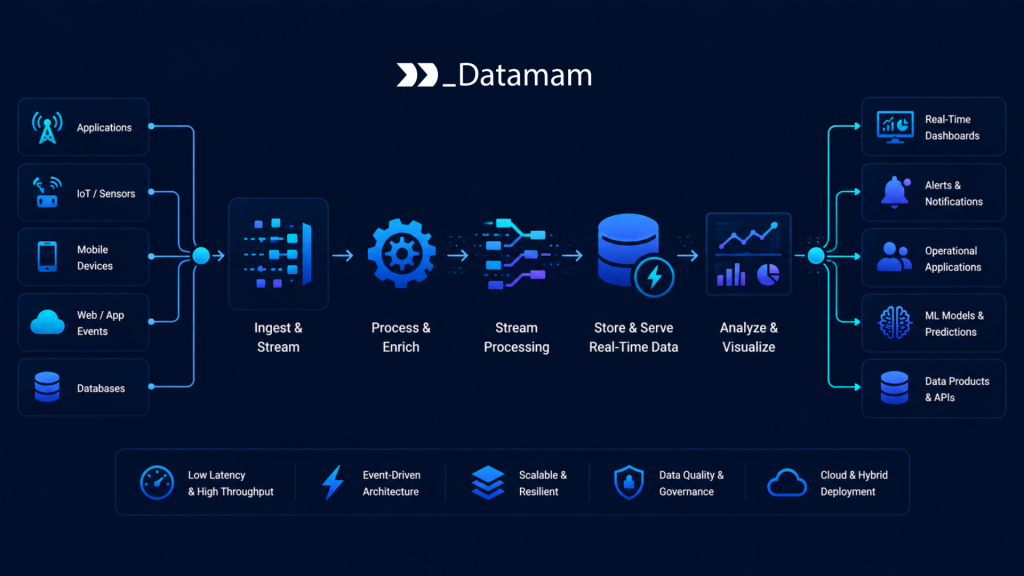
Real-time analytics systems depend on reliable data engineering across event sources, application logs, transaction systems, IoT streams, customer activity platforms, payment systems, operational databases, data warehouses, alerting systems, and analytics dashboards. When Real-Time Data Engineering is weak, teams face delayed alerts, duplicate events, inconsistent metrics, incomplete streaming views, and dashboards that appear live but cannot support operational decisions. The issue is rarely only the analytics interface. It is usually the operating layer behind it: event ingestion, stream processing, validation, ordering, enrichment, observability, lineage, access control, and governance. Real-Time Data Engineering gives product, operations, risk, finance, customer experience, and data teams a structured foundation for turning live data into trusted business signals.
The Data Reliability Gap in Real-Time Analytics
Real-time analytics is often associated with speed, but speed alone does not create reliable intelligence. A dashboard may refresh every few seconds while still showing incomplete, duplicated, or incorrectly ordered events. An alert may fire quickly but from a bad signal. An operational team may react to a live metric without knowing whether upstream systems are delayed.
This creates a reliability gap. Business teams need real-time visibility into customer activity, transactions, inventory, fraud signals, service incidents, product usage, logistics events, and system performance. However, real-time systems must preserve accuracy, context, and governance while processing data continuously. NIST Cybersecurity Framework 2.0 is relevant because real-time analytics environments depend on monitoring, access control, resilience, and governance across connected systems.
Why Real-Time Data Becomes Difficult to Operate
Real-time data becomes difficult to operate because events arrive continuously and imperfectly. Some events arrive late. Some are duplicated. Also, some are missing fields. Some are replayed after outages. Some use old schemas because a source application was not updated. Others arrive out of order because distributed systems do not always process events in the same sequence in which business actions occurred.
Without structured Real-Time Data Engineering, these issues create unstable analytics. A fraud dashboard may double-count transactions. A customer activity stream may miss recent usage. A service operations view may show incident resolution before incident creation. Real-time pipeline engineering must normalize and validate events before they reach decision systems.
Where Streaming Data Infrastructure Breaks Down
Streaming data infrastructure breaks down when organizations treat event capture as the full solution. Capturing events in Kafka or another streaming platform is only one part of the operating model. Teams also need schema management, event contracts, enrichment logic, deduplication, late-event handling, monitoring, and downstream delivery controls.
At scale, unmanaged streams create noise. Dashboards disagree. Alerts become unreliable. Analysts create separate correction logic. Engineers spend time debugging live data instead of improving business systems. Data engineering turns raw streams into controlled, reusable, and trusted analytics inputs. Data pipeline optimization techniques play a crucial role in transforming chaotic data environments into efficient systems. By applying these techniques, organizations can ensure that data moves seamlessly across different stages, significantly enhancing reliability. Furthermore, implementing robust optimization measures can reduce processing times and improve overall data quality.
Real-Time Data Engineering as an Operating Layer
Real-Time Data Engineering becomes valuable when it operates as a controlled layer between event-producing systems, streaming platforms, transformation jobs, analytical stores, alerting tools, and operational workflows. The goal is not simply to move data faster. The goal is to deliver validated, ordered, enriched, and traceable data into systems that depend on timely decisions.
This operating layer should define trusted event sources, schemas, ownership, validation thresholds, replay handling, event-time logic, enrichment rules, retention policies, and downstream dependencies. Without these controls, real-time analytics can become fast but commercially unreliable. Scalable data engineering solutions for enterprises enable organizations to efficiently manage their data workflows. These solutions provide the flexibility needed to adapt to changing business requirements while ensuring data quality and compliance. As a result, enterprises can leverage their data assets more effectively and gain a competitive edge in the market.
Defining Ownership Across Events and Metrics
Source ownership is the foundation of reliable event-driven data pipelines. Product teams may own user activity events, feature usage, sessions, and conversion signals. Finance may own payment events, invoices, refunds, and revenue status. Operations may own fulfillment, inventory, logistics, service, and incident events. Risk teams may own fraud signals, account changes, and exception patterns. Engineering teams may own application logs, system telemetry, and event schemas.
Clear ownership prevents ambiguity. Data engineering can process and route events, but business and technical owners must define what each event means, which fields are required, and when an event is considered valid. For example, “order_created,” “payment_authorized,” and “order_fulfilled” are different business states. Treating them as interchangeable creates downstream metric drift.
Creating a Reusable Streaming Data Model
A reusable streaming model connects event ID, entity ID, event type, source system, event timestamp, ingestion timestamp, schema version, payload fields, validation status, enrichment status, processing state, and lineage reference. This model does not require every use case to share the same event set. However, it does require consistent handling of identity, time, schema, and source context.
For example, a real-time revenue dashboard may need payment, refund, order, subscription, and customer events. A logistics operations dashboard may need scan, pickup, transit, exception, and delivery events. A fraud system may need login, device, transaction, velocity, and account-change events. Real-Time Data Engineering should make these signals reusable and governed.
Infrastructure Requirements for Real-Time Pipeline Engineering
Real-time pipeline engineering depends on infrastructure that can ingest, process, validate, enrich, store, monitor, and govern events continuously. The objective is not to build isolated streams for each dashboard. Teams need shared engineering patterns that handle schema drift, duplicate events, late arrivals, backpressure, source outages, replay logic, access controls, and audit evidence.
Real-time data can be sensitive because it may include transactions, customer behavior, payment activity, account changes, operational events, security signals, or location data. ISO/IEC 27001 is relevant because streaming analytics environments require disciplined controls around confidentiality, access management, monitoring, and risk treatment.
Orchestrating Streaming and Batch Workflows
Real-time data may come from applications, APIs, databases, message queues, IoT devices, payment gateways, ecommerce platforms, logistics systems, customer support tools, and operational logs. Kafka can support high-throughput event ingestion, replay, and downstream publication. Apache Airflow can orchestrate batch enrichment, reconciliation jobs, quality checks, backfills, and reporting table builds.
Spark can process high-volume event streams, transaction logs, customer behavior, and operational records. dbt can manage transformation logic for analytical models, event aggregates, metric tables, and dashboard-ready datasets. Snowflake, BigQuery, Databricks, or time-series stores can support streaming inserts, historical snapshots, and governed analytics layers.
def route_realtime_event(event):

    if event["quality_status"] == "validated":

        return {"action": "publish_to_live_analytics", "event_id": event["event_id"]}

    if event["quality_status"] == "failed":

        return {"action": "alert_pipeline_owner", "event_id": event["event_id"]}

    return {"action": "hold_for_review", "event_id": event["event_id"]}


REQUIRED_REALTIME_FIELDS = ["event_id", "event_type", "source_system", "event_timestamp", "quality_status"]


def validate_realtime_event(event):

    missing = [field for field in REQUIRED_REALTIME_FIELDS if not event.get(field)]

    if missing:

        return {"valid": False, "reason": "missing_fields", "fields": missing}

    if event.get("schema_version") is None:

        return {"valid": False, "reason": "schema_version_required"}

    if event.get("is_duplicate"):

        return {"valid": False, "reason": "duplicate_event"}

    return {"valid": True}


event = {

    "event_id": "EVT-48192",

    "event_type": "payment_authorized",

    "source_system": "checkout_service",

    "event_timestamp": "2026-08-12T03:35:00Z",

    "quality_status": "validated",

    "schema_version": "v3",

    "is_duplicate": False,

}


print(route_realtime_event(event))

print(validate_realtime_event(event))
This engineering logic keeps real-time events controlled before analytical use. Validated events can move into live analytics systems, failed events can alert pipeline owners, and duplicate or schema-incomplete events can be blocked before they distort dashboards or alerts.
Validating Events, Schemas, and Processing State
Validation controls prevent unstable data from entering real-time workflows. These controls should check missing event IDs, invalid timestamps, unsupported event types, schema version mismatches, duplicate events, impossible values, stale batches, processing delays, and source freshness.
Great Expectations can support completeness, accepted-value, freshness, uniqueness, and referential integrity checks. Data observability systems can monitor throughput, lag, error rates, schema drift, source silence, failed jobs, and unusual event volume. Metadata catalogs can document event definitions, owners, lineage, and downstream dependencies. Without validation, real-time dashboards can create false urgency or hide real operational issues.
Technology Stack Behind Streaming Data Infrastructure
Streaming data infrastructure requires a technology stack that supports event ingestion, stream processing, validation, enrichment, storage, observability, and governance. The stack must support low-latency analytics and historical analysis at the same time.
A mature environment connects event producers, Kafka streams, Airflow workflows, Spark jobs, dbt models, data warehouses, observability systems, metadata catalogs, BI dashboards, alerting tools, and operational applications. It should reduce manual event troubleshooting without weakening data quality or security.
Event Pipelines and Analytical Stores
Event pipelines convert raw business activity into usable operational signals. They may enrich events with customer profiles, account status, product metadata, risk scores, inventory state, location, or device context. This allows downstream systems to route alerts, update dashboards, trigger workflows, and support anomaly detection.
Analytical stores should preserve event history, schema versions, source timestamps, validation results, and transformation rules. This allows teams to reproduce incident timelines, compare live metrics with historical trends, and investigate changes in business performance. In practice, this becomes critical when real-time analytics supports fraud detection, customer experience, logistics, revenue operations, service monitoring, or executive dashboards.
Governance, Lineage, and Access Control
Real-time data governance should include role-based access, audit logs, event lineage, retention rules, metadata management, source documentation, and alert versioning. These controls matter because real-time analytics often uses sensitive customer, financial, operational, or security data.
Data lineage should trace events from source creation through ingestion, validation, transformation, enrichment, storage, alerting, and reporting. If a metric spikes unexpectedly, teams need to know whether the cause was a real business event, a duplicate event, schema change, delayed batch, enrichment failure, or dashboard calculation issue.
Commercial Impact of Real-Time Data Engineering
The commercial value of Real-Time Data Engineering appears when teams can trust live signals enough to act on them. Better engineering can reduce alert noise, improve operational response, strengthen fraud and anomaly detection, lower manual troubleshooting, and improve confidence in live dashboards.
For operations leaders, product teams, risk teams, customer experience leaders, revenue teams, engineering groups, and executives, the practical value is confidence. Integrated streaming data infrastructure helps teams understand which events are reliable, which sources are delayed, which checks failed, and which systems depend on specific streams.
Improving Operational Response Speed
Operational response improves when live events, source context, and validation status connect through a common streaming model. Teams can detect payment failures, inventory shortages, service incidents, delivery exceptions, fraud indicators, customer drop-offs, and system performance issues faster.
This supports better action. Operations teams can respond to exceptions sooner. Risk teams can investigate anomalies earlier. Customer experience teams can address service issues before they escalate. Product teams can observe behavior changes while they are still actionable.
Reducing Alert Noise and Metric Disputes
Real-time teams often spend time investigating whether an alert reflects a real business issue or a data issue. Duplicate events, delayed ingestion, missing enrichment, and schema drift can all create false alarms.
Real-Time Data Engineering reduces this burden by automating validation, deduplication, freshness monitoring, and exception routing. Analysts and engineers can spend more time improving operations and less time explaining broken live metrics.
Risk Exposure When Real-Time Data Engineering Is Weak
Weak real-time data engineering creates operational, commercial, and governance risk. Alerts may trigger from bad data. Real incidents may be missed. Dashboards may show stale metrics. Fraud systems may use incomplete signals. Customer-facing workflows may react to events that were never validated.
The risk increases when organizations operate across many applications, markets, devices, payment providers, fulfillment partners, products, and customer channels. Manual monitoring may work for limited streams, but it becomes fragile in enterprise real-time analytics systems. Healthcare analytics infrastructure solutions can provide a robust framework for managing data flow and improving decision-making processes. By leveraging these solutions, organizations can significantly reduce the risks associated with inaccurate data and missed opportunities. Additionally, integrating effective analytics can enhance operational efficiency and lead to better outcomes for both the business and its customers.
Latency, Duplication, and Misleading Signals
Latency and duplication are two of the most common real-time analytics risks. A delayed event may cause teams to act late. A duplicate event may inflate a metric, trigger an alert, or distort anomaly detection. Out-of-order events can also create incorrect state transitions.
Event-driven data pipelines should include lag monitoring, deduplication logic, event-time processing, replay controls, and state validation. These controls allow teams to identify data latency before it affects operational decisions.
Security, Access, and Governance Risk
Real-time streams often carry sensitive information. Payment events, customer behavior, account changes, location signals, and security logs require controlled access and traceability. A live stream that is broadly accessible can expose more risk than a static report because it distributes sensitive data continuously.
NIST SP 800-53 is useful because real-time analytics environments often require access control, audit logging, monitoring, and security governance across sensitive systems and data flows.
Evaluating Real-Time Data Engineering Readiness
Real-Time Data Engineering becomes valuable when it supports repeatable streaming workflows, not simply when events can be captured. Readiness depends on event ownership, schema management, event-time handling, validation controls, lineage, observability, access governance, storage architecture, and downstream dependency documentation.
A readiness review helps identify where streaming risk accumulates before it becomes alert failure, operational blind spot, customer issue, fraud detection gap, or executive reporting dispute.
How Teams Assess Real-Time Data Quality
A structured assessment should evaluate missing event IDs, duplicate events, invalid timestamps, schema drift, unsupported event types, source silence, stream lag, failed transformations, enrichment gaps, stale analytical tables, and source-to-dashboard mapping coverage. It should also review ownership, validation coverage, exception volume, lineage completeness, access controls, and alert dependencies.
For real-time pipeline engineering, quality must be evaluated operationally. An event may arrive successfully while still failing to support live dashboards, alerting, anomaly detection, customer workflows, or executive reporting.
When Organizations Need a Real-Time Data Engineering Architecture Review
A real-time data engineering architecture review becomes useful when teams rely on unmanaged streams, inconsistent event schemas, manual alert investigation, failed refreshes, or dashboards that do not reconcile with source systems. The review should assess source coverage, pipeline workflows, event processing logic, validation controls, storage architecture, lineage tracking, observability, governance posture, and downstream operational dependencies.
The output should clarify where real-time data risk accumulates, where event-driven data pipelines may be incomplete, and which engineering improvements would make streaming data infrastructure more reliable for operations, product, risk, analytics, and executive teams.
Conclusion: Real-Time Data Engineering as Streaming Analytics Infrastructure
Real-time analytics systems depend on reliable data movement across applications, event streams, transaction systems, devices, warehouses, monitoring tools, dashboards, and operational workflows. When data engineering is inconsistent, teams spend excessive time investigating missing events, explaining false alerts, correcting live metrics, and rebuilding trust in dashboards. Real-Time Data Engineering creates the governed foundation needed to coordinate real-time pipeline engineering across the full analytics lifecycle.
Ultimately, organizations that treat real-time data engineering as streaming analytics infrastructure, not just event capture, will be better positioned to improve streaming data infrastructure, strengthen event-driven data pipelines, reduce operational blind spots, and build more reliable real-time analytics systems across the enterprise.