Data Engineering Services have become the infrastructure layer behind scalable enterprise data operations. As organizations expand analytics, AI systems, external data programs, cloud platforms, and operational reporting, the strategic constraint is no longer whether data exists. The constraint is whether data can be engineered into reliable, governed, repeatable, and usable workflows. Without strong engineering foundations, data remains fragmented across sources, platforms, pipelines, dashboards, models, and teams.
Data Engineering Services as Enterprise Operations Infrastructure
Enterprise data engineering is the operational discipline that turns raw, distributed, and inconsistent data into usable infrastructure. It connects ingestion, transformation, storage, pipeline orchestration, delivery, monitoring, and governance into a controlled system. Therefore, data engineering should not be treated as isolated technical work or backlog execution. It is the foundation that determines whether analytics, AI, reporting, risk monitoring, customer intelligence, and operational platforms can function with trusted data.
From Technical Pipeline Work to Operational Data Capability
Traditional data engineering was often described in terms of pipelines, scripts, ETL jobs, warehouses, and platform implementations. Those components still matter, but the enterprise requirement has become broader. Modern data engineering must support business continuity, data quality, lineage, cost control, access management, pipeline reliability, schema change handling, and downstream consumption. In practice, enterprise data engineering is no longer only about building flows. It is about creating an operating capability that keeps data usable across changing systems, teams, and use cases.
Why Engineering Quality Determines Enterprise Data Reliability
Engineering quality determines whether enterprise data is dependable. A dashboard may appear complete while relying on stale pipelines. A model may perform poorly because input transformations are inconsistent. A data warehouse may contain records that no team fully owns. A cloud platform may scale technically, while costs rise out of control. Data engineering solutions reduce these problems by creating repeatable design patterns, controlled transformation logic, monitored pipelines, and governed delivery paths. Reliability is engineered before it is measured.
The Enterprise Data Engineering Gap
The enterprise data engineering gap appears when organizations invest in analytics, AI, and cloud platforms faster than they mature the engineering layer underneath them. Teams may have access to more tools, more sources, and more storage, but still struggle with incomplete pipelines, duplicated transformations, unclear ownership, inconsistent definitions, and slow delivery cycles. The result is operational friction. Data is available somewhere, but not always ready, trusted, timely, or aligned with business needs.
Why Analytics, AI, and Operations Depend on Engineering Foundations
Analytics, AI, and operations all depend on engineered data foundations. Business intelligence requires stable metrics and consistent refreshes. AI systems require prepared, representative, governed, and traceable data. Operational systems require reliable feeds and event-ready outputs. According to Gartner’s 2025 data and analytics predictions, by 2027, 50% of business decisions will be augmented or automated by AI agents for decision intelligence. That shift makes engineering quality more important because automated decisions depend on reliable data flows.
How Fragmented Engineering Creates Data Execution Risk
Fragmented engineering creates execution risk when each team builds its own pipeline logic, transformation rules, storage patterns, and quality checks. Finance may define revenue differently from analytics. AI teams may prepare features outside governed workflows. Operations teams may rely on manual extracts. Product teams may maintain separate event models. Consequently, the enterprise accumulates technical debt across data workflows. Data engineering consulting helps expose these gaps before they become embedded in critical decision systems.
Why Data Engineering Services Have Become Infrastructure
Data engineering becomes infrastructure when recurring business operations depend on reliable data movement and transformation. This now applies across AI model development, executive reporting, external data pipelines, customer 360 programs, risk analytics, pricing intelligence, supply chain monitoring, product intelligence, financial reporting, and operational automation. Once data engineering supports these workflows, it requires architecture, governance, monitoring, standards, documentation, and accountability. A data engineering company is therefore evaluated not only by implementation capacity, but by reliability discipline and operating maturity.
Enterprise Data Engineering Across Analytics, AI, and Operations
Enterprise data engineering must support different consumption models. Analytics teams need clean, modeled, and documented datasets. AI teams need feature-ready and model-ready inputs. Operations teams need reliable feeds that support workflows. Compliance teams need lineage and access control. Executives need metrics that are stable across reporting cycles. In this context, enterprise data engineering must connect technical architecture with business accountability. It must make data usable across the enterprise, not only available inside a platform.
Cloud Data Engineering Across Modern Platform Architectures
Cloud data engineering introduces new flexibility, but it also introduces new operational complexity. Data may move across cloud warehouses, lakes, lakehouses, object storage, streaming environments, APIs, orchestration tools, and AI platforms. Cloud architectures can scale quickly, but uncontrolled pipelines, duplicated datasets, and inefficient transformations can increase cost and weaken reliability. Gartner’s 2025 data and analytics predictions also state that organizations prioritizing semantics in AI-ready data may improve GenAI model accuracy by up to 80% and reduce costs by up to 60%. That reinforces the importance of engineering discipline around metadata, meaning, and reusable data structures.
Governance Requirements for Scalable Data Engineering
Governance requirements now apply directly to engineering workflows. Enterprises need to know where data came from, how it was transformed, who can access it, which quality controls apply, and which downstream systems depend on it. OECD’s 2025 policy brief on data access and sharing in the age of AI emphasizes the need to balance data access and sharing with legal, technical, and organizational safeguards. Data engineering infrastructure is where many of those safeguards become operational.
| Enterprise Driver | What Changed | Why Data Engineering Infrastructure Is Required |
| AI and analytics expansion | Models, dashboards, and intelligent systems require trusted, prepared, and refreshed data | Data engineering must create reliable pipelines, transformations, and governed datasets |
| Cloud modernization | Data platforms now span warehouses, lakes, object storage, orchestration tools, and AI environments | Cloud data engineering must manage scale, cost, lineage, and platform complexity |
| External data dependency | Enterprises increasingly use market, pricing, regulatory, customer, and operational signals from outside internal systems | Pipelines must ingest, normalize, validate, and deliver external data reliably |
| Governance expectations | Data usage requires access control, lineage, quality rules, and auditability | Engineering workflows must embed governance into movement and transformation |
| Operational responsiveness | Business teams need data available at the cadence of decisions | Pipeline reliability and refresh design become business requirements |
The Operating Model Behind Data Engineering Services
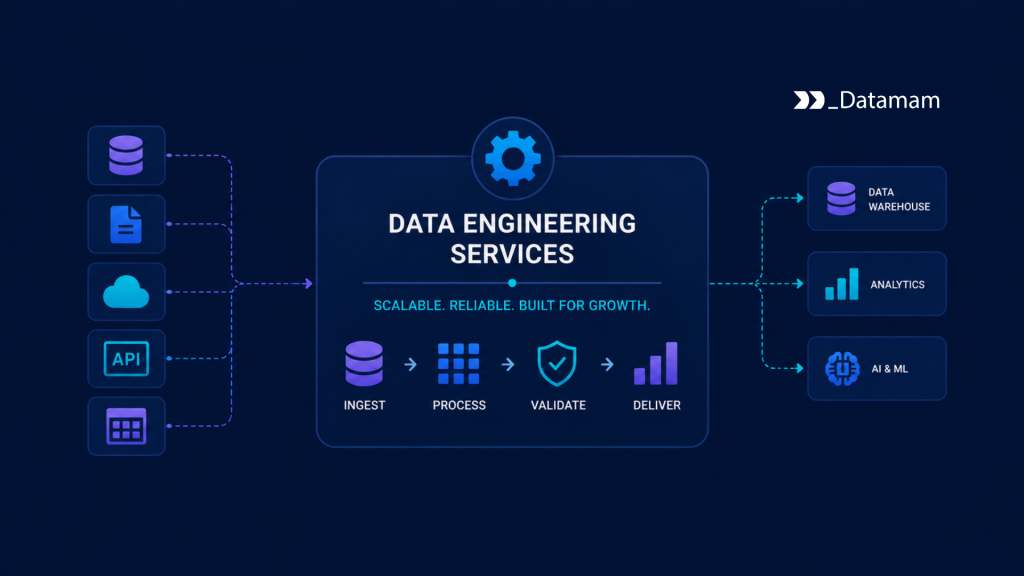
At enterprise scale, Data Engineering Services are not defined by individual pipelines. They are defined by an operating model that manages the full lifecycle of data movement, preparation, storage, orchestration, delivery, monitoring, and governance. Each layer has a specific function. If one layer is weak, downstream systems inherit quality issues, latency, cost inefficiency, or operational fragility. Data pipeline engineering must therefore be designed as infrastructure, not as isolated technical delivery.
| Operating Layer | Core Responsibility | Enterprise Output |
| Ingestion Layer | Bring data from internal systems, external sources, APIs, files, events, databases, and platforms | Controlled source-to-platform data movement |
| Processing Layer | Clean, transform, enrich, normalize, deduplicate, and prepare data for use | Structured and usable enterprise datasets |
| Pipeline Layer | Orchestrate recurring workflows, dependencies, retries, and execution schedules | Repeatable data movement and transformation |
| Storage Layer | Organize data in warehouses, lakes, lakehouses, marts, and operational stores | Scalable and accessible data environments |
| Delivery Layer | Serve data to analytics, AI, applications, APIs, dashboards, and business systems | Consumption-ready data products and outputs |
| Monitoring and Governance Layer | Track quality, freshness, lineage, access, failures, cost, and ownership | Reliable and accountable data operations |
Ingestion Layer for Source-to-Platform Data Movement
The ingestion layer controls how data enters the enterprise environment. Inputs may come from CRM, ERP, billing, product systems, customer platforms, operational databases, third-party APIs, external data feeds, files, event streams, public sources, and cloud storage. Ingestion design must account for source ownership, authentication, frequency, format, schema volatility, record volume, and failure behavior. Without controlled ingestion, downstream systems inherit uncertainty from the first stage of the data lifecycle.
Processing Layer for Transformation, Enrichment, and Preparation
The processing layer converts raw or semi-structured inputs into usable datasets. This may include cleaning, joining, deduplication, field standardization, taxonomy alignment, enrichment, validation, type conversion, timestamp normalization, and business rule application. However, processing should not become undocumented manipulation. It should preserve lineage and follow approved transformation logic. Strong processing creates trust because business users can understand how data changed between source and consumption.
Pipeline Layer for Workflow Orchestration and Repeatability
The pipeline layer orchestrates recurring data workflows. It defines job dependencies, schedules, retries, alerts, versioning, testing, and execution order. Strong pipeline design ensures that data refreshes are predictable and recoverable. Weak pipeline design creates hidden fragility, especially when workflows depend on multiple sources, transformations, and destinations. Data pipeline engineering becomes especially important when reporting, AI, and operations depend on recurring data availability rather than one-time analysis.
Storage Layer for Warehouses, Lakes, and Operational Data Stores
The storage layer organizes data for different types of use. Warehouses support structured analytics and reporting. Lakes and lakehouses support larger, varied, and sometimes less structured data. Operational data stores support application or workflow consumption. Feature stores may support machine learning environments. Cloud data engineering must decide where data should live, how it should be partitioned, what retention rules apply, how access is controlled, and how storage patterns affect cost and performance.
Delivery Layer for Analytics, AI, and Business System Consumption
The delivery layer makes engineered data available to downstream consumers. These consumers may include dashboards, BI tools, AI models, data science notebooks, APIs, applications, compliance systems, executive reports, and operational platforms. Delivery design should account for format, cadence, permissions, freshness, and business usage. Data engineering solutions create value when data is delivered in forms that consumers can actually use, not only stored in technically accessible locations.
Monitoring and Governance Layer for Reliability, Lineage, and Control
The monitoring and governance layer ensures that data engineering remains reliable over time. It tracks pipeline health, data freshness, schema changes, quality exceptions, volume anomalies, access events, lineage, ownership, and cost patterns. KPMG’s 2025 analysis of data governance in the age of AI notes that 62% of organizations believe a lack of data governance is the main data challenge inhibiting AI initiatives. That makes monitoring and governance central to engineering maturity, not optional oversight.
Enterprise Risks Created by Weak Data Engineering Operations
Weak data engineering operations create risks that extend across business functions. They affect reporting reliability, AI model performance, operational workflows, compliance posture, infrastructure costs, and executive trust. The risk is structural. When engineering standards are weak, every downstream team must compensate with manual cleanup, duplicated logic, local scripts, spreadsheet reconciliation, and repeated investigation. The enterprise may have data assets, but it does not have dependable data operations.
Decision Latency from Slow or Unreliable Pipelines
Decision latency occurs when data is delayed, incomplete, or unreliable. A dashboard may refresh late. A risk model may wait for updated inputs. A pricing team may act after the market has already moved. An operations team may rely on yesterday’s data because the current pipeline failed. In these cases, the issue is not lack of data. It is weak engineering reliability. Enterprise data engineering reduces decision latency by aligning pipeline performance with the cadence of business decisions.
AI Degradation from Poor Data Preparation Foundations
AI degradation often begins before the model is trained. If features are inconsistent, source coverage is incomplete, labels are misaligned, transformations change without tracking, or data freshness is weak, model performance becomes unstable. McKinsey’s 2025 State of AI survey found that many organizations have not yet scaled AI across the enterprise despite rising adoption. Data engineering foundations are one practical reason AI can remain stuck in pilots rather than moving into production.
Reporting Inconsistency from Fragmented Data Logic
Reporting inconsistency appears when different teams define metrics, transformations, and data sources differently. Revenue, customer count, churn, product availability, risk exposure, and operational performance can all vary across reports when logic is fragmented. This damages executive confidence and slows decision-making. Data engineering consulting can help identify where definitions diverge, where transformations duplicate each other, and where a governed data model is needed to restore consistency.
Cost Escalation from Uncontrolled Pipeline Growth
Cost escalation becomes common when pipelines expand without standards. Cloud compute jobs run inefficiently. Duplicated datasets increase storage cost. Multiple teams process the same data separately. Poorly designed transformations consume unnecessary resources. Streaming workflows may operate at higher frequency than the business requires. Cloud data engineering must therefore include cost awareness. Engineering quality is not only about reliability. It is also about controlling the economics of data operations.
Operational Fragility from Weak Engineering Standards
Operational fragility appears when pipelines depend on undocumented scripts, informal ownership, fragile schedules, unclear dependencies, and manual intervention. When a source schema changes, downstream reports break. When a developer leaves, knowledge disappears. Also, when a new system is added, hidden dependencies emerge. Gartner’s 2025 prediction that over 40% of agentic AI projects will be canceled by the end of 2027 cites escalating costs, unclear value, and inadequate risk controls. Weak data engineering creates similar failure conditions for AI and automation initiatives.
Build vs Buy Decisions for Data Engineering Services
The build versus buy decision for Data Engineering Services should be evaluated as an operating model decision. Internal teams may be appropriate when data flows are narrow, systems are stable, and engineering capacity is mature. However, enterprise data engineering often requires broader capability across ingestion, transformation, cloud architecture, orchestration, monitoring, governance, and support. The decision should not focus only on whether internal teams can build pipelines. It should assess whether they can operate reliable data infrastructure at scale.
| Evaluation Area | Internal Data Engineering | Managed Data Engineering Capability |
| Best Fit | Narrow workflows, stable systems, mature internal engineering capacity | Multi-source, cloud-based, governed, recurring, and scalable data operations |
| Cost Profile | Lower visible start cost, higher hidden maintenance and backlog burden | Structured cost with delivery accountability and operational controls |
| Control | Full internal ownership of architecture, code, and standards | Shared operating model with documented governance and handoff |
| Scalability | Limited by internal hiring, platform maturity, and backlog capacity | Designed for expansion across sources, platforms, teams, and use cases |
| Risk Ownership | Pipeline reliability, monitoring, cost, and governance remain internal | Risk is distributed through standards, service expectations, and managed execution |
When Internal Data Engineering Operations Are Rational
Internal data engineering operations are rational when the organization has strong platform maturity, stable data requirements, clear ownership, and enough engineering capacity to maintain pipelines over time. Internal ownership may also be appropriate when business logic is highly proprietary or deeply embedded in core systems. For example, a mature enterprise data platform team may manage core warehouse models and internal operational pipelines directly. However, internal ownership still requires standards, documentation, testing, monitoring, and governance.
Where Internal Data Engineering Breaks at Scale
Internal data engineering breaks at scale when the backlog grows faster than team capacity. Business units request new sources, dashboards, models, feeds, and transformations. AI teams need more prepared datasets. Compliance teams need more lineage. Operations teams need faster refreshes. Meanwhile, engineers spend increasing time maintaining existing pipelines. Deloitte’s 2026 State of AI in the Enterprise report notes that worker access to AI rose by 50% in 2025 and that the number of companies with at least 40% of AI projects in production is expected to double in six months. That acceleration increases pressure on data engineering capacity.
Total Cost Beyond Pipelines, Cloud Tools, and Engineering Hours
The total cost of data engineering extends beyond engineering hours, cloud tools, and pipeline implementation. It includes architecture planning, data profiling, transformation design, QA, monitoring, documentation, incident response, access control, optimization, stakeholder support, platform administration, and ongoing refactoring. A pipeline that is inexpensive to build but expensive to maintain is not efficient. Data engineering solutions should be evaluated by lifecycle economics, not only initial delivery speed.
Risk Allocation Across Reliability, Governance, and Platform Continuity
Risk allocation determines who is responsible when pipelines fail, data arrives late, transformations change, cloud costs rise, access controls break, or downstream systems lose trust. Internal builds concentrate that responsibility inside the organization. Managed models distribute responsibility through standards, monitoring, documentation, operating controls, and service expectations. A data engineering company becomes valuable when it reduces operational uncertainty and gives leadership clearer accountability across reliability, governance, and continuity.
Data Engineering Platforms vs Managed Data Engineering Infrastructure
Data engineering platforms are useful, but they are not the same as managed engineering infrastructure. A platform may provide storage, compute, orchestration, transformation frameworks, monitoring features, or cataloging tools. However, tools do not automatically create architecture, pipeline standards, ownership, quality rules, governance workflows, or business alignment. Platform access gives teams capability. Managed data engineering infrastructure creates operating discipline around how those capabilities are used.
Why Platform Access Is Not the Same as Engineering Maturity
Platform access means teams can build. Engineering maturity means teams can build reliably, govern consistently, monitor continuously, and scale efficiently. A cloud warehouse does not define data ownership. An orchestration tool does not decide business priority. A transformation framework does not guarantee semantic consistency. A monitoring dashboard does not resolve accountability. Enterprises often discover that tool adoption increases activity but does not automatically reduce fragmentation. Engineering maturity comes from standards, design, and operational control.
The Ownership Gap Between Tools, Pipelines, and Operational Outcomes
The ownership gap appears when different teams own parts of the data lifecycle, but no team owns end-to-end outcomes. Platform teams own infrastructure. Data engineers own pipelines. Analysts own reporting logic. Data scientists own features. Security owns access. Business teams own decisions. Without a clear operating model, failures move between teams instead of being resolved. Managed data engineering infrastructure reduces this gap by defining responsibilities across architecture, pipeline delivery, monitoring, governance, and handoff.
Industry Applications of Data Engineering Services
Industry applications vary because each sector has different data sources, operating requirements, governance exposure, and decision cadence. AI and machine learning programs require model-ready and feature-ready pipelines. Financial services require governed analytics and risk data flows. Healthcare requires privacy-aware data engineering across clinical, operational, and research environments. Customer 360 programs require identity alignment and cross-system preparation. The engineering model remains consistent, but validation, governance, latency, and delivery requirements change by industry.
AI and Machine Learning Data Infrastructure
AI and machine learning data infrastructure depends on reliable data ingestion, transformation, feature preparation, versioning, monitoring, and delivery. Models require consistent inputs across training, evaluation, deployment, and monitoring. Weak engineering creates feature drift, stale data, incomplete coverage, and poor reproducibility. Data pipeline engineering is therefore central to AI readiness. In practical enterprise settings, stronger engineering foundations can reduce model preparation delays by 20-40%, especially where teams previously relied on manual extracts or fragmented feature logic.
Financial Risk and Analytics Data Engineering
Financial risk and analytics data engineering must support customer records, transactions, market data, regulatory inputs, exposure calculations, fraud signals, portfolio reporting, and audit trails. These environments require strong lineage, access control, reconciliation, and data quality checks. Reporting errors or late feeds can affect risk decisions and compliance evidence. Enterprise data engineering helps reduce this risk by creating governed pipelines that preserve accuracy, timing, and traceability across analytical workflows.
Healthcare Analytics and Clinical Data Operations
Healthcare analytics and clinical data operations require careful engineering across patient records, claims, provider data, clinical systems, research datasets, scheduling systems, and operational metrics. Privacy, security, lineage, and data quality are critical. Data engineering solutions must support controlled access, transformation documentation, identifier management, and reliable delivery into analytics or operational environments. In healthcare, engineering quality affects not only reporting efficiency, but also trust in data used for care operations, research, and administrative decisions.
Customer 360 and Unified Data Platforms
Customer 360 programs require data engineering across CRM, billing, support, product usage, marketing automation, transaction history, external enrichment, and identity systems. The engineering challenge is not only combining data. It is resolving identifiers, preserving history, applying business rules, and delivering usable customer views to analytics and operational teams. Without strong engineering, customer data remains fragmented across systems. With disciplined engineering, unified customer data can support segmentation, retention, sales operations, support prioritization, and AI-enabled personalization. Web scraping tools for data extraction can play a crucial role in gathering insights from various sources. These tools enable businesses to aggregate information that can be leveraged for enhanced decision-making and strategic planning. By effectively harnessing web scraping tools, companies can ensure they are equipped with comprehensive data that drives innovation and growth.

Business Outcomes from Enterprise Data Engineering Infrastructure
The business value of enterprise data engineering infrastructure should be measured by reliability, speed, scalability, governance, reduced rework, and downstream usability. These outcomes depend on source complexity, platform maturity, operating discipline, and adoption by business teams. However, when engineering infrastructure is designed well, the organization reduces friction across analytics, AI, operations, and compliance. Data engineering creates leverage because every downstream data product depends on it.
Faster Data Availability Across Analytics and Operations
Data availability improves when pipelines are designed for repeatability and aligned with business cadence. Teams receive current datasets without waiting for manual exports, one-off engineering requests, or broken refreshes. Analytics teams can build faster. AI teams can iterate sooner. Operations teams can respond with current information. For recurring workflows, mature data engineering can reduce delivery delays by 20-40%, especially where teams previously relied on manual preparation or fragmented pipeline ownership.
Higher Reliability Across Recurring Data Pipelines
Reliability improves when pipelines include monitoring, testing, retries, freshness checks, and clear ownership. Recurring workflows should not depend on users discovering failures. Engineering infrastructure should detect incomplete loads, schema changes, volume anomalies, transformation errors, and downstream delivery issues. This creates trust in reports, models, feeds, and operational data products. Reliability matters because data systems increasingly support decisions that are repeated daily, hourly, or continuously.
Lower Engineering Rework and Operational Maintenance
Engineering rework declines when pipelines are standardized and documented. Teams can reuse patterns for ingestion, transformation, validation, monitoring, and delivery. Duplicate scripts and inconsistent logic are reduced. Engineers spend less time fixing avoidable failures and more time improving platform capability. Business teams spend less time explaining the same data requirements repeatedly. The result is lower operational maintenance and better use of specialized engineering capacity.
Stronger Governance Across Data Movement and Transformation
Governance improves when engineering workflows document where data came from, how it changed, who owns it, and who can access it. OECD’s data governance guidance defines data governance as the technical, policy, and regulatory frameworks used to manage data across its value cycle. Data engineering is where those frameworks become concrete through lineage, access controls, quality rules, metadata, retention logic, and transformation records.
More Reliable Scaling Across Platforms, Teams, and Use Cases
Scaling becomes more reliable when data engineering patterns are reusable across sources, platforms, teams, and use cases. A mature model can support new data products, new AI workflows, new external sources, new dashboards, and new operating systems without rebuilding the foundation from scratch. Without reusable engineering patterns, each new initiative becomes custom work. With disciplined infrastructure, new initiatives benefit from existing standards and operating controls.
Data Engineering Services as an Operational Control Point
Data engineering is an operational control point because it determines whether enterprise data systems behave predictably. Also, data strategy may define priorities. Data governance may define rules. Data platforms may provide technology. However, engineering workflows determine whether data actually moves, transforms, stores, and delivers according to those priorities and rules. In this context, Data Engineering Services connect executive intent with operational execution.
Why Pipeline Reliability Shapes Business Responsiveness
Pipeline reliability shapes business responsiveness because teams can only act on data that arrives correctly and on time. A late pipeline can delay pricing changes, risk reviews, customer outreach, inventory analysis, compliance reporting, or model retraining. A failed transformation can distort KPIs. A missing source can weaken external market visibility. Therefore, pipeline reliability should be measured as a business capability, not only a technical metric. Data engineering quality directly affects response speed.
How Engineering Discipline Supports AI and Analytics Readiness
Engineering discipline supports AI and analytics readiness by creating stable inputs, documented transformations, consistent definitions, and trusted delivery paths. AI systems require data that is fresh, representative, traceable, and reproducible. Analytics systems require governed metrics and stable refresh cycles. Gartner’s 2025 analytics outlook predicts that 75% of new analytics content will be contextualized for intelligent applications through generative AI by 2027. That shift requires engineering foundations capable of supporting more dynamic and automated analytics environments.
Commercial Evaluation Criteria for a Data Engineering Company
Enterprise buyers should evaluate a data engineering company by operating discipline, not only technical skill. The provider should demonstrate how it designs pipelines, manages cloud architectures, validates transformations, monitors reliability, controls access, documents lineage, and supports operational handoff. It should also understand how engineering decisions affect business outcomes. A strong partner reduces ambiguity across architecture, delivery, governance, and continuity.
Evidence of Pipeline Design and Delivery Discipline
A serious data engineering capability should show evidence of structured pipeline design and delivery discipline. This includes source analysis, data profiling, transformation rules, orchestration design, validation logic, testing approach, monitoring setup, and ownership documentation. Pipeline logic should be reviewable by technical and business stakeholders. Without this discipline, engineering work becomes hidden in scripts, tools, or individual knowledge. That creates long-term maintenance and governance risk.
Monitoring, Reliability, and Failure Management Standards
Monitoring, reliability, and failure management standards should be part of the engineering model from the beginning. Buyers should assess how pipeline failures are detected, how freshness is measured, how retries work, how schema changes are flagged, how volume anomalies are reviewed, and how incidents are escalated. Strong failure management prevents silent degradation. It also gives business teams confidence that data workflows are actively managed rather than assumed to be functioning.
Security, Governance, and Operational Handoff Quality
Security, governance, and operational handoff quality determine whether engineering infrastructure can scale safely. Buyers should expect access controls, lineage records, transformation documentation, retention rules, audit logs, runbooks, ownership assignments, and internal handoff materials. Handoff should provide enough clarity for internal teams to understand how pipelines operate, where failures appear, and who owns resolution. Durable engineering infrastructure depends on documentation and accountability as much as code.
Conclusion: Data Engineering Services as Enterprise Data Operations Infrastructure
Data Engineering Services have become enterprise data operations infrastructure because modern organizations depend on reliable data movement, transformation, storage, delivery, monitoring, and governance. Analytics, AI, reporting, external data programs, cloud platforms, and operational workflows all depend on the engineering layer that prepares data for use.
The enterprise advantage is not simply building more pipelines. It is creating governed, scalable, monitored, and cost-aware data operations that business teams can trust. Strong data engineering infrastructure reduces decision latency, improves AI readiness, lowers maintenance burden, strengthens governance, and supports reliable scaling across platforms and use cases.
Ultimately, enterprise data value depends on engineering quality. Organizations that treat data engineering as infrastructure build stronger foundations for analytics, automation, compliance, customer intelligence, financial reporting, and long-term data scalability.
Strategic Consultation for Enterprise Data Engineering Readiness
A strategic consultation should clarify whether the organization’s current data engineering model can support its data operations roadmap. Many enterprises already have cloud platforms, dashboards, orchestration tools, warehouses, data lakes, and internal teams, but still lack reliable pipeline standards, monitoring, governance, ownership, and cost discipline. The assessment should identify where engineering gaps, pipeline fragility, platform complexity, or unclear ownership limit downstream value.
Assessing Pipeline, Platform, and Governance Gaps
A data engineering readiness assessment should begin by mapping critical data flows, platforms, source systems, transformation logic, downstream consumers, refresh requirements, access controls, and governance expectations. This includes reviewing pipeline reliability, monitoring coverage, data quality checks, lineage visibility, cost patterns, and ownership. The assessment should identify where data breaks, slows, duplicates, or becomes difficult to trust. From there, leadership can distinguish a platform issue from an engineering operating model issue.
Evaluating Internal, External, and Managed Data Engineering Models
The final step is evaluating whether data engineering should remain internal, be supported by external specialists, or operate through a managed engineering model. The decision should consider platform complexity, internal capacity, data volume, AI requirements, governance exposure, cost control, and required speed to delivery. Submit an inquiry when the objective is to clarify the right engineering operating model before expanding data products, cloud workloads, AI pipelines, or enterprise analytics investments.