Key Takeaways
- Parallel Run Design allows legacy and target systems to operate side by side so migration teams can compare outputs before cutover.
- Parallel run testing helps detect mismatched records, missing fields, incorrect transformations, timing differences, and downstream reporting variance.
- A parallel system run should include ownership, comparison rules, tolerance thresholds, exception handling, reconciliation evidence, and go-live decision criteria.
- Migration parallel testing reduces cutover risk by proving whether the target system can support real business operations before the legacy system is retired.
- Strong parallel run architecture requires test data control, operational monitoring, user validation, defect routing, audit trails, and formal readiness review.
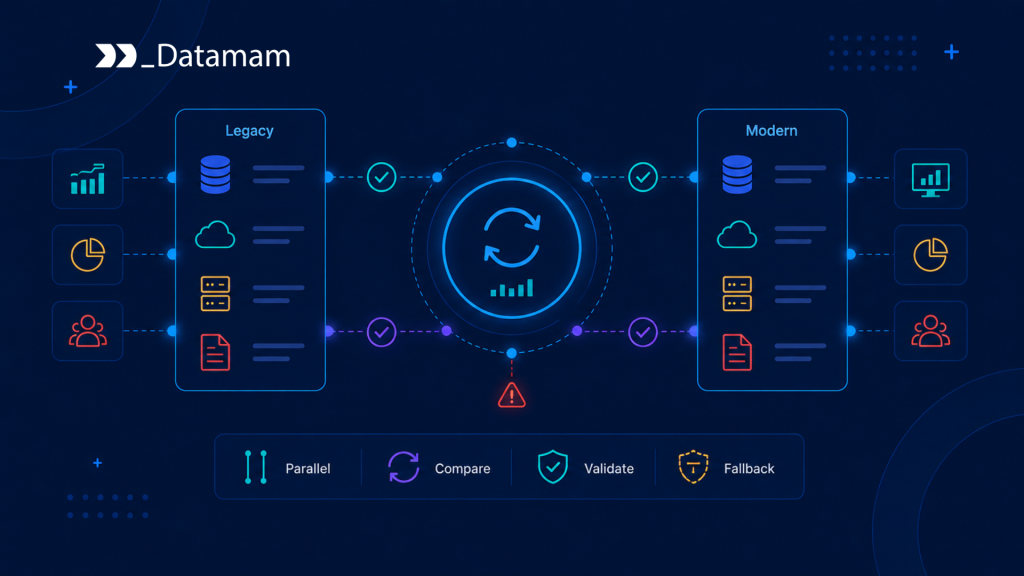
Enterprise data migration becomes high risk when the new platform is trusted before its outputs are proven. A migration job may load successfully, records may appear in the target system, and basic row counts may match. However, customers may classify differently, product attributes may behave differently, finance balances may not reconcile, or operational reports may produce different results from the legacy system.
Parallel Run Design creates a controlled comparison period between the legacy environment and the target platform. Instead of assuming the new system is ready after migration testing, teams run both environments long enough to compare results, identify mismatches, resolve defects, and decide whether cutover is safe.
In high-risk data migration environments, parallel running is not a testing formality. It is a cutover risk reduction mechanism that protects business continuity, reporting trust, operational workflows, and governance confidence.
Why Parallel Run Design Matters in Migration Programs
Parallel Run Design matters because migration success cannot be measured only by whether data moved. The target system must produce outputs that are operationally acceptable when compared with the legacy system or approved target-state rules.
Deloitte’s enterprise data strategy and architecture guidance notes that migration to an integrated platform requires sound data architecture and alignment between business, technology, and data objectives. A parallel run tests that alignment under real operating conditions, not only in mapping documents or migration scripts. Enterprise system modernization strategies are crucial for ensuring that new systems meet the evolving demands of businesses. By focusing on these strategies, organizations can enhance their adaptability and responsiveness to market changes. Implementing a well-thought-out modernization plan ultimately leads to improved operational efficiency and a stronger competitive edge.
Why Migration Testing Alone Is Not Enough
Standard migration testing usually confirms whether data can be extracted, transformed, loaded, and validated against defined rules. That is necessary, but not sufficient for high-risk modernization programs.
Parallel run testing asks a different question: when both systems operate against comparable inputs, do they produce acceptable outputs? This matters because many migration defects do not appear at the field level. They appear in reports, calculations, workflow states, user screens, downstream exports, and operational decisions.
For example, a migrated customer record may pass validation but still produce a different billing treatment. A product record may load into the target platform but publish differently by channel. A finance migration may pass row counts but produce account-level variance in close reporting.
How Parallel Running Reduces Cutover Risk
Parallel running reduces cutover risk by giving teams evidence before the legacy system is retired. It shows whether target outputs are accurate, whether business users can operate in the new environment, whether downstream systems behave correctly, and whether unresolved defects are acceptable.
This is especially important when migration supports ERP, CRM, finance, healthcare, ecommerce, customer support, cloud warehouse, or product platform transitions. In those environments, cutover failure affects business operations, not only technical teams.
Gartner’s 2025 data and analytics trends highlight that data and analytics are becoming more embedded across enterprise operations. As data becomes more operationally central, migration cutover decisions need evidence from real system behavior, not only successful technical loads.
Parallel Run Design for High-Risk Migrations
A parallel run design defines how the legacy and target systems will be compared before cutover. It should specify scope, data domains, timing, comparison rules, tolerance levels, ownership, defect handling, and readiness criteria.
The design should be created before migration execution. If teams decide how to compare systems after testing begins, the parallel run often becomes inconsistent and difficult to govern.
Defining Parallel Run Scope
Parallel run scope should focus on high-risk domains. Not every table, field, or report requires the same level of comparison. Customer identity, billing records, finance balances, product publication fields, healthcare records, support history, inventory values, and compliance outputs may require deeper testing than descriptive reference fields.
The scope should define which entities are included, which reports are compared, which workflows are simulated, which downstream systems are included, and which differences require escalation.
In practice, parallel run scope should be risk-based. Critical operational and financial data should receive stronger comparison controls than low-impact historical attributes.
Selecting Comparison Periods and Operating Windows
A parallel system run should cover enough time to test normal business behavior. A one-day test may miss weekly, monthly, seasonal, or close-cycle logic. A finance migration may need period-end comparison. A support system migration may need ticket lifecycle comparison. An ecommerce migration may need product, inventory, order, and return events across active selling periods.
The comparison period should also account for data volatility. Highly active systems may reveal defects quickly. Low-volume systems may require a longer run to test meaningful scenarios.
The goal is not to run systems in parallel forever. The goal is to run them long enough to generate trustworthy evidence.
Establishing Success Criteria Before Testing
Parallel run success criteria should be defined before testing starts. Teams should not decide after seeing results whether differences are acceptable.
Success criteria may include row count alignment, field-level match rates, financial tolerance thresholds, workflow completion rates, report variance limits, exception volume, user acceptance results, and unresolved defect severity.
A simple comparison rule can look like this:
PARALLEL_RUN_RULES = {
"allowed_variance": {
"invoice_total": 0.01,
},
"blocked_statuses": ["unmapped", "validation_failed", "manual_review_required"],
}


def evaluate_parallel_record(legacy_record, target_record):

    if not legacy_record.get("legacy_id") or not target_record.get("target_id"):

        return {"matched": False, "reason": "missing_identifier"}


    if target_record.get("migration_status") in PARALLEL_RUN_RULES["blocked_statuses"]:

        return {"matched": False, "reason": "blocked_target_status"}


    legacy_total = legacy_record.get("invoice_total", 0)

    target_total = target_record.get("invoice_total", 0)


    if abs(legacy_total - target_total) > PARALLEL_RUN_RULES["allowed_variance"]["invoice_total"]:

        return {"matched": False, "reason": "invoice_total_variance"}


    return {"matched": True}
This follows the same structure as the previous snippets: a rule object, a comparison function, and a clear result. It shows how parallel testing can move from informal review to controlled validation logic.
Parallel Run Testing Across Data Domains
Parallel run testing should compare the target system against legacy outputs, approved target-state rules, and downstream business expectations. The comparison must go beyond technical row counts.
High-risk migrations need several layers of parallel validation.
Comparing Record Counts and Completeness
Record count comparison confirms whether the expected number of records moved. However, it should be segmented by data domain, status, region, time period, business unit, and record type. A total count can match while important subgroups are missing.
Completeness checks should also verify required fields, relationship integrity, parent-child links, and target acceptance status. For example, customer records may load successfully while associated billing profiles or contacts fail.
Parallel run testing should explain every material difference. Some differences may be intentional, such as excluding test records or deprecated entities. Others may indicate migration defects.
Comparing Calculations, Balances, and Derived Outputs
Many migration defects appear in calculated outputs. Finance totals, inventory balances, product availability, customer segmentation, support SLA status, and dashboard metrics may change because the target system applies different logic.
Parallel run testing should compare derived outputs, not just migrated fields. If a finance system produces different totals, the team must determine whether the difference comes from mapping, transformation, rounding, tax logic, timing, or target configuration.
For high-risk programs, tolerance thresholds should be approved by business owners. Engineering teams should not decide financial or operational tolerance alone.
Comparing Operational Workflows
Operational workflows should be tested in both systems where possible. This may include order creation, billing updates, customer lookup, product publishing, ticket routing, inventory adjustment, claims processing, or report generation.
A workflow may pass field validation but still fail operational use. For example, a migrated product may exist in the target system but fail channel publication because required marketplace attributes were not mapped. A migrated customer may exist but fail billing because tax region logic differs.
Parallel run design should include workflow-level evidence before cutover.
Parallel System Run Architecture
A parallel system run requires architecture that can support comparison without corrupting production operations. The legacy system, target system, migration pipelines, reconciliation tables, monitoring dashboards, and defect workflows must be coordinated.
This architecture should protect the integrity of both environments.
Managing Inputs Across Legacy and Target Systems
Parallel testing works only when the inputs are comparable. If the legacy system receives updates that the target system does not, differences may reflect timing rather than migration failure. If the target system receives transformed records that the legacy system never had, comparison becomes unclear.
Input control may involve frozen snapshots, synchronized extracts, controlled test windows, or replayed production-like events. The chosen approach depends on migration risk and system constraints.
For high-volume or real-time systems, teams may need to compare time-bounded windows rather than entire datasets. The important point is that input conditions must be documented.
Building Reconciliation Tables and Crosswalks
Reconciliation tables connect legacy records to target records. They store legacy IDs, target IDs, match rules, migration batch, validation status, exception reason, and approval status. These tables allow teams to trace differences across systems.
A lightweight reconciliation pattern can look like this:
def build_parallel_run_result(legacy_record, target_record, comparison):

    return {

        "legacy_id": legacy_record.get("legacy_id"),

        "target_id": target_record.get("target_id"),

        "entity_type": legacy_record.get("entity_type"),

        "comparison_status": comparison.get("matched"),

        "variance_reason": comparison.get("reason"),

        "legacy_updated_at": legacy_record.get("updated_at"),

        "target_updated_at": target_record.get("updated_at"),

    }


legacy_record = {

    "legacy_id": "LEG-88421",

    "entity_type": "invoice",

    "invoice_total": 1294.75,

    "updated_at": "2026-06-17T10:30:00Z",

}


target_record = {

    "target_id": "TGT-44890",

    "invoice_total": 1294.75,

    "updated_at": "2026-06-17T10:35:00Z",

}


comparison = {"matched": True, "reason": None}


parallel_result = build_parallel_run_result(legacy_record, target_record, comparison)
This snippet shows the evidence layer behind a parallel run. The output is not only pass or fail. It preserves identifiers, entity type, timing, status, and variance reason for reconciliation and audit.
Separating Test Evidence from Production Data
Parallel run evidence should be stored separately from operational production data. Reconciliation outputs, test exceptions, comparison results, and defect logs should not pollute the target platform’s live business records.
This separation helps teams preserve clean operational environments while still maintaining audit evidence. It also supports repeatable comparison across migration waves.
In practice, parallel run architecture often includes staging tables, reconciliation datasets, exception queues, dashboards, and controlled review workflows. Data mapping strategies for migration are crucial for ensuring that data integrity is maintained throughout the process. Teams must identify the relationships between legacy systems and the target data model to facilitate smooth transitions. By leveraging effective data mapping, organizations can mitigate risks associated with data loss or corruption during migration.
Migration Parallel Testing and Exception Handling
Migration parallel testing produces differences. The important question is whether those differences are expected, explainable, and acceptable.
Exception handling determines whether a parallel run improves readiness or becomes a long list of unresolved findings.
Classifying Parallel Run Exceptions
Exceptions should be classified consistently. Common categories include missing record, unmatched identifier, field variance, calculation variance, timing difference, transformation defect, target configuration difference, duplicate record, or manual review required.
Classification helps assign ownership. A mapping defect may go to data migration. A target configuration issue may go to the platform team. A business-rule disagreement may go to the domain owner. A timing difference may go to migration operations.
Without classification, every variance becomes a generic defect, and teams lose time deciding who should resolve it.
Routing Defects to the Right Owners
Parallel run findings should route to owners based on failure type. For example:

def route_parallel_exception(exception):

    if exception["type"] == "missing_record":

        return {"owner": "migration_operations", "action": "investigate_load_gap"}


    if exception["type"] == "field_variance":

        return {"owner": "data_mapping_team", "action": "review_mapping_rule"}


    if exception["type"] == "calculation_variance":

        return {"owner": "business_domain_owner", "action": "validate_business_logic"}


    if exception["type"] == "target_configuration":

        return {"owner": "platform_owner", "action": "review_target_setup"}


    return {"owner": "cutover_governance", "action": "manual_review"}
This keeps the snippet close to the earlier pattern: inspect the condition, route it to the correct owner, and avoid unresolved operational ambiguity.
Managing Defect Severity and Cutover Impact
Not all exceptions should block cutover. Some differences may be low-risk, explainable, or expected because the target system has improved business rules. Others should block go-live.
Severity should be defined before review. A missing active customer, unmatched finance transaction, broken product relationship, or incorrect healthcare record may be critical. A formatting difference in a nonessential descriptive field may be minor.
Parallel run defect management should connect every unresolved exception to cutover readiness. If critical exceptions remain open, go-live should be delayed or formally risk-accepted.
Cutover Risk Reduction Through Parallel Runs
Cutover risk reduction depends on evidence. Parallel runs provide evidence that the target system can operate safely before the legacy system is retired.
The value of a parallel run is not that both systems are identical. The value is that differences are known, classified, resolved, or accepted.
Defining Go-Live Readiness Gates
Go-live readiness gates should combine technical, business, and governance criteria. These may include migration completion, reconciliation pass rate, critical defect closure, business user approval, downstream report validation, operational workflow testing, and rollback readiness.
NIST’s incident response guidance emphasizes preparation, evidence collection, analysis, prioritization, response, and recovery. Migration cutover planning benefits from the same discipline because teams need evidence, severity classification, and recovery paths before high-risk transition decisions are made. Executive data migration strategies play a vital role in ensuring smooth transitions. Effective planning and execution of these strategies can minimize downtime and maximize data integrity. Organizations should continuously assess their approaches to data migration to adapt to evolving business needs and technological advancements.
Planning Rollback and Contingency Paths
Parallel run design should include rollback and contingency thinking. If target outputs fail comparison, teams need to know whether they can rerun migration batches, correct mappings, delay cutover, keep legacy read-only access, or activate a fallback process.
Rollback planning is not a sign of weak migration design. It is evidence that the migration is being managed as an operational risk event.
High-risk cutovers should not rely on optimism. They should rely on tested contingency paths.
Protecting Business Users During Transition
Business users need stable operating guidance during parallel runs. They should know which system is authoritative, which outputs are being compared, how discrepancies are reported, and when the target system becomes the source of record.
If users interact with both systems without clear rules, parallel running can create confusion. For example, users may update records in one system but not the other. Reports may show different values. Teams may make decisions from the wrong environment.
Parallel run design should define user access, data entry rules, reporting guidance, and escalation paths during the comparison period.
Monitoring and Governance During Parallel Runs
Parallel run monitoring should show comparison progress, defect volume, match rates, unresolved exceptions, test coverage, business approvals, and cutover readiness.
Governance ensures that the evidence is reviewed and acted on.
Tracking Match Rates, Variances, and Trend Lines
A parallel run dashboard should track match rate by entity type, critical field, business unit, region, system, and migration wave. It should show whether defects are decreasing across test cycles or repeating.
Trend lines matter. A one-time mismatch may be resolved. A repeating class of variance may indicate a deeper mapping, configuration, or business-rule issue.
Deloitte’s 24/7 data pipeline guidance emphasizes real-time tracking of latency, freshness, and drift in always-on data platforms. Parallel migration environments need similar visibility into drift between legacy and target outputs during the transition period.
Maintaining Audit Trails for Parallel Run Decisions
Audit trails should capture comparison rules, test windows, source extracts, target loads, reconciliation results, defects, approvals, risk acceptances, and go-live decisions.
This matters when migration outcomes are challenged after cutover. Teams should be able to show what was tested, what matched, what failed, who approved exceptions, and why the cutover decision was made.
Auditability turns parallel run testing into governance evidence.
Connecting Parallel Run Findings to Governance Review
The OECD’s data governance work describes governance as the technical, policy, and regulatory structures needed to manage data across its value cycle. Parallel Run Design fits this model because it governs how data is compared, validated, accepted, and transitioned from legacy to target systems.
Governance review should include business owners, migration leads, platform owners, data governance, risk, compliance, and operational teams where appropriate. The group should review unresolved exceptions, readiness evidence, rollback options, and post-cutover monitoring plans.
This prevents cutover from becoming a purely technical decision.
Conclusion: Turning Parallel Runs into Cutover Control Infrastructure
Parallel Run Design helps enterprises reduce migration risk by proving target-system readiness before legacy systems are retired. It connects parallel run testing, parallel system run architecture, migration parallel testing, reconciliation, defect routing, readiness gates, rollback planning, and governance review.
Strong parallel run design protects business operations from silent migration defects. It shows whether migrated data produces acceptable records, reports, calculations, workflows, and downstream outputs under realistic conditions.
The capability matters because high-risk migrations fail when confidence is assumed instead of evidenced. A target system may load data successfully and still fail operational comparison. When parallel runs are structured, monitored, and auditable, cutover decisions become evidence-based rather than schedule-driven.
A structured review can help evaluate whether current migration workflows have reliable Parallel Run Design, parallel run testing, parallel system run controls, migration parallel testing, and cutover risk reduction evidence. You can run an external data infrastructure audit with our team to review your current setup and understand what is required to build reliable, enterprise-scale data migration infrastructure.