Key Takeaways
- Migration Data Mapping defines how fields, records, identifiers, formats, business rules, and relationships move from legacy systems into target platforms.
- A migration mapping strategy should connect source structures, target schemas, transformation rules, ownership, validation logic, and exception handling.
- Source-target mapping must account for renamed fields, merged records, split objects, deprecated values, missing identifiers, and changed business meaning.
- Migration field mapping should be validated before cutover, so inaccurate records do not move silently into ERP, CRM, cloud warehouse, finance, healthcare, ecommerce, or support platforms.
- Strong mapping architecture requires metadata, lineage, reconciliation, mapping review, controlled exceptions, test cycles, and audit-ready evidence.
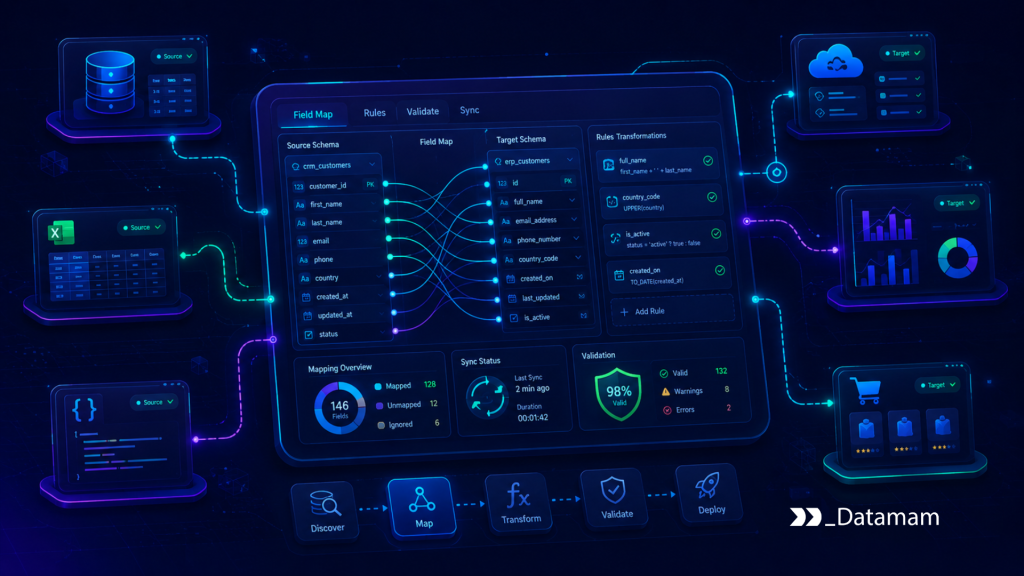
Enterprise migration programs often fail before cutover because teams underestimate mapping complexity. A source field may look simple until the target platform requires a different format, different identifier, different hierarchy, or different business meaning. A customer record in a legacy CRM may not match the customer object in the new platform. A product category may split into several attributes. A finance code may depend on region, tax treatment, and entity structure. A healthcare record may require stricter identity and consent handling.
Migration Data Mapping creates the architecture that controls this movement. It defines how legacy structures become target-ready records, how transformation rules are governed, and how exceptions are handled before data reaches the new system.
In complex migration workflows, mapping is not spreadsheet administration. It is the control layer between old system reality and new platform reliability.
Why Migration Data Mapping Matters in Enterprise Modernization
Migration Data Mapping matters because modernization changes how data is structured, used, governed, and consumed. A migration is not a direct copy. It is a transition from one operating model to another. That transition may involve new applications, new data models, new reporting logic, new cloud platforms, new security rules, and new business processes.
Deloitte’s enterprise data strategy and architecture guidance emphasizes that enterprise data architecture connects technology, governance, and business needs so organizations can manage data consistently across systems. In migration programs, mapping architecture is where that consistency is tested at the field level. Effective enterprise system modernization strategies can significantly enhance operational efficiency. By aligning technology with organizational goals, businesses can ensure that their data management processes are optimized for future growth. Ultimately, these strategies empower companies to leverage their data more effectively and derive valuable insights for decision-making.
Why Field-Level Mapping Becomes a Business Risk
Field-level mapping becomes a business risk when teams assume that similar fields mean the same thing. A legacy field called customer_status may represent account activity, billing eligibility, sales stage, or support status depending on the source system. A target platform may require those meanings to be separated.
The same issue appears across product, finance, supplier, employee, and transaction records. A single legacy value may need to map to several target fields. Several source values may need to consolidate into one standardized target value. Some source fields may be obsolete but still used in downstream reports.
Migration field mapping must therefore define business meaning, not only column movement. If the mapping only lists source field and target field, it will miss the operating logic required for migration accuracy.
How Weak Mapping Creates Cutover Failure
Weak mapping creates cutover failure because incorrect data can enter the target system without obvious technical errors. The migration job may complete successfully. Row counts may match. The target platform may accept the records. However, billing addresses may map to shipping fields, inactive customers may become active, product variants may lose parent-child relationships, or finance dimensions may classify transactions incorrectly.
These failures are expensive because they appear after business users begin operating in the new platform. By then, remediation requires correction, reconciliation, reloading, reporting review, and user trust repair.
Gartner’s 2025 data and analytics trends highlight that data and analytics are becoming more embedded across enterprise operations. As data becomes more operationally central, migration mapping errors create business disruption rather than isolated data defects.
Migration Mapping Strategy for Complex Workflows
A migration mapping strategy defines the rules and controls that determine how data moves from source systems to target environments. It should include source profiling, target schema review, transformation logic, identity resolution, exception rules, validation criteria, ownership, and audit evidence.
The strategy should be developed before migration execution. Mapping that is discovered during load testing usually creates delays, rework, and unresolved business decisions.
Profiling Source Data Before Mapping
Source profiling identifies what actually exists in the legacy system. This includes field completeness, duplicate records, invalid values, formatting inconsistencies, deprecated codes, orphaned records, and unusual relationships.
Without profiling, mapping decisions are based on assumptions. A field may be expected to contain country codes but actually contain country names, blanks, internal abbreviations, and historical values. A customer ID may appear unique until merged accounts, test records, and regional duplicates are discovered.
Source profiling should produce evidence that informs mapping rules. It should show which fields are reliable, which need transformation, which need cleansing, and which require business review.
Aligning Target Schema Requirements
Target schema requirements define what the new system expects. These requirements may include mandatory fields, allowed values, data types, object relationships, referential integrity, field length, localization rules, and system-generated identifiers.
Target schema alignment should involve platform owners and business domain owners. A target ERP, CRM, cloud warehouse, ecommerce platform, or healthcare record system may enforce rules differently than the legacy environment.
In practice, mapping architecture should begin with the target operating model. The question is not “where can we place this source field?” The question is “what does the target system require to operate correctly?”
Defining Transformation and Exception Rules
Transformation rules explain how source values become target-ready values. This may include formatting dates, standardizing country codes, splitting full names, merging duplicate records, converting currencies, normalizing product categories, or mapping legacy statuses into new status models.
Exception rules define what happens when the source value cannot be mapped safely. The record may be quarantined, routed to business review, assigned a default only under approved conditions, or excluded from migration until corrected.
A simple migration mapping validation pattern can look like this:
MIGRATION_MAPPING_RULES = {

    "required_target_fields": ["target_customer_id", "legal_name", "billing_country", "customer_status"],

    "blocked_source_values": ["unknown", "deprecated", "test_record"],

    "status_mapping": {

        "A": "active",

        "I": "inactive",

        "S": "suspended",

    },

}


def validate_customer_mapping(record):

    missing = [field for field in MIGRATION_MAPPING_RULES["required_target_fields"] if not record.get(field)]


    if missing:

        return {"valid": False, "reason": "missing_target_fields", "fields": missing}


    if record.get("source_status") in MIGRATION_MAPPING_RULES["blocked_source_values"]:

        return {"valid": False, "reason": "blocked_source_value", "field": "source_status"}


    if record.get("source_status") not in MIGRATION_MAPPING_RULES["status_mapping"]:

        return {"valid": False, "reason": "unmapped_status_value"}


    return {"valid": True}
This snippet follows the same structure used in earlier articles: a rules object, a small validation function, and a clear control result. The purpose is to show how mapping rules can become executable controls before cutover.
Source Target Mapping Architecture
Source target mapping defines how each source field, object, and relationship corresponds to the target model. In simple migrations, this may appear as a field-to-field exercise. In enterprise migrations, it becomes an architecture problem.
Source-target mapping must account for object changes, identifier changes, relationship changes, and business-rule changes.
Mapping Objects, Not Only Fields
Field mapping is only one layer. Complex migrations require object mapping. A legacy customer table may become accounts, contacts, billing profiles, and subscriptions in the target system. A product table may become product master, variants, attributes, categories, and channel-specific publication records. A finance record may split into ledger entries, tax dimensions, cost centers, and legal entities.
Object mapping defines how source entities become target entities. It also defines dependencies between those entities. For example, account records may need to migrate before contacts. Product masters may need to migrate before variants. Supplier masters may need to migrate before procurement transactions.
If object sequencing is wrong, the target system may reject valid records because the required parent object does not exist yet.
Preserving Identifiers and Cross-System References
Identifier management is one of the hardest parts of Migration Data Mapping. Source identifiers may not match target identifiers. Some identifiers may be reused, duplicated, missing, or system-generated. Cross-system references may depend on legacy IDs that must remain traceable after migration.
Mapping architecture should define legacy ID preservation, target ID generation, crosswalk tables, reference lookups, and reconciliation keys. This is especially important when legacy and target systems operate in parallel during testing or transition.
A controlled source-to-target mapping record may look like this:
def build_customer_crosswalk(source_record, target_record):

    if not source_record.get("legacy_customer_id"):

        return {"mapped": False, "reason": "missing_legacy_customer_id"}


    if not target_record.get("target_customer_id"):

        return {"mapped": False, "reason": "missing_target_customer_id"}


    return {

        "legacy_customer_id": source_record["legacy_customer_id"],

        "target_customer_id": target_record["target_customer_id"],

        "source_system": source_record.get("source_system"),

        "match_rule": target_record.get("match_rule", "migration_mapping"),

        "mapped": True,

    }
This example shows a lightweight crosswalk pattern. In production, the same concept supports reconciliation, exception review, rollback analysis, and auditability.
Handling One-to-Many and Many-to-One Mappings
Many migration defects come from structural mismatch. A source field may split into several target fields. Several source fields may consolidate into one target value. A legacy category hierarchy may need to flatten. A target platform may require normalized attributes where the source used free text.
One-to-many and many-to-one mapping rules require explicit documentation and validation. Teams should define which source values are combined, which target fields are derived, and which business rules justify the transformation.
These rules should not be hidden inside migration scripts. They should be visible to data owners, platform owners, and governance teams.
Migration Field Mapping and Validation Controls
Migration field mapping should be validated continuously during test cycles. The goal is not only to prove that records load. The goal is to prove that migrated records preserve business meaning in the target environment.
Validation should include technical checks, business checks, and downstream usage checks.
Validating Required Fields and Allowed Values
Required-field validation ensures that target records can operate after migration. Allowed-value validation ensures that migrated values fit the target model. For example, a target CRM may allow only specific customer status values. A finance platform may require approved tax codes. A healthcare platform may require standardized patient identifiers and record classifications.
Validation should compare mapping outputs against target requirements before load and after load. Failed mappings should be routed for correction rather than forced into the target.
At scale, validation rules should be reusable across migration waves so defects are detected consistently.
Comparing Source and Target Record Counts
Record counts are not sufficient, but they are still important. Teams should compare source record count, target record count, accepted record count, rejected record count, duplicate count, and exception count.
Count differences should be explained. Some exclusions may be intentional, such as test records, inactive historical records, or deprecated entities. Other differences may indicate data loss or mapping failure.
A migration validation approach should preserve the reason behind every difference so reconciliation does not become guesswork.
Testing Business Meaning After Migration
Business validation confirms whether migrated data behaves correctly in the target system. This includes sample review, process simulation, report comparison, parallel run analysis, and user acceptance testing.
For example, migrated customers should support billing workflows. Migrated products should publish correctly. Migrated finance records should roll up to expected reporting structures. Also, migrated support tickets should retain history and ownership.
NIST’s security and privacy control catalog includes control families for access control, audit and accountability, configuration management, system and information integrity, and related safeguards. Also, migration mapping validation can apply the same control mindset by preserving evidence of rules, approvals, exceptions, and test outcomes before data becomes operational in the target system.
Migration Mapping Tools and Operating Systems
Migration mapping tools help manage field mappings, transformation rules, metadata, lineage, test results, and exception workflows. However, tools do not replace mapping architecture. They support it.
A migration mapping tool is only useful if mapping ownership, rule definitions, validation logic, and exception handling are clear.
Using Mapping Repositories and Metadata Systems
A mapping repository should store source field, target field, transformation rule, owner, data type, required status, validation rule, exception policy, test result, and approval status. It should also track version changes as mappings evolve during test cycles.
Metadata systems and data catalogs can help connect mapping rules to lineage, data domains, owners, and downstream reports. This improves visibility when migration decisions affect analytics, operations, compliance, or AI workflows.
Without a repository, mappings often live in spreadsheets, scripts, and analyst notes. That may work early, but it becomes risky when multiple migration waves, teams, and systems are involved.
Connecting Mapping Logic to ETL and ELT Pipelines
Mapping rules should connect to migration execution pipelines. Tools such as dbt, Airflow, Spark, SQL pipelines, Snowflake, BigQuery, Databricks, and warehouse migration jobs may transform and load records into the target environment.
The key is traceability. Teams should know which mapping rule produced each target field and which validation check approved it. If a migrated record is challenged later, the team should be able to trace it back to the source value and transformation rule.
In practice, mapping architecture becomes stronger when documentation, transformation code, validation checks, and reconciliation outputs are connected.
Managing Mapping Changes Across Test Cycles
Mappings change during testing. A target owner may adjust a required field. A business team may reject a transformation assumption. A data profiling result may reveal an unexpected legacy value. A parallel run may expose reporting differences.
Mapping changes should be version-controlled. Teams should capture what changed, why it changed, who approved it, and which records or workflows were affected.
This prevents uncontrolled mapping drift during migration execution.
Governance and Auditability in Migration Data Mapping
Governance defines who owns mapping decisions, who approves transformation rules, who resolves exceptions, and how evidence is preserved. Auditability ensures that teams can explain how migrated data reached its target state.
The OECD’s data governance work describes governance as the technical, policy, and regulatory structures needed to manage data across its value cycle. Migration Data Mapping fits this model because it controls how data changes state, structure, and meaning during modernization.
Creating Mapping Ownership and Review Cycles
Each mapping domain should have an owner. Customer mappings may require CRM and billing owners. Product mappings may require merchandising, ecommerce, and operations owners. Finance mappings may require accounting and reporting owners. Healthcare mappings may require clinical, privacy, and compliance input.
Review cycles should occur during profiling, design, test migration, parallel run, cutover readiness, and post-migration reconciliation. High-risk mappings should receive deeper review than low-risk descriptive fields.
Ownership prevents mapping decisions from being buried inside technical execution.
Maintaining Audit Trails for Mapping Decisions
Audit trails should capture source fields, target fields, transformation rules, approval decisions, exception handling, validation results, rejected records, mapping changes, and cutover status.
Auditability matters when migrated data supports billing, compliance, reporting, healthcare records, customer operations, product publishing, or AI workflows. Teams should be able to explain how a field was mapped, why a transformation was applied, and whether validation passed.
This creates procurement reassurance because migration execution becomes evidence-based rather than manually interpreted.
Handling Exceptions Without Breaking Cutover Readiness
Exceptions are normal in migration programs. The issue is not whether exceptions exist. The issue is whether they are visible, owned, classified, and resolved before cutover.
Exception categories may include missing required fields, duplicate records, unmapped values, invalid formats, orphaned relationships, unsupported target values, and business-rule conflicts. Each category should have a resolution path.
Unresolved exceptions should be measured against cutover readiness. If critical exceptions remain open, the migration should not proceed without formal risk acceptance.
Risk Containment Through Strong Mapping Architecture
Strong mapping architecture reduces migration risk by preventing silent data defects. It makes transformation logic visible, exceptions traceable, validation repeatable, and cutover decisions evidence-based.
This is especially important in modernization programs where teams are replacing systems that support daily operations. Parallel run strategies for data migration allow teams to test new systems with actual business data while the old system remains operational. This approach minimizes disruption and increases confidence in the new setup before a complete switch. Additionally, it provides an opportunity to identify any performance issues or data discrepancies early in the process. An effective enterprise data strategy for businesses is critical for leveraging data as a strategic asset. By aligning data initiatives with business objectives, organizations can enhance decision-making and drive innovation. This holistic approach also ensures that data governance practices are enforced, leading to improved data quality and compliance.
Preventing Silent Mapping Failure
Silent mapping failure occurs when data lands in the target system but carries the wrong meaning. A record is not rejected. A job does not fail. Users only discover the problem when reports, workflows, or customer interactions behave incorrectly.
Mapping controls reduce this risk through validation, reconciliation, sample review, business testing, and lineage. The goal is to catch meaning-level defects before cutover.
Protecting Downstream Reporting and AI Systems
Migrated data often feeds downstream reports, dashboards, AI features, and analytics workflows. If mapping errors enter the target platform, they can propagate into metrics, models, decision systems, and operational processes.
Mapping architecture should therefore connect migration testing to downstream validation. It is not enough for the target platform to accept the data. The migrated data must remain usable for reporting, forecasting, segmentation, monitoring, and automation.
Supporting Cutover Readiness
Cutover readiness depends on evidence. Teams need to know which mappings are approved, which exceptions remain open, which validation checks passed, which records were rejected, and which downstream workflows were tested.
Migration Data Mapping supports cutover readiness by giving decision-makers a clear view of mapping risk. This helps prevent go-live decisions based on incomplete confidence.
Conclusion: Turning Mapping into Migration Control Infrastructure
Migration Data Mapping is one of the most important control layers in enterprise modernization. It defines how source records, fields, identifiers, relationships, and business meanings become target-ready data in new platforms.
A strong migration mapping strategy connects source profiling, source-target mapping, migration field mapping, transformation rules, validation checks, exception handling, migration mapping tools, lineage, governance, and audit trails. It prevents mapping decisions from becoming hidden assumptions inside scripts or spreadsheets.
The capability matters because migration failure is rarely caused by movement alone. Data can move successfully and still be wrong. When mapping architecture is weak, errors surface after cutover. When mapping is governed, validated, and auditable, migration becomes a controlled transition from legacy complexity to modernized system reliability.
A structured review can help evaluate whether current migration workflows have reliable Migration Data Mapping, migration mapping strategy, source-target mapping, migration field mapping, and migration mapping tools. You can run an external data infrastructure audit with our team to review your current setup and understand what is required to build reliable, enterprise-scale data migration infrastructure.