Key Takeaways
- Delivery Access Control defines who can receive delivered data, which systems can access it, and under what operational conditions distribution is allowed.
- Role-based access helps separate delivery permissions by business function, system owner, data sensitivity, and downstream responsibility.
- Access control models should account for users, applications, service accounts, partner endpoints, reporting systems, and automated workflows.
- Secure data delivery requires approval rules, endpoint permissions, credential management, audit trails, delivery logs, and exception handling.
- Strong data access control prevents prepared data from being delivered to unauthorized, expired, over-permissioned, or poorly governed destinations.
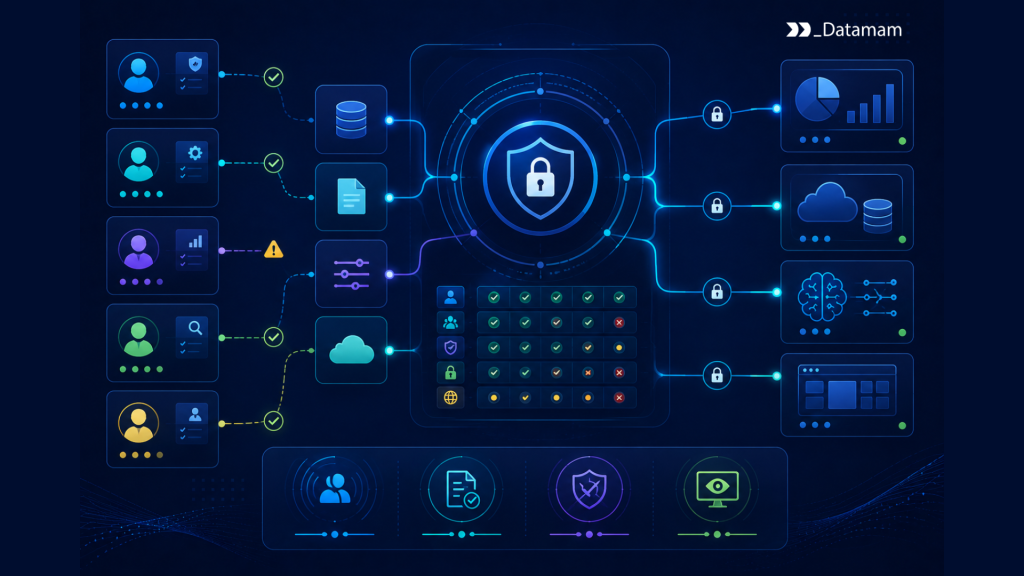
Enterprise data delivery becomes risky when access is treated as an endpoint configuration detail. A dataset may be validated, scheduled, and prepared correctly, but still create exposure if it is delivered to the wrong system, an over-permissioned user group, an expired partner endpoint, or a workflow that no longer has approval to consume it.
Delivery Access Control creates the permission layer for enterprise data distribution. It defines which users, systems, roles, applications, service accounts, and external endpoints can receive data outputs.
In enterprise delivery environments, access control is not only a security concern. It is an operational governance function. It protects dashboards, reporting systems, compliance archives, customer notifications, product feeds, procurement reports, revenue workflows, and inventory updates from unauthorized or uncontrolled distribution.
Why Delivery Access Control Matters in Enterprise Data Distribution
Delivery Access Control matters because prepared data often moves beyond the team that produced it. The same dataset may be distributed to BI tools, executive dashboards, operational applications, customer-facing workflows, compliance archives, APIs, partner systems, and automated delivery endpoints.
The OECD’s data flows and governance work states that effective data use and governance depend on the ability to move, share, analyze, and protect data. In enterprise delivery systems, access control is the mechanism that keeps sharing and movement aligned with approved use. Enterprise data distribution solutions play a crucial role in ensuring that information reaches its intended users while maintaining security protocols. These solutions help organizations manage data flow effectively, allowing for real-time insights and seamless collaboration across departments. By implementing robust distribution strategies, businesses can enhance their decision-making processes and overall productivity.
Why Delivery Permissions Are Different from Storage Permissions
Storage permissions define who can access data where it resides. Delivery permissions define who can receive data when it moves. These are related but not identical.
A user may have access to a warehouse table but not permission to receive an exported file. A dashboard may show aggregated metrics but should not receive row-level customer records. A partner endpoint may receive product availability but not pricing strategy fields. A customer notification system may receive delivery-ready message fields but not internal segmentation logic.
Delivery Access Control must therefore evaluate the destination, data type, delivery purpose, user role, endpoint status, and approval state before distribution occurs.
How Weak Access Control Creates Delivery Risk
Weak access control creates risk because delivery multiplies exposure. A dataset that remains inside a governed warehouse may be protected by platform permissions, lineage, logging, and masking. Once exported or pushed to downstream endpoints, control can weaken unless delivery permissions are enforced.
Common failure modes include stale access grants, shared delivery credentials, over-broad user roles, unregistered endpoints, uncontrolled report distribution, partner access that remains active after contract changes, and automated jobs that continue sending data to retired destinations.
Gartner’s data governance guidance describes governance programs as specifying decision rights and accountability so data is properly valued, created, consumed, and controlled. Delivery access control applies those decision rights at the point where data leaves prepared systems and becomes available to consumers.
Access Control Models for Data Delivery
Access control models define how permissions are assigned and enforced. In enterprise delivery environments, the model should support people, systems, applications, endpoints, and automated workflows.
A mature design usually combines role-based access, attribute-based rules, system-level permissions, endpoint-level controls, and exception workflows.
Applying Role-Based Access to Delivery Workflows
Role-based access assigns permissions based on business function or operational responsibility. A finance analyst may receive revenue reports. A procurement manager may receive supplier reporting. A compliance officer may receive controlled audit packages. A warehouse operations user may receive inventory update summaries.
Role-based access works well when responsibilities are clear and stable. However, roles should be sufficiently specific to prevent excessive access. A broad “operations” role may be too permissive if it includes customer, product, inventory, and revenue data.
For delivery workflows, role-based access should define not only what data a role can view, but also what delivery format, cadence, and destination are allowed.
Using Attribute-Based Rules for Sensitive Delivery
Attribute-based access control evaluates context. This may include data sensitivity, region, purpose, endpoint type, business unit, approval status, user function, and delivery method.
For example, a dataset containing customer identifiers may require additional approval before delivery outside the warehouse. A regional report may only be delivered to users responsible for that market. A compliance archive may require immutable delivery with restricted access. A product feed may exclude supplier cost fields unless the recipient has an approved role.
In practice, attribute-based rules are useful when delivery decisions require more context than a simple role can provide.
Separating Human, System, and Partner Access
Human users, internal systems, and external partners should not share the same access model. Human users need role assignment, approval, and review. Internal systems need service identity, endpoint permissions, and workflow ownership. External partners need contractual scope, data minimization, expiration rules, and delivery monitoring.
Mixing these access patterns creates risk. A partner should not receive internal service credentials. A dashboard distribution list should not behave like a system endpoint. A service account should not be treated as a person without ownership.
Delivery access control should classify consumers before assigning permissions.
Data Access Control Before Delivery
Data access control should be enforced before data leaves the prepared environment. This means delivery jobs should check recipient permissions, endpoint approval, dataset sensitivity, delivery purpose, and required controls before releasing the output.
NIST’s Security and Privacy Controls for Information Systems and Organizations provides a control catalog that includes Access Control, Audit and Accountability, Identification and Authentication, and related security control families for protecting systems and data. Enterprise delivery systems can apply these principles by enforcing permissions and preserving delivery evidence before distribution occurs.
Validating Recipient and Endpoint Permissions
A delivery job should not assume that a target remains approved because it was approved once. Permissions should be checked at runtime or through regularly refreshed access records.
A simple access validation pattern can look like this:
DELIVERY_ACCESS_RULES = {

    "finance_reporting": {

        "allowed_roles": ["finance_analyst", "finance_director"],

        "allowed_endpoints": ["revenue_dashboard", "finance_archive"],

    },

    "inventory_operations": {

        "allowed_roles": ["inventory_manager", "commerce_operations"],

        "allowed_endpoints": ["inventory_feed", "warehouse_dashboard"],

    },

}


def validate_delivery_access(delivery):

    rules = DELIVERY_ACCESS_RULES.get(delivery["data_domain"])


    if not rules:

        return {"approved": False, "reason": "unknown_data_domain"}


    if delivery["recipient_role"] not in rules["allowed_roles"]:

        return {"approved": False, "reason": "role_not_allowed"}


    if delivery["target_endpoint"] not in rules["allowed_endpoints"]:

        return {"approved": False, "reason": "endpoint_not_allowed"}


    return {"approved": True}
This follows the same structure as the prior snippets: rules first, then a short function that blocks unsafe delivery before downstream exposure occurs.
Blocking Delivery When Approval Is Missing
Some data outputs require approval before distribution. Revenue reports may need a finance review. Compliance files may need legal or risk approval. Customer datasets may need a privacy review. Product catalog feeds may need merchandising approval before publication.
Delivery systems should block outputs when approval is missing, expired, or incomplete. This prevents technically successful but governance-invalid delivery.
A blocked delivery should not disappear. It should return a clear reason, owner, and remediation path so the correct team can approve, correct, or cancel the delivery.
Controlling Fields, Granularity, and Format
Delivery Access Control should also control what is delivered. Two recipients may receive the same data product at different levels of detail. One dashboard may show aggregated metrics. Another system may receive record-level data. A partner feed may receive only approved product fields. A compliance archive may receive full evidence with restricted access.
This requires field-level and format-level control. Delivery permissions should define allowed columns, masking rules, aggregation level, file format, retention expectations, and whether downstream redistribution is allowed.
Secure data delivery is not only about who receives data. It is also about how much data they receive and in what form.
Secure Data Delivery Across Endpoints
Secure data delivery applies access control to the delivery path itself. This includes credentials, transport security, endpoint approval, encryption, logs, and acknowledgement.
The objective is to ensure that data reaches only authorized destinations and that delivery can be proven afterward.
Managing Credentials for Delivery Endpoints
Delivery endpoints often use credentials: API keys, service accounts, SFTP keys, warehouse roles, cloud storage permissions, message queue identities, or partner tokens. These credentials should have owners, expiration rules, rotation schedules, and permitted destinations.
Shared credentials should be avoided where possible. If multiple delivery workflows use the same credential, teams lose visibility into which workflow delivered which data. If the credential is compromised, the blast radius becomes larger.
Credential records should connect to endpoint records. A team should know which credential supports which endpoint, which data domains it can receive, when it was last rotated, and who owns it.
Enforcing Delivery Rules by Data Sensitivity
Not all data require the same delivery control. Public product attributes, aggregated operational metrics, customer-level records, payment-related data, workforce data, and compliance evidence carry different risk profiles.
A delivery model can classify data by sensitivity and enforce different requirements:
SENSITIVITY_DELIVERY_RULES = {

    "public": {

        "requires_approval": False,

        "allowed_methods": ["api", "dashboard"],

    },

    "confidential": {

        "requires_approval": True,

        "allowed_methods": ["secure_api", "warehouse_role"],

    },

    "restricted": {

        "requires_approval": True,

        "allowed_methods": ["encrypted_archive"],

    },

}


def approve_secure_delivery(record):

    rules = SENSITIVITY_DELIVERY_RULES.get(record["sensitivity"])


    if not rules:

        return {"approved": False, "reason": "unknown_sensitivity_level"}


    if record["delivery_method"] not in rules["allowed_methods"]:

        return {"approved": False, "reason": "delivery_method_not_allowed"}


    if rules["requires_approval"] and record.get("approval_status") != "approved":

        return {"approved": False, "reason": "approval_required"}


    return {"approved": True}
This keeps the code close to the earlier cluster examples while focusing specifically on secure delivery access.
Monitoring Unauthorized and Over-Permissioned Delivery
Secure delivery requires monitoring. Teams should track unauthorized delivery attempts, denied endpoints, expired permissions, role mismatches, unusual recipient activity, large exports, new destinations, and repeated access exceptions.
Over-permissioned delivery is especially important. A role may be technically approved but too broad for the intended use. A dashboard group may include more users than expected. A partner endpoint may receive more fields than the agreement allows.
Monitoring should identify these patterns before they become incidents.
Operational Controls for Delivery Access Control
Operational controls ensure that access rules are not only documented but enforced during delivery. They also help teams recover when delivery is blocked, misconfigured, or challenged.
These controls should connect access policy, scheduling, endpoint coordination, monitoring, and audit evidence.
Routing Access Failures to the Correct Owner
Access failures should be classified. A role mismatch may go to the data owner. An expired credential may go to platform operations. A partner permission issue may go to vendor management. A restricted dataset request may go to compliance review.
Generic failure messages slow recovery. Owner-aware routing helps teams correct access issues without exposing data prematurely.
In practice, blocked delivery should be treated as a controlled event, not a pipeline inconvenience.
Reviewing Delivery Permissions Periodically
Access reviews should occur on a defined schedule. Teams should review who receives each data product, which endpoints are active, which credentials are still used, which roles are over-permissioned, and which exceptions remain open.
This is important because delivery access changes over time. Employees change roles. Partners leave. Dashboards are retired. Reports lose business relevance. Systems migrate. Old endpoints remain active unless reviewed.
Access reviews reduce permission drift.
Handling Emergency Access Without Losing Control
Emergency delivery may be necessary during incidents, regulatory deadlines, executive reviews, or operational disruptions. However, emergency access should still be controlled.
The access model should define who can approve emergency delivery, how long access remains active, what data may be delivered, and how the exception is logged. Temporary access should expire automatically or require reapproval.
NIST’s incident response guidance emphasizes preparation, evidence collection, analysis, prioritization, response, and recovery. Delivery environments should apply the same discipline to emergency access so urgent distribution does not bypass governance permanently.
Technology and Architecture Considerations
Delivery Access Control depends on identity systems, data catalogs, warehouse permissions, endpoint registries, orchestration tools, delivery services, audit logs, and monitoring platforms.
The architecture should enforce access where delivery occurs, not only where data is stored. Realtime data analysis techniques can provide insights into user interactions and access patterns. Implementing these techniques allows organizations to optimize their systems for better performance and enhanced security. By continually monitoring and analyzing real-time data, businesses can adapt quickly to changes and potential threats.
Connecting Access Control to Orchestration and Delivery Systems
Orchestration tools such as Airflow, Dagster, Prefect, dbt jobs, warehouse tasks, and enterprise schedulers can enforce access checks before delivery jobs run. Delivery systems can check endpoint permissions before publishing files, API payloads, dashboard refreshes, or queue messages.
The access check should be part of the delivery path. A job should not export data first and validate access afterward.
In practice, access control should become a gate in the workflow: prepare data, validate data, confirm access, deliver data, record evidence.
Using Catalogs and Lineage for Access Visibility
Catalogs and lineage systems help teams understand who receives which data products and which downstream systems depend on them. This is critical when access changes.
If a role is revoked, teams should know which deliveries are affected. If a dataset is reclassified as restricted, teams should know which endpoints must be reviewed. Also, if a dashboard is retired, teams should remove its access from delivery workflows.
Access visibility connects governance to operational delivery.
Preserving Access to Evidence for Audit
Delivery systems should preserve evidence of access decisions. This includes recipient role, endpoint, dataset, sensitivity level, approval status, delivery method, timestamp, credential identity, decision result, and owner.
Deloitte’s data observability guidance argues that data observability requires a combination of technology, process, governance, and talent. Delivery access control follows the same logic because access evidence must be observable, reviewable, and operationally actionable. Data delivery solutions for compliance reporting are essential to ensure that organizations meet regulatory requirements. Furthermore, these solutions help in maintaining transparency and accountability in data handling practices. By implementing robust data delivery systems, companies can streamline their compliance processes and minimize the risk of violations.
Governance and Auditability in Delivery Access Control
Governance defines who can approve data delivery, who can create endpoints, who can assign roles, who can approve exceptions, and who reviews access. Auditability preserves the evidence behind these decisions.
The OECD’s data governance work describes governance as the technical, policy, and regulatory frameworks required to manage data across its value cycle. Delivery Access Control fits that model because access decisions determine how data leaves governed environments and becomes available downstream.
Creating Ownership and Review Cycles
Each critical delivery workflow should have an access owner. Ownership may include data owner, business owner, security owner, endpoint owner, and delivery operations owner.
Review cycles should evaluate active recipients, endpoint permissions, role definitions, credential status, data sensitivity, exception history, and failed access attempts. High-risk deliveries should be reviewed more frequently than low-risk internal outputs.
This prevents access control from becoming a one-time approval.
Maintaining Audit Trails for Access Decisions
Audit trails should capture access grants, denials, role changes, endpoint approvals, credential rotations, emergency exceptions, manual overrides, and delivery decisions.
Auditability matters when data is delivered to dashboards, customer notification systems, compliance archives, procurement reports, revenue operations, product feeds, inventory workflows, or external partners. Teams should be able to show who received data, why delivery was approved, and what controls were applied.
This is what makes secure data delivery defensible during incident review, compliance review, and procurement evaluation.
Conclusion: Turning Access Control into Delivery Infrastructure
Delivery Access Control helps enterprises govern who receives data, which endpoints are approved, what delivery methods are allowed, and how sensitive outputs move across systems. It connects role-based access, access control models, data access control, secure data delivery, endpoint permissions, credential management, monitoring, and audit trails.
Strong access control prevents prepared data from being delivered to unauthorized users, expired endpoints, over-permissioned roles, unapproved partners, or unsupported workflows. It protects executive dashboards, reporting systems, customer notification workflows, procurement reporting, compliance archives, product catalog feeds, inventory updates, and operational applications.
The capability matters because delivery is the moment when data leaves one controlled environment and becomes available elsewhere. If access control is weak, even accurate and validated data can create governance, security, and operational risk.
A structured review can help evaluate whether current delivery workflows have reliable Delivery Access Control, role-based access, access control models, data access control, and secure data delivery oversight. You can run an external data infrastructure audit with our team to review your current setup and understand what is required to build a reliable, enterprise-scale data delivery infrastructure.