Key Takeaways
- Migration Monitoring Systems give teams live visibility into migration progress, batch status, validation results, exceptions, and cutover readiness.
- Migration monitoring tools should track source extraction, transformation, loading, reconciliation, failed records, performance, and downstream impact.
- Migration progress tracking helps executives, platform teams, data owners, and risk stakeholders understand whether transition work is on schedule and under control.
- Live migration monitoring should detect blocked batches, validation failures, slow loads, missing dependencies, duplicate records, and target-system rejection before they damage cutover.
- Migration performance tracking requires dashboards, alerts, ownership, thresholds, audit trails, and post-cutover monitoring.
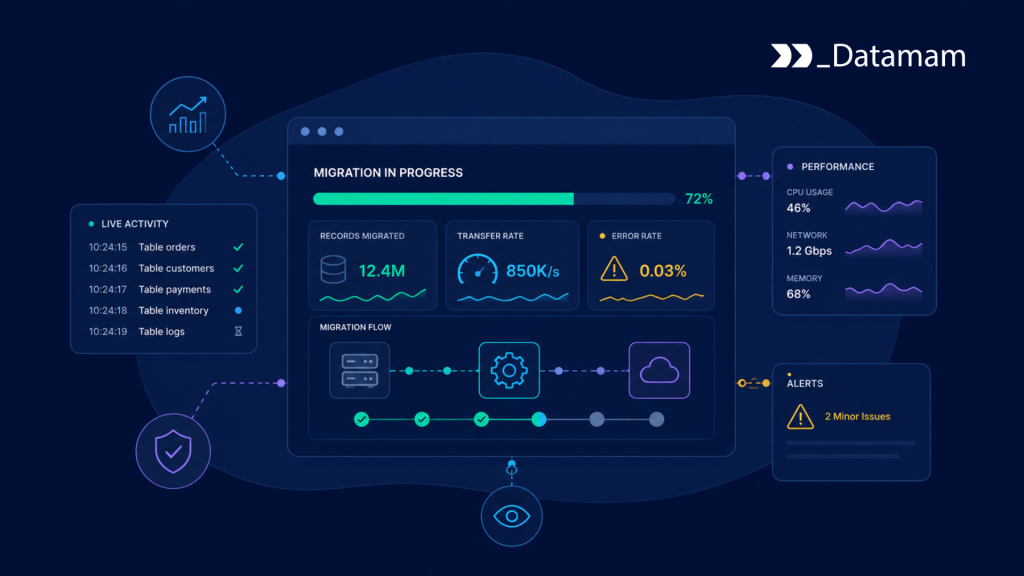
Enterprise migrations become risky when teams only discover problems after a batch completes, a report fails, or users begin operating in the target system. A migration may look healthy at the job level while specific records fail validation, target loads slow down, downstream reports drift, or exception queues grow silently.
Migration Monitoring Systems create the live control layer for transition execution. They show what has moved, what has failed, what is delayed, which systems are affected, and whether cutover readiness is improving or deteriorating.
In enterprise modernization programs, monitoring is not a dashboard add-on. It is the operational visibility needed to manage migration risk while data is actively moving between legacy and target environments.
Why Migration Monitoring Systems Matter During Live Transition
Migration Monitoring Systems matter because migration execution involves many moving parts: source extraction, staging, mapping, transformation, validation, loading, reconciliation, user testing, downstream reporting, and cutover decision-making.
Deloitte’s data modernization and migration guidance connects migration work with modern data platform architecture, governance, and scalable analytics. That level of modernization requires visibility across migration execution, not only confirmation that files or tables moved. Enterprise system modernization strategies enable organizations to enhance their operational efficiency and improve data accessibility. By adopting these strategies, businesses can better align their technology with evolving market demands. Furthermore, a well-planned modernization initiative can significantly reduce operational risks associated with outdated systems.
Why Static Migration Reports Are Not Enough
Static migration reports show what happened after a job or phase completes. They are useful, but they are not enough for live transition control. During active migration, teams need to know whether extraction is delayed, whether transformation rules are failing, whether validation is blocking records, and whether target systems are accepting loads.
A weekly status report cannot detect a failed batch in time to protect a cutover window. A migration spreadsheet cannot show real-time backlog, load speed, retry volume, or target-system rejection patterns.
Live migration monitoring gives teams operational visibility while issues can still be corrected.
How Poor Monitoring Increases Cutover Risk
Poor monitoring increases cutover risk because migration issues accumulate invisibly. A small number of failed records may become a large exception backlog. A slow load may compress the validation window. A target-system bottleneck may delay business testing. A reconciliation mismatch may remain unresolved until go-live review.
Gartner’s 2025 data and analytics trends state that data and analytics are becoming more ubiquitous while operational stakes rise for D&A leaders. In migration programs, that means transition monitoring must support operational decisions, not only technical reporting.
Migration Progress Tracking Across the Transition Lifecycle
Migration progress tracking shows how migration work is moving across planned phases. It should track scope, batch progress, validation status, exception volume, reconciliation results, and cutover readiness.
The objective is to give engineering, business, governance, and executive stakeholders a shared view of migration reality.
Tracking Source Extraction, Transformation, and Loading
Migration progress should be visible across each stage. Source extraction tracking shows whether expected records were captured. Transformation tracking shows whether mapping and business rules completed successfully. Loading tracking shows whether the target system accepted the records.
If teams only track the final load result, they lose visibility into where issues began. A failed target load may be caused by source incompleteness, transformation logic, schema mismatch, identifier problems, or access constraints.
Progress tracking should therefore separate migration stages rather than collapse them into one success or failure status.
Measuring Batch Status and Completion
Most enterprise migrations move in batches or waves. Each batch should have status indicators such as pending, extracting, transformed, validating, loaded, reconciled, blocked, failed, or approved.
A simple monitoring classifier can look like this:
MIGRATION_STATUS_RULES = {

    "required_steps": ["extracted", "transformed", "validated", "loaded"],

    "blocked_results": ["validation_failed", "target_rejected", "reconciliation_failed"],

}


def classify_migration_batch(batch):

    missing = [step for step in MIGRATION_STATUS_RULES["required_steps"] if step not in batch.get("completed_steps", [])]


    if missing:

        return {"status": "incomplete", "reason": "missing_steps", "steps": missing}


    if batch.get("result") in MIGRATION_STATUS_RULES["blocked_results"]:

        return {"status": "blocked", "reason": batch.get("result")}


    return {"status": "ready_for_reconciliation"}
This follows the same snippet pattern used across the cluster: define the rules, evaluate the batch, and return a clear status that can drive monitoring and escalation.
Connecting Progress to Cutover Readiness
Migration progress tracking should connect directly to cutover readiness. A migration may be 95 percent loaded but still not ready if the remaining 5 percent includes active customers, open invoices, regulated records, or critical product data.
Progress should be weighted by risk. High-impact domains should carry more decision value than low-risk historical data. A readiness view should show which critical domains are complete, which are blocked, and which require business approval.
In practice, progress tracking becomes useful when it informs go-live decisions.
Live Migration Monitoring During Execution
Live migration monitoring shows what is happening while migration jobs are running. It should detect failures, delays, validation issues, load bottlenecks, exception growth, and target-system instability.
This is especially important during cutover windows, when time to detect and respond is limited.
Monitoring Validation Failures and Exception Queues
Validation failures should be visible as they occur. Common issues include missing required fields, unmapped values, duplicate identifiers, invalid formats, orphaned relationships, and target-system rejection.
Exception queues should show volume, category, severity, owner, and resolution status. A queue with many low-risk historical exceptions may be acceptable. A small queue containing active finance or customer records may block cutover.
Live migration monitoring should therefore classify exceptions by business impact, not only count them.
Tracking Target-System Rejection and Load Failures
The target system may reject records for many reasons: schema mismatch, missing parent records, invalid values, access rules, configuration constraints, duplicate keys, or performance bottlenecks.
A monitoring system should separate target rejection from upstream migration failure. If target configuration is the issue, platform owners need to act. If mapping is the issue, migration teams need to adjust rules. Also, if source data is incomplete, business owners may need to resolve records.
Clear failure classification reduces time lost during live transition.
Detecting Timing, Backlog, and Dependency Issues
Migration timing matters during live transition. A delayed source extract can compress the entire cutover schedule. A slow transformation job can delay validation. A backlog of failed records can delay reconciliation. A downstream reporting refresh can start before the target load is ready.
Live monitoring should track elapsed time, expected completion time, queue depth, dependency status, and delayed jobs. These signals help teams decide whether to continue, pause, rerun, escalate, or delay cutover.
Deloitte’s 24/7 data pipeline guidance emphasizes resilience, observability, governance, and tracking latency, freshness, and drift in always-on data platforms. Also, migration monitoring applies the same discipline to temporary but high-risk transition pipelines.
Migration Performance Tracking
Migration performance tracking measures whether the transition can complete within the expected operating window. It includes throughput, latency, processing duration, retry volume, load speed, validation duration, and target-system response.
Performance matters because cutover windows are often limited. Effective migration validation techniques for accuracy are essential for ensuring a smooth transition. Organizations must prioritize these techniques to minimize the risk of errors that could lead to downtime. By implementing robust validation processes, businesses can enhance their confidence in the migration outcomes.
Measuring Throughput and Processing Speed
Throughput shows how many records, files, tables, or batches are moving per time period. Processing speed shows whether extraction, transformation, validation, and loading are completing fast enough to meet the migration plan.
If throughput falls below expectation, teams need to understand why. The issue may be source-system slowness, transformation complexity, compute limits, target load constraints, network transfer, or retry volume.
Performance tracking should be measured by stage and by data domain. Aggregate throughput can hide critical bottlenecks.
Tracking Retry Volume and Failure Patterns
Retries are normal, but repeated retries can signal deeper problems. A batch that retries because of temporary target unavailability is different from a batch that retries because of persistent schema failure.
A simple failure routing pattern can look like this:
def route_migration_issue(issue):

    if issue["type"] == "slow_load":

        return {"owner": "platform_operations", "action": "review_target_capacity"}


    if issue["type"] == "validation_failure":

        return {"owner": "data_migration_team", "action": "review_mapping_rule"}


    if issue["type"] == "missing_source_record":

        return {"owner": "business_data_owner", "action": "resolve_source_gap"}


    if issue["type"] == "reconciliation_variance":

        return {"owner": "cutover_governance", "action": "review_cutover_risk"}


    return {"owner": "migration_operations", "action": "manual_review"}
This keeps monitoring operational. The point is not only to detect issues, but to route them to the right owner quickly.
Monitoring Target-System Capacity
Target systems may behave differently under migration load than under normal use. A cloud warehouse may handle analytical queries well but slow during heavy load. A CRM may enforce API limits. An ERP may reject large batches. A file store may become slow under high-volume writes.
Migration performance tracking should monitor target-system capacity before and during live transition. If the target cannot accept the planned load, the migration schedule may need batching, throttling, or wave redesign.
Migration Monitoring Tools and Architecture
Migration monitoring tools should provide visibility across migration pipelines, validation systems, reconciliation outputs, target platforms, logs, queues, and downstream consumers. The toolset may include orchestration systems, warehouse monitoring, data quality frameworks, dashboards, alerting tools, and incident workflows.
The architecture matters more than a single tool name. Monitoring should connect signals into one operating view.
Connecting Orchestration, Logs, and Validation Results
Tools such as Airflow, dbt jobs, Spark, warehouse tasks, migration scripts, data quality checks, and reconciliation dashboards can all generate migration signals. These signals should be connected through shared metadata such as batch ID, source system, target system, data domain, validation status, and run time.
Without shared identifiers, teams see disconnected logs rather than a migration control system.
Migration monitoring tools should help answer: which batch is affected, what failed, who owns it, what downstream systems are impacted, and whether cutover readiness changed.
Building Dashboards for Different Stakeholders
Different stakeholders need different views. Engineering teams need batch-level and job-level details. Data owners need exception categories and record impact. Governance teams need validation evidence and risk status. Executives need readiness, trend, and blocker visibility.
One dashboard should not try to serve everyone. A mature monitoring system provides layered views.
At scale, this reduces confusion because stakeholders can act from the same underlying evidence while seeing the level of detail they need.
Preserving Monitoring Evidence
Monitoring evidence should be retained. This includes job status, batch status, validation results, reconciliation outputs, failure categories, retry history, performance metrics, approvals, and cutover decisions.
NIST’s incident response guidance emphasizes preparation, evidence collection, analysis, prioritization, response, and recovery. Migration monitoring systems should preserve similar evidence so teams can diagnose transition incidents and explain remediation decisions.
Governance and Auditability in Migration Monitoring Systems
Governance defines who owns migration monitoring, who responds to alerts, who approves exceptions, and how monitoring evidence affects cutover decisions. Auditability preserves the record of what happened during migration execution.
Migration monitoring should therefore be part of transition governance, not only technical operations.
Creating Monitoring Ownership and Escalation Paths
Monitoring ownership should be clear before live migration begins. Data migration teams may own transformation failures. Platform teams may own target load performance. Business owners may own source data gaps. Governance teams may own cutover risk and exception approval.
Escalation paths should define who responds to blocked batches, failed validation, slow loads, reconciliation variance, and missing downstream readiness.
Without ownership, alerts create noise instead of action.
Maintaining Audit Trails for Transition Decisions
Audit trails should capture migration events, validation outcomes, blocked batches, approved exceptions, performance issues, replay actions, cutover approvals, and post-cutover findings.
The OECD’s data governance work describes governance as the technical, policy, and regulatory frameworks required to manage data across its value cycle. Migration Monitoring Systems fit that model because they govern how data movement is observed, controlled, corrected, and accepted during transition. Data migration challenges in healthcare often involve ensuring data integrity and privacy during the transfer process. Additionally, healthcare organizations must navigate regulatory compliance while managing the complexities of various data formats. Effective strategies are essential to minimize disruptions and maintain continuity of patient care throughout the migration.
Supporting Post-Cutover Monitoring
Monitoring should continue after cutover. Some defects only appear under live usage. Post-cutover monitoring should track rejected records, reporting mismatches, workflow errors, user-reported issues, data freshness, performance degradation, and access failures.
This gives migration teams a controlled stabilization period rather than ending visibility at go-live.
Conclusion: Turning Monitoring into Live Migration Control
Migration Monitoring Systems help enterprises control live transition risk by showing migration progress, validation status, performance behavior, exception growth, and cutover readiness. They connect migration monitoring tools, migration progress tracking, live migration monitoring, migration performance tracking, ownership, and audit evidence into one operating model.
Strong monitoring prevents migration teams from relying on delayed reports or incomplete confidence. It detects blocked batches, failed validation, slow loads, target rejection, reconciliation variance, and downstream readiness issues while there is still time to act.
The capability matters because migrations fail when problems remain invisible until cutover. When monitoring is structured, governed, and audit-ready, live transition decisions become evidence-based rather than schedule-driven.
A structured review can help evaluate whether current migration workflows have reliable Migration Monitoring Systems, migration monitoring tools, migration progress tracking, live migration monitoring, and migration performance tracking. You can run an external data infrastructure audit with our team to review your current setup and understand what is required to build reliable, enterprise-scale data migration infrastructure.