Key Takeaways
- How Healthcare Data Migration supports electronic health records migration across patient, encounter, lab, medication, billing, and clinical history data
- Why patient record migration depends on source profiling, identity resolution, code mapping, validation, reconciliation, and audit evidence
- How clinical data transition reduces risk when allergies, medications, diagnoses, encounters, and care history are tested before go-live
- Why healthcare record migrations fail when teams rely on late exports, manual cleanup, or incomplete clinical validation
- How structured migration pipelines protect continuity of care, compliance posture, and post-transition operational confidence
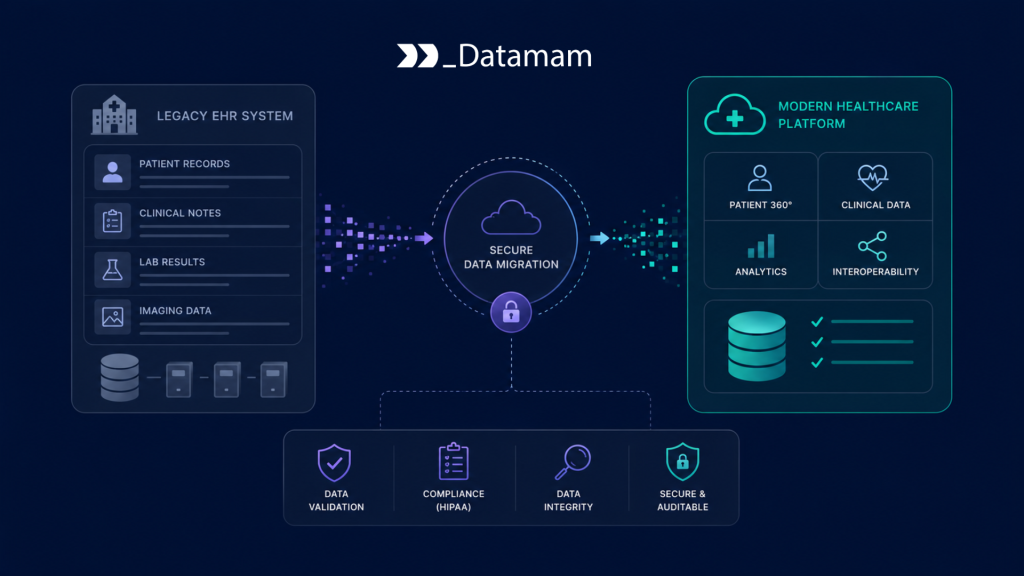
Healthcare record platform transitions depend on accurate data movement across legacy EHR systems, patient administration platforms, laboratory systems, imaging repositories, billing records, claims platforms, pharmacy systems, clinical notes, scheduling tools, and reporting environments. When Healthcare Data Migration is poorly controlled, providers face incomplete patient histories, duplicate records, broken encounter timelines, missing consent data, delayed clinical workflows, and compliance exposure. The issue is rarely only the target EHR or clinical platform. It is usually the migration operating layer behind the transition: source profiling, patient identity matching, clinical code mapping, validation, reconciliation, access control, auditability, and cutover governance. Healthcare Data Migration gives clinical operations, compliance, IT, revenue cycle, data governance, and executive teams a structured way to move patient and clinical records without weakening care continuity.
The Migration Risk Gap in Healthcare Record Transitions
Healthcare platform transitions are often described as technology modernization projects, but the highest operating risk usually sits in clinical data continuity. Legacy healthcare environments contain patient demographics, encounters, diagnoses, procedures, allergies, medications, immunizations, lab results, imaging references, care plans, clinical notes, consent records, claims data, and appointment history. Some records may be duplicated, incomplete, scanned, inconsistently coded, or tied to legacy workflows.
This creates a migration risk gap. A target platform may be configured correctly while the patient record remains unresolved. Clinicians need accurate patient history. Compliance teams need traceable access and audit evidence. Revenue cycle teams need billing continuity. Operations teams need scheduling and referral data. HIPAA guidance from HHS is relevant because healthcare record transitions involve protected health information, access control, privacy safeguards, and audit accountability.
Why Healthcare Data Becomes Difficult to Move
Healthcare data is difficult to migrate because it is both operational and clinical. A diagnosis, allergy, lab result, medication, or encounter record can influence care decisions. Legacy systems may include old code sets, local clinical abbreviations, inactive patient records, merged charts, duplicate medical record numbers, scanned documents, and unstructured notes.
During electronic health records migration, these issues become transition defects. A patient may have two identities across systems. A medication history may be incomplete. A lab result may lose timestamp context. A procedure code may not map correctly to the target standard. Healthcare Data Migration reduces this risk by exposing patient and clinical data issues before records are loaded into the new environment.
Where Healthcare Migration Strategy Breaks Down
Healthcare migration strategy breaks down when data is treated as a technical extract rather than a clinical governance workstream. Extracting records is only one step. Teams also need patient matching rules, clinical field ownership, source-to-target mapping, terminology conversion, validation, reconciliation, privacy controls, and clinician sign-off.
Late discovery creates pressure. If allergies fail validation near go-live, clinical teams may need manual workarounds. If patient identities are duplicated, care history may fragment. also, if billing records do not connect to encounters, revenue cycle operations may be disrupted. At scale, patient record migration must be governed from the beginning.
Healthcare Data Migration as an Operating Layer
Healthcare Data Migration becomes valuable when it operates as a controlled layer between legacy clinical sources, transformation workflows, validation processes, and the target record platform. The goal is not simply to move healthcare records. The goal is to deliver accurate, reconciled, approved, and traceable patient data into the new clinical environment.
This operating layer should define which system owns each data domain, which records are eligible for migration, which mapping rules apply, which exceptions require clinical review, and which reconciliations must pass before cutover. Without these controls, clinical data transition can move old record defects into a newer platform. Data migration solutions for ecommerce can also benefit from similar structured approaches. Ensuring that data integrity is maintained throughout the migration process is crucial, as any errors can significantly impact customer experiences. Implementing robust governance and validation protocols will enhance the reliability of the migrated data, ultimately leading to better operational outcomes.
Defining Ownership Across Clinical Data Domains
Source ownership is the foundation of reliable healthcare data migration. Clinical operations may own encounters, care plans, notes, and clinical history. Pharmacy teams may own medication data and dispense records. Laboratory systems may own test results, specimen references, and result timestamps. Revenue cycle teams may own claims, charges, payer references, and billing status. Compliance teams may own consent, retention, access, and audit requirements.
Clear ownership prevents migration disputes. IT can extract patient records, but clinicians must validate whether migrated clinical history is usable. Revenue cycle teams must approve billing continuity. Compliance teams must confirm privacy controls and auditability. The migration layer should preserve this accountability before go-live.
Creating a Source-to-Target Patient Record Model
A source-to-target patient record model connects legacy object, legacy field, target object, target field, transformation rule, owner, validation rule, load sequence, and reconciliation requirement. This model does not require every legacy field to move. However, it does require explicit decisions before healthcare data transfer begins.
For example, a legacy allergy field may need mapping into structured allergy, reaction, severity, and status fields. A diagnosis may require terminology mapping. A historical encounter may migrate as read-only clinical history. A scanned document may require metadata tagging rather than full structured conversion. Healthcare Data Migration should make these decisions visible before mock loads.
Infrastructure Requirements for Clinical Data Transition
Clinical data transition depends on infrastructure that can extract, profile, transform, validate, load, reconcile, monitor, and govern records across legacy and target healthcare platforms. The objective is not to create one-time scripts that only technical teams understand. Teams need repeatable migration workflows that handle patient identity issues, schema differences, terminology mappings, failed records, access restrictions, and audit evidence.
Healthcare data is highly sensitive because it includes protected health information, clinical decisions, billing records, consent status, appointment history, and care documentation. NIST SP 800-53 is useful because healthcare migration environments often require access control, audit logging, monitoring, and security governance across sensitive records.
Profiling, Validating, and Routing Healthcare Records
Migration data may come from EHR systems, patient administration tools, lab information systems, radiology systems, pharmacy platforms, billing systems, claims records, scheduling tools, and clinical data warehouses. Profiling should identify duplicate patients, missing medical record numbers, invalid dates of birth, unmapped codes, incomplete consent fields, inconsistent encounter references, and unstructured record dependencies.
Apache Airflow can orchestrate recurring extracts, profiling jobs, validation runs, and mock load workflows. Spark can process high-volume patient, encounter, claims, lab, and medication datasets. dbt can manage repeatable transformation logic for patient matching, encounter mapping, clinical code normalization, and reconciliation-ready tables.
def route_healthcare_record(record):

    if record["migration_status"] == "validated":

        return {"action": "load_to_target_ehr", "patient_id": record["patient_id"]}

    if record["migration_status"] == "failed":

        return {"action": "send_to_clinical_review", "patient_id": record["patient_id"]}

    return {"action": "hold_for_review", "patient_id": record["patient_id"]}


REQUIRED_HEALTHCARE_FIELDS = ["patient_id", "source_system", "record_type", "migration_status"]


def validate_healthcare_record(record):

    missing = [field for field in REQUIRED_HEALTHCARE_FIELDS if not record.get(field)]

    if missing:

        return {"valid": False, "reason": "missing_fields", "fields": missing}

    if record["record_type"] == "allergy" and not record.get("reaction"):

        return {"valid": False, "reason": "reaction_required"}

    if record.get("consent_status") == "restricted" and not record.get("access_rule"):

        return {"valid": False, "reason": "access_rule_required"}

    return {"valid": True}


record = {

    "patient_id": "PAT-48192",

    "source_system": "legacy_ehr",

    "record_type": "allergy",

    "migration_status": "validated",

    "reaction": "rash",

    "consent_status": "allowed",

}


print(route_healthcare_record(record))

print(validate_healthcare_record(record))
This migration logic keeps healthcare records controlled before target loading. Validated records can move into the target EHR, failed records can be routed to clinical review, and incomplete or access-restricted records can be blocked before they create clinical or compliance risk.
Normalizing Patients, Encounters, Codes, and Clinical History
Raw healthcare data rarely aligns cleanly with the target platform. Legacy systems may use different patient IDs, encounter types, provider identifiers, diagnosis codes, procedure codes, medication names, lab result formats, document categories, and consent fields. Some records may be structured in one system and scanned or semi-structured in another.
Normalization aligns patient identities, MRNs, encounters, providers, facilities, diagnosis codes, procedure codes, medication records, lab results, document metadata, consent status, and reporting periods. Snowflake, BigQuery, or Databricks can support staging, comparison, historical preservation, and reconciliation layers during migration. HL7 and FHIR-based structures can help standardize clinical exchange patterns where applicable.
Validating Clinical Continuity Before Cutover
Validation controls prevent incomplete or unsafe records from entering the target healthcare platform. These controls should check duplicate patients, missing demographics, unmatched encounters, incomplete allergies, missing medication fields, invalid result dates, unmapped clinical codes, consent gaps, and access rule mismatches.
Validation should occur before mock cutovers, clinical user acceptance testing, and final production load. Data quality frameworks such as Great Expectations can support completeness, uniqueness, accepted-value, freshness, and referential integrity checks. Without validation, electronic health records migration can create clinical uncertainty after go-live.
Technology Stack Behind Electronic Health Records Migration
Electronic health records migration requires a technology stack that supports extraction, staging, transformation, validation, reconciliation, loading, monitoring, and governance. The stack must support repeated mock migrations before final cutover, not just a one-time production import.
A mature environment connects legacy EHR databases, HL7 or FHIR interfaces, ETL/ELT pipelines, migration staging tables, data quality checks, target platform APIs, reconciliation dashboards, audit repositories, and secure storage. It should reduce manual correction without weakening privacy, clinical accountability, or operational continuity. Data migration solutions for enterprises play a crucial role in ensuring the efficiency and accuracy of this process. Organizations must choose solutions that not only meet their current needs but also scale seamlessly as they grow. Investing in the right data migration solutions for enterprises can lead to significant improvements in data integrity and accessibility across departments.
Orchestration, Processing, and Loading
Migration workflows often use database extracts, APIs, secure file transfers, interface messages, and staging tables. Airflow can coordinate extraction schedules, dependency chains, validation jobs, load batches, and exception reports. APIs and interoperability interfaces can load validated demographics, encounters, allergies, medications, labs, documents, and billing records into target systems.
Processing layers convert raw healthcare records into target-ready objects. Spark can process high-volume encounter history, claims records, laboratory results, and clinical events. dbt can standardize transformation logic, patient matching outputs, clinical mappings, and reconciliation tables. The migration design should include retry logic, load sequencing, idempotency, failed-record reporting, and batch monitoring.
Governance, Lineage, and Privacy Controls
Healthcare migration governance should include role-based access, audit logs, metadata catalogs, data lineage, retention rules, source documentation, consent handling, approval evidence, and cutover versioning. These controls matter because healthcare records affect patient safety, privacy, compliance, billing, and clinical operations.
Data lineage should trace each migrated record from source extraction through profiling, mapping, transformation, validation, staging, target load, reconciliation, and approval. If a patient record appears incorrectly after migration, teams need to determine whether the issue came from source data, identity matching, code mapping, consent logic, or load configuration.
Commercial Impact of Healthcare Data Migration
The commercial value of Healthcare Data Migration appears when teams can trust the completeness, accuracy, and usability of patient records after transition. Better migration control can reduce go-live disruption, protect clinical continuity, improve compliance confidence, reduce manual cleanup, and support faster adoption of the new platform. The result is not only cleaner data transfer. It is stronger healthcare modernization execution.
For clinical leaders, CIOs, compliance officers, revenue cycle leaders, operations teams, and health system executives, the practical value is confidence. Integrated migration data helps teams understand which records are ready, which failed, which patient histories reconcile, and which exceptions require clinical review.
Protecting Care Continuity and Clinical Adoption
Clinicians adopt a new platform faster when patient records, encounters, medications, allergies, notes, and lab results are accurate. If users find missing history, duplicate patients, or incomplete clinical context after go-live, adoption weakens and manual verification increases.
Healthcare Data Migration supports continuity by validating clinical data before cutover and preserving the context required for care delivery. It also reduces post-go-live cleanup, which can otherwise consume clinical and IT capacity during a high-pressure transition period. Migration challenges in urban areas can lead to significant disruptions in public health initiatives. As populations grow and urban environments evolve, the demand for effective healthcare solutions becomes increasingly critical. Addressing these issues requires innovative strategies that ensure equitable access to medical services and support for diverse communities.
Supporting Revenue Cycle, Compliance, and Reporting
Healthcare record platform transitions affect more than clinicians. Revenue cycle teams need encounter, charge, claim, payer, and billing continuity. Compliance teams need consent, access, audit, and retention controls. Executives need reliable operational and clinical reporting after transition.
Reliable patient record migration helps these teams operate from a shared clinical record structure. It reduces disputes over patient identity, encounter completeness, historical reporting, and billing continuity after go-live.
Risk Exposure When Healthcare Migration Is Poorly Controlled
Poorly controlled healthcare migration creates clinical, operational, financial, and compliance risk. Patient histories may fragment. Allergies or medications may be incomplete. Consent rules may fail. Duplicate records may increase. Claims or billing records may disconnect from encounters. Audit teams may be unable to trace how records moved from legacy to target systems.
The risk increases when healthcare environments include multiple facilities, acquired practices, old EHR instances, custom forms, scanned documents, specialized clinical systems, and inconsistent patient identifiers. Manual migration methods may work for narrow datasets, but they become fragile in enterprise clinical data transition programs.
Patient Identity and Clinical Record Fragmentation
Patient identity errors weaken clinical continuity. A patient may appear under multiple medical record numbers. A merged chart may split during migration. Encounters may attach to the wrong patient. Historical notes may not connect to the correct provider or facility.
Healthcare migration workflows should preserve patient identifiers, merge history, encounter links, provider references, and source timestamps. This improves clinical usability and reduces manual record investigation.
Access, Consent, and Audit Risk
Healthcare data often includes protected health information and sensitive clinical context. Migration can create risk if access permissions, consent restrictions, audit trails, or retention rules are not preserved. A record that was restricted in the legacy platform may become overexposed in the target system if access rules are not mapped correctly.
ISO/IEC 27001 is relevant because healthcare platform transitions require disciplined controls around confidentiality, access management, auditability, and risk treatment.
Evaluating Healthcare Data Migration Readiness
Healthcare Data Migration becomes valuable when it supports repeatable migration workflows, not simply when records can be exported. Readiness depends on source ownership, patient identity matching, clinical mapping, validation controls, reconciliation, privacy governance, mock cutover results, and exception handling.
A readiness review helps identify where migration risk accumulates before it becomes a go-live delay, clinical workflow issue, compliance finding, billing disruption, or adoption problem.
How Teams Assess Healthcare Migration Data Quality
A structured assessment should evaluate duplicate patients, missing MRNs, invalid demographics, incomplete allergies, medication gaps, unmapped clinical codes, broken encounter links, missing consent fields, document metadata quality, billing linkage, and source-to-target mapping coverage. It should also review ownership, validation coverage, exception volume, reconciliation results, access controls, and lineage completeness.
For healthcare data migration, quality must be evaluated clinically and operationally. A record may load successfully while still failing to support care continuity, privacy obligations, billing, or reporting.
When Organizations Need a Healthcare Migration Architecture Review
A healthcare migration architecture review becomes useful when teams rely on manual extracts, incomplete mapping files, inconsistent patient records, failed mock loads, or reports that do not reconcile after test migration. The review should assess source coverage, migration workflows, identity resolution, transformation logic, validation controls, staging architecture, lineage tracking, privacy controls, governance posture, and cutover execution.
The output should clarify where healthcare migration risk accumulates, where patient record migration may be incomplete, and which infrastructure improvements would make electronic health records migration more reliable for clinical, compliance, revenue cycle, IT, and executive teams.
Conclusion: Healthcare Data Migration as Clinical Transition Infrastructure
Healthcare record platform transitions depend on reliable data movement across legacy EHR systems, patient administration platforms, lab systems, imaging repositories, pharmacy systems, billing records, claims data, scheduling tools, and target clinical applications. When migration is inconsistent, teams spend excessive time correcting patient identities, validating clinical history, resolving billing gaps, and stabilizing user trust after go-live. Healthcare Data Migration creates the governed foundation needed to coordinate clinical data transition across the full platform lifecycle.
Ultimately, organizations that treat healthcare migration as clinical transition infrastructure, not just healthcare data transfer activity, will be better positioned to protect care continuity, improve patient record migration, reduce go-live risk, and build more reliable electronic health records migration outcomes across healthcare operations.