Key Takeaways
- How ERP Data Migration supports enterprise ERP upgrade programs across finance, procurement, inventory, customer, vendor, and operational data
- Why ERP migration strategy depends on source profiling, field mapping, conversion logic, validation, reconciliation, and cutover control
- How ERP data conversion reduces legacy inconsistency when supported by transformation rules, audit logs, and business ownership
- Why ERP system migration fails when teams rely on late-stage extracts, manual corrections, or incomplete validation evidence
- How structured migration pipelines improve cutover confidence, reporting continuity, and post-migration operating stability
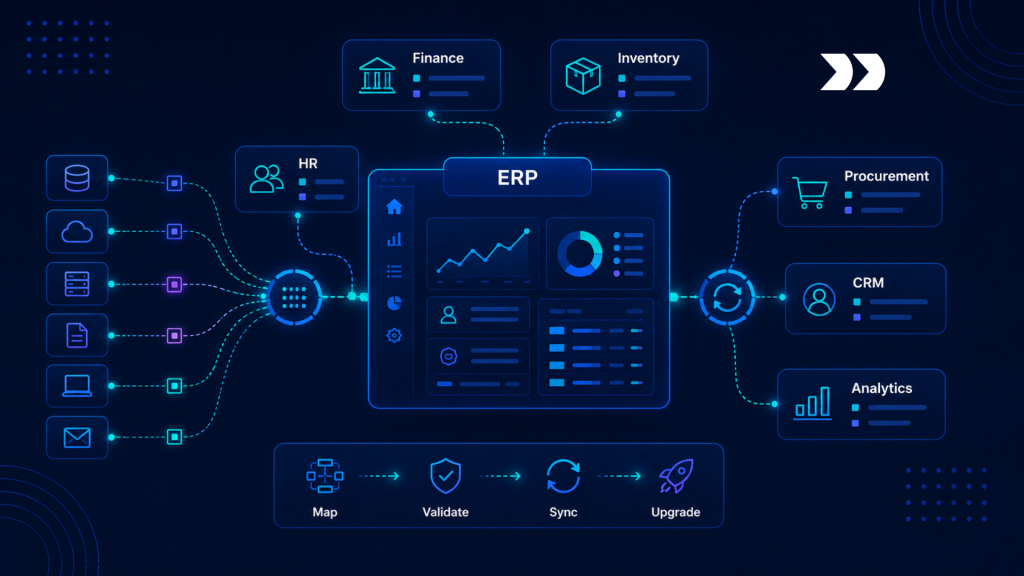
ERP modernization programs depend on accurate data movement across legacy ERP platforms, finance systems, procurement modules, inventory records, customer and vendor masters, manufacturing data, reporting warehouses, and downstream operational applications. When ERP Data Migration is poorly controlled, modernization teams face broken reconciliations, delayed cutovers, incomplete master data, duplicate records, and business users who lose trust in the new system before adoption begins. The issue is rarely only the target ERP platform. It is usually the migration operating layer behind the program: source profiling, data mapping, conversion rules, validation, reconciliation, access control, auditability, and cutover governance. ERP Data Migration gives finance, operations, IT, procurement, supply chain, and executive teams a structured way to move enterprise records into a modern ERP environment without weakening operational continuity.
The Migration Risk Gap in ERP Modernization
ERP modernization is often framed as a platform upgrade, but the greatest operational risk typically lies in the data transition. Legacy ERP environments contain years of customer records, vendor masters, chart of accounts structures, item records, open purchase orders, invoices, inventory balances, work orders, tax fields, approval histories, and custom attributes. Some fields may be obsolete, duplicated, incomplete, or maintained differently across business units.
This creates a migration risk gap. A target ERP system may be technically ready while the data remains unresolved. Finance may need reconciled balances. Procurement may need approved vendor records. Operations may need accurate item and inventory data. Reporting teams may need continuity across historical and new structures. NIST Cybersecurity Framework 2.0 is relevant because ERP modernization programs depend on governance, asset visibility, access control, monitoring, and risk management across connected enterprise systems.
Why ERP Data Becomes Difficult to Move
ERP data becomes difficult to move because it reflects how the business actually operated over time. Legacy systems often include custom fields, local naming conventions, inactive records, duplicate vendors, regional tax logic, historical workarounds, and undocumented dependencies. These records may have been usable in the old system because users knew the exceptions manually.
During ERP system migration, those exceptions become migration defects. A vendor may have multiple IDs across regions. A product may exist in inventory but not in the active item master. A customer may be linked to old payment terms. A chart of accounts segment may no longer map cleanly to the target design. ERP Data Migration reduces this risk by exposing legacy data issues early and converting records through governed rules.
Where ERP Migration Strategy Breaks Down
ERP migration strategy breaks down when data is treated as a late-stage technical task. Teams may focus on configuration, integrations, and process design while assuming legacy data can be extracted and loaded near cutover. In practice, migration requires early profiling, ownership, cleansing decisions, conversion rules, test loads, reconciliation, and business signoff.
Late discovery creates pressure. If vendor records fail validation close to cutover, procurement may not be ready. If open invoices do not reconcile, finance may delay go-live. Also, if item records lack required fields, warehouse operations may be blocked. At scale, ERP migration strategy must treat data migration as an operating workstream, not a final export step.
ERP Data Migration as an Operating Layer
ERP Data Migration becomes valuable when it operates as a controlled layer between legacy systems, transformation workflows, validation processes, and the target ERP environment. The goal is not simply to move records. The goal is to deliver accurate, reconciled, approved, and traceable business data into the new ERP system.
This operating layer should define which system owns each source field, which records are eligible for migration, which conversion rules apply, which exceptions require review, and which data must be reconciled before cutover. Without these controls, ERP modernization can move defects into a more expensive system. Data migration strategies for enterprises are crucial to ensure a smooth transition from outdated systems to modern solutions. These strategies often involve risk assessment, planning, and the use of automated tools to minimize errors. Ultimately, a well-defined approach can enhance data integrity and operational efficiency in the new environment.
Defining Ownership Across ERP Data Domains
Source ownership is the foundation of reliable ERP data conversion. Finance may own chart of accounts, cost centers, open receivables, payables, tax rules, and financial balances. Procurement may own vendor status, supplier categories, payment terms, and onboarding completeness. Operations may own item masters, warehouse records, production data, and inventory balances. Sales may own customer records, credit terms, and order history.
Clear ownership prevents migration disputes. For example, IT can extract vendor records, but procurement and finance must decide which vendors are active, payable, and compliant. A migration team can map chart of accounts segments, but finance must approve reporting continuity. The migration layer should preserve accountability before records move into the target ERP.
Creating a Source-to-Target Migration Model
A source-to-target migration model connects legacy table, legacy field, target object, target field, transformation rule, owner, validation rule, load sequence, and reconciliation requirement. This model does not require every source system to match the target ERP design. However, it does require clear mapping before ERP data conversion begins.
For example, a legacy vendor table may split legal name, local name, payment method, tax region, and bank references differently from the target ERP vendor object. A product item may require new mandatory fields in the target system. A cost center may need mapping into a new organizational hierarchy. ERP Data Migration should make these differences explicit before test loads begin.
Connecting Data Conversion to Cutover Decisions
ERP data conversion becomes commercially useful when it supports cutover decisions. Leadership needs to know whether open orders migrated, whether balances reconcile, whether master data passed validation, whether inactive records were excluded properly, and whether business owners signed off on exceptions.
In practice, migration teams need evidence, not assumptions. Test loads should produce validation results, defect logs, reconciliation outputs, and approval status. This allows steering committees to decide whether to proceed, delay, or narrow scope based on migration readiness.
Infrastructure Requirements for ERP Data Conversion
ERP data conversion depends on infrastructure that can extract, profile, transform, validate, load, reconcile, monitor, and govern records across legacy systems and the target ERP environment. The objective is not to create one-time scripts that only a few technical users understand. Teams need repeatable migration workflows that handle schema changes, load dependencies, failed records, reference mismatches, late source changes, and audit requirements.
ERP data is highly sensitive because it affects financial statements, purchasing, inventory, customer commitments, payroll-adjacent records, tax handling, and operational continuity. ISO/IEC 27001 is relevant because ERP migration programs require disciplined information security controls around access, confidentiality, risk treatment, and governance.
Continuous Profiling Across Legacy ERP and Related Systems
ERP migration data may come from legacy ERP databases, finance systems, procurement tools, inventory platforms, CRM records, manufacturing systems, supplier files, data warehouses, and spreadsheets created by business teams. Profiling should identify missing fields, duplicate records, inactive records, invalid references, outdated codes, inconsistent formats, and ownership gaps.
Apache Airflow can orchestrate recurring profiling, extract, and test-load workflows. Spark can process high-volume historical transactions, item masters, purchase orders, invoice records, and inventory snapshots. Controlled profiling helps teams detect migration defects before they become cutover blockers.
def route_erp_record(record):

    if record["migration_status"] == "validated":

        return {"action": "load_to_target_erp", "record_id": record["record_id"]}

    if record["migration_status"] == "failed":

        return {"action": "send_to_data_owner", "record_id": record["record_id"]}

    return {"action": "hold_for_review", "record_id": record["record_id"]}


REQUIRED_ERP_FIELDS = ["record_id", "source_system", "object_type", "migration_status"]


def validate_erp_record(record):

    missing = [field for field in REQUIRED_ERP_FIELDS if not record.get(field)]

    if missing:

        return {"valid": False, "reason": "missing_fields", "fields": missing}

    if record["object_type"] == "vendor" and not record.get("payment_terms"):

        return {"valid": False, "reason": "payment_terms_required"}

    return {"valid": True}


record = {

    "record_id": "VEN-48192",

    "source_system": "legacy_erp",

    "object_type": "vendor",

    "migration_status": "validated",

    "payment_terms": "NET30",

}


print(route_erp_record(record))

print(validate_erp_record(record))
This migration logic keeps ERP records controlled before target loading. Validated records can move into the new ERP environment, failed records can be routed to business owners, and incomplete objects can be blocked before they create downstream procurement or finance issues.
Normalizing Master Data, Transactions, and Reference Structures
Raw ERP data is rarely aligned with the target operating model. Legacy systems may use different customer IDs, vendor numbers, item codes, warehouse locations, tax categories, GL segments, units of measure, and approval statuses. Some fields may be optional in the legacy system but mandatory in the target ERP.
Normalization aligns customer records, vendor records, item masters, chart of accounts, cost centers, purchase orders, invoices, inventory balances, tax codes, payment terms, and reference data. dbt can manage repeatable transformation models and documentation. Data warehouses such as Snowflake, BigQuery, or Databricks can support staging, comparison, and reconciliation layers.
Validating ERP Data Before Target Load
Validation controls prevent incomplete or incorrect data from entering the target ERP system. These controls should check missing required fields, duplicate vendors, invalid customer references, inactive items, unmatched GL accounts, negative inventory balances, missing tax codes, invalid payment terms, and unresolved open transaction mismatches.
Validation should occur before test loads, mock cutovers, and final production loads. Data quality tools such as Great Expectations can support checks for completeness, uniqueness, accepted values, referential integrity, and cross-system consistency. Without validation, ERP system migration can transfer legacy defects into the modernized platform.
ERP_MIGRATION_RULES = {

    "required_fields": ["record_id", "object_type", "owner", "cutover_batch"],

    "blocked_statuses": ["draft", "unmapped", "unapproved"],

}


def validate_cutover_batch(item):

    missing = [f for f in ERP_MIGRATION_RULES["required_fields"] if not item.get(f)]

    if missing:

        return {"valid": False, "reason": "missing_fields", "fields": missing}

    if item.get("status") in ERP_MIGRATION_RULES["blocked_statuses"]:

        return {"valid": False, "reason": "not_ready_for_cutover"}

    return {"valid": True}


item = {

    "record_id": "ITEM-77102",

    "object_type": "inventory_item",

    "owner": "supply_chain",

    "cutover_batch": "mock_cutover_03",

    "status": "approved",

}


print(validate_cutover_batch(item))
This validation check prevents draft, unmapped, or unapproved records from entering cutover batches. A record can be blocked if it lacks ownership, object context, batch assignment, or approval status.
Technology Stack Behind ERP System Migration
ERP system migration requires a technology stack that supports extraction, staging, transformation, validation, reconciliation, loading, monitoring, and governance. The stack must support both repeated mock loads and controlled final cutover execution.
A mature environment connects legacy ERP databases, ETL/ELT pipelines, data quality tools, migration workbenches, target ERP APIs, staging databases, BI dashboards, and audit repositories through governed workflows. It should reduce manual migration work without weakening finance control, operational accountability, or security. Cloud data migration strategies for enterprises are essential for ensuring a smooth transition from on-premises to cloud-based systems. They involve meticulous planning and the use of advanced tools to help manage data integrity and minimize downtime. Organizations must also prioritize training their teams to adapt to new cloud environments and ensure optimal use of the migrated data.
Orchestration and Connectivity Using Airflow, APIs, and Migration Pipelines
Migration workflows often use APIs, database extracts, secure file transfers, and staging tables. Airflow can coordinate extraction schedules, transformation dependencies, validation jobs, load sequences, and exception reports. APIs can load validated records into target ERP modules or support reference checks.
The migration design should include retry logic, load sequencing, dependency checks, idempotency, failed-record handling, and batch monitoring. These controls matter because ERP objects are interdependent. Vendors, customers, items, cost centers, and accounts must be loaded in the right order before dependent transactions can move.
Processing and Transformation Through Spark, dbt, and ERP ETL Pipelines
Processing layers convert raw legacy ERP data into structured target-ready datasets. Spark can process high-volume historical transactions, invoices, purchase orders, work orders, inventory movements, and customer records. dbt can manage standardized models for field mapping, data conversion, business rules, and reconciliation-ready tables.
ERP ETL and ELT pipelines can normalize codes, split or merge fields, map legacy objects, align fiscal periods, convert units of measure, classify active records, and prepare target load files. This makes ERP data conversion repeatable rather than dependent on manual spreadsheet correction.
Storage, Analytics, and Governance in Snowflake, BigQuery, or Databricks
Snowflake, BigQuery, and Databricks can support migration staging and reconciliation layers where IT, finance, operations, and business owners review data quality, load status, exception trends, and reconciliation results. These platforms can store source extracts, mapped records, validation logs, failed loads, transformation history, and approval evidence.
Governance controls should include role-based access, audit logs, metadata catalogs, row-level security, lineage, retention rules, source documentation, and cutover versioning. These controls matter because ERP migration data affects financial reporting, operational continuity, and audit confidence.
Commercial Impact of ERP Data Migration
The commercial value of ERP Data Migration appears when modernization teams can trust the completeness, accuracy, and readiness of target ERP data. Better migration control can reduce cutover delays, improve reconciliation confidence, lower manual cleanup, protect business continuity, and support faster adoption of the modern ERP environment. The result is not only cleaner data movement. It is stronger ERP modernization execution.
For CFOs, CIOs, COOs, procurement leaders, finance controllers, and ERP program sponsors, the practical value is confidence. Integrated migration data helps teams understand which objects are ready, which records failed, which reconciliations passed, and which issues require business decisions.
Improving Cutover Confidence
Cutover confidence improves when teams have evidence that master data, open transactions, balances, and operational records are ready for production. Test loads should show pass rates, failed records, reconciliation gaps, and owner sign-off before final cutover.
This reduces go-live uncertainty. ERP modernization leaders can make decisions based on migration readiness rather than optimistic assumptions from technical load completion.
Reducing Manual Cleanup After Go-Live
Post-go-live cleanup is costly because business teams are already trying to operate in the new system. If vendor records are duplicated, items are incomplete, or open orders fail, teams may need workarounds that weaken adoption.
ERP Data Migration reduces cleanup by resolving defects before load. It also creates a documented exception process for issues that must be accepted into go-live scope.
Supporting Finance, Procurement, and Operations Continuity
ERP modernization affects daily operating processes. Finance needs reconciled balances and open items. Procurement needs usable suppliers and purchase orders. Operations needs inventory, items, production records, and warehouse locations. Customer-facing teams need order continuity.
Reliable migration pipelines help preserve these workflows. They make it easier for teams to continue operating after cutover without losing visibility into critical records.
Risk Exposure When ERP Migration Is Poorly Controlled
Poorly controlled ERP migration creates operational, financial, and governance risk. Financial balances may not reconcile. Vendors may be duplicated or blocked. Inventory may be inaccurate. Customer records may be incomplete. Open transactions may fail. Users may lose trust in the target ERP system.
The risk increases when legacy environments include multiple regions, customizations, acquisitions, historical workarounds, and undocumented dependencies. Manual migration approaches may work for small datasets, but they become fragile in enterprise ERP upgrade programs.
Reconciliation Failures and Financial Risk
Reconciliation failures occur when source balances do not match target balances or when open transactions do not map correctly. Finance may be unable to confirm receivables, payables, inventory value, or GL balances after migration.
ERP migration workflows should preserve source totals, transformation rules, load results, and reconciliation outputs. This allows finance to identify whether differences come from source data, mapping logic, excluded records, or target system rules.
Operational Disruption From Master Data Defects
Master data defects can disrupt procurement, order management, manufacturing, warehousing, and finance. A missing vendor payment term can block purchase orders. An incomplete item record can block inventory movement. An invalid customer record can delay invoicing.
ERP data conversion should validate required fields before target loading. It should also route defects to business owners, not only technical teams, because many defects require operational decisions.
Governance Gaps in Migration Evidence
Migration evidence can create governance issues if source extracts, transformation rules, approvals, and reconciliation results are not documented. Teams may complete migration technically but struggle to prove what was moved, what was excluded, and who approved exceptions.
NIST SP 800-53 is useful because ERP migration environments often require access control, audit logging, system monitoring, and security governance across sensitive enterprise data.
Governance Requirements for ERP Modernization Programs
ERP modernization programs must be governed because migrated data affects financial reporting, supplier payments, customer commitments, inventory, tax treatment, internal controls, and operational continuity. Data may come from legacy ERP modules, external applications, spreadsheets, acquired systems, and regional databases. Each source has different ownership, quality, and sensitivity.
Governance should make ERP migration data easier to trust while protecting sensitive business information. The goal is to give teams migration visibility without exposing confidential financial, supplier, customer, or employee-related data unnecessarily.
Source Documentation, Access Controls, and Audit Logs
Migration datasets should document source system, field owner, extraction date, transformation logic, validation result, load batch, exception owner, and approval status. Access controls should restrict sensitive supplier banking data, customer records, pricing data, financial balances, payroll-adjacent data, and tax fields. Audit logs should record who extracted, changed, approved, loaded, or rejected migration records.
These controls help finance, IT, operations, and audit teams demonstrate that ERP migration was based on approved and traceable workflows.
Data Lineage Across Source, Transformation, and Target ERP
Data lineage allows teams to understand how ERP data moved from source to target. Traceability should cover source extraction, profiling, mapping, transformation, validation, staging, test load, reconciliation, approval, and final load.
Lineage also supports debugging. If a vendor record appears incorrectly in the target ERP, teams can determine whether the issue came from legacy data, mapping logic, transformation rules, target load configuration, or manual exception handling.
Multi-Entity and Cross-Regional ERP Migration Considerations
ERP Data Migration becomes more complex across countries, currencies, legal entities, tax rules, languages, chart-of-accounts structures, and operating models. A field that is optional in one region may be mandatory in another. A vendor may be active in one legal entity but blocked in another. A tax rule may require localized handling.
Cross-regional controls should document legal entity mapping, currency conversion rules, tax logic, data residency, access rights, retention requirements, and permitted use. This reduces the risk that ERP system migration works technically but fails operationally or financially across markets.
Evaluating ERP Data Migration Readiness
ERP Data Migration becomes valuable when it supports repeatable migration workflows, not simply when records can be exported. Readiness depends on source ownership, field mapping, data profiling, transformation rules, validation controls, reconciliation, governance, mock cutover results, and exception handling.
A readiness review helps identify where migration risk accumulates before it becomes a cutover delay, reconciliation issue, operational blockage, or post-go-live cleanup burden.
How Teams Assess ERP Migration Data Quality
A structured assessment should evaluate duplicate vendors, missing customer fields, invalid GL references, incomplete item masters, unmatched purchase orders, open invoice reconciliation, inventory balance consistency, inactive record handling, tax code validity, and source-to-target mapping completeness. It should also review ownership, update cadence, validation coverage, exception volume, reconciliation results, and lineage completeness.
For ERP data conversion, quality must be evaluated operationally and financially. A record may look complete in the legacy system while still failing to support the target ERP process.
When Organizations Need an ERP Migration Architecture Review
An ERP migration architecture review becomes useful when teams rely on manual extracts, incomplete mapping files, inconsistent source data, failed mock loads, or reconciliation reports that do not explain differences. The review should assess source coverage, migration workflows, transformation logic, validation controls, staging architecture, reconciliation design, lineage tracking, governance posture, and cutover execution.
The output should clarify where ERP migration risk accumulates, where ERP data conversion may be incomplete, and which infrastructure improvements would make enterprise ERP upgrade execution more reliable for finance, IT, operations, procurement, and leadership teams. Effective migration validation testing strategies are essential to ensure data integrity throughout the transition process. Teams should focus on creating comprehensive test scenarios that cover all possible data paths and validation checks. By implementing robust testing frameworks, organizations can minimize risks associated with data discrepancies and enhance overall project success.
Conclusion: ERP Data Migration as Modernization Infrastructure
ERP modernization depends on reliable data movement across legacy ERP modules, finance systems, procurement tools, inventory platforms, customer records, vendor masters, reporting environments, and target ERP applications. When migration is inconsistent, teams spend excessive time reconciling balances, correcting master data, investigating failed loads, and delaying cutover decisions. ERP Data Migration creates the governed foundation needed to coordinate enterprise ERP upgrade programs across the full migration lifecycle.
Ultimately, organizations that treat ERP migration as modernization infrastructure, not just data export and load activity, will be better positioned to improve ERP migration strategy, strengthen ERP data conversion, reduce cutover risk, and build more reliable ERP system migration outcomes across the enterprise.