Key Takeaways
- Data Pipeline Architecture defines how enterprise data moves through ingestion, validation, transformation, enrichment, storage, publishing, monitoring, and governance layers.
- Enterprise data pipeline design should support reliability, modularity, scalability, observability, ownership, and downstream consumption requirements.
- Modular pipeline architecture reduces fragility by separating pipeline stages, making failures easier to isolate and recovery easier to control.
- Pipeline architecture patterns should reflect workload type, including batch processing, streaming, event-driven processing, ELT, ETL, AI feature preparation, and reporting pipelines.
- Scalable pipeline architecture requires validation gates, dependency controls, retry logic, lineage, metadata, orchestration, and audit-ready operating evidence.
Enterprise data pipelines become fragile when they grow as isolated jobs instead of managed architecture. A warehouse load may depend on source availability. A transformation may depend on schema consistency. A dashboard may depend on freshness. An AI feature pipeline may depend on stable historical context. A finance workflow may depend on reconciliation and timing. When these dependencies are not designed explicitly, scale exposes hidden weaknesses.
Data Pipeline Architecture creates the operating structure behind enterprise data movement. It defines how pipeline stages are separated, how dependencies are controlled, how errors are handled, how outputs are validated, and how downstream systems receive trusted data.
In scalable enterprise workloads, pipeline architecture is not only about moving records. It is about designing reliable data operations that can support analytics, AI, reporting, risk, customer, IoT, and real-time workloads without constant manual intervention.
Why Data Pipeline Architecture Matters at Enterprise Scale
Data Pipeline Architecture matters because enterprises rarely run one pipeline for one use case. The same platform may support BI dashboards, machine learning features, finance reports, customer 360 systems, operational monitoring, product analytics, IoT streams, and compliance outputs.
Deloitte’s enterprise data strategy and architecture guidance notes that organizations need enterprise data architecture to align business, technology, and data objectives. In pipeline engineering, that alignment is expressed through repeatable architecture, not one-off workflow scripts.
Why Pipelines Fail When They Are Designed as Jobs
A job performs a task. A pipeline architecture manages a flow. That distinction matters at scale.
A single job may extract data from a source, transform it, and load it into a target table. That can work early. However, as more sources, domains, transformations, consumers, and dependencies appear, isolated jobs become difficult to monitor, test, reuse, and recover.
The failure pattern is common. Teams add more logic to the same job. Validation is added after transformation. Retry logic is inconsistent. Downstream consumers depend on tables without clear freshness guarantees. Metadata is incomplete. Ownership is unclear. Eventually, the pipeline becomes critical but hard to operate.
Enterprise data pipeline design should separate stages and responsibilities so failures are visible and recovery paths are controlled.
How Pipeline Architecture Shapes Business Reliability
Data pipelines support business processes. If a pipeline is late, dashboards become stale. If a transformation fails silently, metrics become unreliable. Also, if a streaming job falls behind, operational systems act on delayed signals. If an AI feature pipeline receives incomplete data, model outputs can drift.
Gartner’s 2025 data and analytics trends highlight that data and analytics are becoming more embedded in enterprise operations. As data becomes operational infrastructure, pipeline architecture becomes a reliability concern, not only an engineering implementation choice.
Enterprise Data Pipeline Design Principles
Enterprise data pipeline design should define the pipeline’s structure before implementation. This includes source boundaries, stage separation, validation logic, transformation ownership, output contracts, metadata capture, and operational monitoring.
The objective is to build pipelines that can scale across workloads without becoming opaque or fragile. Effective enterprise data operations solutions can enhance the overall efficiency of data management. By adopting best practices in pipeline design, organizations can ensure robust data flows that meet their increasing demands. Additionally, these solutions contribute to improved data integrity and accessibility for all users within the enterprise.
Separating Pipeline Stages
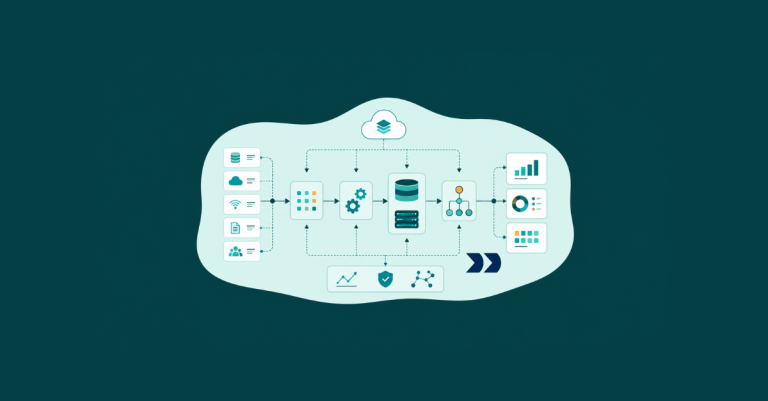
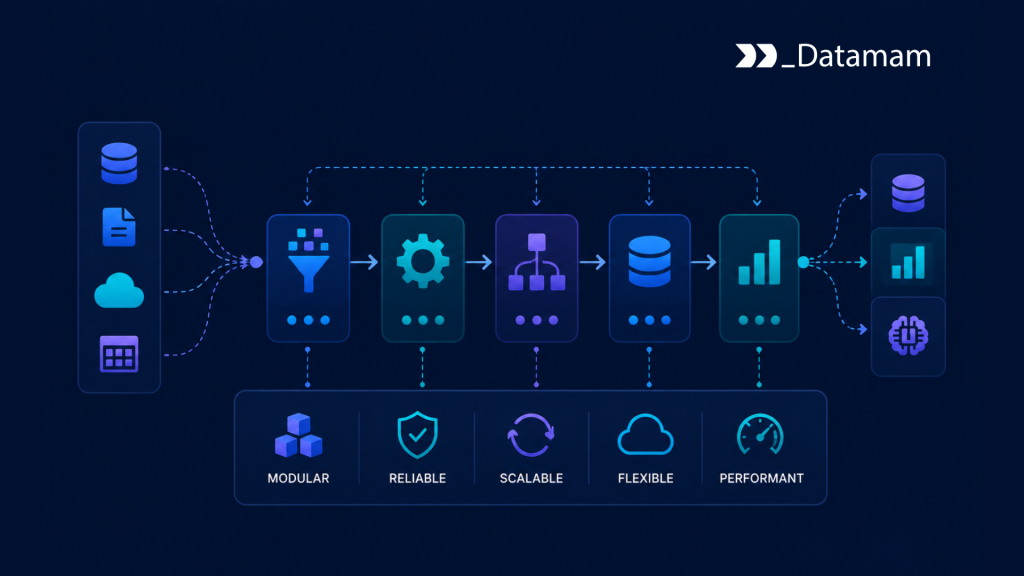
A scalable pipeline should usually separate ingestion, validation, transformation, enrichment, storage, publishing, and monitoring. Each stage should have a clear purpose and measurable output.
Ingestion captures data from source systems. Validation checks completeness, schema, freshness, and quality. Transformation standardizes and models data. Enrichment adds business logic or reference data. Publishing prepares outputs for downstream systems. Monitoring tracks health, latency, failures, and ownership.
This separation helps engineering teams isolate failures. If validation fails, transformation should not proceed blindly. If publishing fails, the pipeline should preserve validated data rather than rerun every upstream step unnecessarily.
Designing for Data Domains and Ownership
Pipeline architecture should reflect data domains. Customer, product, finance, risk, healthcare, IoT, and operational data often require different validation rules, owners, update frequencies, and governance controls.
Domain ownership makes pipelines more accountable. A finance pipeline should not rely only on central engineering teams to interpret business logic. A customer pipeline should involve CRM, billing, support, and privacy stakeholders where relevant. An AI feature pipeline should include model owners and data platform teams.
In practice, domain-aware pipeline architecture reduces ambiguity because ownership is assigned to the data being processed, not only to the code that processes it.
Building Validation Gates Before Downstream Use
Validation should be designed as a gate, not an afterthought. Pipelines should check whether data is complete, current, structurally valid, and acceptable before downstream systems consume it.
A simple pipeline run gate can look like this:
PIPELINE_STAGE_RULES = {

    "required_stages": ["ingested", "validated", "transformed", "published"],

    "blocked_results": ["schema_failed", "quality_failed", "source_missing"],

}


def approve_pipeline_run(run):

    missing = [stage for stage in PIPELINE_STAGE_RULES["required_stages"] if stage not in run.get("completed_stages", [])]


    if missing:

        return {"approved": False, "reason": "missing_pipeline_stages", "stages": missing}


    if run.get("result") in PIPELINE_STAGE_RULES["blocked_results"]:

        return {"approved": False, "reason": "blocked_pipeline_result"}


    return {"approved": True}
This is not a production framework. It shows the control principle: pipeline outputs should not be treated as ready until required stages and validation conditions are satisfied.
Modular Pipeline Architecture
Modular pipeline architecture breaks complex workflows into reusable, observable, and testable components. Instead of building one large pipeline that handles every source and destination, modular design separates responsibilities.
This improves maintainability, scalability, and recovery.
Why Modularity Reduces Operational Fragility
Large monolithic pipelines are difficult to operate because every change affects the full workflow. A small source change can break downstream reporting. A transformation defect can force full reruns. A single failure can hide which stage actually caused the issue.
Modularity reduces this fragility. Ingestion modules can be tested separately from transformation modules. Validation modules can be reused across domains. Publishing modules can handle destination-specific logic without rewriting upstream processing.
At scale, modularity also supports engineering velocity. Teams can update one component without destabilizing the full pipeline estate.
Designing Reusable Pipeline Components
Reusable components may include source connectors, schema validation rules, data quality checks, transformation templates, enrichment logic, publishing handlers, retry policies, and observability events.
For example, a schema validation component may apply across CRM, ERP, product, and finance pipelines with domain-specific rules. A publishing module may support Snowflake tables, BigQuery datasets, Kafka topics, dashboard extracts, or feature stores using consistent status tracking.
Tools such as Airflow, Dagster, Prefect, dbt, Spark, Kafka, Snowflake, BigQuery, and cloud storage services can support modular architectures. However, the tool choice matters less than the architectural discipline: each module needs clear inputs, outputs, ownership, and failure behavior.
Preventing Module Sprawl
Modularity can also create risk if every team builds its own component style. Without standards, modular pipelines become fragmented. Naming conventions differ. Metadata fields vary. Retry logic is inconsistent. Logs cannot be compared. Lineage becomes incomplete.
Pipeline standards should define how modules are named, versioned, documented, monitored, and approved. This preserves flexibility without losing enterprise control.
Pipeline Architecture Patterns for Enterprise Workloads
Pipeline architecture patterns should reflect workload behavior. Batch reporting, streaming telemetry, AI feature generation, operational analytics, and compliance reporting do not need identical architectures.
The right pattern depends on latency, volume, governance, accuracy, and downstream use.
Batch, Streaming, and Hybrid Patterns
Batch pipelines are useful when workloads require scheduled processing, reconciliation, aggregation, or controlled reporting windows. Finance reports, procurement summaries, compliance archives, and executive dashboards often use batch or scheduled patterns.
Streaming pipelines are useful when events need low-latency processing. IoT telemetry, fraud signals, customer behavior events, inventory updates, and operational monitoring may require streaming or near-real-time processing.
Hybrid patterns combine both. A streaming system may capture events continuously while a batch layer reconciles results daily. An AI feature platform may use streaming for recent behavior and batch pipelines for historical features.
The architecture should match the operational requirement. Real-time processing is not automatically better if the use case requires review, stability, or reconciliation.
ETL, ELT, and Transformation Placement
ETL transforms data before loading it into the target environment. ELT loads data first and transforms it inside the warehouse or lakehouse. Both patterns can be valid.
ETL may be appropriate when sensitive data must be filtered before storage, when target systems cannot handle raw structures, or when upstream processing reduces volume. ELT may be appropriate when cloud warehouses or lakehouse platforms provide scalable transformation capacity and teams need raw history for audit or reprocessing.
Pipeline architecture should define where transformation belongs based on governance, cost, performance, lineage, and downstream requirements.
Event-Driven Pipeline Patterns
Event-driven pipelines react to system events such as customer updates, payment changes, inventory movement, support ticket changes, or sensor readings. These patterns require different controls from scheduled jobs.
They need idempotency, event ordering, duplicate handling, replay controls, and consumer lag monitoring. Event-driven architecture can improve responsiveness, but it also increases operational complexity.
In this context, pipeline architecture should define how events enter the platform, how they are validated, where they are buffered, and how downstream consumers receive trusted outputs.
Scalability Mechanics in Data Pipeline Architecture
Scalability is not only about processing more records. It is about handling more sources, consumers, domains, failures, and governance requirements without redesigning the platform every time demand grows.
Pipeline scalability depends on workload isolation, dependency control, observability, and automation.
Managing Workload Isolation and Capacity
Enterprise platforms often process mixed workloads. A large historical backfill should not block a critical finance update. A streaming telemetry pipeline should not be slowed by a low-priority reporting job. AI feature generation should not consume all transformation capacity during business reporting windows.
Workload isolation can involve separate queues, compute pools, warehouse clusters, priority classes, processing windows, or domain-specific pipelines.
The architecture should define which workloads share infrastructure and which require isolation. Without this design, scale creates unpredictable performance problems.
Controlling Dependencies Between Pipelines
Pipeline dependencies should be explicit. A downstream transformation should know which upstream outputs it depends on. A dashboard refresh should know which tables must be current. A feature pipeline should know which source events are required before model input generation.
A dependency check can look like this:
PIPELINE_DEPENDENCY_RULES = {

    "customer_360": ["crm_accounts_ready", "billing_profiles_ready", "support_history_ready"],

    "finance_reporting": ["ledger_ready", "invoice_ready", "payment_ready"],

}


def validate_pipeline_dependencies(pipeline_name, completed_dependencies):

    required = PIPELINE_DEPENDENCY_RULES.get(pipeline_name)


    if not required:

        return {"ready": False, "reason": "unknown_pipeline"}


    missing = [dependency for dependency in required if dependency not in completed_dependencies]


    if missing:

        return {"ready": False, "reason": "missing_dependencies", "dependencies": missing}


    return {"ready": True}
This keeps dependency control clear. A pipeline should not proceed simply because its job is scheduled. It should proceed when required upstream conditions are satisfied.
Designing for Backfill and Reprocessing
Enterprise pipelines must support backfills and reprocessing. Source corrections, schema changes, late-arriving data, historical enrichment, and incident recovery can all require rerunning data through the pipeline.
Backfill design should avoid damaging current workloads. It should define historical windows, compute isolation, output overwrite rules, validation checks, and downstream notification.
Without backfill controls, teams may correct historical data while accidentally changing current reports or model inputs.
Observability, Metadata, and Governance Controls
Data Pipeline Architecture must include visibility and governance. A pipeline that runs without observable evidence is difficult to trust, especially when it supports regulated, financial, AI, or executive reporting use cases.
The OECD’s data governance work frames governance as technical, policy, and regulatory structures that manage data across its value cycle. Pipeline architecture fits this model because pipelines control how data is transformed, validated, moved, and made available across that lifecycle. Implementing metadata management best practices is crucial for ensuring the integrity and usability of data throughout the pipeline. These practices help mitigate risks associated with data governance and enhance the ability to audit and trace data lineage effectively. By focusing on structured metadata, organizations can improve collaboration and streamline data access, making it easier for stakeholders to derive insights.
Capturing Pipeline Metadata
Pipeline metadata should include owner, data domain, source system, transformation logic, validation rules, schedule, freshness expectation, downstream consumers, lineage, and failure history.
Metadata helps teams understand what the pipeline does and who is affected when it fails. It also supports auditability, incident response, and change review.
In practice, metadata should be captured as part of the pipeline workflow, not maintained manually after deployment.
Monitoring Pipeline Health
Pipeline health monitoring should track freshness, volume, validation status, schema changes, latency, retry count, failure category, downstream delay, and data quality outcomes.
A pipeline can be technically successful but operationally unhealthy. For example, it may run on time but process incomplete source data. It may publish outputs but fail validation thresholds. It may refresh a dashboard while using stale upstream partitions.
Monitoring should therefore evaluate data reliability, not only job completion.
Preserving Audit Evidence
Audit evidence should capture pipeline runs, validation results, schema changes, failed records, approvals, exception decisions, lineage, and downstream publication status.
NIST’s Security and Privacy Controls for Information Systems and Organizations provides control families for auditability, integrity, access control, configuration management, and system protection. Enterprise pipeline architecture can apply the same control mindset by preserving evidence of how data was processed and governed.
Technology and Architecture Considerations
Modern pipeline architecture often uses orchestration, distributed processing, transformation frameworks, warehouses, streaming systems, object storage, observability platforms, catalogs, and data quality tooling.
The architecture should make these systems work together instead of creating disconnected layers.
Orchestration and Processing
Airflow, Dagster, Prefect, Spark, Kafka, dbt, and warehouse-native scheduling can all support pipeline execution depending on workload type. Orchestration should define sequencing, dependency checks, retries, alerts, and recovery behavior.
Processing systems should be selected based on volume, latency, transformation complexity, and cost profile. A small scheduled reporting pipeline does not need the same architecture as a high-volume streaming telemetry system.
The enterprise standard should define when to use which pattern. Effective data pipeline optimization techniques can significantly reduce processing times and improve resource utilization. Organizations should regularly evaluate their current systems to identify bottlenecks and make necessary adjustments. By implementing these optimizations, teams can achieve a more resilient and efficient data processing environment.
Storage and Analytical Platforms
Snowflake, BigQuery, Databricks, cloud object storage, relational databases, and lakehouse platforms can all serve different roles in pipeline architecture. Raw zones may preserve source history. Curated zones may support reporting. Feature stores may support AI workloads. Marts may support domain-specific analytics.
The architecture should define what each storage layer is for. Without that clarity, teams duplicate data, create inconsistent transformations, and weaken governance.
Data Quality and Metadata Integration
Great Expectations, dbt tests, catalog tools, lineage systems, and observability platforms can support validation and governance. However, they should be integrated into pipeline operations.
Validation results should influence pipeline status. Metadata should update when outputs change. Lineage should reflect actual transformations. Observability should alert the right owner when reliability degrades.
Tooling creates value only when it is connected to the operating model.
Governance and Operating Model for Pipeline Architecture
Pipeline architecture requires governance because pipelines become shared enterprise assets. They support decisions, models, reports, and operational workflows.
Governance should define who owns pipelines, who approves changes, how standards are enforced, and how failures are reviewed.
Creating Pipeline Ownership
Each production pipeline should have an owner. Ownership may include the data product owner, engineering owner, platform owner, domain owner, and governance contact.
Ownership should be visible in metadata and monitoring systems. When a pipeline fails, teams should know who is accountable for remediation.
This prevents critical pipelines from becoming orphaned workflows.
Reviewing Architecture Standards
Pipeline standards should define design patterns, validation requirements, retry behavior, naming conventions, metadata fields, logging rules, dependency documentation, and release review.
Standards should not prevent engineering flexibility. They should prevent uncontrolled variation in critical pipeline behavior.
At scale, standards reduce operational risk because teams can understand and operate pipelines built by different groups.
Managing Change and Release Control
Pipeline changes should be reviewed based on impact. A minor transformation update may need lightweight review. A change affecting finance reporting, AI features, compliance outputs, or customer operations may require deeper testing and approval.
Change control should capture what changed, why it changed, who approved it, and which downstream consumers were affected.
This makes pipeline architecture auditable and reliable over time.
Conclusion: Turning Pipelines Into Enterprise Data Infrastructure
Data Pipeline Architecture gives enterprises the structure needed to operate data at scale. It connects enterprise data pipeline design, modular pipeline architecture, pipeline architecture patterns, validation gates, dependency controls, observability, metadata, governance, and operational ownership.
Strong architecture prevents pipelines from becoming fragile collections of jobs. It helps teams isolate failures, validate outputs, manage dependencies, support backfills, control workloads, and preserve audit evidence.
The capability matters because enterprise data platforms now support analytics, AI, finance, customer operations, healthcare analytics, IoT, and real-time decision systems. When pipeline architecture is weak, every new workload adds fragility. When it is modular, governed, and observable, data engineering becomes a scalable enterprise capability.
A structured review can help evaluate whether current workflows have reliable Data Pipeline Architecture, enterprise data pipeline design, modular pipeline architecture, and pipeline architecture patterns. You can run an external data infrastructure audit with our team to review your current setup and understand what is required to build reliable, enterprise-scale data engineering infrastructure.