
Key Takeaways
- Data-Centric AI shifts enterprise AI strategy from model experimentation toward data quality and operational reliability.
- Model data quality determines whether AI systems remain useful after deployment.
- Data-centric machine learning requires stronger ownership across data engineering, governance, domain expertise, and business teams.
- Enterprise AI leadership increasingly depends on whether data systems can sustain trustworthy model performance over time.
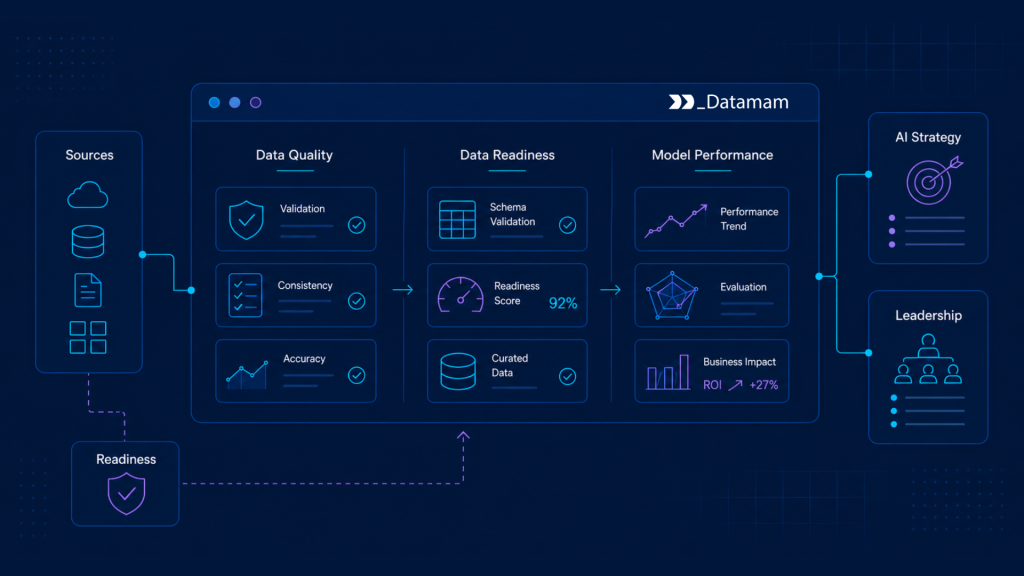
Enterprise AI leadership is shifting from a model-first mindset to a data-first operating discipline. For years, many AI programs were evaluated through model selection, experimentation speed, compute capacity, and proof-of-concept performance. Those factors still matter. However, as organizations move AI systems into production, leaders are increasingly discovering that model performance is constrained by the quality, structure, governance, and reliability of the data behind the system.
Data-Centric AI reframes this issue. Instead of treating data as a fixed input and models as the primary source of improvement, it treats data quality, coverage, labeling, lineage, validation, and refresh cycles as central drivers of AI performance. This shift changes executive accountability. AI leadership is no longer only about choosing better models. It is about building the data systems that allow models to operate reliably at enterprise scale.
Data-Centric AI Moves Enterprise AI Strategy Beyond Model Selection
Many enterprise AI programs begin with a model question. Which foundation model should be used? Which algorithm performs best? Also, which vendor offers the strongest capability? These questions are valid, but they are incomplete. In production environments, model performance depends heavily on the data system surrounding the model, including how data is sourced, prepared, labeled, refreshed, and governed.
McKinsey’s State of AI 2025 shows that AI adoption has become widespread, but many organizations still have not embedded AI deeply enough into workflows and processes to realize material enterprise-level benefits. That gap points to a broader leadership issue. AI value is not created by experimentation alone. It depends on the operational systems that support AI after deployment.
Leadership Teams Are Reframing AI Performance Around Data Quality, Not Only Algorithms
Executives are beginning to recognize that better models cannot fully compensate for weak data foundations. A technically advanced model trained on incomplete, outdated, biased, or poorly labeled data will still produce unreliable outcomes. The problem may appear as lower accuracy, inconsistent recommendations, weak personalization, hallucinated outputs, unstable forecasts, or poor performance in edge cases.
Data-Centric AI changes the leadership conversation. Instead of asking only whether the model is strong enough, leaders must ask whether the data is representative enough, fresh enough, traceable enough, and governed enough for production use. This distinction matters because data quality problems often become visible only after a model enters real workflows.
In practice, the most mature AI teams evaluate performance as a system outcome. Model architecture, data quality, workflow design, monitoring, and governance all determine whether AI creates enterprise value.
Data-Centric Machine Learning Creates Accountability for Inputs Before Outputs
Data-centric machine learning creates accountability before model outputs are generated. It asks whether training data reflects the real environment, whether labels are consistent, whether source data is trustworthy, whether edge cases are represented, and whether the dataset can be audited.
This is a different operating model from traditional experimentation. In many early AI projects, teams focus on improving outputs through model tuning. Data-centric machine learning moves attention upstream. It treats source quality, annotation standards, feature definitions, dataset balance, and metadata as levers of performance.
Consequently, accountability expands beyond data science teams. Data engineering teams must manage pipelines. Domain experts must validate labels and business meaning. Governance leaders must ensure traceability and compliance. Product and business owners must define what “good performance” means in context. Data-Centric AI, therefore, reshapes leadership by making input quality an enterprise responsibility.
Why Model Data Quality Is Becoming a Strategic Leadership Concern
Model data quality has become a strategic concern because AI systems increasingly affect decisions that have operational, financial, legal, and customer-facing consequences. When model outputs influence pricing, risk scoring, search ranking, customer support, demand forecasting, fraud detection, or workflow automation, weak data quality is no longer a technical inconvenience. It becomes enterprise exposure.
NIST’s AI Risk Management Framework is designed to help organizations incorporate trustworthiness considerations into the design, development, use, and evaluation of AI systems. For enterprise leaders, this reinforces a practical point: AI governance must include the data foundation, not only the model or application layer.
Poor Data Quality Limits AI Reliability Even When Models Are Technically Advanced
Poor data quality limits AI reliability in ways that model benchmarks may not fully reveal. A model may score well in aggregate testing while underperforming on specific customer segments, regions, languages, product categories, or rare scenarios. These failures often originate in the training data.
Missing values, duplicate records, inconsistent schemas, weak annotations, outdated examples, or underrepresented edge cases can all shape model behavior. If a recommendation model lacks current product availability data, it may suggest unavailable items. When a forecasting model relies on historical patterns without current external signals, it may miss demand shifts. A classification model trained on inconsistent labels may behave unpredictably across similar cases.
The strategic issue is that poor data quality reduces trust. Leaders may hesitate to scale AI if outputs cannot be explained or if failures appear uneven across business contexts.
Enterprise AI Teams Need Traceable Evidence Behind Training, Validation, and Evaluation Data
Enterprise AI teams need evidence behind the datasets that shape model behavior. This includes documentation of sources, transformations, label logic, dataset versions, validation rules, refresh cycles, and evaluation coverage. Without this evidence, AI systems become difficult to defend when stakeholders ask why the model behaved a certain way.
Traceability matters because production AI systems evolve. Datasets change. Labels are updated. New sources are added. Features are removed. Model versions are retrained. If teams cannot connect model behavior back to specific data versions, root-cause analysis becomes slow and uncertain.
In regulated or high-risk environments, traceability also supports governance and compliance. Audit logs, metadata, lineage records, and access controls help organizations show how data was used and whether controls were applied. Model data quality, therefore, becomes both a performance requirement and a governance requirement.
The Shift from Model Experimentation to Data Discipline
Enterprise AI programs often begin with experimentation because experimentation is necessary for discovery. However, experimentation and production require different disciplines. A prototype can succeed with a limited dataset, manual review, or narrow evaluation criteria. Production AI systems must operate continuously across changing business conditions, user behavior, source data, and regulatory expectations.
The World Economic Forum’s AI in Action 2025 report focuses on moving beyond experimentation toward responsible industry transformation. This distinction is central to data-centric AI. Organizations cannot transform operations with AI unless the data layer is stable enough to support production systems over time.
AI Prototypes Can Hide Data Weaknesses That Production Systems Cannot Tolerate
AI prototypes often hide data weaknesses because their operating environment is controlled. Teams may select clean examples, manually correct labels, limit the scope of use, or test the model against known scenarios. These practices are appropriate for experimentation, but they can create false confidence when the organization prepares for deployment.
Production systems face greater variation. Users behave unpredictably. Source systems change. External environments shift. New edge cases appear. Business definitions evolve. Data pipelines fail. If the training data strategy does not account for this variation, a model that looked promising in a prototype can become unreliable in production.
This is why the data-centric discipline must begin before deployment. Leaders need to understand whether the data foundation is ready for scale, not only whether the prototype performed well in a limited test.
Data-Centric AI Forces Organizations to Manage Datasets as Long-Term Infrastructure
Data-Centric AI treats datasets as long-term infrastructure rather than temporary development inputs. A production AI dataset needs ownership, versioning, documentation, refresh logic, validation rules, quality thresholds, and governance controls. It must be maintained because the operating environment changes.
This approach changes the economics of AI leadership. The cost of AI does not end when the model is trained. Ongoing value depends on whether the organization can keep datasets current, representative, and trusted. As a result, leaders must invest in data operations, not just model development.
A data-centric organization can identify when source quality changes, when labels drift, when coverage gaps appear, and when retraining is justified. Without that discipline, AI systems decay quietly while dashboards continue to show activity.
How Data-Centric Machine Learning Changes AI Operating Models
Data-centric machine learning changes how AI teams are organized. It reduces the separation between data science, engineering, governance, domain expertise, and business ownership. Model performance becomes a shared operating outcome rather than a narrow technical result. This shift is especially important when AI systems move from experimentation into enterprise workflows.
Gartner’s 2025 Data and Analytics Predictions state that by 2027, half of business decisions will be augmented or automated by AI agents for decision intelligence. Gartner also warns that failures in managing synthetic data can create risks for governance, model accuracy, and compliance. These predictions reinforce the need for stronger data-centric operating models as AI becomes more embedded in decision systems.
Data Engineering, Governance, and Domain Expertise Become Core to AI Performance
AI performance increasingly depends on disciplines that sit outside model training alone. Data engineering ensures that pipelines are reliable, scalable, and consistent. Governance ensures that data use is traceable, compliant, and controlled. Domain expertise ensures that labels, features, evaluation sets, and model outputs reflect business reality.
A data science team may understand model behavior, but domain experts understand whether the data represents the problem correctly. Engineering teams may build pipelines, but governance teams ensure those pipelines preserve lineage and access controls. Business leaders may define use cases, but data teams must translate those use cases into reliable input structures.
Accordingly, data-centric machine learning requires cross-functional ownership. It creates a model where AI performance is jointly shaped by technical systems, data quality, and business context.
Cross-Functional Ownership Reduces the Gap Between Business Context and Model Behavior
Many AI failures occur when there is a gap between the business context and model behavior. A model may optimize for the wrong target, learn from mislabeled examples, underrepresent important scenarios, or produce outputs that are statistically valid but operationally unhelpful. Cross-functional ownership reduces this gap.
Business teams help define the decision the model supports. Domain experts validate whether examples and labels reflect real conditions. Data teams manage quality, pipelines, and transformations. Governance teams ensure traceability and compliance. AI teams evaluate performance across relevant segments and edge cases.
This operating model improves model data quality because it embeds business meaning into the data lifecycle. The model becomes less isolated from the environment where it must perform.
The Infrastructure Layer Behind Data-Centric AI
Data-centric AI requires infrastructure that can manage data across sourcing, validation, transformation, labeling, versioning, storage, observability, and governance. Without this infrastructure, data quality depends too heavily on manual work, informal knowledge, and one-time cleanup efforts. Those methods are not sufficient for production AI systems that must operate continuously.
The World Economic Forum’s 2025 article on scaling AI with strategy, data, and workforce readiness argues that leaders must embed AI into strategy while building strong data foundations for enterprise-wide scale. That principle aligns directly with data-centric AI: organizations cannot scale trustworthy AI without strengthening the systems that manage model inputs.
Validation, Versioning, Lineage, and Metadata Improve Model Data Quality
Validation ensures that datasets meet expected quality standards before they influence model behavior. Versioning preserves the exact datasets used for training, validation, and evaluation. Lineage shows how data moved from source to model input. Metadata explains source, ownership, processing logic, label method, timing, and usage.
Tools such as Great Expectations can support schema validation, completeness checks, and anomaly detection. Data lineage tools and metadata systems help teams trace datasets across transformations. Storage and analytics platforms such as Snowflake, BigQuery, and Databricks can support large-scale dataset management, historical versions, and analytical workflows.
When external data is part of the model input environment, browser automation frameworks such as Playwright may be required to capture dynamic web sources. Airflow can orchestrate recurring workflows, Kafka can support continuous data movement, Spark can process large-scale datasets, and dbt can structure transformations into governed models. The stack may differ by organization, but the requirement is consistent: data must be managed as a reliable production asset.
Observability Systems Help AI Teams Detect Drift, Coverage Gaps, and Data Pipeline Failures
Observability is essential because data quality changes over time. Source systems fail. Schemas drift. Labels become inconsistent. External signals change. Missing values increase. Distribution shifts occur. Coverage gaps appear as new customer segments, product categories, or market conditions emerge.
Prometheus and other observability systems can monitor pipeline health, data freshness, latency, failures, and coverage. Model monitoring systems can track prediction drift, output stability, and performance changes across segments. Metadata systems help connect these changes back to dataset versions and source conditions.
Without observability, teams may discover data problems only after model outputs degrade. Stronger monitoring allows organizations to detect issues earlier, determine whether the root cause is data-related, and decide when retraining, relabeling, or pipeline correction is required.
Why Data-Centric AI Is Becoming an Executive AI Capability
Data-Centric AI is becoming an executive capability because AI systems increasingly influence enterprise decisions, customer experiences, operational workflows, and risk controls. Leaders cannot delegate the entire issue to data science teams. They need to understand whether the organization has the data infrastructure, governance model, and operating discipline required to scale AI responsibly.
IBM’s 2025 CDO Study emphasizes that organizations need high-quality data and governance frameworks to unlock value from proprietary and ecosystem data. For AI leadership, this means data quality is not a back-office concern. It is one of the central conditions for realizing enterprise AI value. To achieve these goals, organizations are increasingly turning to ai data annotation services for enterprises, ensuring that their datasets are accurately labeled and enriched. This step is critical in enhancing machine learning models and delivering meaningful insights. By investing in high-quality data annotation, leaders can better support their AI initiatives and drive successful outcomes across their operations.
Enterprise AI Strategy Depends on Whether Data Systems Can Sustain Reliable Model Performance
Enterprise AI strategy depends on whether data systems can sustain performance after deployment. A model can be launched, but the organization must keep it reliable. That requires fresh data, validated inputs, representative coverage, traceable sources, and monitoring for drift or degradation.
This changes how executives should evaluate AI readiness. Instead of asking only whether the model works, leaders should ask whether the data system can support the model over time. Are data sources stable? Are labels consistent? Also, are important segments represented? Is lineage preserved? Are pipeline failures visible? Is compliance built into the workflow?
These questions determine whether AI systems can move from pilots to production with confidence.
AI Leaders Need Data-Centric Operating Models to Scale Production AI With Trust
Scaling AI with trust requires a data-centric operating model. This means treating data quality, annotation standards, validation, lineage, governance, observability, and refresh cycles as leadership priorities. It also means aligning data engineering, AI teams, domain experts, compliance leaders, and business owners around shared responsibility for model performance.
Ultimately, Data-Centric AI is reshaping enterprise AI leadership because it makes the data foundation visible as a strategic asset. Enterprise AI strategy can no longer depend only on model selection or experimentation speed. It must depend on model data quality, operational discipline, and trustworthy data systems.
Organizations that adopt data-centric machine learning will be better positioned to build production AI systems that remain reliable under changing conditions. Those that remain model-centric may continue producing impressive prototypes, but they will struggle to sustain enterprise AI performance when data quality, governance, and operational complexity begin to determine real-world outcomes.