
Key Takeaways
- Training data confidence determines whether AI systems can be trusted beyond controlled testing.
- Model input reliability affects forecasting, automation, compliance review, and production decision-making.
- Annotation confidence is now a strategic control point because inconsistent labels create hidden model weaknesses.
- Enterprise AI trust depends on validation, lineage, metadata, governance, and observability across the data lifecycle.
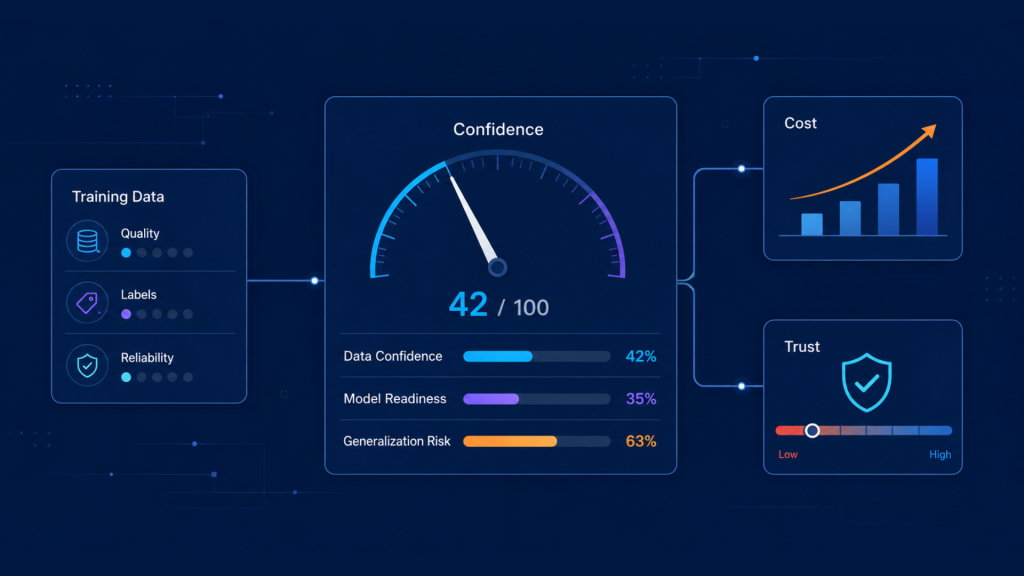
Training data confidence is becoming one of the most important constraints in enterprise AI. A model may perform well in testing, pass internal benchmarks, and still face resistance once leaders ask a harder question: can the organization trust the data behind the model? When teams cannot explain where training data came from, how it was labeled, whether it represents the operating environment, or how quality was validated, confidence breaks before model performance fully collapses.
This is where AI trust becomes an enterprise issue rather than a technical concern. Weak confidence in training data slows deployment, increases governance review, creates uncertainty for legal and compliance teams, and reduces executive willingness to rely on production AI systems. The cost is not only lower model accuracy. It is delayed adoption, duplicated review, rework, and weaker trust in AI-supported decisions.
Why AI Trust Breaks Before Model Performance Fully Declines
AI trust often weakens before performance metrics show a dramatic failure. Leaders may not immediately see model degradation in aggregate dashboards, but they begin to question whether the system can be relied on in production. That concern usually appears when teams cannot explain the inputs behind the model, the labeling standards used during training, or the coverage of critical edge cases.
McKinsey’s State of AI 2025 shows that organizations continue to expand AI adoption, yet many still struggle to generate scaled enterprise impact. That gap is not only about models or tools. It is also about whether organizations can embed AI into real workflows with enough trust, governance, and operational discipline to support business decisions.
Leaders Lose Confidence When Model Inputs Cannot Be Explained
Executives do not need to inspect every training example. However, they do need assurance that model inputs are explainable, representative, and governed. When data teams cannot clearly describe source selection, labeling logic, dataset coverage, or data refresh cycles, leadership confidence declines.
A model used for customer segmentation may rely on incomplete behavioral data. A risk model may underrepresent rare but material events. A recommendation model may learn from outdated product availability. An automation system may inherit inconsistent labels from multiple annotation teams. Each issue creates uncertainty about whether the model can be trusted in the environment where it will operate.
Training data confidence, therefore, becomes an executive trust signal. If the input foundation cannot be explained, the output becomes harder to defend.
Production Decisions Require Evidence Behind the Data, Not Only Model Outputs
Production AI systems influence real decisions. They may affect pricing, fraud detection, search ranking, forecasting, customer support, underwriting, procurement, or operational prioritization. In these environments, model outputs must be supported by evidence about the data behind them.
Accuracy scores alone are not enough. Leaders need to know whether the training data reflects current conditions, whether labels are consistent, whether source quality was evaluated, and whether dataset changes are tracked across model versions. Without that evidence, teams may hesitate to deploy models even when evaluation metrics look strong.
In practice, weak training data confidence creates a governance bottleneck. The organization cannot move quickly because the model may be technically promising but institutionally difficult to trust.
The Hidden Cost of Unreliable Training Foundations
The cost of unreliable training data often appears indirectly. Projects take longer to move into production. Compliance teams request additional documentation. Data scientists rebuild datasets. Engineers adjust pipelines after deployment issues. Business owners delay adoption because outputs feel inconsistent. Legal teams question sourcing, consent, or retention practices. These costs accumulate across the AI program.
IBM’s 2025 CDO Study emphasizes the importance of high-quality data and governance frameworks for unlocking value from proprietary and ecosystem data. That point is central to enterprise AI. Models do not become reliable because data exists. They become reliable when data is trusted enough to support operational and strategic use.
Model Input Reliability Shapes Forecasting, Automation, and Risk Decisions
Model input reliability affects the business functions that depend on AI. Forecasting systems require representative historical and current data. Automation systems require stable inputs and clear labels. Risk models need adequate coverage of rare events, anomalies, and edge cases. Customer-facing systems need clean and current data that reflects real usage patterns.
When input reliability is weak, model behavior becomes harder to interpret. Forecasts may shift unexpectedly. Automated decisions may become inconsistent across segments. Risk outputs may underperform in unusual conditions. Customer experiences may degrade when models rely on outdated or incomplete signals.
Accordingly, model input reliability is not a narrow data quality issue. It shapes whether AI systems can operate with consistency in the parts of the enterprise where mistakes become expensive.
Weak Data Provenance Creates Friction Across AI, Legal, and Compliance Teams
Data provenance explains where data came from, how it was collected, what transformations were applied, and whether it can be used for the intended purpose. When provenance is weak, legal and compliance teams face uncertainty. They may not know whether data was sourced appropriately, whether restrictions apply, whether cross-border rules are relevant, or whether sensitive fields were handled correctly.
This uncertainty slows AI deployment. Teams must reconstruct documentation, review sources manually, and validate assumptions late in the project. In some cases, models must be retrained because the organization cannot defend the original dataset.
NIST’s AI Risk Management Framework emphasizes governance, measurement, and management practices across the AI lifecycle. For enterprise AI teams, provenance is part of that lifecycle discipline. Without traceable inputs, model trust becomes difficult to sustain under review.
Annotation Quality Has Become a Strategic Control Point
Annotation quality is often treated as a production detail, but it has become a strategic control point for enterprise AI. Labels define what the model learns. If labels are inconsistent, subjective, poorly documented, or misaligned with business objectives, the model may learn patterns that weaken performance in production. The risk is especially high when models support regulated, customer-facing, or high-value business decisions.
Gartner’s 2025 data and analytics governance research notes that generative AI and the need to govern unstructured data are straining existing data governance operating models. Meaning, annotation is part of this strain because much AI training depends on text, images, documents, conversations, product content, public data, and other unstructured sources that require human or automated labeling discipline.
Annotation Confidence Determines Whether Labels Can Support Enterprise Use Cases
Annotation confidence refers to how much trust teams can place in the labels used for training, testing, and evaluation. It depends on label guidelines, reviewer consistency, inter-annotator agreement, quality sampling, dispute resolution, metadata capture, and version control.
A model trained for document classification may fail if labelers interpret categories differently. Customer sentiment models can become unreliable when annotators disagree on tone or intent. Computer vision systems may underperform if object boundaries are inconsistently marked. Risk models may produce unstable results when rare-event labels are incomplete or ambiguous.
Enterprise use cases require label confidence because labels become part of the control environment. When the labeling process is weak, the model’s learning foundation is weak, even if the algorithm is sophisticated.
Inconsistent Labeling Standards Create Performance Gaps Across Segments and Edge Cases
Inconsistent labeling standards often create uneven performance. A model may perform well on common cases but fail on minority segments, unusual scenarios, regional variations, language differences, or edge cases. Aggregate metrics can hide these gaps because dominant examples outweigh less frequent but strategically important situations.
This creates risk in production AI systems. A support automation model may handle standard requests but fail on urgent or complex cases. A fraud model may detect common patterns while missing emerging tactics. A product classification model may work in one geography but fail in another because naming conventions differ.
Annotation confidence must therefore be measured not only at the dataset level, but across segments and edge cases. Enterprise AI trust depends on knowing where the model is strong, where it is uncertain, and where additional data or review is required.
When Data Uncertainty Becomes Enterprise AI Risk
Data uncertainty becomes enterprise risk when teams cannot determine whether a model is failing because of algorithm design, input quality, label inconsistency, source gaps, drift, or governance weakness. This uncertainty makes AI harder to manage. It also creates friction between technical teams and executive stakeholders because the organization cannot clearly explain where risk is concentrated.
The World Economic Forum’s 2025 analysis on scaling AI with strategy, data, and workforce readiness argues that leaders must build strong data foundations to scale AI across the enterprise. That foundation includes data quality, governance, ownership, and readiness. Without it, AI programs struggle to move from experimentation into sustained operational value.
Teams Slow Deployment When They Cannot Validate Source Quality or Dataset Coverage
AI teams often slow deployment when source quality or dataset coverage cannot be validated. The delay may appear as additional testing, extended governance review, retraining, manual sampling, or requests for more documentation. These steps are rational because teams are trying to reduce risk. However, they also increase time-to-value.
Source quality matters because not all data should influence a model equally. Some sources may be outdated, incomplete, biased, duplicated, or misaligned with the target use case. Coverage matters because production environments include variations that limited datasets may not capture.
A readiness review should therefore ask whether the training data covers the relevant markets, user segments, languages, behaviors, risk scenarios, product types, and operating conditions. If the answer is unclear, deployment risk rises.
Trust Gaps Increase Review Cycles, Rework, and Governance Pressure
Trust gaps create organizational drag. Compliance teams ask for more evidence. Legal teams revisit sourcing assumptions. Data science teams rerun experiments. Engineers rebuild pipelines. Business owners delay launch. Executives request further validation before approving scale.
The result is a hidden cost structure around AI deployment. The organization may believe it has a model performance challenge, but the deeper issue is weak confidence in the data foundation. Poor documentation, unclear lineage, inconsistent annotation, and fragmented validation increase the number of review cycles required to move forward.
Consequently, training data confidence becomes a speed factor. Strong confidence accelerates responsible deployment. Weak confidence slows even promising AI systems.
The Infrastructure Layer Behind Reliable AI Inputs
Reliable AI inputs require infrastructure that manages data across capture, validation, transformation, labeling, versioning, monitoring, and governance. Training data confidence cannot depend on manual inspection or informal team knowledge. It must be built into systems that preserve evidence and make data quality visible.
KPMG’s 2025 report on data governance in the age of AI argues that generative AI has disrupted traditional governance practices, especially as organizations confront unstructured data and new AI oversight demands. For AI teams, this means training data governance must become more operational, more automated, and more connected to model lifecycle management. Equipping teams with effective enterprise model development strategies is essential for keeping pace with these changes. Organizations must implement frameworks that not only streamline model design and implementation but also foster collaboration among cross-functional teams. This holistic approach will enhance the adaptability and scalability of AI solutions in an increasingly complex data landscape.
Validation, Versioning, and Lineage Make Training Data Easier to Defend
Validation ensures that data meets expected quality standards before it is used. Versioning preserves the state of datasets used for each model iteration. Lineage shows how data moved from source to training set and how it changed along the way.
Systems such as Great Expectations can support schema validation, completeness checks, anomaly detection, and quality rules. Data lineage tools and metadata systems help teams trace sources, transformations, labels, ownership, and usage. Storage and analytics platforms such as Snowflake, BigQuery, and Databricks can support scalable training datasets and historical versioning.
For workflows that depend on external data, browser automation frameworks such as Playwright may capture dynamic sources, while Airflow can orchestrate collection and transformation workflows. Kafka can support continuous data movement, Spark can process large-scale datasets, and dbt can structure transformations into governed analytical models. The specific stack may vary, but the operating principle is consistent: confidence depends on traceable data operations.
Observability Systems Help Teams Detect Drift, Data Gaps, and Pipeline Degradation
Observability makes training data confidence sustainable after deployment. Production AI systems operate in changing environments, so teams need visibility into data freshness, schema changes, source failures, distribution shifts, missing values, label drift, and pipeline latency.
Prometheus and other observability systems can monitor pipeline health and alert teams when data flows degrade. Model monitoring systems can track output changes, performance shifts, and drift indicators. Metadata systems can connect these observations back to dataset versions and source changes.
Without observability, teams often discover data problems only after model behavior deteriorates. With stronger monitoring, they can detect issues earlier and determine whether the root cause is model drift, input instability, label inconsistency, or source failure.
Why Training Data Confidence Is Becoming an Executive AI Requirement
Training data confidence is becoming an executive requirement because AI systems increasingly influence decisions that matter to customers, employees, regulators, investors, and boards. Weak confidence increases the perceived risk of AI adoption, even when the underlying technology is capable. Leaders need evidence that training inputs are reliable, governed, explainable, and suitable for enterprise use.
SAS and IDC’s Data and AI Impact Report: The Trust Imperative highlights the gap between organizations that say they trust AI and those that have invested in demonstrable trustworthiness through governance, explainability, and safeguards. That gap reflects the enterprise reality: AI trust must be proven through systems, not assumed through enthusiasm.
Enterprise AI Trust Depends on Data Systems That Are Traceable, Governed, and Repeatable
Enterprise AI trust depends on repeatability. Teams must be able to reproduce datasets, explain labeling processes, trace data sources, validate changes, and show how governance controls were applied. This is especially important when AI systems support regulated workflows, customer-facing decisions, financial analysis, or operational automation.
Traceability allows teams to investigate failures. Governance provides accountability. Repeatability ensures that model development is not dependent on one-off data preparation. Together, these capabilities make AI systems easier to review, approve, and scale.
At the executive level, this changes how AI programs are evaluated. Leaders should not ask only whether a model works. They should ask whether the organization can defend the data behind the model over time.
Scalable AI Programs Require Confidence in the Inputs Behind Every Model Decision
Scalable AI programs are built on confidence in inputs. If teams cannot trust training data, they will hesitate to trust model behavior. When annotation confidence is weak, model input reliability becomes uncertain. When provenance is incomplete, governance risk increases. Over time, these issues reduce enterprise AI trust and slow the path from experimentation to production.
Ultimately, training data confidence is not a technical luxury. It is a prerequisite for reliable AI at enterprise scale. Models depend on inputs that are representative, validated, traceable, and governed. Production AI systems depend on infrastructure that can detect drift, preserve lineage, and maintain quality as conditions change.
Organizations that invest in training data confidence will be better positioned to deploy AI systems with credibility. Those that ignore it may continue building models, but they will face higher review costs, slower deployment cycles, weaker executive trust, and greater difficulty scaling AI into production environments.