
Key Takeaways
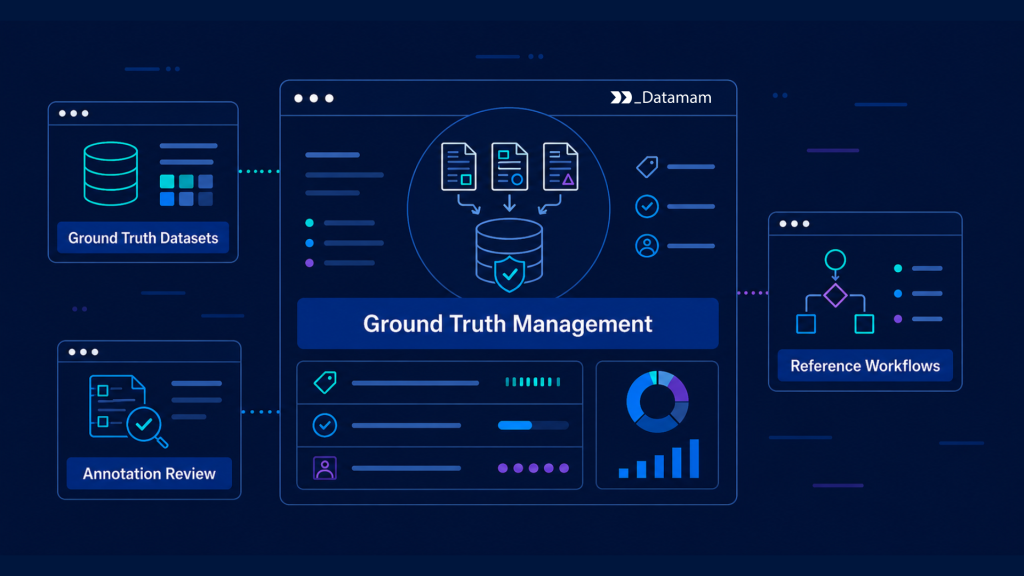
- Ground Truth Management gives enterprise AI systems a controlled reference layer for training, evaluation, monitoring, and retraining.
- Ground truth datasets must be versioned, reviewed, and aligned with business reality as markets, policies, products, and user behavior change.
- Ground truth labeling requires clear annotation rules, reviewer agreement checks, and structured handling of ambiguous or low-confidence examples.
- Reference data workflows connect source records, labeling decisions, evaluation sets, production monitoring, and model improvement cycles.
- Annotation review systems strengthen AI reliability by preserving audit trails, quality checks, dispute resolution, and governance metadata.
Enterprise AI systems depend on reference data that is accurate enough to define what the model should learn, how performance should be evaluated, and when retraining is required. If that reference layer is weak, the model may appear technically functional while drifting away from business reality.
Ground Truth Management is the discipline of designing, maintaining, reviewing, and governing the datasets that AI systems treat as authoritative. It includes ground truth datasets, labeling rules, reference data workflows, annotation review systems, versioning, lineage, access control, and quality checks.
In enterprise environments, ground truth is not a static dataset created once before training. It is an operational asset. Business definitions change, product categories evolve, market signals shift, customer behavior changes, and policy requirements become more specific. AI systems that rely on outdated or inconsistent ground truth eventually produce unstable outputs, unreliable evaluations, and weak decision confidence.
Why Ground Truth Management Matters in Enterprise AI Systems
AI systems are only as reliable as the reference data used to train, evaluate, and monitor them. Ground truth defines expected answers, valid classifications, known entity matches, accepted labels, and target outcomes. If this reference layer is inconsistent, downstream models inherit that inconsistency.
Ground Truth Management becomes especially important as organizations move beyond experimentation. McKinsey’s 2025 report on AI in the workplace found that almost all companies are investing in AI, but only a small share believes they have reached maturity. One reason enterprise AI struggles to mature is that data, workflow, and governance foundations often remain weaker than model ambitions.
Why AI Systems Depend on Trusted Reference Data
Trusted reference data gives AI systems a stable basis for learning and evaluation. For a classification model, ground truth may define correct categories. For a matching model, it may define which records refer to the same entity. Also, for a ranking system, it may define relevance judgments. For a market intelligence AI workflow, it may define whether a product match, competitor signal, review sentiment, or demand indicator is correct.
The model uses this reference layer to learn patterns. Evaluation teams use it to measure performance. Monitoring systems use it to detect drift. Business teams use it to decide whether outputs are reliable enough for operational use.
Ground truth datasets, therefore, act as the benchmark against which AI systems are judged. If the benchmark is inconsistent, incomplete, or outdated, model performance metrics become misleading.
How Weak Ground Truth Creates Model Risk and Output Instability
Weak ground truth creates risk because it gives the model contradictory instructions. If two similar examples receive different labels without a clear rule, the model learns noise. If edge cases are handled inconsistently, the model may perform unpredictably in production. Also, if business definitions change but reference data does not, the model may optimize for an outdated reality.
Output instability often appears after deployment. The model may work well on a curated test set but fail when exposed to new data patterns. Evaluation scores may appear strong because the ground truth dataset does not represent current production conditions. Retraining may fail to improve results because the label set itself is inconsistent.
NIST’s current AI Risk Management Framework emphasizes governance, risk management, and trustworthiness across AI systems. In practical terms, ground truth quality is one of the upstream controls that determines whether AI behavior can be evaluated and governed responsibly.
Operational Problems Created by Poor Ground Truth Controls
Poor ground truth controls usually do not appear as immediate system outages. They emerge as disputed labels, unstable metrics, inconsistent evaluations, false confidence, model drift, and disagreement between technical teams and business users. These problems become more expensive as AI systems move closer to production decisions.
Therefore, Ground Truth Management must be treated as an operating model, not only a data preparation step. Enterprises need ownership, review processes, quality thresholds, version control, and auditability around the datasets that define model correctness.
When Training Data, Labels, and Business Reality Drift Apart
Business reality changes continuously. Product taxonomies are revised. Fraud patterns evolve. Customer language changes. Market signals shift. Policy definitions become more specific. Competitor behavior changes. A label that was valid six months ago may no longer represent the correct business interpretation.
When training data and labels drift away from reality, models continue optimizing against outdated examples. This creates a gap between measured performance and operational performance. A model may score well against old validation data but produce weak recommendations in current workflows.
Reference data workflows help close this gap by connecting production feedback, new source data, expert review, and dataset versioning. Ground truth should evolve when the business changes, but it should do so through controlled review rather than ad hoc relabeling.
How Inconsistent Ground Truth Datasets Affect AI Evaluation and Deployment
Inconsistent ground truth datasets distort AI evaluation. If labels are noisy, model metrics become noisy. If labels are incomplete, evaluation sets may ignore important failure modes. Also, if label definitions vary across teams, performance comparisons become unreliable.
For enterprise deployment, this creates serious decision risk. A model may be approved because it performs well against a weak evaluation set. Another model may be rejected because the test set contains ambiguous or outdated labels. Teams may argue about model performance when the real issue is reference data quality.
IBM’s Data Quality solutions position trusted, AI-ready data as a requirement for reliable analytics and AI workflows. The same principle applies directly to ground truth datasets: evaluation confidence depends on the quality, consistency, and governance of the reference data.
Designing Ground Truth Datasets for Enterprise AI Workflows
Ground truth datasets must be designed for the AI system’s operational context. A dataset used for experimentation may not be sufficient for enterprise deployment. Production AI requires reference data that reflects business definitions, edge cases, source diversity, operating conditions, and governance requirements.
A strong design process defines what the dataset represents, which decisions it supports, which labels are authoritative, how edge cases are handled, and how versions are maintained over time. Incorporating robust sampling methods for enterprise data is crucial to ensure comprehensive coverage of all relevant scenarios. By utilizing diverse techniques, organizations can improve the accuracy and reliability of their AI models. This approach not only enhances model performance but also aligns the datasets more closely with real-world business needs.
Defining Reference Data Standards Before Model Training Begins
Reference data standards should be defined before labeling begins. These standards specify what counts as a valid example, which fields are required, which labels are allowed, how ambiguity is handled, and which business rules govern classification.
For example, a product matching model needs standards for parent products, variants, bundles, replacements, and regional naming differences. A sentiment model needs standards for sarcasm, mixed sentiment, neutral statements, and domain-specific language. A market intelligence classifier needs standards for competitor actions, promotional signals, demand indicators, and irrelevant noise.
Without these standards, annotation teams make inconsistent decisions. Model teams then inherit that inconsistency as training noise. Clear reference standards improve labeling consistency and reduce downstream model instability.
Structuring Ground Truth Datasets Across Use Cases, Markets, and Domains
Enterprise AI systems often operate across multiple use cases, markets, and domains. A ground truth dataset that works in one region may not work in another. Labels that apply to one product category may not apply to another. Business definitions may vary by department, regulatory context, or operating model.
Ground truth datasets should therefore include metadata that describes the scope. This may include market, language, source type, business domain, use case, product category, time window, reviewer confidence, and version. That metadata allows teams to evaluate whether a dataset is appropriate for a specific model or decision workflow.
A single universal ground truth set is rarely sufficient. Enterprises often need layered reference datasets: core standards, domain-specific extensions, market-specific examples, and production feedback sets.
Managing Version Control for Ground Truth as Business Conditions Change
Ground truth must change, but uncontrolled changes create evaluation instability. Version control allows teams to update reference data while preserving historical context. Each version should record what changed, why it changed, who approved it, which examples were added or removed, and which models or evaluations were affected.
Versioned ground truth datasets support reproducibility. If a model trained in January performed differently from a model trained in March, teams can inspect whether the reference dataset changed. If a production issue appears after a dataset update, teams can compare versions and isolate the cause.
Version control also protects governance. It prevents quiet label changes from altering performance metrics without review.
Ground Truth Labeling Workflows at Enterprise Scale
Ground truth labeling is not simply assigning labels to records. It is the controlled translation of business judgment into machine-readable reference data. At enterprise scale, labeling workflows must manage human reviewers, annotation guidelines, quality checks, disagreements, ambiguous cases, and reviewer calibration.
The objective is not maximum labeling speed. The objective is dependable label quality under operational complexity.
Establishing Labeling Rules, Taxonomies, and Decision Criteria
Labeling rules define how annotators should classify records. Taxonomies define the available categories, hierarchical relationships, and allowed distinctions. Decision criteria explain how to choose between labels when examples are difficult.
For example, if annotators label customer reviews, they need rules for mixed sentiment, product defects, delivery complaints, pricing complaints, and irrelevant content. If annotators label market signals, they need rules for product launches, temporary promotions, stockouts, assortment changes, and competitor repositioning.
Good labeling rules reduce interpretation gaps. They also create a basis for reviewer agreement measurement. If reviewers disagree frequently, the issue may not be reviewer quality. It may be unclear criteria.
Managing Human-in-the-Loop Labeling Across Complex Data Sources
Human-in-the-loop labeling is essential when examples require domain judgment. External data, customer text, legal documents, product descriptions, images, and market signals often contain ambiguity that automated labeling cannot resolve safely.
Enterprise workflows should assign records based on reviewer expertise, source type, domain, and complexity. Easy examples may move through standard annotation. Difficult examples may require expert review. High-impact labels may require dual review or adjudication.
Human-in-the-loop systems should also capture reviewer decisions as metadata. The record should show who labeled it, when it was labeled, what guideline version applied, whether confidence was high or low, and whether the label was later changed.
Reducing Label Ambiguity Through Annotation Guidelines and Review Layers
Ambiguity cannot be eliminated, but it can be managed. Annotation guidelines should include definitions, examples, counterexamples, edge cases, escalation rules, and decision trees. They should evolve as reviewers encounter new patterns.
Review layers help detect inconsistency. A second reviewer may verify labels. A senior reviewer may adjudicate disagreements. Sampling checks may evaluate quality across annotators. Agreement metrics may identify where guidelines need clarification.
Annotation review systems should preserve the full decision path. If a label changes after review, the system should record the original label, revised label, reviewer rationale, and approval status. This creates accountability and improves future labeling quality.
Reference Data Workflows for AI Reliability
Reference data workflows connect ground truth to the AI lifecycle. They define how data moves from source selection to labeling, review, dataset assembly, model training, evaluation, production monitoring, and retraining. Without these workflows, ground truth becomes disconnected from model operations.
Enterprise AI reliability depends on this connection. Teams need to know which reference datasets were used, which versions trained a model, which examples were used for evaluation, and which production failures should update the ground truth set.
Connecting Source Data, Labeling Decisions, and Model Evaluation Sets
Ground truth records should remain connected to source data. If an example comes from a customer conversation, product page, public record, image, document, or market feed, the system should preserve source origin, collection context, preprocessing steps, and annotation history.
This connection matters because labels without source context can be misleading. A label may be correct only within a specific domain or time period. A record may require a different interpretation depending on the market, language, or use case.
Evaluation sets should be built from labeled records that represent the operational conditions the model will face. They should include common cases, edge cases, recent examples, and high-risk categories. If evaluation sets are not connected to labeling decisions and source context, performance metrics may overstate production readiness.
Maintaining Reference Data Consistency Across Training, Testing, and Production
Training, testing, and production monitoring often use different datasets. Ground Truth Management ensures that these datasets remain consistent where they should and intentionally different where appropriate.
Training datasets should be broad enough for learning. Testing datasets should measure generalization. Production reference sets should monitor live performance and drift. If label definitions differ across these sets, evaluation becomes unreliable.
Consistency requires shared label taxonomies, guideline versions, dataset versioning, and metadata standards. When a label definition changes, teams must understand which datasets need updates and which historical evaluations should remain unchanged for comparison.
Detecting Changes in Reference Data Before They Affect Model Performance
Reference data itself can drift. New examples may expose gaps in the label taxonomy. Reviewer behavior may shift. Source distributions may change. Business definitions may evolve. If these changes are not monitored, model performance can degrade even when the model architecture remains unchanged.
Detection controls may include label distribution monitoring, reviewer agreement tracking, confidence score trends, edge-case volume, class imbalance checks, and production feedback analysis. Sudden shifts should trigger review before retraining or redeployment.
Gartner’s 2025 research abstract on the data and analytics governance reset with AI states that the rise of generative AI and the need to govern unstructured data are straining governance efforts. Ground truth workflows are one practical response to that strain because they impose structure, review, and accountability on AI reference data.
Annotation Review Systems and Quality Control
Annotation review systems provide the quality control layer for ground truth labeling. They help teams review label accuracy, measure reviewer agreement, resolve disputes, and preserve audit trails. Without a review system, labeling quality depends too heavily on individual judgment and informal correction.
At enterprise scale, annotation review must be systematic. It should identify low-confidence records, inconsistent reviewers, unclear guidelines, and categories with high disagreement.
Reviewing Label Accuracy, Reviewer Agreement, and Edge Cases
Label accuracy should be evaluated through sampling, expert review, gold-standard checks, and comparison against known reference examples. Reviewer agreement measures whether multiple annotators apply the same rules consistently. Low agreement often indicates ambiguity in the guideline or taxonomy.
Edge cases deserve special attention because they often define production risk. Common examples may be easy for the model to learn, but ambiguous or rare cases can create serious output failures. Review systems should identify edge cases, route them to experts, and decide whether they should be included in training, evaluation, or separate stress tests.
Quality control is not only about removing bad labels. It is about improving the reference system that generates labels.
Handling Disputes, Low-Confidence Labels, and Ambiguous Records
Disputes should follow defined adjudication logic. If two reviewers disagree, a senior reviewer or domain expert may resolve the label. If confidence remains low, the record may be excluded from training, included in an ambiguity set, or flagged for future taxonomy refinement.
Low-confidence labels should not be hidden. They should carry metadata that allows model teams to decide how to use them. Some may be useful for training robustness. Others may be inappropriate for evaluation because they do not represent a clear expected answer.
Ambiguous records often reveal where business rules are incomplete. A strong review process feeds these cases back into annotation guidelines, taxonomy updates, and reviewer training.
Creating Audit Trails for Labeling and Review Decisions
Audit trails preserve the history of labeling and review. They should record the original label, reviewer identity or role, timestamp, guideline version, confidence score, review outcome, dispute resolution, and final approval status.
This matters when AI outputs are questioned. Teams may need to show why a label was considered correct, who approved it, and whether the model was evaluated against the reviewed ground truth. Audit trails also support reproducibility. If a dataset version produced a specific model result, teams should be able to reconstruct the labeling state behind it.
For enterprise AI governance, auditability is not optional. Ground truth datasets influence model behavior, so their creation and review process must be defensible.
Technology Stack Behind Ground Truth Management
Ground Truth Management relies on coordinated systems for source ingestion, labeling, review, storage, versioning, metadata, orchestration, observability, and governance. The stack must support both data engineering workflows and human review processes.
The goal is to make ground truth operational. Teams should be able to trace examples from source to label, from label to dataset version, from dataset version to model evaluation, and from model performance back to reference data improvement.
Orchestration, Storage, and Processing for Ground Truth Pipelines
Airflow can coordinate reference data workflows such as source ingestion, sampling, annotation batch creation, quality checks, dataset assembly, and evaluation set publication. Spark can process large datasets for sampling, deduplication, entity matching, and feature preparation. Kafka can support event-driven feedback loops from production systems into review workflows.
Storage systems such as Snowflake, BigQuery, and Databricks can preserve raw examples, labeled records, review states, dataset versions, and evaluation sets. These platforms allow AI, data, and governance teams to query the relationship between source data and ground truth assets.
Processing and storage should preserve both raw and labeled forms. If a label is questioned later, teams should be able to inspect the source example and the review history.
Metadata, Lineage, and Versioning Across Labeling Workflows
Metadata connects each labeled record to its source, label, reviewer, guideline version, confidence score, review status, and dataset version. Lineage connects source records to labeled datasets, training sets, evaluation sets, and model versions.
Versioning is critical because ground truth changes. A dataset version should not be overwritten without history. Teams need to know which records were added, removed, relabeled, or reclassified. They also need to understand which model evaluations were based on each dataset version.
dbt can help structure dataset models and documentation, while data catalogs and lineage systems can make ground truth assets discoverable and reviewable across teams.
Observability, Audit Logs, and Governance Controls for AI Reference Data
Observability tools such as Prometheus can monitor labeling throughput, review backlog, error rates, dataset freshness, class balance, and workflow failures. Validation frameworks can check schema consistency, label completeness, allowed values, and dataset integrity before publication.
Audit logs preserve changes to guidelines, taxonomies, labels, reviewer permissions, dataset versions, and approval decisions. Access controls ensure that sensitive records, restricted datasets, or high-impact labels are only visible to authorized users.
These controls make ground truth manageable as an enterprise asset. They also support compliance, model governance, and procurement evaluation because the organization can show how AI reference data is controlled.
Governance and Compliance in Ground Truth Management
Ground truth governance defines who can create labels, approve guidelines, modify taxonomies, publish dataset versions, access sensitive examples, and approve evaluation sets. It also defines how long records are retained, how disputes are resolved, and how reference data changes are communicated.
For enterprise AI, this governance layer is essential because ground truth directly shapes model behavior. Weak governance allows hidden label changes, inconsistent evaluation, and unclear accountability. embracing datacentric ai trends in enterprise leadership can further enhance the governance framework by enabling better data quality and more transparent decision-making processes. As organizations prioritize data-driven strategies, effective governance will become a key differentiator in leveraging AI for competitive advantage. By aligning governance with emerging trends, enterprises can foster a culture of accountability and trust in their AI implementations.
Managing Source Accountability, Access Controls, and Review Permissions
Source accountability ensures that records used in ground truth datasets are suitable for the intended AI workflow. Teams should know where examples came from, whether they are allowed for the use case, whether they contain sensitive attributes, and whether additional restrictions apply.
Access controls should protect sensitive data and high-impact labels. Not every reviewer should see every record. Some datasets may require restricted access due to privacy, contractual obligations, legal sensitivity, or commercial importance.
Review permissions should reflect expertise and responsibility. Junior annotators may label routine examples. Domain experts may handle ambiguous cases. Governance owners may approve taxonomy changes and dataset publication. These controls reduce accidental misuse and improve accountability.
Supporting Audit Readiness for AI Training and Evaluation Data
Audit readiness requires evidence that ground truth datasets were created, reviewed, versioned, and approved under controlled conditions. Teams should be able to show which data was used, how it was labeled, which guidelines applied, which reviewers were involved, and which dataset version supported a specific model.
OECD’s 2025 Digital Government Index and Open, Useful and Re-usable Data Index emphasize coherent data foundations and reusable data policies in digital systems. The same operating principle applies to enterprise AI: reference data becomes more valuable when it is structured, governed, reusable, and traceable.
In practice, audit readiness reduces friction with compliance teams, risk owners, procurement evaluators, and executive stakeholders. It helps the organization explain not only what the model does, but what evidence was used to evaluate it.
You can run an external data infrastructure audit with our team to review your current setup and understand what is required to build a reliable, enterprise-scale external data infrastructure.
Ground Truth Management as AI Infrastructure
Ground Truth Management becomes AI infrastructure when it operates continuously across the model lifecycle. It supports training, testing, monitoring, retraining, model comparison, drift analysis, and governance review. It is not limited to the first labeling project.
As enterprise AI systems become embedded in workflows, the reference layer must remain current. Production feedback should update review queues. Edge cases should inform new labels. Model failures should improve evaluation sets. Business rule changes should trigger dataset updates. The continuous evolution of AI systems often hinges on effective ai model training data solutions that adapt to changing business needs. To maintain the quality and relevance of the AI models, organizations must prioritize the integration of diverse datasets alongside the established feedback mechanisms. This ensures that the insights derived from real-world applications can fuel ongoing improvements and drive better decision-making.
Strengthening Model Evaluation, Monitoring, and Retraining Decisions
Model evaluation depends on reliable ground truth. Monitoring depends on knowing whether production outputs remain aligned with reviewed reference examples. Retraining depends on identifying which new examples should be added, corrected, or excluded.
Ground Truth Management strengthens all three. It gives teams a consistent way to measure model performance, detect drift, review failures, and improve datasets over time. Without this discipline, retraining may simply recycle old errors or introduce new inconsistencies.
For example, a model that misclassifies new product categories may need updated labels, not only more training data. A sentiment model that fails on emerging language patterns may need guideline updates and new evaluation examples. Ground truth workflows make those improvements controlled rather than reactive.
Building Long-Term Trust in Enterprise AI Systems
Long-term AI trust depends on repeatable evidence. Teams need to know that the model was trained and evaluated on reviewed, versioned, and relevant reference data. They need to know that labels were not arbitrary, that edge cases were handled consistently, and that changes to ground truth were documented.
Ground Truth Management creates that evidence layer. It allows AI teams to compare models fairly, business teams to understand performance limits, governance teams to review controls, and executives to trust deployment decisions.
Ultimately, enterprise AI reliability is not created only by model architecture. It is created by the operational discipline around the data that defines what correct means.
Conclusion: Turning Reference Data Discipline into Reliable AI Performance
Enterprise AI systems require more than large datasets and capable models. They require a trusted reference layer that defines correctness, supports evaluation, and evolves with business reality. Ground Truth Management provides that layer.
By governing ground truth datasets, ground truth labeling, reference data workflows, and annotation review systems, enterprises reduce model risk and improve decision confidence. Strong ground truth operations make labels reviewable, datasets versioned, edge cases visible, and evaluation results more meaningful.
For organizations building AI systems that affect pricing, product decisions, customer operations, compliance workflows, market intelligence, or automation, ground truth is not a one-time preparation task. It is core AI infrastructure.
A structured review can help evaluate whether current AI data workflows have reliable ground truth standards, labeling controls, annotation review systems, versioning, lineage, and audit-ready governance records. You can run an external data infrastructure audit with our team to review your current setup and understand what is required to build a reliable, enterprise-scale external data infrastructure.