
Key Takeaways
- AI data readiness determines whether enterprise data can support real AI workflows, not only model experiments.
- Data readiness assessment must evaluate quality, coverage, lineage, ownership, governance, and operational usability.
- AI workflow readiness depends on whether data can move reliably through training, evaluation, inference, and monitoring systems.
- Operational data readiness is becoming a cross-functional leadership responsibility across AI, data, legal, compliance, and business teams.
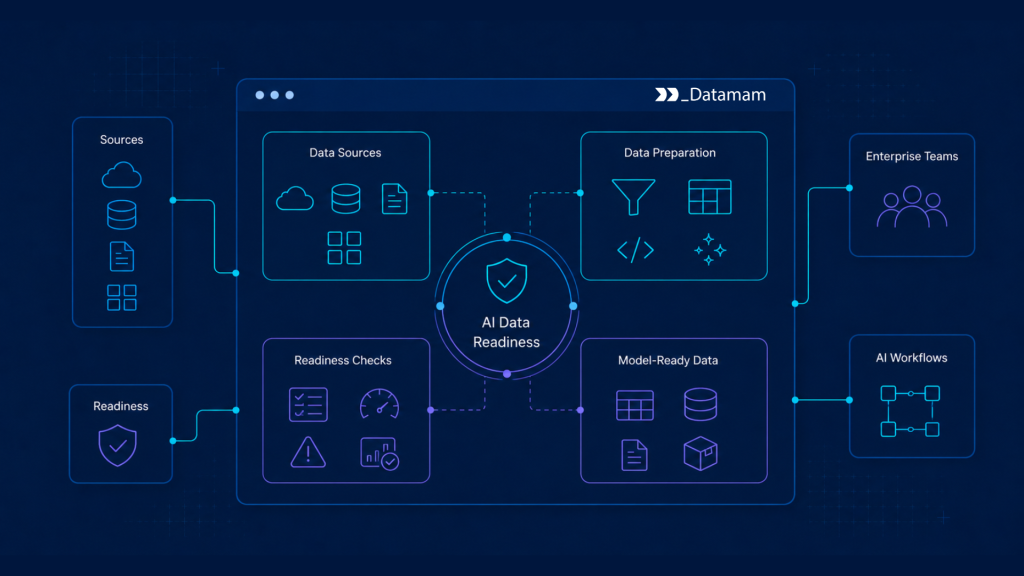
AI data readiness is often misunderstood as a technical checklist completed before model development begins. In enterprise environments, it is broader than that. It determines whether data can support real AI workflows across training, evaluation, inference, monitoring, governance, and business adoption. A dataset may exist, but that does not mean it is usable, trusted, representative, or operationally ready for AI.
AI Data Readiness is the condition that allows enterprise teams to move from experimentation to reliable AI execution. It connects data quality, source coverage, lineage, ownership, metadata, compliance, refresh cycles, and workflow integration into one operating standard. Without that standard, AI teams may build promising models while business teams hesitate to deploy them, compliance teams request more review, and production systems struggle with inconsistent inputs.
AI Data Readiness Is an Operating Condition, not a Pre-Deployment Checklist
Many organizations approach AI readiness as a sequence of approvals before launch. Teams check whether data is available, whether a model can be trained, whether performance is acceptable, and whether deployment infrastructure exists. That process is useful, but it misses the deeper question: can the organization sustain reliable AI workflows once the system enters production?
McKinsey’s State of AI 2025 shows that AI adoption is widespread, yet many organizations still struggle to generate scaled enterprise impact. The issue is rarely model access alone. Enterprise AI depends on whether data, workflows, governance, and operating models are mature enough to support continuous use.
Enterprise Teams Need to Know Whether Data Can Support Real AI Workflows
AI workflows place different demands on data than traditional analytics. Training workflows need representative historical and current examples. Evaluation workflows require trusted test sets that reflect real operating conditions. Inference workflows depend on stable, current inputs. Monitoring workflows require metadata, timestamps, baseline distributions, and clear performance indicators.
A dataset that works for reporting may not be ready for AI. Reporting data often explains past performance, while AI systems need data that can support prediction, classification, generation, ranking, automation, or decision support. This difference matters because AI systems are more sensitive to missing context, inconsistent schemas, weak labels, and poor coverage.
In practice, enterprise teams need to evaluate whether data can move through the full AI lifecycle, not simply whether it is stored somewhere in a warehouse or lake.
Data Readiness Assessment Must Evaluate Quality, Coverage, Lineage, and Ownership
A serious data readiness assessment goes beyond surface-level availability. It asks whether the data is accurate, complete, current, representative, explainable, and governed. It also evaluates whether ownership is clear enough for teams to resolve issues when data quality changes.
Quality determines whether data can be trusted. Coverage determines whether important segments, products, geographies, use cases, languages, and edge cases are represented. Lineage shows where the data came from and how it changed. Ownership clarifies who is responsible for definitions, access, stewardship, updates, and issue resolution.
Without these elements, AI teams may begin development with data that looks usable but becomes difficult to defend during evaluation, deployment, or audit review.
Why AI Workflow Readiness Depends on More Than Model Access
Access to powerful models has become easier. Cloud platforms, foundation models, open-source tooling, and managed AI services have lowered the barrier to experimentation. However, easier model access does not automatically create AI workflow readiness. The harder enterprise problem is whether data can be prepared, validated, governed, and delivered into AI systems with enough consistency to support real work.
Cisco’s AI Readiness Index 2025 evaluates readiness across strategy, infrastructure, data, governance, talent, and culture. That structure is useful because it shows that AI readiness is multidimensional. Data is one pillar, but it connects directly to infrastructure, governance, and operating capability.
AI Systems Fail When Data Inputs Are Fragmented Across Teams and Tools
Fragmented data inputs create operational weakness. Customer records may sit in CRM systems. Transaction data may sit in ERP platforms. Product data may live in PIM systems. Support conversations may be stored elsewhere. External signals may be collected through separate pipelines. Labels may be managed by annotation vendors or internal teams.
When these inputs are disconnected, AI workflows become fragile. Teams spend time reconciling definitions, cleaning duplicates, resolving conflicting identifiers, and rebuilding context. A model may train successfully on a prepared extract, but the production workflow may fail because the source data remains fragmented.
AI workflow readiness, therefore, depends on integration discipline. Data must be connected, standardized, and governed across the systems that influence the model.
Operational Data Readiness Determines Whether AI Can Perform Reliably in Production
Operational data readiness refers to whether data can support AI systems during live use. This includes data freshness, schema stability, access controls, quality checks, latency requirements, monitoring coverage, and failure visibility.
A recommendation system needs current product availability. A fraud model needs updated behavioral patterns. A forecasting model needs recent demand signals. A customer support system needs fresh policy, product, and issue data. If operational data is delayed, incomplete, or inconsistent, the model may behave poorly even if its original training performance was strong.
Therefore, enterprise AI readiness is not achieved at the moment a model is deployed. It is sustained through operational data systems that keep inputs reliable over time.
The Gap Between Available Data and Usable AI Data
Enterprises often have large volumes of data but relatively little AI-ready data. Availability is not the same as usability. Data may exist in storage, but lack the structure, context, permissions, metadata, or validation needed for AI. This gap is one of the most common reasons enterprise AI programs slow down after early experimentation.
IBM’s 2025 CDO Study emphasizes that organizations need high-quality data and strong governance frameworks to create value from proprietary and ecosystem data. For AI programs, that point is direct: data must be made usable, governed, and trusted before it can reliably support production systems. The data quality impact on enterprise AI cannot be overstated; poor data quality can lead to flawed insights and misguided decisions. Ensuring that data is clean, accurate, and properly annotated is crucial for machine learning models to perform effectively. Enterprises must invest in robust data management practices to bridge the usability gap and harness the full potential of their AI initiatives.
Enterprise Data Often Exists but Lacks Structure, Context, or Validation
Enterprise data may be abundant, but AI systems require specific forms of readiness. Documents need structure and permissions. Product records need consistent attributes. Customer data needs consent-aware handling and identity resolution. External data needs sourcing controls and schema validation. Labeled datasets need annotation guidelines and quality review.
Context is equally important. A model needs to understand what fields mean, how they were created, when they were updated, and whether they remain valid. Without metadata, data can become ambiguous. Without validation, teams cannot distinguish usable inputs from corrupted or incomplete ones.
As a result, enterprises frequently discover that their data volume is high, but their usable AI data is limited.
Training, Evaluation, and Inference Workflows Require Different Readiness Standards
Training data must be representative enough for the model to learn useful patterns. Evaluation data must be independent and realistic enough to measure performance honestly. Inference data must be stable and current enough for live system use. Monitoring data must preserve enough context to detect drift, failures, and performance changes.
These workflows should not be treated as one readiness category. A dataset may be acceptable for training but weak for evaluation. Another may support evaluation but lack the latency or freshness required for inference. Monitoring may fail if metadata, timestamps, source versions, or ground-truth feedback loops are missing.
AI data readiness must therefore define standards for each workflow. That distinction prevents teams from declaring readiness too early.
How Weak Data Readiness Creates Enterprise AI Risk
Weak data readiness creates risk because AI systems amplify input weaknesses. Missing data, outdated records, inconsistent definitions, weak labels, and unclear permissions can all influence model behavior. In production, those issues may affect decisions, customer experiences, compliance obligations, and executive trust.
NIST’s AI Risk Management Framework provides a structured approach for governing, mapping, measuring, and managing AI risks. For enterprise teams, the relevance is clear: data readiness must be treated as part of AI risk management because data quality, traceability, and governance shape the behavior of AI systems. Focusing on ai model training data strategies can help mitigate these risks by ensuring that the input data is both accurate and relevant. By implementing robust data collection and management processes, organizations can enhance the quality of their training datasets, leading to more reliable AI outcomes. This proactive approach not only strengthens compliance but also builds confidence among stakeholders in the performance of AI systems.
Poor Source Quality and Incomplete Metadata Reduce Trust in Model Outputs
Poor source quality weakens the foundation of AI outputs. If source systems contain duplicated records, outdated fields, inconsistent categories, or missing values, the model may learn patterns that do not reflect reality. Incomplete metadata makes the problem harder to diagnose because teams cannot easily explain how the data was created or whether it should be trusted.
Trust declines when teams cannot answer basic questions. Which source produced this input? When was it updated? Was it validated? Did it include restricted data? Which model version was used? How did the schema change? Were important segments missing?
Without clear answers, model outputs become difficult to defend. Business teams hesitate to rely on them, and governance teams require more review.
Data Gaps Increase Review Cycles, Rework, and Deployment Delays
Data gaps create hidden costs. AI teams may need to rebuild datasets, relabel examples, resolve source conflicts, or redesign pipelines. Legal and compliance teams may request documentation that was not captured earlier. Business stakeholders may ask for additional validation before approving deployment.
These review cycles slow AI programs. The delay may look like a model problem, but the root cause is often data readiness. Teams are not blocked because AI is impossible. They are blocked because the organization cannot prove that the data foundation is reliable enough for production.
Operational data readiness reduces this friction by making quality, ownership, lineage, and governance visible before deployment pressure builds.
The Infrastructure Layer Behind AI Data Readiness
AI data readiness depends on infrastructure that can manage data across the full lifecycle. This includes sourcing, ingestion, transformation, validation, labeling, storage, versioning, monitoring, governance, and delivery into AI workflows. Manual cleanup and informal documentation may support early pilots, but they cannot support enterprise-scale AI.
The World Economic Forum’s 2025 analysis on scaling AI with strategy, data, and workforce readiness argues that leaders need strong data foundations to scale AI across the enterprise. That principle is central to readiness: AI systems cannot become reliable operating capabilities when the data layer remains fragmented or poorly governed. Investing in enterprise ai model training solutions is essential for organizations looking to harness the full potential of their data. These solutions provide the frameworks necessary for developing robust models that can adapt and thrive in dynamic environments. By prioritizing these strategies, leaders can ensure that their AI initiatives are not only innovative but also sustainable in the long run.
Validation, Versioning, and Normalization Make AI Inputs More Reliable
Validation ensures that data meets expected standards before it enters AI workflows. Versioning preserves the exact datasets used for training, evaluation, and deployment. Normalization aligns formats, categories, entities, timestamps, units, and definitions across sources.
Tools such as Great Expectations can support schema validation, completeness checks, anomaly detection, and quality rules. Airflow can orchestrate data workflows. Kafka can support continuous data movement. Spark can process large-scale datasets. dbt can structure transformations into governed analytical models. Snowflake, BigQuery, and Databricks can provide scalable environments for storing, versioning, and analyzing AI-ready datasets.
External data adds further complexity. Browser automation frameworks such as Playwright may be needed when data comes from dynamic web environments rather than stable APIs. Source resilience, extraction monitoring, and schema change detection become part of readiness when external signals influence AI behavior.
Lineage, Observability, and Governance Make Data Readiness Auditable
Lineage shows how data moved from the source to the AI workflow. Observability reveals whether pipelines are healthy, fresh, complete, and performing as expected. Governance defines who can access data, how it can be used, what restrictions apply, and how compliance is documented.
Prometheus and other observability systems can monitor pipeline failures, latency, freshness, and coverage. Data lineage tools and metadata systems help teams trace source, transformation, ownership, labels, and model usage. Audit logs and access controls support accountability. Legal review and sourcing documentation help manage compliance exposure.
Cross-border considerations also matter. AI data may move across jurisdictions, business units, vendors, and cloud environments. GDPR, data residency requirements, consent rules, platform policies, and internal governance frameworks must be considered when data is used for training, evaluation, or inference.
Why AI Data Readiness Is Becoming a Cross-Functional Leadership Responsibility
AI data readiness is becoming a leadership responsibility because AI systems increasingly affect enterprise decisions, customer interactions, operations, risk controls, and strategy. Data readiness cannot remain isolated inside technical teams. It requires alignment across data owners, AI teams, engineering, legal, compliance, security, product, and business leadership.
Gartner’s 2025 Data and Analytics Predictions state that by 2027, half of business decisions will be augmented or automated by AI agents for decision intelligence. As more decisions become AI-supported, readiness failures become more consequential because weak data can influence decisions at scale.
Data, AI, Legal, Compliance, and Business Teams Need Shared Readiness Criteria
Different teams define readiness differently. Data teams may focus on quality and pipeline stability. AI teams may focus on training performance and evaluation coverage. Legal teams may focus on sourcing rights, consent, and retention. Compliance teams may focus on auditability and regulatory obligations. Business teams may focus on usability and decision impact.
Shared readiness criteria reduce friction. They create a common standard for whether data is acceptable for AI use. These criteria should include source quality, coverage, lineage, labeling quality, metadata completeness, access control, compliance review, refresh frequency, monitoring, and business relevance.
When readiness criteria are shared, AI teams move faster because expectations are clear before deployment review begins.
Enterprise AI Programs Scale Faster When Operational Data Readiness Is Treated as Infrastructure
Enterprise AI programs scale faster when operational data readiness is treated as infrastructure rather than a project-by-project task. Each new AI use case should not require teams to rediscover data sources, rebuild quality checks, recreate metadata, or renegotiate governance standards from scratch.
A mature readiness layer creates reusable capabilities. Data products become easier to evaluate. Training datasets become easier to version. Evaluation sets become more reliable. Inference pipelines become easier to monitor. Compliance review becomes more structured. Business teams gain confidence because data readiness is visible and repeatable.
Ultimately, AI Data Readiness means the organization can supply AI systems with trusted, governed, representative, and operationally reliable data across the full workflow. A data readiness assessment clarifies whether those conditions exist. AI workflow readiness depends on whether data can move through training, evaluation, inference, and monitoring without breaking trust. Operational data readiness determines whether production systems can remain reliable as conditions change.
Enterprise teams that treat readiness as infrastructure will be better positioned to scale AI responsibly. Those who treat readiness as a final checklist may continue to launch pilots, but they will struggle to build production AI systems that leaders, users, and regulators can trust.