Key Takeaways
- How CRM Data Quality improves sales reporting, forecasting, account visibility, and revenue operations analytics
- Why CRM data accuracy depends on validation rules, ownership, identity resolution, and controlled field governance
- How CRM data cleansing reduces duplicate accounts, incomplete contacts, stale opportunities, and segmentation errors
- Why customer data quality management fails when teams rely on manual fixes or inconsistent sales process discipline
- How continuous quality controls improve pipeline trust, revenue visibility, customer handoffs, and executive reporting
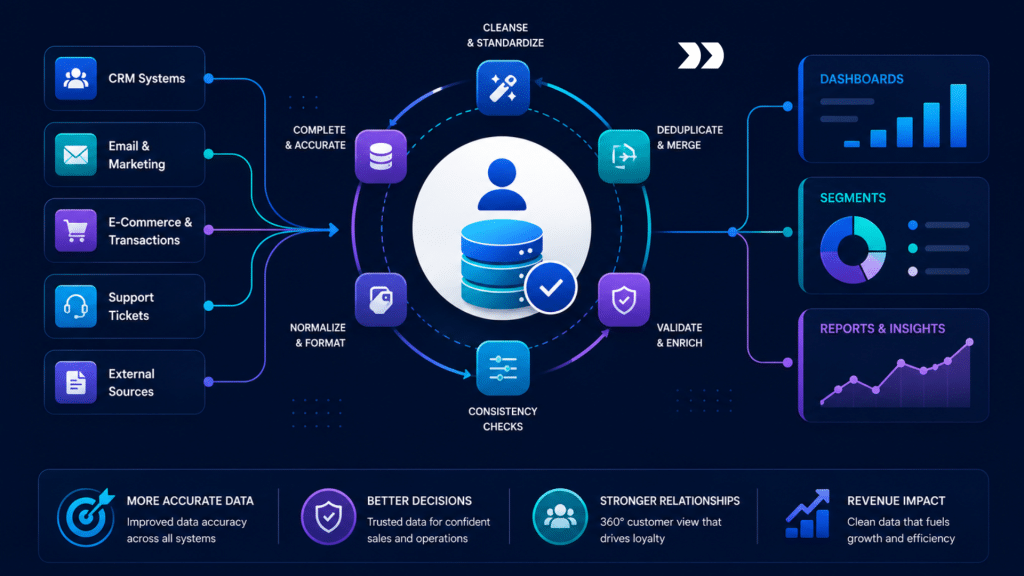
Sales and revenue operations depend on accurate CRM data across accounts, contacts, opportunities, pipeline stages, customer records, marketing sources, billing references, renewal dates, support signals, and executive dashboards. When CRM Data Quality is weak, teams face duplicate accounts, incomplete contacts, inaccurate forecasts, broken attribution, poor segmentation, and revenue reports that do not reconcile with finance. The issue is rarely only the CRM platform. It is usually the quality operating layer around it: validation rules, ownership, cleansing workflows, identity resolution, pipeline controls, lineage, access governance, and remediation. CRM Data Quality gives sales, marketing, revenue operations, customer success, finance, and leadership teams a structured foundation for using customer and revenue data with confidence.
The Data Quality Gap in CRM and Revenue Operations
CRM systems are expected to act as the operating record for sales, customer relationships, pipeline, and revenue activity. However, many organizations discover that CRM adoption does not automatically create reliable revenue data. A CRM may contain every account and opportunity while still producing unreliable forecasts, duplicate customers, stale stages, missing contact roles, and incomplete renewal visibility.
This creates a revenue data quality gap. Sales leaders need accurate pipeline. Finance needs bookings and revenue records that reconcile. Marketing needs clean segmentation and attribution. Customer success needs complete account context. NIST Privacy Framework is relevant because CRM environments often contain personal data, consent fields, customer identifiers, and data-use obligations across connected systems.
Why CRM Data Accuracy Becomes Difficult to Maintain
CRM data accuracy becomes difficult to maintain because customer data changes constantly. Contacts move roles. Companies merge. Opportunities slip. Territories change. Marketing campaigns add new leads. Customer success updates account health. Billing systems update subscription status. Support teams record escalations that may affect renewal risk.
Without structured CRM Data Quality controls, these changes create inconsistent customer records. A prospect may appear under multiple accounts. A closed-lost opportunity may remain in forecast views. A contact may lack consent status. A renewal account may show active in billing but stale in CRM. CRM data accuracy requires continuous validation, not occasional cleanup.
Where CRM Data Cleansing Breaks Down
CRM data cleansing breaks down when teams treat it as a periodic project. Quarterly deduplication, one-time field cleanup, and manual spreadsheet reviews may temporarily improve data, but defects return quickly when validation and ownership are weak.
A sales rep may create a duplicate account because matching rules are incomplete. A marketing import may add contacts without required fields. A revenue operations analyst may fix pipeline stages in one dashboard but not in the source CRM. At scale, CRM data cleansing must become an operating workflow tied to source controls, ownership, and remediation.
CRM Data Quality as an Operating Layer
CRM Data Quality becomes valuable when it operates as a controlled layer between CRM records, marketing platforms, billing systems, customer success tools, support systems, data warehouses, and reporting environments. The goal is not simply to clean records after errors appear. The goal is to prevent unreliable customer and revenue data from entering operational workflows.
This operating layer should define trusted sources, account ownership, required fields, duplicate detection rules, lifecycle stages, pipeline validation, enrichment controls, consent requirements, and exception routing. Without these controls, CRM can become a shared system of activity but not a reliable system of record.
Defining Ownership Across Customer and Revenue Data
Ownership is the foundation of reliable customer data quality management. Sales may own account ownership, opportunity stage, forecast category, next steps, and close date. Marketing may own lead source, campaign attribution, consent status, and lifecycle stage. Customer success may own health score, renewal risk, and adoption context. Finance may own billing customer ID, contract value, invoice status, and recognized revenue references.
Clear ownership prevents data disputes. Data engineering or revenue operations can detect missing or conflicting CRM fields, but the business owner must confirm the correct value and process rule. For example, sales may own opportunity stage, but finance may own whether a deal has converted into recognized revenue.
Creating a Common CRM Quality Model
A common CRM quality model connects account ID, contact ID, opportunity ID, source system, lifecycle stage, owner, required fields, duplicate status, validation result, consent status, revenue reference, and lineage. This does not require every team to work from the same interface. However, it does require consistent handling of customer identity, ownership, field rules, and quality status.
For example, a revenue forecast may need opportunity stage, close date, amount, probability, account hierarchy, contract reference, and owner. A customer health view may need product usage, support tickets, renewal date, billing status, and executive sponsor. CRM Data Quality makes these inputs testable before teams rely on them.
Infrastructure Requirements for CRM Data Accuracy
CRM data accuracy depends on infrastructure that can validate, monitor, cleanse, reconcile, and govern customer and revenue records across systems. The objective is not to build isolated cleanup scripts. Teams need shared quality patterns that handle duplicate accounts, invalid emails, missing required fields, stale opportunities, consent gaps, broken account hierarchies, and reporting mismatches.
CRM data is sensitive because it includes personal information, customer relationships, contract values, pipeline, pricing, support history, and marketing preferences. ISO/IEC 27001 is relevant because CRM and revenue operations environments require disciplined controls around confidentiality, access management, monitoring, and auditability.
Orchestrating CRM Quality Workflows
CRM data may come from sales systems, marketing automation, customer success platforms, billing tools, product analytics, support systems, enrichment providers, and data warehouses. Apache Airflow can orchestrate CRM validation jobs, deduplication checks, enrichment reviews, and exception reports. Spark can process large customer, opportunity, activity, and account datasets. dbt can manage repeatable transformation logic for account hierarchies, lifecycle stages, revenue references, and reporting-ready models.
Snowflake, BigQuery, or Databricks can support governed customer data layers where validated CRM records, quality logs, duplicate clusters, and remediation history are stored. Prometheus or broader data observability systems can monitor refresh failures, freshness gaps, job anomalies, and quality thresholds.
def route_crm_record(record):

    if record["quality_status"] == "validated":

        return {"action": "publish_to_revenue_reporting", "record_id": record["record_id"]}

    if record["quality_status"] == "failed":

        return {"action": "send_to_record_owner", "record_id": record["record_id"]}

    return {"action": "hold_for_review", "record_id": record["record_id"]}


REQUIRED_CRM_FIELDS = ["record_id", "object_type", "owner", "quality_status"]


def validate_crm_record(record):

    missing = [field for field in REQUIRED_CRM_FIELDS if not record.get(field)]

    if missing:

        return {"valid": False, "reason": "missing_fields", "fields": missing}

    if record["object_type"] == "contact" and not record.get("email"):

        return {"valid": False, "reason": "email_required"}

    if record["object_type"] == "opportunity" and not record.get("close_date"):

        return {"valid": False, "reason": "close_date_required"}

    return {"valid": True}


record = {

    "record_id": "OPP-48192",

    "object_type": "opportunity",

    "owner": "sales_ops",

    "quality_status": "validated",

    "close_date": "2026-09-30",

}


print(route_crm_record(record))

print(validate_crm_record(record))
This quality logic keeps CRM records controlled before downstream use. Validated records can move into revenue reporting, failed records can route to owners, and incomplete contacts or opportunities can be blocked before they distort pipeline, segmentation, or executive dashboards.
Validating Accounts, Contacts, Opportunities, and Consent
CRM validation should test whether records are structurally complete and commercially usable. These controls should check duplicate accounts, missing emails, invalid phone numbers, stale opportunity stages, missing close dates, inactive owners, incomplete contact roles, broken account hierarchies, inconsistent lifecycle stages, and missing consent fields.
Great Expectations can support completeness, uniqueness, accepted-value, freshness, and referential integrity checks. Metadata catalogs can document CRM fields, owners, definitions, source systems, and downstream dependencies. Without validation, CRM records can appear complete while still failing revenue operations workflows.
Technology Stack Behind Customer Data Quality Management
Customer data quality management requires a technology stack that supports ingestion, orchestration, transformation, validation, cleansing, observability, governance, and controlled delivery. The stack must support daily sales execution, marketing activation, customer success workflows, revenue reporting, and executive dashboards.
A mature environment connects CRM, marketing automation, billing systems, customer success tools, support platforms, product analytics, Airflow workflows, dbt models, Spark jobs, warehouse tables, observability systems, metadata catalogs, and BI tools. It should reduce manual cleanup without weakening customer data governance. Data cleansing solutions for enterprises play a crucial role in enhancing the overall integrity of customer information. These solutions not only automate the cleanup process but also ensure compliance with data governance standards. By incorporating advanced algorithms, they help to identify and rectify inaccuracies, leading to improved decision-making across business functions.
Cleansing Rules and Identity Resolution
CRM data cleansing should include deduplication, standardization, enrichment review, invalid-field detection, account hierarchy correction, and stale-record routing. Identity resolution connects records across CRM, billing, product, support, and marketing systems so teams can see a more accurate customer view.
This matters because revenue operations often depends on account-level rollups. If contacts, opportunities, invoices, and support tickets attach to different versions of the same customer, pipeline reporting, segmentation, churn analysis, and account planning become unreliable.
Governance, Lineage, and Access Control
CRM data governance should include role-based access, audit logs, data lineage, retention rules, metadata management, source documentation, field ownership, and change approval history. These controls matter because CRM data influences forecasting, compensation, marketing outreach, customer success prioritization, and executive reporting.
Data lineage should trace CRM data from source entry through validation, cleansing, enrichment, transformation, warehouse storage, dashboard publication, and downstream activation. If a revenue metric changes unexpectedly, teams need to know whether the cause was a source update, deduplication rule, ownership change, lifecycle-stage correction, or dashboard calculation.
Commercial Impact of CRM Data Quality
The commercial value of CRM Data Quality appears when sales, marketing, customer success, and finance teams can trust customer and revenue data enough to act on it. Better quality controls can reduce manual cleanup, improve forecast confidence, strengthen segmentation, lower reporting disputes, and improve customer handoffs.
For CROs, CMOs, revenue operations leaders, customer success teams, sales managers, finance stakeholders, and data teams, the practical value is confidence. Integrated CRM data quality controls help teams understand which records are reliable, which checks failed, which dashboards are affected, and which owners need to resolve exceptions. Data quality improvements for analytics platforms are essential for making informed decisions. When organizations prioritize data integrity, they can unlock deeper insights and drive better business outcomes. As teams leverage these enhancements, their ability to strategize and respond to market changes will significantly increase.
Improving Forecast Confidence and Pipeline Discipline
Forecast confidence improves when opportunities have valid stages, close dates, owners, amounts, account relationships, and next steps. Sales leaders can inspect pipeline quality more effectively when defects are visible before forecast meetings.
This supports better revenue planning. Teams can distinguish between pipeline risk caused by deal movement and reporting risk caused by poor CRM data. CRM data accuracy becomes a revenue operations control, not a data hygiene preference.
Improving Segmentation and Customer Handoffs
Marketing segmentation improves when contacts have valid emails, consent status, account links, lifecycle stages, and enrichment fields. Customer success handoffs improve when account ownership, support history, billing status, product usage, and renewal context are connected.
Customer data quality management reduces internal friction. Teams spend less time reconciling customer records and more time coordinating customer-facing actions.
Risk Exposure When CRM Data Quality Is Weak
Weak CRM data quality creates commercial, operational, and governance risk. Forecasts may be inaccurate. Marketing may target the wrong contacts. Customer success may miss renewal signals. Finance may struggle to reconcile bookings. Sales managers may coach teams from unreliable pipeline reports.
The risk increases as organizations add regions, product lines, sales motions, customer segments, and revenue systems. Manual cleanup may work in small teams, but it becomes fragile in enterprise revenue operations.
Duplicate Accounts and Broken Revenue Visibility
Duplicate accounts weaken revenue visibility. Opportunities may split across account records. Contacts may attach to the wrong company. Support tickets may not appear in customer success views. Billing records may fail to reconcile with CRM accounts.
CRM data cleansing should preserve account hierarchy, duplicate clusters, match confidence, merge decisions, and exception history. These controls improve visibility without hiding uncertainty in the data.
Privacy, Consent, and Access Risk
CRM data often includes personal identifiers, contact preferences, account notes, contract values, support details, and sales strategy. This creates risk if consent fields, role-based access, masking rules, or retention policies are incomplete.
NIST SP 800-53 is useful because CRM environments often require access control, audit logging, monitoring, and security governance across sensitive customer data.
Evaluating CRM Data Quality Readiness
CRM Data Quality becomes valuable when it supports repeatable revenue workflows, not simply when records can be cleaned periodically. Readiness depends on source ownership, validation coverage, cleansing rules, identity resolution, observability, lineage, access governance, and downstream dependency documentation.
A readiness review helps identify where CRM quality risk accumulates before it becomes a forecast dispute, campaign error, customer handoff issue, finance reconciliation problem, or executive reporting gap.
How Teams Assess CRM Data Quality
A structured assessment should evaluate duplicate accounts, missing contacts, invalid emails, stale opportunities, incomplete close dates, inactive owners, inconsistent lifecycle stages, missing consent fields, broken account hierarchies, billing-link gaps, support-history gaps, and source-to-dashboard mapping coverage. It should also review ownership, validation coverage, exception volume, lineage completeness, access controls, and remediation history.
For CRM data accuracy, quality must be evaluated commercially. A record may pass technical checks while still failing to support sales execution, marketing activation, customer success planning, or revenue reporting.
When Organizations Need a CRM Data Quality Architecture Review
A CRM data quality architecture review becomes useful when teams rely on manual cleanup, duplicate reports, inconsistent pipeline logic, spreadsheet-based account matching, or revenue dashboards that do not reconcile. The review should assess source coverage, validation rules, cleansing workflows, identity resolution logic, transformation models, observability, lineage tracking, access governance, and downstream reporting dependencies.
The output should clarify where CRM quality risk accumulates, where customer data quality management may be incomplete, and which improvements would make CRM data accuracy more reliable for sales, marketing, customer success, finance, and executive teams. Ensuring data integrity in business intelligence is critical for making informed decisions across the organization. It enables teams to trust the insights derived from their analytics and enhances overall operational efficiency. Furthermore, a focus on data integrity helps mitigate risks associated with ineffective data management practices.
Conclusion: CRM Data Quality as Revenue Operations Infrastructure
CRM, sales, and revenue operations depend on reliable quality controls across customer records, account hierarchies, opportunities, marketing fields, billing references, support signals, and reporting workflows. When CRM data quality is inconsistent, teams spend excessive time cleaning records, reconciling dashboards, correcting pipeline views, and rebuilding trust in customer data. CRM Data Quality creates the governed foundation needed to coordinate customer data quality management across the full revenue lifecycle.
Ultimately, organizations that treat CRM quality as revenue operations infrastructure, not just occasional CRM data cleansing, will be better positioned to improve CRM data accuracy, strengthen customer visibility, reduce forecast risk, and build more reliable sales and revenue operations across the enterprise.