Key Takeaways
- How ML Data Quality improves reliability across feature pipelines, training datasets, inference inputs, and model monitoring
- Why machine learning data quality depends on freshness checks, schema controls, label validation, and lineage
- How ML feature data validation reduces training-serving skew, drift, missing values, and unreliable model behavior
- Why feature pipeline data quality fails when teams rely on ad hoc notebooks, manual extracts, or undocumented transformations
- How governed quality controls improve model reproducibility, auditability, and enterprise AI confidence
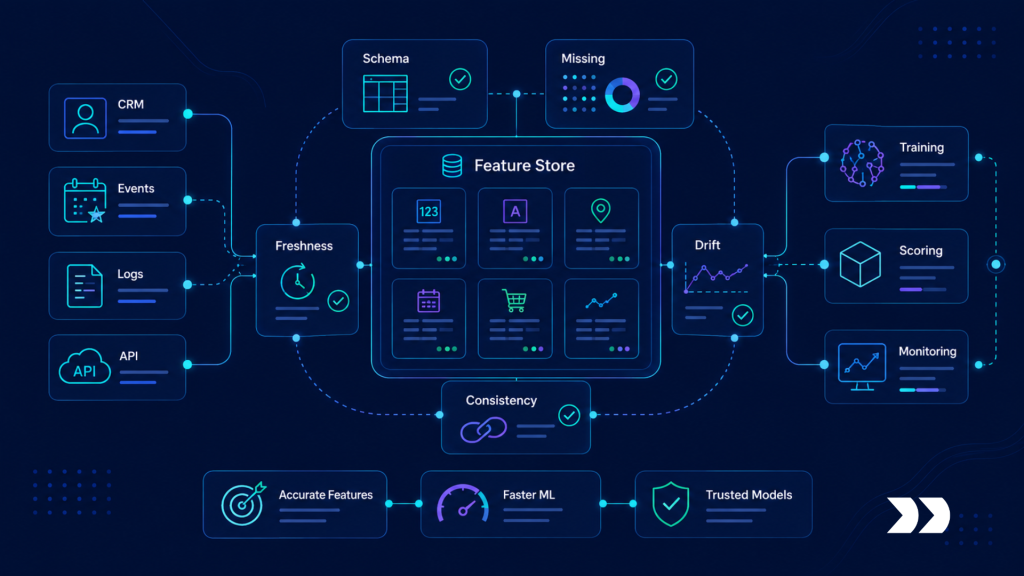
Machine learning feature pipelines depend on reliable data quality across source systems, event streams, data warehouses, feature stores, labeling workflows, model training environments, and production inference systems. When ML Data Quality is weak, models train on incomplete features, stale labels, inconsistent transformations, and datasets that cannot be reproduced. The issue is rarely only the model itself. It is usually the quality operating layer behind the model: schema validation, feature checks, freshness monitoring, lineage, versioning, drift detection, ownership, and governance. ML Data Quality gives data science, machine learning, product, risk, compliance, and data engineering teams a structured foundation for using features that are accurate, explainable, and production-ready.
The Data Quality Gap in Machine Learning Pipelines
Machine learning teams often focus on model performance, but production model quality depends heavily on feature quality. A model may perform well in experimentation and fail later because the data changed, labels became delayed, source fields drifted, or inference features were calculated differently from training features.
This creates a feature quality gap. Data scientists need stable features. ML engineers need reproducible pipelines. Product teams need reliable predictions. Compliance teams need traceability. Risk teams need defensible controls for models that influence business decisions. NIST AI Risk Management Framework is relevant because enterprise AI systems require attention to reliability, monitoring, transparency, and risk management throughout the AI lifecycle.
Why Machine Learning Data Quality Is Hard to Maintain
Machine learning data quality is difficult to maintain because models depend on historical, current, and future-facing data behavior. Training data must represent the intended problem. Labels must reflect the outcome being modeled. Features must be calculated consistently. Evaluation data must be protected from leakage. Inference data must arrive on time and match training assumptions.
Without structured ML Data Quality, models can become unstable even when pipelines technically run. A churn feature may use delayed subscription data. A fraud feature may miss recent transaction events. A pricing model may use stale competitor inputs. A recommendation system may train on duplicated interactions. These issues often appear as model degradation, but the root cause is data quality.
Where Feature Pipeline Data Quality Breaks Down
Feature pipeline data quality breaks down when teams rely on notebook transformations, local extracts, one-off SQL, or undocumented preprocessing logic. These methods may support early experiments, but they do not provide the repeatability required for production machine learning.
At scale, feature pipelines need quality rules that run before features are published, before models are trained, and before inference systems consume the data. Quality must be continuous because source systems, user behavior, product workflows, and business definitions change over time.
ML Data Quality as an Operating Layer
ML Data Quality becomes valuable when it operates as a controlled layer between source systems, feature engineering workflows, training datasets, model registries, inference services, and monitoring environments. The goal is not simply to detect broken records. The goal is to prevent unreliable features from entering model workflows.
This operating layer should define trusted sources, feature owners, expected schemas, freshness thresholds, missing-value tolerances, label rules, drift thresholds, and escalation paths. Without these controls, teams may deploy models that are mathematically sound but operationally unreliable. Data quality importance for enterprises cannot be overstated, especially in today’s data-driven landscape. High-quality data drives better decision-making and enhances operational efficiency. Enterprises that prioritize data quality are more likely to gain a competitive advantage and foster trust among their stakeholders.
Defining Ownership Across Features and Labels
Ownership is the foundation of reliable ML feature data validation. Product teams may own behavioral events, user actions, sessions, and engagement signals. Finance may own revenue, billing, payment, and account status fields. Operations may own fulfillment, inventory, service, or logistics events. Risk teams may own exposure, fraud, policy, or exception signals. Data science teams may own feature definitions, label logic, and model evaluation criteria.
Clear ownership prevents ambiguity. Data engineering can build feature pipelines, but business and model owners must define what the feature means and what quality threshold is acceptable. For example, “active customer” may be defined by product usage, billing status, login frequency, or account contract state. A feature pipeline should not hide those differences.
Creating a Common Feature Quality Model
A common feature quality model connects feature name, source system, entity ID, event timestamp, transformation rule, expected value range, null tolerance, freshness threshold, owner, validation status, dataset version, model dependency, and lineage reference. This does not require every model to use the same features. However, it does require consistent controls around identity, time, transformation, validation, and monitoring.
For example, a risk model may need credit exposure, payment delays, transaction velocity, and account age. A personalization model may need browsing history, purchase frequency, category preferences, and consent status. ML Data Quality makes these inputs testable before they influence predictions.
Infrastructure Requirements for ML Feature Data Validation
ML feature data validation depends on infrastructure that can test, monitor, reconcile, and govern feature data across training and production environments. The objective is not to add one-off checks to each model. Teams need shared quality patterns that handle schema drift, late events, label leakage, feature nulls, duplicate records, outliers, access restrictions, and monitoring evidence.
ML data can be sensitive because it may include customer behavior, financial transactions, healthcare records, product usage, operational activity, or proprietary business signals. ISO/IEC 27001 is relevant because ML feature environments require disciplined controls around confidentiality, access management, monitoring, and auditability.
Orchestrating Feature Quality Workflows
Feature data may come from CRM, ERP, billing systems, product analytics, payments, support platforms, operational logs, external data feeds, and data warehouses. Apache Airflow can orchestrate feature refresh schedules, validation jobs, retraining workflows, and exception alerts. Kafka can support event-driven updates when low-latency inference requires recent behavioral or transaction signals.
Spark can process high-volume event, transaction, and historical datasets. dbt can manage repeatable transformation logic for entity tables, feature views, training datasets, and model-ready data. Snowflake, BigQuery, or Databricks can support feature history, validation logs, training data snapshots, and governed analytical layers.
def route_feature_batch(batch):

    if batch["quality_status"] == "validated":

        return {"action": "publish_to_feature_store", "feature_set": batch["feature_set"]}

    if batch["quality_status"] == "failed":

        return {"action": "alert_ml_data_owner", "feature_set": batch["feature_set"]}

    return {"action": "hold_for_review", "feature_set": batch["feature_set"]}


REQUIRED_FEATURE_FIELDS = ["feature_set", "source_system", "entity_id", "quality_status"]


def validate_feature_batch(batch):

    missing = [field for field in REQUIRED_FEATURE_FIELDS if not batch.get(field)]

    if missing:

        return {"valid": False, "reason": "missing_fields", "fields": missing}

    if batch.get("freshness_hours") is not None and batch["freshness_hours"] > 12:

        return {"valid": False, "reason": "stale_features"}

    if batch.get("null_rate") is not None and batch["null_rate"] > 0.05:

        return {"valid": False, "reason": "null_rate_exceeded"}

    return {"valid": True}


batch = {

    "feature_set": "customer_churn_features",

    "source_system": "product_events",

    "entity_id": "customer_id",

    "quality_status": "validated",

    "freshness_hours": 2,

    "null_rate": 0.01,

}


print(route_feature_batch(batch))

print(validate_feature_batch(batch))
This quality logic keeps feature batches controlled before model use. Validated feature sets can move into the feature store, failed batches can alert ML data owners, and stale or incomplete features can be blocked before they affect training or inference.
Validating Features, Labels, Freshness, and Drift
ML feature data validation should test whether feature data is structurally complete and model-safe. These controls should check missing entity IDs, invalid timestamps, duplicate rows, feature null rates, outlier values, stale batches, label delays, training-serving skew, schema changes, and feature distribution drift.
Great Expectations can support completeness, uniqueness, accepted-value, freshness, and referential integrity checks. Data observability systems can monitor pipeline failures, unusual feature movements, late-arriving events, schema drift, and source freshness. Metadata catalogs can document feature owners, definitions, model dependencies, and lineage.
Technology Stack Behind Feature Pipeline Data Quality
Feature pipeline data quality requires a technology stack that supports ingestion, orchestration, transformation, validation, versioning, observability, and governance. The stack must support both offline training datasets and online inference features.
A mature environment connects source systems, Airflow workflows, Kafka streams, Spark jobs, dbt models, feature stores, data warehouses, model registries, observability systems, metadata catalogs, audit logs, and monitoring dashboards. It should reduce manual data preparation without weakening model governance. Automating data quality for pipelines can enhance the efficiency of the entire feature engineering process. By implementing robust validation mechanisms within the automated workflows, organizations can significantly minimize errors and inconsistencies. Additionally, this approach allows data teams to focus on developing more advanced models rather than spending time on manual quality checks.
Feature Stores and Training Data Layers
Feature stores help standardize feature definitions and make them reusable across models. However, a feature store is only useful if the data entering it is validated and traceable. Quality controls should run before feature publication, not only after model performance declines.
Training data layers should preserve dataset versions, source timestamps, transformation rules, feature definitions, label logic, and validation outcomes. This allows teams to reproduce model runs, compare training datasets, and investigate performance changes after retraining.
Governance, Lineage, and Access Control
ML data governance should include role-based access, audit logs, data lineage, retention rules, metadata management, dataset approvals, model dependency mapping, and feature versioning. These controls matter because feature data often influences automated decisions at scale.
Data lineage should trace feature data from source extraction through transformation, validation, feature publication, training dataset creation, model training, and inference usage. If model performance changes, teams need to know whether the cause was source drift, feature logic, label quality, delayed data, or model behavior.
Commercial Impact of ML Data Quality
The commercial value of ML Data Quality appears when data science and engineering teams can trust features enough to train, deploy, and monitor models repeatedly. Better quality controls can reduce model debugging time, improve retraining stability, lower production risk, and increase confidence in AI-supported decisions.
For AI leaders, product teams, risk teams, data science groups, compliance stakeholders, and engineering teams, the practical value is confidence. Integrated feature quality controls help teams understand which features are ready, which checks failed, which models are affected, and which owners need to resolve exceptions. Data integrity in distributed systems plays a crucial role in ensuring that the data used across various platforms remains consistent and accurate. When teams work with multiple data sources, maintaining this integrity reduces the risk of errors that could lead to flawed decisions. Establishing robust protocols for data handling and validation is essential for building trust among stakeholders involved in the process.
Improving Model Reliability and Reproducibility
Model reliability improves when features, labels, and training datasets are validated and versioned. If a model behaves differently after retraining, teams can compare feature versions, source changes, label logic, and validation results.
This improves reproducibility. Data scientists can spend less time reconstructing datasets and more time improving model design, testing business impact, and reducing risk.
Reducing Production Incidents and Retraining Delays
Production ML incidents often originate from data issues. A source field changes. A feature arrives late. A label is delayed. A new category appears unexpectedly. A pipeline publishes incomplete data. Without quality controls, these issues reach models before teams detect them.
ML Data Quality reduces this risk by blocking bad features, alerting owners, and documenting quality status before downstream use. This makes retraining and deployment workflows more reliable.
Risk Exposure When ML Data Quality Is Weak
Weak ML Data Quality creates technical, commercial, and governance risk. Models may train on incomplete data. Inference systems may receive stale features. Labels may leak future information. Drift may remain hidden until business performance declines. Compliance teams may lack evidence explaining how model inputs were created.
The risk increases when models support pricing, fraud detection, risk scoring, personalization, healthcare analytics, forecasting, or operational decisioning. Manual checks may work during experimentation, but they become fragile in enterprise ML platforms.
Training-Serving Skew and Model Drift
Training-serving skew occurs when features are calculated differently during training and production inference. Model drift occurs when input distributions or business behavior change after deployment. Both can reduce model performance even when the model code has not changed.
Feature pipeline data quality should include shared feature definitions, online and offline consistency checks, freshness monitoring, and drift detection. These controls help teams identify data issues before model outcomes become unreliable.
Governance Gaps in Feature Pipelines
Governance gaps emerge when teams cannot explain which features trained a model, which transformations were applied, which records were excluded, or which feature versions were used in production. This weakens auditability and slows model review.
NIST SP 800-53 is useful because ML data environments often require access control, audit logging, monitoring, and security governance across sensitive data pipelines.
Evaluating ML Data Quality Readiness
ML Data Quality becomes valuable when it supports repeatable model workflows, not simply when data can be loaded into training. Readiness depends on feature ownership, label quality, validation coverage, lineage, observability, dataset versioning, access governance, drift monitoring, and model dependency documentation.
A readiness review helps identify where feature quality risk accumulates before it becomes model instability, delayed deployment, compliance concern, or production incident.
How Teams Assess Machine Learning Data Quality
A structured assessment should evaluate missing entity IDs, duplicate records, invalid timestamps, feature null rates, stale features, label delays, leakage risk, schema drift, outlier patterns, training-serving skew, drift signals, and source-to-feature mapping coverage. It should also review ownership, validation coverage, exception volume, lineage completeness, access controls, and model dependency documentation.
For machine learning data quality, success must be evaluated across the full ML lifecycle. A feature table may load successfully while still failing to support reproducible training, reliable inference, or defensible monitoring.
When Organizations Need an ML Data Quality Architecture Review
An ML data quality architecture review becomes useful when teams rely on notebook-based transformations, manual training extracts, inconsistent feature logic, failed retraining jobs, or production models that are difficult to reproduce. The review should assess source coverage, feature pipelines, validation controls, storage architecture, lineage tracking, observability, governance posture, label quality, and production dependencies.
The output should clarify where ML quality risk accumulates, where ML feature data validation may be incomplete, and which improvements would make feature pipeline data quality more reliable for data science, product, risk, compliance, and engineering teams.
Conclusion: ML Data Quality as Feature Pipeline Infrastructure
Machine learning feature pipelines depend on reliable quality controls across source systems, transformations, feature stores, training datasets, inference services, and monitoring workflows. When data quality is inconsistent, teams spend excessive time debugging models, rebuilding features, explaining drift, and delaying production deployment. ML Data Quality creates the governed foundation needed to coordinate machine learning data quality across the full model lifecycle.
Ultimately, organizations that treat ML data quality as feature pipeline infrastructure, not just model cleanup, will be better positioned to improve ML feature data validation, strengthen feature pipeline data quality, reduce model risk, and build more reliable machine learning systems across the enterprise.