Data Quality Services have become the reliability layer of enterprise data operations. As organizations scale analytics, AI systems, reporting, external data pipelines, automation, compliance workflows, and cloud platforms, the strategic issue is no longer whether data exists. The issue is whether data is accurate, complete, consistent, timely, valid, traceable, and trusted enough to support decisions. Without governed quality control, data becomes operational friction rather than enterprise infrastructure.
Data Quality Services as Enterprise Reliability Infrastructure
Enterprise data quality is the control layer that determines whether data can be used with confidence. It applies profiling, validation, monitoring, remediation, standardization, governance, and ownership controls across data sources, pipelines, platforms, and consumption environments. Therefore, data quality should not be treated as cleanup after defects appear. It should be designed as reliability infrastructure that prevents weak data from damaging analytics, AI, reporting, operational workflows, and executive decision-making.
From Data Cleanup to Continuous Data Reliability
Traditional data quality work often focused on cleanup projects. Teams identified duplicates, corrected fields, fixed broken records, or reconciled reports after issues were discovered. That model is too reactive for modern enterprise environments. Data now moves continuously across systems, pipelines, APIs, dashboards, AI workflows, and external sources. Consequently, Data Quality Services must operate continuously. They should detect defects early, enforce quality rules, route issues to owners, monitor recurrence, and reduce the cost of repeated correction.
Why Data Quality Determines Operational Trust
Operational trust depends on whether business teams believe the data in front of them. If executives question dashboard numbers, analysts spend time reconciling instead of interpreting. If AI teams do not trust inputs, models remain experimental. Also, if compliance teams cannot trace data origin, review cycles slow down. If operations teams see conflicting records, process execution becomes uncertain. Enterprise data quality is therefore not only a technical discipline. It is the foundation of trust in data-driven work.
The Enterprise Data Quality Gap
The enterprise data quality gap appears when organizations expand data volume, platforms, and use cases faster than they mature quality controls. More data does not automatically create better decisions. In many cases, it increases noise, duplication, inconsistency, and remediation burden. Data quality issues move from source systems into warehouses, reports, AI pipelines, business applications, and executive dashboards. As a result, quality becomes an enterprise-wide operating issue rather than a localized data team problem.
Why More Data Does Not Create Better Decisions
More data can create weaker decisions if quality controls are poor. Additional sources may introduce inconsistent formats, duplicate entities, incomplete fields, conflicting definitions, stale records, and uncertain lineage. A larger dataset is not automatically a better dataset. According to Gartner’s 2025 data and analytics predictions, by 2027, 50% of business decisions will be augmented or automated by AI agents for decision intelligence. That raises the cost of poor quality because automated decisions can amplify defects faster than manual processes.
How Data Defects Move Across Systems and Workflows
Data defects rarely stay where they originate. A missing customer identifier in CRM can affect billing, support, marketing, customer 360, analytics, and AI models. A product attribute error can affect pricing, marketplace publishing, inventory planning, and digital shelf reporting. A supplier record defect can affect procurement, risk review, finance, and operational workflows. Data quality management must therefore operate across systems and workflows. Otherwise, each downstream team becomes responsible for correcting upstream issues repeatedly.
Why Data Quality Services Have Become Infrastructure
Data quality becomes infrastructure when recurring enterprise workflows depend on reliable data. This now applies to AI model development, executive reporting, financial analysis, customer intelligence, risk monitoring, compliance review, product information management, procurement, pricing intelligence, healthcare analytics, and external data programs. Once data quality supports these workflows, it requires governance, monitoring, rule design, remediation processes, ownership, auditability, and continuous improvement. A data quality company is therefore evaluated by operating discipline, not by cleanup capacity alone.
Enterprise Data Quality Across Analytics, AI, and Operations
Enterprise data quality must support different consumption environments. Analytics teams need consistent metrics and complete fields. AI teams need representative, valid, and traceable inputs. Operations teams need accurate records to execute workflows. Compliance teams need data that is documented and reviewable. Executives need numbers that do not change unexpectedly across reports. In this context, enterprise data quality connects technical validation with business confidence. It makes data dependable across the operating model.
Data Quality Management Across Complex Data Environments
Data quality management becomes harder as environments expand across cloud warehouses, data lakes, SaaS platforms, internal applications, external sources, APIs, event streams, files, and AI platforms. Each environment introduces different schemas, update cadences, field definitions, ownership models, and quality risks. KPMG’s 2025 analysis of data governance in the age of AI notes that 62% of organizations believe lack of data governance is the main data challenge inhibiting AI initiatives. Data quality sits inside that governance challenge because models and analytics depend on controlled data foundations.
Governance Requirements for Reliable Data Quality Control
Governance requirements apply directly to data quality because defects are not only technical errors. They are ownership, policy, accountability, and process failures. Enterprises need to know who owns quality rules, who approves thresholds, who remediates exceptions, which systems are authoritative, and how recurring defects are escalated. The NIST AI Risk Management Framework emphasizes trustworthiness considerations in the design, development, deployment, and use of AI systems. Data quality assurance is one of the practical controls that supports trust in AI and analytics environments.
| Enterprise Driver | What Changed | Why Data Quality Infrastructure Is Required |
| AI and automation expansion | Models, agents, and automated workflows increasingly rely on enterprise data inputs | Quality controls must prevent defects from scaling into automated decisions |
| Analytics dependency | Executives and operating teams rely on dashboards, KPIs, and recurring reports | Metrics require consistent definitions, complete records, and trusted refreshes |
| Multi-system complexity | Data moves across CRM, ERP, warehouses, cloud platforms, APIs, and external sources | Quality must be monitored across workflows, not only inside one system |
| Governance expectations | Data must be traceable, explainable, secure, and reviewable | Quality rules, lineage, ownership, and remediation must be documented |
| Operational scale | More teams consume data across more use cases | Quality standards must reduce repeated cleanup and manual reconciliation |
The Operating Model Behind Data Quality Services
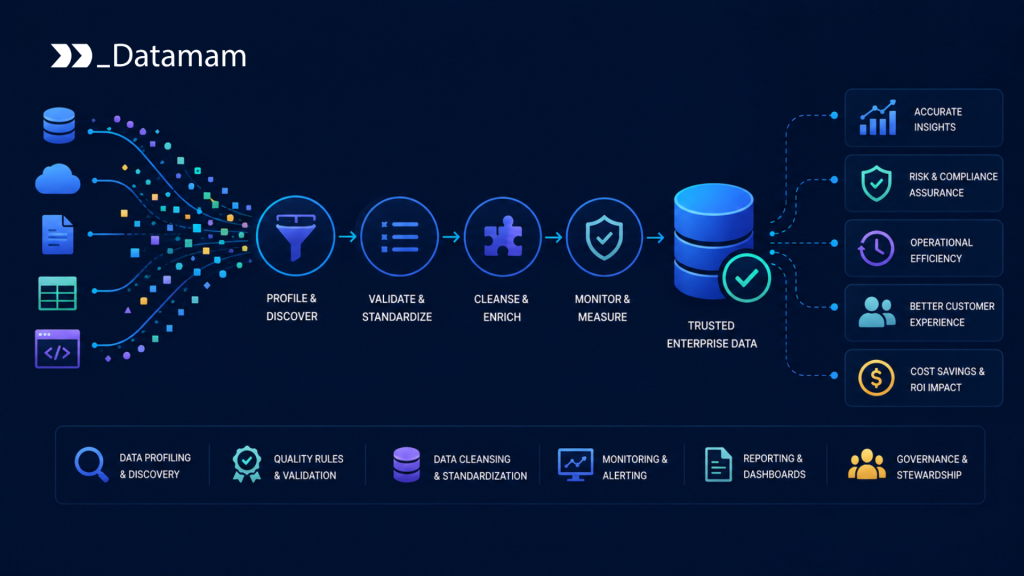
At enterprise scale, Data Quality Services are not defined by one-time checks or dashboard alerts. They are defined by an operating model for profiling, validating, standardizing, monitoring, remediating, and governing data across the enterprise lifecycle. Each layer has a specific role. If one layer is weak, defects continue moving downstream. The goal is not only to find bad data. The goal is to prevent unreliable data from becoming business input.
| Operating Layer | Core Responsibility | Enterprise Output |
| Profiling Layer | Assess data condition, patterns, anomalies, completeness, duplicates, and field behavior | Baseline view of data quality risks |
| Validation Layer | Check accuracy, completeness, conformity, validity, and business rule compliance | Data quality results tied to defined rules |
| Standardization Layer | Align formats, identifiers, taxonomies, fields, and definitions across systems | Consistent data structures for enterprise use |
| Monitoring Layer | Detect quality defects, freshness issues, drift, anomalies, and recurring failures | Continuous visibility into data reliability |
| Remediation Layer | Route issues to owners, correct defects, classify exceptions, and prevent recurrence | Controlled issue resolution and root cause reduction |
| Governance Layer | Manage ownership, lineage, thresholds, policy alignment, and accountability | Sustainable quality infrastructure with clear responsibility |
Profiling Layer for Data Condition Assessment
The profiling layer creates visibility into the current condition of data. It identifies missing values, duplicate records, outliers, invalid formats, inconsistent categories, unusual patterns, field drift, outdated records, and dependency issues. Profiling helps teams understand whether a dataset is suitable for reporting, AI, migration, integration, delivery, or operational use. Without profiling, quality decisions rely on assumptions. At enterprise scale, assumptions are expensive because defects often remain hidden until they affect business workflows.
Validation Layer for Accuracy, Completeness, and Conformity
The validation layer checks whether data meets defined quality rules. Rules may test required fields, accepted values, reference matches, uniqueness, date logic, numeric ranges, entity relationships, and business conditions. Validation must be tied to the business use case because not every defect has the same impact. A missing optional field may be low risk. A missing customer ID in billing may be critical. Data quality solutions should therefore distinguish between technical errors and business-critical defects.
Standardization Layer for Consistency Across Systems
The standardization layer aligns data across systems so that records can be compared, joined, analyzed, and used consistently. This may include formatting dates, normalizing addresses, aligning product categories, standardizing country codes, harmonizing customer identifiers, cleaning names, and enforcing controlled values. Standardization is especially important when data comes from multiple internal and external sources. Without it, different teams may use different versions of the same entity, category, or metric.
Monitoring Layer for Continuous Quality Detection
The monitoring layer detects quality problems over time. It tracks freshness, completeness, duplicate rates, anomaly patterns, schema changes, validation failures, volume shifts, and recurring defects. Continuous data quality monitoring is essential because data conditions change as systems, users, sources, and workflows evolve. Deloitte’s 2026 State of AI in the Enterprise report notes that organizations feel less prepared in infrastructure, data, risk, and talent even as AI adoption progresses. Continuous monitoring helps close the gap between AI ambition and data readiness.
Remediation Layer for Issue Resolution and Workflow Routing
The remediation layer determines what happens after a defect is found. Some issues can be corrected automatically. Others require business review, source system correction, access review, manual approval, or producer escalation. Remediation should classify issue type, assign ownership, track resolution, and identify root cause. This prevents teams from fixing the same defect repeatedly. Data quality assurance becomes stronger when remediation reduces recurrence instead of only correcting individual records.
Governance Layer for Ownership, Lineage, and Accountability
The governance layer ensures quality controls are owned, documented, and aligned with enterprise policy. It includes data ownership, stewardship roles, quality thresholds, lineage, rule approval, exception handling, audit logs, and escalation paths. OECD’s 2025 policy brief on data access and sharing in the age of AI emphasizes balancing data access with privacy, rights, intellectual property, and other safeguards. Data quality governance helps enterprises make that balance operational by controlling how trusted data is defined, monitored, and used.
Enterprise Risks Created by Weak Data Quality Operations
Weak data quality operations create risk across analytics, AI, operations, finance, compliance, customer experience, procurement, product management, and executive reporting. The risk is structural. Poor data does not only create wrong numbers. It slows decisions, increases manual work, weakens automation, damages trust, and makes governance harder. When defects are not controlled upstream, downstream teams build workarounds. Over time, those workarounds become hidden operating costs.
Decision Latency From Low-Trust Data
Decision latency occurs when teams do not trust the data available to them. Executives request reconciliation before approving plans. Analysts investigate definitions before producing insights. Operations teams compare records across systems before acting. Finance teams verify numbers manually before reporting. In each case, decisions slow down because data reliability is uncertain. Enterprise data quality reduces latency by improving confidence in the data used for recurring decisions.
AI Degradation From Inconsistent Training and Operational Inputs
AI degradation occurs when models rely on inconsistent, incomplete, stale, biased, or poorly governed inputs. A model may perform well during testing but degrade in production if operational data changes without monitoring. Feature values may drift. Entity identifiers may break. Training data may not represent current conditions. McKinsey’s 2025 State of AI survey reports that most organizations remain in early stages of scaling AI and capturing enterprise-level value. Data quality is one of the foundations required to move from experimentation to dependable AI operations.
Reporting Failure From Conflicting Metrics and Definitions
Reporting failure appears when different teams produce different versions of the same metric. Customer count, revenue, churn, active accounts, product availability, risk exposure, and operational performance can all vary when quality rules and definitions are inconsistent. Conflicting metrics damage executive confidence and create unnecessary debate. Data quality consulting can help identify where definitions diverge, where source systems conflict, and where governed metric logic is needed to stabilize reporting.
Compliance Exposure From Inaccurate or Untraceable Data
Compliance exposure increases when organizations cannot prove that data is accurate, traceable, complete, and governed. Regulatory reports, customer records, financial data, healthcare information, legal records, and AI datasets may all require quality evidence. If data lineage is unclear or defects are unresolved, compliance review becomes more difficult. NIST’s AI RMF highlights governance, measurement, and management of AI risks. In practice, data quality controls are part of that risk management when data feeds automated or regulated workflows.
Operational Fragility From Recurring Data Defects
Operational fragility appears when recurring data defects require constant manual correction. Teams build exception lists, spreadsheet checks, local scripts, and informal review processes. These workarounds may keep the business moving temporarily, but they create dependency on individuals and hidden processes. When volume increases or staff changes, the workarounds break down. Managed data quality infrastructure reduces fragility by identifying root causes, assigning ownership, and turning repeated defects into controlled remediation workflows.
Build vs Buy Decisions for Data Quality Services
The build-versus-buy decision for Data Quality Services should be evaluated as an operating-model choice. Internal teams may manage quality when data domains are narrow, systems are stable, and ownership is clear. However, enterprise data quality becomes more complex as data moves across platforms, business units, AI systems, external sources, and regulated workflows. The decision should account for rule design, monitoring, remediation, governance, tooling, and long-term accountability.
| Evaluation Area | Internal Data Quality Model | Managed Data Quality Capability |
| Best Fit | Narrow domains, stable systems, mature ownership, limited quality rules | Multi-system, AI-dependent, regulated, high-volume, or recurring quality needs |
| Cost Profile | Lower visible start cost, higher hidden remediation and reconciliation burden | Structured cost with monitoring, governance, and remediation accountability |
| Control | Full internal ownership of rules, thresholds, and remediation | Shared operating model with documented controls and handoff |
| Scalability | Limited by internal stewardship capacity and tool maturity | Designed for expansion across systems, domains, teams, and use cases |
| Risk Ownership | Accuracy, monitoring, remediation, and business impact remain internal | Risk is distributed through process, tooling, service expectations, and governance |
When Internal Data Quality Operations Are Rational
Internal data quality operations are rational when the organization has strong data ownership, mature governance, stable systems, and limited quality complexity. For example, a single domain such as finance reporting or product catalog governance may be managed internally if ownership and rules are already clear. Internal control may also be appropriate when data is sensitive or deeply tied to proprietary business logic. However, internal quality work still requires profiling, validation, monitoring, documentation, and remediation discipline.
Where Internal Data Quality Management Breaks at Scale
Internal data quality management breaks when quality issues span many systems, owners, domains, and consumption environments. Sales, finance, product, operations, risk, AI, and analytics teams may each define quality differently. Defects may originate upstream but appear downstream. Remediation may require coordination across teams that do not share the same priorities. As data programs scale, quality management becomes a cross-functional operating capability. A managed model can help create structure when internal ownership is fragmented.
Total Cost Beyond Tools, Rules, and Remediation Work
The total cost of data quality extends beyond software tools, rule creation, and cleanup work. It includes data profiling, rule governance, exception handling, stakeholder review, quality monitoring, remediation workflows, root cause analysis, documentation, policy alignment, and repeated operational checks. The hidden cost is often the time spent reconciling, questioning, correcting, and explaining data. Data quality solutions should therefore be evaluated by lifecycle economics, not only by initial implementation cost.
Risk Allocation Across Accuracy, Monitoring, and Accountability
Risk allocation determines who is responsible when data defects damage reports, models, operations, or compliance workflows. Internal teams may own quality but lack capacity to monitor continuously or remediate root causes across systems. Managed quality models distribute responsibility through service expectations, monitoring, documentation, and escalation processes. The correct model depends on internal maturity, data complexity, regulatory exposure, and downstream dependency. A data quality company becomes valuable when it reduces uncertainty across accuracy, monitoring, and accountability.
Data Quality Tools vs Managed Data Quality Infrastructure
Data quality tools are useful, but they are not the same as managed quality infrastructure. A tool may profile data, apply rules, flag anomalies, or show dashboards. However, tools do not automatically define business thresholds, assign ownership, approve remediation paths, resolve root causes, or align quality controls with operational outcomes. Tools provide detection capability. Managed data quality infrastructure provides accountability, governance, and sustained reliability. Data extraction tools for businesses play a crucial role in transforming raw information into actionable insights. They streamline workflows and enhance decision-making processes by automating the retrieval and processing of data. Investing in efficient data extraction tools for businesses can significantly improve productivity and incorporate data-driven strategies.
Why Rule Engines Are Not the Same as Data Quality Assurance
Rule engines can detect whether data violates predefined conditions. Data quality assurance requires more. It requires knowing which rules matter, which defects are material, who owns remediation, how exceptions are classified, how thresholds are governed, and how quality affects downstream decisions. A rule that flags every minor issue may create noise. A rule that misses business-critical defects may create false confidence. Assurance depends on rule relevance, operating context, and remediation discipline.
The Ownership Gap Between Quality Checks and Business Outcomes
The ownership gap appears when technical teams monitor data quality, but business teams experience the consequences. Data teams may detect missing fields, but operations teams handle failed workflows. Analytics teams may see inconsistent metrics, but executives face decision uncertainty. AI teams may detect model drift, but source system owners control the data. Without clear accountability, quality checks become alerts without resolution. Managed data quality infrastructure closes this gap by connecting detection, ownership, remediation, and business impact.
Industry Applications of Data Quality Services
Industry applications vary because quality risks differ by domain, data sensitivity, operating cadence, and regulatory exposure. Financial services require trusted data for risk, compliance, and reporting. Healthcare requires accurate and privacy-aware operational records. Retail and e-commerce require reliable product, pricing, inventory, and customer data. AI and technology companies require stable inputs for models, analytics, and product systems. The quality architecture remains similar, but rules, thresholds, and remediation priorities change by industry.
Financial Services Data Quality and Risk Reporting
Financial services data quality supports risk models, customer records, regulatory reporting, transaction monitoring, fraud detection, and portfolio analytics. A small defect in account status, exposure classification, counterparty data, or transaction history can affect reporting and risk decisions. Quality controls must include completeness checks, lineage, reconciliation, access control, and exception documentation. In practical financial environments, stronger data quality assurance can reduce recurring reconciliation effort by 20-40% when teams previously relied on manual comparison and report correction.
Healthcare Data Quality and Operational Reliability
Healthcare data quality affects patient records, claims data, provider information, scheduling, research data, billing workflows, and operational reporting. Defects can create administrative delays, reporting errors, or workflow confusion. Quality controls must support accuracy, privacy, identity matching, lineage, and domain review. Healthcare environments also require careful remediation because not every correction is purely technical. Business, clinical, compliance, and operational context must be considered before data is changed.
Retail and E-Commerce Product Data Quality
Retail and e-commerce data quality affects product catalogs, pricing, inventory, promotions, marketplace feeds, reviews, availability, and customer records. Inaccurate product attributes can damage search visibility, marketplace publishing, fulfillment accuracy, and customer experience. Inventory defects can distort demand planning. Pricing errors can affect margin. Data quality management in retail should prioritize SKU completeness, duplicate detection, category consistency, image and attribute validation, pricing logic, and channel-specific requirements.
AI and Technology Data Quality for Model Readiness
AI and technology teams require data quality controls across training datasets, product usage records, customer events, support tickets, operational logs, feature pipelines, and analytics outputs. Model readiness depends on data freshness, completeness, representativeness, and traceability. Gartner’s 2025 analytics outlook predicts that 75% of new analytics content will be contextualized for intelligent applications through GenAI by 2027. That increases the need for dependable quality controls because analytics outputs are becoming more automated and action-oriented.
Business Outcomes From Enterprise Data Quality Infrastructure
The business value of enterprise data quality infrastructure should be measured through trust, speed, reduced rework, AI stability, compliance readiness, and operational reliability. These outcomes depend on system complexity, domain ownership, quality maturity, and downstream adoption. However, when data quality infrastructure is designed well, it reduces friction across the entire data lifecycle. The organization spends less time questioning data and more time using it.
Higher Trust in Analytics and Executive Reporting
Trust improves when metrics, datasets, and dashboards follow consistent quality rules. Executives can make decisions without repeated reconciliation cycles. Analysts can focus on interpretation instead of defect investigation. Finance, operations, sales, and strategy teams can align around shared numbers. Data quality monitoring supports this trust by showing whether critical datasets remain complete, fresh, valid, and stable. Trust is not created by reporting design alone. It is created by reliable data behind the report.
Better AI Stability Through Reliable Input Data
AI stability improves when input data is governed, validated, monitored, and traceable. Models depend on source quality, transformation consistency, feature freshness, and representative coverage. If data changes without monitoring, model behavior can degrade unexpectedly. Data Quality Services help AI teams identify missing fields, drift patterns, invalid values, stale inputs, and inconsistent labels before they damage model performance. In enterprise AI programs, quality controls reduce the operational risk of moving models from pilots into production.
Lower Rework Across Data, Analytics, and Operations Teams
Rework declines when defects are detected early and routed to the right owners. Analysts no longer need to manually reconcile reports. Engineers no longer need to patch downstream pipelines repeatedly. Operations teams no longer need to correct records one by one. Compliance teams no longer need to reconstruct data history under time pressure. In recurring workflows, mature quality infrastructure can reduce manual remediation and review effort by 30-60%, especially where teams previously relied on spreadsheets, local checks, and informal exception handling.
Stronger Compliance Readiness Through Traceable Quality Controls
Compliance readiness improves when quality controls are documented and traceable. Enterprises should know which quality rules apply, who approved them, which records failed, how issues were resolved, and which systems consumed the data. OECD’s data governance guidance frames data governance around the technical, policy, and regulatory arrangements used to manage data across its value cycle. Data quality infrastructure supports that lifecycle by producing evidence of reliability, control, and accountability.
More Reliable Scaling Across Systems, Teams, and Use Cases
Scaling becomes more reliable when quality patterns are reusable. A mature model can extend profiling, validation, monitoring, remediation, and governance across new systems, domains, sources, and workflows. Without reusable quality infrastructure, every new data initiative creates custom rules, local checks, and isolated remediation. With disciplined quality operations, new initiatives benefit from existing standards and ownership models. This creates leverage across analytics, AI, operations, compliance, and external data programs.
Data Quality Services as an Operational Control Point
Data quality is an operational control point because it determines whether data can move into decision workflows safely. Also, data strategy may define priorities. Data engineering may move and transform data. Data governance may define ownership. However, data quality controls determine whether the resulting data is usable. In this context, Data Quality Services connect enterprise ambition with operational confidence. They make the difference between having data and having data that the business can rely on.
Why Quality Monitoring Shapes Business Responsiveness
Quality monitoring shapes business responsiveness because defects delay action. A failed completeness check may delay pricing analysis. A duplicate customer record may slow sales operations. A stale feed may weaken risk monitoring. An invalid product attribute may block marketplace publishing. Monitoring allows teams to detect these issues before they become business interruptions. In practice, data quality monitoring should be aligned with decision cadence. Critical workflows require more frequent quality visibility than low-impact datasets.
How Data Quality Assurance Supports AI and Analytics Readiness
Data quality assurance supports AI and analytics readiness by creating confidence in the inputs used for models, dashboards, and intelligent applications. Assurance includes rule relevance, validation coverage, lineage, remediation workflows, owner accountability, and continuous monitoring. Deloitte’s 2026 State of AI in the Enterprise report notes that companies are enforcing enterprise standards for quality, interoperability, and lineage as part of AI activation. Data quality assurance is therefore a direct enabler of reliable AI and analytics operations.
Commercial Evaluation Criteria for a Data Quality Company
Enterprise buyers should evaluate a data quality company by operating discipline, not by tool familiarity alone. The provider should demonstrate how it profiles data, defines rules, monitors quality, routes issues, supports remediation, documents lineage, assigns ownership, and aligns quality controls with business outcomes. It should also understand the difference between technical defects and business-impacting quality failures. A strong partner reduces uncertainty by making quality measurable, governable, and operationally sustainable.
Evidence of Profiling, Validation, and Monitoring Discipline
A serious data quality capability should show evidence of structured profiling, validation, and monitoring discipline. This includes baseline assessments, field-level rules, completeness thresholds, duplicate detection, anomaly review, freshness checks, schema monitoring, and defect classification. Rules should be tied to business use cases and reviewed with stakeholders. Without this discipline, quality programs can produce many alerts but little improvement. Monitoring must support action, not only visibility.
Remediation, Escalation, and Root Cause Management Standards
Remediation, escalation, and root cause standards should be part of the quality model from the beginning. Buyers should evaluate how defects are assigned, how issues are prioritized, how recurring failures are investigated, how source system owners are involved, and how resolution is documented. Root cause management is essential because repeated correction without prevention creates permanent operational burden. A mature quality model reduces defect recurrence over time.
Governance, Ownership, and Operational Handoff Quality
Governance, ownership, and operational handoff quality determine whether data quality infrastructure can last beyond implementation. Buyers should expect ownership records, rule documentation, escalation paths, quality dashboards, exception workflows, lineage visibility, audit logs, and runbooks. Handoff should give internal teams enough clarity to understand how quality is monitored, who owns issues, and how remediation decisions are made. Durable data quality depends on accountability as much as detection.
Conclusion: Data Quality Services as Enterprise Data Reliability Infrastructure
Data Quality Services have become enterprise data reliability infrastructure because modern organizations depend on trusted data across analytics, AI, reporting, operations, governance, and compliance. Data volume, platform investment, and automation do not create value if the underlying data is incomplete, inconsistent, stale, invalid, or untraceable.
The enterprise advantage is not simply finding and fixing defects. It is creating a controlled quality layer that profiles, validates, monitors, remediates, standardizes, and governs data before it damages downstream workflows. Strong data quality infrastructure reduces decision latency, improves AI stability, strengthens reporting trust, lowers remediation burden, and creates clearer accountability across systems and teams.
Ultimately, reliable enterprise data operations depend on quality control. Organizations that treat Data Quality Services as infrastructure build stronger foundations for decision-making, automation, compliance, customer intelligence, financial reporting, and long-term data scalability.
Strategic Consultation for Enterprise Data Quality Readiness
A strategic consultation should clarify whether the organization’s current data quality model can support its operating requirements. Many enterprises already have data platforms, dashboards, AI initiatives, governance policies, and internal data teams, but still lack continuous quality monitoring, rule ownership, remediation workflows, and quality accountability. The assessment should identify where defects originate, how they move downstream, which workflows are affected, and where controls should be strengthened.
Assessing Quality Gaps Across Data, Systems, and Workflows
A data quality readiness assessment should begin by mapping critical data domains, source systems, downstream consumers, business workflows, quality rules, ownership, and remediation paths. This includes reviewing completeness, accuracy, consistency, timeliness, validity, lineage, monitoring coverage, and recurring defect patterns. The assessment should identify where quality issues create decision delays, rework, compliance exposure, or AI instability. From there, leadership can distinguish a data platform issue from a quality operating model issue.
Evaluating Internal, External, and Managed Data Quality Models
The final step is evaluating whether data quality should remain internal, be supported by external specialists, or operate through a managed quality model. The decision should consider data complexity, regulatory exposure, AI dependency, internal stewardship capacity, system fragmentation, and required monitoring frequency. Submit an inquiry when the objective is to clarify the right data quality operating model before expanding analytics, AI workflows, cloud platforms, or enterprise data products.