Key Takeaways
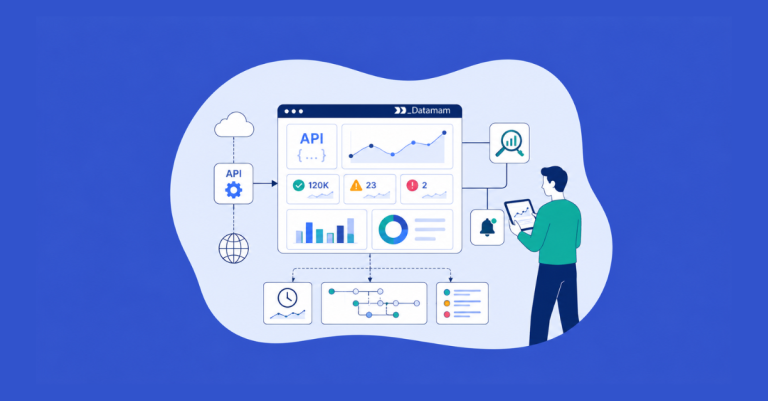
- API Observability gives enterprises visibility into request behavior, latency, failures, dependencies, and downstream impact across integrated systems.
- API performance monitoring should track latency, error rates, throughput, timeout behavior, retry volume, and consumer-level reliability.
- API health visibility requires more than uptime checks. Teams need endpoint health, dependency status, payload failures, authentication issues, and business-process impact.
- A request tracing strategy connects API calls across gateways, services, queues, databases, warehouses, BI systems, and operational workflows.
- Reliable observability requires trace IDs, structured logs, metrics, alerts, ownership, audit trails, and incident review cycles.
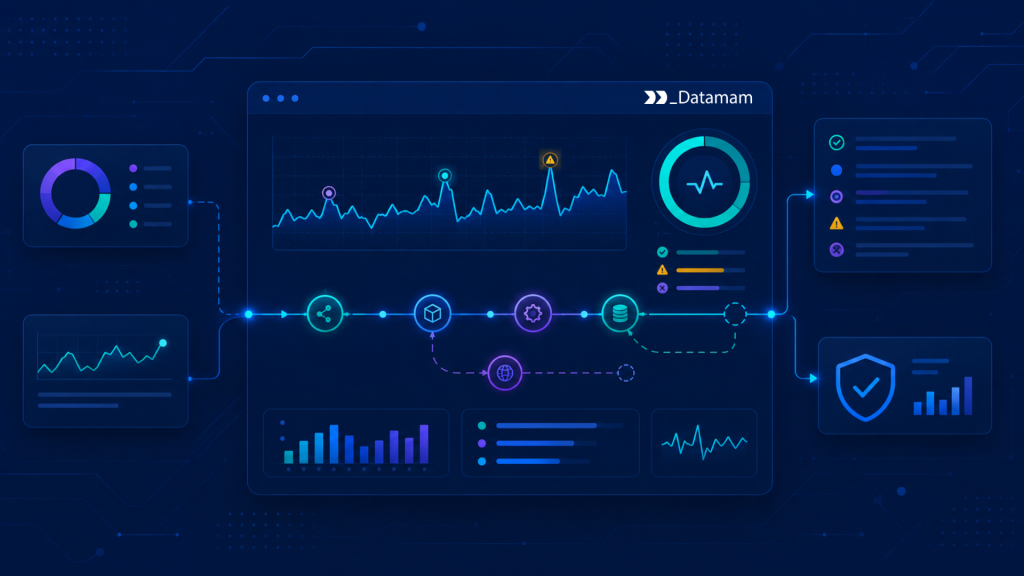
Enterprise API integrations rarely fail in isolation. A payment API may slow down during peak load. A product API may return partial responses. A customer endpoint may reject requests because of missing scopes. A supplier API may respond successfully while downstream processing fails. A marketplace integration may retry until it creates duplicate events. From the outside, the API may appear available, but the operational workflow is already degraded.
API Observability gives teams the visibility required to detect, diagnose, and recover from these failures before they damage downstream systems. It connects request telemetry, performance metrics, logs, traces, error classification, dependency status, and business-process impact.
In enterprise integration environments, observability is not only an engineering dashboard. It is an operational reliability control for APIs that support ERP, CRM, warehouse, BI, AI, payment, marketplace, product, supplier, booking, and customer workflows.
Why API Observability Matters in Enterprise Integration
API Observability matters because APIs are now operational pathways between business systems. When they degrade, the issue may affect ordering, billing, product publishing, payment reconciliation, customer support, supplier coordination, AI features, or executive reporting.
Deloitte’s API governance guidance argues that enterprise API strategy should standardize how APIs are designed, published, secured, and reused as AI and cross-system workflows scale. Observability supports standardization by showing whether APIs are operating reliably after they are published. Api authentication best practices are essential for maintaining secure access to APIs and protecting sensitive data. Implementing robust authentication mechanisms can significantly reduce the risk of unauthorized access. Additionally, regularly reviewing and updating these practices ensures that they evolve in line with emerging security threats.
Why Uptime Is Not Enough for API Reliability
API uptime only confirms that an endpoint is reachable. It does not confirm that the API is returning complete responses, meeting latency targets, preserving schema expectations, enforcing authentication properly, or supporting downstream workflows.
An API can return 200 OK while still creating operational problems. It may return stale inventory, incomplete product attributes, missing customer identifiers, unsupported status values, or delayed processing metadata. A basic health check will not catch these issues.
API Observability expands the reliability view. It shows whether requests are successful, whether responses are usable, whether latency is acceptable, whether consumers are affected, and whether downstream systems completed the expected work.
How Poor API Visibility Creates Operational Risk
Poor API visibility increases recovery time. Teams may know that a dashboard is wrong but not whether the issue came from the API, gateway, authentication layer, schema change, downstream warehouse, retry logic, or consumer application.
This creates a fragmented incident response. Application teams inspect logs. Data teams inspect pipelines. Platform teams inspect gateway metrics. Business teams report symptoms. Without shared observability, each team sees only one layer of the problem.
Gartner’s 2025 Magic Quadrant for Observability Platforms states that observability platforms are changing how organizations manage system health, driven by analytics, cost optimization, and AI observability. That shift matters for API integration because system health must be visible across distributed services, not only individual endpoints.
API Performance Monitoring Across Integrated Systems
API performance monitoring tracks whether APIs are operating within expected service levels. It should include latency, throughput, status codes, error rates, timeout behavior, retry volume, rate-limit events, and consumer-level performance.
Performance monitoring should not stop at infrastructure metrics. It should also connect API behavior to integration reliability and business impact.
Tracking Latency, Error Rates, Throughput, and Timeouts
Latency should be measured across multiple layers: gateway time, service processing time, dependency time, downstream write time, and consumer response time. A single average latency number is not enough because outliers often cause operational failures.
Error rates should be categorized. Authentication failures, validation failures, rate-limit errors, upstream dependency failures, internal server errors, and consumer misuse should not be grouped. Each category has a different owner and recovery path.
Throughput monitoring helps teams understand normal request volume and detect anomalies. A sudden drop may indicate producer failure. A sudden spike may indicate retry storms, abuse, or unexpected consumer behavior. Timeout monitoring shows where requests are exceeding operational tolerances.
Separating Technical Success from Business Success
Technical success and business success are not the same. An API request may succeed technically but fail operationally if the downstream action does not complete. For example, a product update API may accept a request but fail in marketplace publication later. A booking API may accept an update but fail to synchronize availability. A payment status API may respond correctly but fail reconciliation in the billing workflow.
API performance monitoring should therefore include business-level signals where possible. These may include accepted events, completed workflows, rejected records, downstream sync status, publish status, reconciliation status, and processing completion.
A simple monitoring classification pattern can look like this:
API_HEALTH_RULES = {
    "latency_warning_ms": 750,
    "latency_critical_ms": 2000,
    "retryable_statuses": [429, 500, 502, 503, 504],
    "blocked_statuses": [401, 403],
}


def classify_api_response(response):
    if response["status_code"] in API_HEALTH_RULES["blocked_statuses"]:
        return {"status": "access_issue", "owner": "security_operations"}

    if response["status_code"] in API_HEALTH_RULES["retryable_statuses"]:
        return {"status": "retryable_failure", "owner": "integration_operations"}

    if response["latency_ms"] >= API_HEALTH_RULES["latency_critical_ms"]:
        return {"status": "critical_latency", "owner": "platform_operations"}

    if response["latency_ms"] >= API_HEALTH_RULES["latency_warning_ms"]:
        return {"status": "latency_warning", "owner": "api_owner"}

    return {"status": "healthy"}
This mirrors the previous article’s style: a small policy object, a function, and a clear routing outcome. The operational point is that API health should be classified, not just logged.
Monitoring Performance by Consumer and Endpoint
API performance should be monitored by endpoint, method, consumer, environment, region, and integration workflow. Aggregate API performance can hide consumer-specific failures.
One consumer may experience high latency because of request volume. Another may fail because it uses an old version. A partner integration may hit rate limits. A warehouse ingestion job may trigger timeouts because it sends large requests.
Consumer-level monitoring helps teams identify whether a problem is systemic or isolated. This is critical for enterprise APIs that support many internal teams, partners, and automated workflows.
API Health Visibility for Operational Workflows
API health visibility shows whether APIs are healthy enough to support operational processes. This requires more than endpoint-level monitoring. Teams need dependency visibility, authentication visibility, payload visibility, and downstream workflow status.
KPMG’s Technology Operations Governance and Observability for DevSecOps report frames observability as the visibility needed to enforce and validate governance in real time, including system performance, risk, and compliance posture. That same principle applies to API operations: observability makes API governance measurable during production use.
Monitoring Endpoint Health and Dependency Status
Endpoint health should include availability, latency, error rate, request volume, rate-limit status, authentication failures, schema validation failures, and downstream dependency health. An endpoint may be available while its database dependency is degraded or its downstream queue is delayed.
Dependency status is especially important in API integration. An order API may depend on customer, inventory, pricing, tax, and fulfillment services. If one dependency slows down, the API may degrade even if its own service is healthy.
Health visibility should therefore show dependency relationships. Teams should know whether API failures come from the API service, gateway, authentication provider, backend database, external provider, downstream queue, or consumer behavior.
Detecting Payload-Level and Contract-Level Failures
API health also depends on payload quality. A high-level endpoint metric may show success while payload-level failures increase. These failures include missing required fields, unsupported enum values, invalid timestamps, schema mismatches, duplicate request IDs, or unexpected nulls.
Payload-level visibility connects API Observability to schema and contract management. If an API starts receiving invalid product records, the issue may come from a producer change. If responses begin returning new values, consumers may need contract review.
Monitoring should therefore include request and response validation outcomes. These metrics help teams detect integration drift before downstream systems break.
Showing Health in Business Terms
Operational teams need API health in business terms. Instead of only seeing “5xx error rate,” they need to know whether product publishing is delayed, payment reconciliation is blocked, booking availability is stale, customer updates are failing, or supplier sync is incomplete.
This requires mapping technical metrics to business workflows. An API dashboard should show which workflows are affected and which owners need to respond.
In practice, API health visibility becomes more valuable when it helps non-engineering stakeholders understand operational impact without reading logs.
Request Tracing Strategy for Distributed API Flows
A request tracing strategy connects API calls across systems. It shows how a request enters the gateway, reaches backend services, calls dependencies, writes to databases, triggers queues, updates warehouses, and appears in downstream systems.
Without tracing, teams investigate each system separately. With tracing, they can follow the request path.
Creating Trace IDs Across API Gateways, Services, and Consumers
Each request should carry a trace ID or correlation ID. This ID should move through gateway logs, application logs, queue messages, database writes, warehouse loads, and downstream workflow events.
Trace IDs make incidents easier to investigate. If a customer update fails, teams can search for a trace ID and see where the request moved, where it slowed down, and where it failed.
A basic trace enrichment pattern can look like this:
def enrich_api_event(request, response):
    return {
        "trace_id": request.get("trace_id"),
        "consumer": request.get("consumer"),
        "endpoint": request.get("endpoint"),
        "method": request.get("method"),
        "status_code": response.get("status_code"),
        "latency_ms": response.get("latency_ms"),
        "schema_version": request.get("schema_version"),
        "timestamp": response.get("timestamp"),
    }


request = {
    "trace_id": "trc-20260617-88421",
    "consumer": "marketplace_connector",
    "endpoint": "/products/update",
    "method": "POST",
    "schema_version": "v2",
}

response = {
    "status_code": 202,
    "latency_ms": 418,
    "timestamp": "2026-06-17T11:15:00Z",
}

event = enrich_api_event(request, response)
The snippet is intentionally simple. It shows the structure of observability metadata that should travel with API activity so teams can connect requests to downstream behavior.
Tracing Requests Across Synchronous and Asynchronous Steps
Many API workflows are not fully synchronous. A request may be accepted immediately, then processed through queues, event handlers, enrichment services, warehouse loaders, or operational workflows. If tracing stops at the initial response, teams lose visibility into the real outcome.
A request tracing strategy should include asynchronous processing. The same trace ID should appear in queue messages, worker logs, retry events, dead-letter records, and downstream publication events.
This is especially important for payment, booking, product, order, and customer workflows where an API call may trigger several later steps.
Using Traces for Root Cause Analysis
Traces help teams move from symptoms to root cause. A slow API may be caused by an authentication provider, database query, third-party call, downstream service, rate limit, or queue backlog. Tracing shows where time is spent.
Root-cause analysis should combine traces with logs and metrics. Metrics show that something is wrong. Logs show details. Traces show the path. Together, they create an operational view of API reliability.
NIST’s API protection guidance describes APIs as critical integration mechanisms for enterprise IT systems and emphasizes controls across the API lifecycle. Request tracing supports that lifecycle because it creates evidence of how API calls behave in production.
Operational Controls for API Observability
Operational controls turn observability data into action. Metrics, logs, and traces are useful only if they drive alerts, escalation, recovery, and continuous improvement.
API Observability should support real-time monitoring and longer-term reliability review.
Defining Alerts, Thresholds, and Severity Levels
Alerts should be based on operational impact. A small increase in latency may be informational. A spike in authentication failures may require a security review. A rising error rate in a payment API may require immediate escalation. A delayed product publishing endpoint may require business notification.
Thresholds should include technical and business conditions. Technical thresholds may include latency, error rate, timeout rate, and retry volume. Business thresholds may include failed orders, delayed bookings, rejected product updates, incomplete customer sync, or missed supplier events.
Alert severity should account for criticality. A low-volume API may be highly critical if it supports finance or compliance. A high-volume API may be less critical if failures affect only nonessential enrichment.
Routing Incidents to the Correct Owners
API incidents often involve multiple teams. Gateway owners, API producers, authentication teams, data platform teams, consumer teams, and business owners may all be involved. Observability should route incidents based on error type and ownership.
For example, authentication failures may be routed to identity or security operations. Schema validation failures may be routed to the producer team. Consumer misuse may be routed to the consuming application owner. Dependency latency may route to platform operations.
This prevents generic alerting from creating noise. The right team should receive the right incident with enough context to act.
Reviewing Patterns After Incidents
Incident review should identify recurring patterns. Repeated latency spikes may indicate capacity issues. Repeated 429 responses may indicate poor rate-limit planning. Also, repeated schema failures may indicate weak release control. Repeated consumer errors may indicate documentation or versioning problems.
Deloitte’s data observability guidance states that observability is not only a platform decision, but a combination of technology, process, governance, and talent needed to improve data investments and operational value. API Observability should be treated the same way: the value comes from the operating model, not only the monitoring tool.
Technology and Integration Considerations
API Observability depends on gateways, logs, metrics, traces, dashboards, alerting systems, data catalogs, lineage tools, and incident workflows. These systems should work together instead of producing disconnected monitoring views.
The goal is to provide a reliable operational picture of API behavior across systems. Api integration services for businesses can enhance collaboration and streamline processes across different platforms. They enable organizations to achieve seamless data exchange and improve overall efficiency. Furthermore, these services help in eliminating silos and fostering innovation by connecting disparate systems effectively. Api integration benefits for workforce systems include optimizing staffing processes and improving communication among team members. By leveraging these integrations, organizations can automate repetitive tasks, enabling employees to focus on more strategic initiatives. Additionally, they provide valuable insights that drive better decision-making and enhance overall productivity.
Using API Gateways, Logs, Metrics, and Traces Together
API gateways can capture request volume, authentication failures, rate limits, latency, and response codes. Application logs can capture business decisions, validation errors, and workflow status. Metrics show patterns over time. Traces show request paths across distributed systems.
These layers should use shared identifiers. Request ID, trace ID, consumer ID, endpoint, version, schema version, and source system should be consistent across logs and metrics.
Without shared identifiers, observability becomes fragmented. Teams can see signals, but they cannot easily connect them.
Connecting Observability Metadata to Warehouses, BI, AI, and Lineage Systems
Observability metadata should flow into analytical and governance environments where appropriate. Warehouses can store API request summaries, error patterns, consumer behavior, and data freshness status. BI dashboards can expose API health for critical business workflows. AI pipelines can track which API version, schema, or request window supplied input data. Lineage systems can connect API activity to downstream assets.
This helps teams understand the impact of API health on data products, reports, models, and operational systems.
For enterprise integration, observability metadata is not just technical telemetry. It becomes part of the data reliability evidence.
Governance and Auditability in API Observability
Governance defines what must be monitored, who owns observability signals, how incidents are reviewed, and how evidence is preserved. Auditability ensures that API behavior can be reconstructed when needed.
The OECD’s data governance work describes governance as the technical, policy, and regulatory structures needed to manage data across its value cycle. API Observability supports that model by giving teams visibility into how data is requested, moved, delayed, rejected, and recovered across integration flows.
Creating Ownership, Review Cycles, and Escalation Paths
Each critical API should have an observability owner. Ownership should include API producer teams, platform teams, security teams, data operations, and business owners where the API supports critical workflows.
Review cycles should cover performance trends, error patterns, consumer behavior, incident history, and monitoring gaps. High-risk APIs should be reviewed more frequently than low-risk internal endpoints.
Escalation paths should define who responds to latency incidents, authentication failures, version misuse, schema failures, gateway issues, and downstream processing failures.
Maintaining Audit Trails for Requests, Incidents, and Recovery Actions
Audit trails should preserve request metadata, error events, incident timelines, recovery actions, consumer notifications, retry behavior, and post-incident decisions. Sensitive data should be protected, but operational evidence should remain available.
Auditability matters when APIs support payments, bookings, customer updates, product publishing, supplier workflows, AI systems, compliance reporting, or executive dashboards. Teams should be able to explain what happened, when it happened, who was affected, and how recovery was completed.
A reliable audit trail turns API Observability into procurement and governance reassurance. It shows that integration reliability is controlled, not merely monitored.
Conclusion: Turning API Observability into Controlled Integration Reliability
API Observability helps enterprises understand whether APIs are operating reliably across complex integration environments. It moves beyond basic uptime checks into request behavior, latency, errors, dependency health, payload failures, tracing, consumer impact, and business-process visibility.
Strong API performance monitoring shows how endpoints behave under real load. API health visibility connects technical signals to operational workflows. A request tracing strategy allows teams to follow API activity across gateways, services, queues, databases, warehouses, BI systems, AI workflows, and downstream applications.
The capability matters because APIs often sit between critical systems. ERP, CRM, warehouse, BI, AI, payment, marketplace, booking, product, supplier, workforce, and customer workflows all depend on API reliability. When observability is weak, failures become slow to diagnose. When observability is governed, structured, and auditable, API integration becomes a controlled enterprise infrastructure layer.
A structured review can help evaluate whether current API workflows have reliable API Observability, api performance monitoring, api health visibility, request tracing strategy, and audit-ready operational monitoring. You can run an external data infrastructure audit with our team to review your current setup and understand what is required to build reliable, enterprise-scale API integration infrastructure.